
Pennsylvania Traffic Laws: A Driver’s Essential Guide For 2026
A practical overview of Pennsylvania driving rules, penalties, and roadway safety requirements.
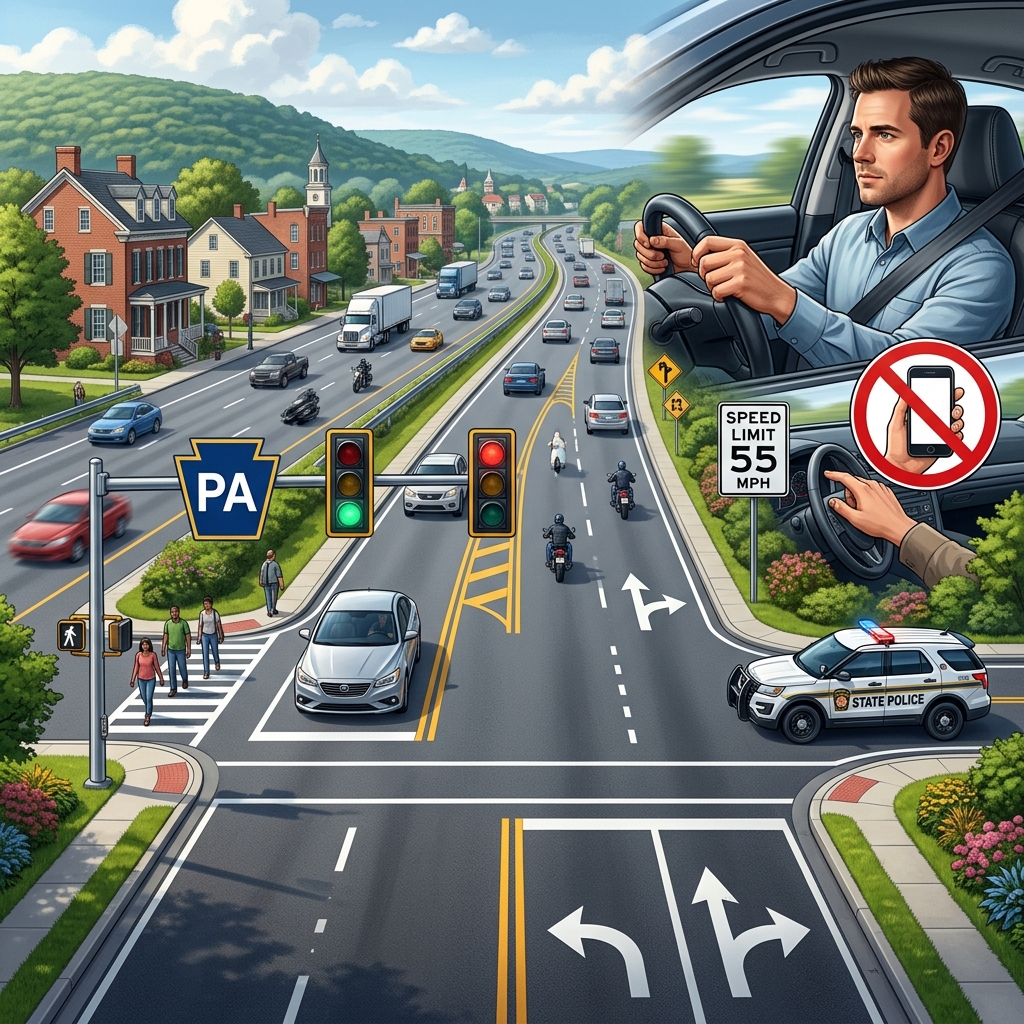
Driving in Pennsylvania means following a detailed set of rules built to keep roads safe, traffic moving, and drivers accountable. The core source of these rules is the Pennsylvania Vehicle Code, commonly called Title 75, which covers licensing, registration, vehicle operation, and penalties for violations.
Whether you are a new resident, a long-time driver, or simply refreshing your knowledge, understanding the basics of Pennsylvania traffic law can help you avoid tickets, license trouble, and serious safety risks. The rules apply to everyday actions such as turning, passing, yielding, and responding to emergency and school vehicles.
The legal framework behind Pennsylvania driving rules
Pennsylvania traffic law is not a single rulebook for one situation. It is a structured body of statutes that governs how vehicles are titled, registered, insured, and operated on public roads. Title 75 is organized into parts and chapters covering topics such as driver licensing, operation of vehicles, and vehicle equipment.
State law works alongside local traffic controls and roadway markings. In practice, that means a driver must obey both broad statewide rules and the specific signs, signals, and lane restrictions posted on a particular road.
Core rules every driver should know
Most traffic violations start with a basic failure to follow the rules of the road. Pennsylvania expects drivers to use reasonable care, observe posted warnings, and drive in a way that protects others on the roadway.
- Obey signs and signals: Stop signs, traffic lights, lane-use signs, and construction warnings must be followed.
- Use proper lane discipline: Drivers should travel in the correct lane and use passing lanes appropriately.
- Keep a safe distance: Tailgating creates a risk of rear-end collisions and may support a citation for careless driving.
- Drive at a safe speed: Speed must be adjusted for conditions, not just for the posted limit.
These may sound like common-sense points, but many citations are issued because a driver assumes the roadway is flexible when the law requires consistency and caution.
Speed limits and driving for conditions
Pennsylvania uses posted speed limits, but a lawful speed is not always a safe speed. Weather, congestion, roadway design, work zones, and visibility all affect whether a driver can safely maintain the posted limit.
School zones and construction areas deserve special caution. These locations often carry reduced limits and enhanced enforcement because pedestrians, workers, and children are more exposed to danger.
| Situation | What the driver should do |
|---|---|
| School zone | Reduce speed and watch for children, crossings, and flashing warnings |
| Work zone | Slow down, follow cones and temporary signs, and expect lane shifts |
| Heavy rain or snow | Drive below the posted limit if road conditions require it |
| Traffic congestion | Maintain safe spacing and avoid abrupt lane changes |
Right-of-way, turns, and passing
Right-of-way rules are a central part of Pennsylvania traffic law because they reduce confusion at intersections and lane merges. Drivers must know when to yield, when to proceed, and how to complete turns without creating a hazard.
At intersections, the driver who arrives first generally gets to proceed first, unless a traffic control device says otherwise. When two vehicles arrive at roughly the same time, the rules of yielding help prevent conflict and collisions.
Passing rules also matter. A driver must not pass in a way that endangers others, and passing on the right is limited to situations where it is lawful and safe. The left lane is generally used for passing, not lingering.
- Left turns: Yield to oncoming traffic unless a signal or sign gives you the right to turn.
- Right turns: Check for pedestrians and cyclists before turning.
- Passing on the right: Use caution and only when road conditions and lane markings allow it.
- Lane changes: Signal early and confirm the lane is clear before moving over.
School buses, pedestrians, and vulnerable road users
Pennsylvania law places special protection around school buses because children are among the most vulnerable people on the road. When a school bus is stopped and its stop arm is extended, drivers must stop and remain stopped until it is safe and legal to proceed.
Pedestrians also receive strong protection under Pennsylvania roadway rules. Drivers must watch crosswalks, intersections, sidewalks, and roadside areas where people may enter the roadway unexpectedly.
Bicyclists are another important category. Because bicycles are treated as vehicles for many roadway purposes, drivers should give them enough space, pass carefully, and avoid cutting them off when turning.
Distracted and impaired driving restrictions
One of the most important modern traffic issues is distraction. Pennsylvania restricts handheld device use while driving, and officials emphasize that attention must stay on the road, not on texting or other device activity.
Impaired driving carries even more serious consequences. DUI law in Pennsylvania can lead to criminal charges, license consequences, and other penalties depending on the facts of the arrest and the driver’s record. Alcohol, controlled substances, and certain medications can all impair driving ability.
- Do not text and drive: Device use can draw attention away from traffic and increase crash risk.
- Do not drive under the influence: Alcohol and drugs can trigger criminal enforcement.
- Stay focused: Avoid anything that takes your eyes, hands, or mind off driving.
Emergency vehicles, move-over duties, and roadside safety
Drivers in Pennsylvania must respond carefully when emergency vehicles, tow trucks, or other service vehicles are stopped with flashing lights. The move-over rule requires drivers to shift away from the stopped vehicle when possible; if a lane change is not safe, the driver must slow down.
This rule exists to protect roadside workers, law enforcement, and stranded motorists. Crashes often happen when a passing driver fails to create enough clearance or does not reduce speed near the shoulder.
What happens when a driver breaks the rules
Traffic violations in Pennsylvania can lead to more than a fine. Depending on the offense, a driver may face points, insurance consequences, license suspension, or criminal charges.
Minor violations may be handled like civil infractions, while more serious conduct such as DUI, fleeing police, or reckless driving can create criminal exposure. Repeat offenses often bring stronger penalties, especially when the violation shows a pattern of unsafe behavior.
| Type of violation | Possible consequence |
|---|---|
| Speeding or signaling errors | Fine, points, and possible insurance impact |
| School bus or work zone violations | Higher penalties and stricter enforcement |
| DUI | Criminal penalties, license consequences, and court involvement |
| Reckless or fleeing conduct | Serious criminal and licensing consequences |
How enforcement works in practice
Traffic enforcement in Pennsylvania is carried out by state and local authorities, with PennDOT and related agencies supporting the broader transportation system. Police officers may issue citations based on direct observation, automated enforcement where allowed, or crash investigations.
Drivers should remember that roadway rules are enforced not only to punish misconduct but also to prevent avoidable injuries. A citation can be a warning sign that a driving habit needs to change before it causes a collision.
Practical habits that reduce risk
Safe driving in Pennsylvania is often less about memorizing obscure rules and more about building steady habits. Defensive drivers tend to make fewer mistakes because they leave more room for correction and react earlier to hazards.
- Scan ahead for brake lights, pedestrians, bicycles, and stopped vehicles.
- Leave enough following distance to stop safely.
- Check mirrors and blind spots before changing lanes.
- Slow down near schools, construction, and roadside emergencies.
- Keep your attention on driving instead of your phone or passengers.
These habits support compliance with Pennsylvania traffic law and make the road safer for everyone else using it.
Frequently asked questions
What is Title 75 in Pennsylvania?
Title 75 is the Pennsylvania Vehicle Code, the main statute covering vehicles, drivers, and rules of the road in the state.
Do drivers have to stop for a school bus?
Yes. When a school bus has its stop arm extended and is loading or unloading children, drivers must stop and wait until it is safe to continue.
Can I use my phone while driving in Pennsylvania?
Pennsylvania limits handheld device use while driving, and officials warn that distracted driving creates serious safety risks.
What is the move-over law?
The move-over law requires drivers to shift away from stopped emergency or service vehicles with flashing lights when possible, or slow down if moving over is not safe.
Are bicycles covered by traffic rules?
Yes. Bicyclists are treated as roadway users and drivers must give them appropriate space and caution, especially when passing or turning.
References
- Traffic Laws — Pennsylvania Department of Transportation. 2025-01-01. https://www.pa.gov/agencies/penndot/news-and-media/media-resources/traffic-laws
- Title 75 – Vehicles — Pennsylvania General Assembly. 2026-07-09. https://www.legis.state.pa.us/wu01/li/li/ct/htm/75/75.htm
- Laws and Regulations | Driver and Vehicle Services — Commonwealth of Pennsylvania. 2026-07-09. https://www.pa.gov/agencies/dmv/resources/laws-and-regulations
- PA Vehicle Code (Title 75) — Commonwealth of Pennsylvania. 2026-07-09. https://www.pa.gov/agencies/dmv/resources/laws-and-regulations/pa-vehicle-code-title-75
- Understanding Traffic Control Legislation and Regulations in Pennsylvania — Summit Flagging. 2025-01-01. https://summitflagging.com/understanding-traffic-control-legislation-and-regulations-in-pennsylvania/
- 6 laws every Pennsylvania newbie needs to know — Pittwire, University of Pittsburgh. 2025-08-19. https://www.pittwire.pitt.edu/announcements-and-updates/2025/08/19/pennsylvania-laws-quirks
Similar Articles








Read full bio of Sneha Tete


