
Pennsylvania Last Will and Testament Guide
Comprehensive guide to creating a valid last will and testament in Pennsylvania, covering requirements, processes, and estate planning essentials.
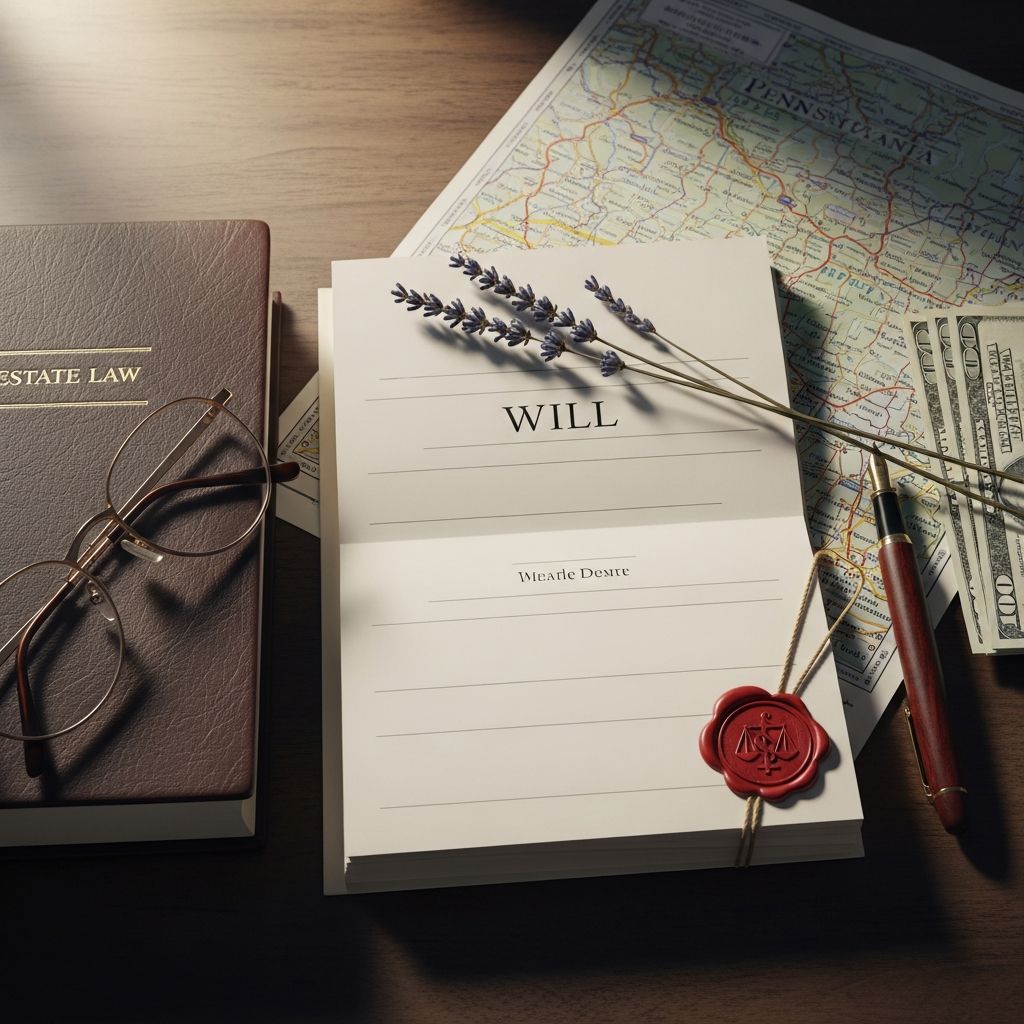
A last will and testament serves as a cornerstone of estate planning, allowing Pennsylvania residents to dictate how their assets are distributed after death, appoint key roles, and protect loved ones. Without one, state intestacy laws control distribution, potentially leading to unintended outcomes. This guide outlines legal standards, drafting steps, and best practices under Pennsylvania law.
Why Every Pennsylvanian Needs a Will
Drafting a will ensures your wishes are honored, avoiding disputes and court interventions. It specifies beneficiaries for property, names an executor to manage the estate, designates guardians for minors, and can include funeral directives. Pennsylvania’s intestacy rules prioritize spouses, children, and relatives, but may exclude stepchildren, partners, or charities unless specified. For unmarried individuals or blended families, a will prevents assets from escheating to the state if no heirs exist.
Adults should create wills upon major life events like marriage, parenthood, or asset acquisition. Updating occurs with divorce, births, or deaths. Online tools or attorneys facilitate creation, ensuring state compliance.
Legal Eligibility to Create a Will in Pennsylvania
Pennsylvania statutes set clear criteria for will-makers. Individuals must be at least 18 years old and possess sound mental capacity, meaning they understand their assets, relationships, and the will’s effects. Courts assess capacity at signing; prior incompetency rulings may challenge validity.
- Age Requirement: 18 or older, regardless of emancipation.
- Mental Capacity: Ability to know one’s property, kin, and document nature.
- Voluntary Intent: Free from undue influence or duress.
These align with Title 20 of the Pennsylvania Consolidated Statutes, emphasizing a ‘disposing mind’.
Core Requirements for a Valid Pennsylvania Will
Pennsylvania wills must be written documents—typed, printed, or handwritten—signed by the testator at the end. Oral or digital wills (audio/video) lack validity; paper is mandatory.
| Requirement | Details | Legal Basis |
|---|---|---|
| Written Form | Paper document; no electronic files | 20 Pa.C.S. § 2502 |
| Testator Signature | Handwritten at document’s end; mark allowed if witnessed | 20 Pa.C.S. § 2502 |
| Witnesses | Not required unless testator uses mark or proxy signer | 20 Pa.C.S. § 2502 |
Unlike most states, Pennsylvania does not mandate witnesses for standard signatures, simplifying execution. However, post-death authentication requires two witnesses (subscribing or not) to verify the signature. Holographic wills (fully handwritten and signed) are valid without witnesses if proven.
Self-Proving Wills: Simplifying Probate
A self-proving will attaches a notarized affidavit from the testator and two witnesses, affirming proper execution. This eliminates courtroom testimony, expediting probate. The affidavit, signed before a notary, deems the will authentic upon filing.
Process:
- Draft and sign will with two witnesses present.
- All three sign affidavit stating identities and witnessing facts.
- Notary witnesses signatures and attaches to will.
Highly recommended, especially if witnesses may become unavailable. Section 3132 governs proof; self-proving avoids oaths from witnesses.
Key Elements to Include in Your Pennsylvania Will
A comprehensive will covers:
- Asset Inventory: List real estate, bank accounts, investments, personal items.
- Beneficiaries: Specific heirs or contingents; per stirpes or per capita distribution.
- Executor: Trusted person to handle probate, pay debts, distribute assets.
- Guardians: For minor children or dependents.
- Pet Care: Caretaker and fund provisions.
- Residue Clause: Catch-all for unassigned property.
Name alternates for all roles. Revocation clause nullifies prior wills. No post-signature additions bind.
Pennsylvania Intestacy: Risks of Dying Without a Will
Dying intestate triggers Title 20’s distribution: surviving spouse gets first $30,000 plus half/issue share; no spouse means children/parents inherit. Distant relatives follow; none means state takeover. Excludes non-relatives, causing disputes in modern families.
Probate is mandatory, public, costly. Wills bypass this partially via self-proving.
Drafting Options: DIY, Online, or Attorney
DIY: Use forms ensuring compliance.
Online Services: State-specific generators with review options.
Attorney: Ideal for complex estates, taxes, trusts.
Sign per rules; store safely, inform executor. Updates via codicil or new will.
Probate Process Overview in Pennsylvania
Executor files will with Register of Wills, authenticates, notifies heirs, pays debts/taxes, distributes. Self-proving skips witness testimony. Contests allege incapacity/influence; subscribing witnesses strengthen defenses.
Special Considerations: Marriage, Divorce, and Updates
Marriage/divorce partially revokes wills; review post-events. Trusts complement wills for probate avoidance.
Frequently Asked Questions
Does Pennsylvania require witnesses for a will?
No, unless signing by mark or proxy; advisable for proof.
Can I make an electronic will in PA?
No; must be paper.
What if I die without a will in Pennsylvania?
Intestacy laws distribute to spouse/children/relatives.
How do I make my will self-proving?
Add notarized affidavit with witnesses.
Who can serve as executor?
Any competent adult; out-of-state ok with agent.
References
- Basic Requirements for a Last Will and Testament in Pennsylvania — LawInfo. Accessed 2026. https://www.lawinfo.com/resources/wills/pennsylvania/
- How Wills are Validated in Pennsylvania — KMA Elder Law. 2021-06. https://kmaelderlaw.com/blog/2021/06/how-wills-are-validated-in-pennsylvania/
- What Makes a Will Valid and Enforceable? — Heritage Elder Law. Accessed 2026. https://www.heritageelderlaw.com/what-makes-a-will-valid-and-enforceable/
- Making a Will in Pennsylvania — Nolo. 2025. https://www.nolo.com/legal-encyclopedia/pennsylvania-make-will-31750.html
- Will Information — York County, PA Government. Accessed 2026. https://yorkcountypa.gov/425/Will-Information
- How to Create a Last Will and Testament in Pennsylvania — YouTube (LegalZoom). Accessed 2026. https://www.youtube.com/watch?v=j5I5W6S3C30
Similar Articles








Read full bio of Sneha Tete




