PA Employer Rules on Criminal Records in Hiring
Navigate Pennsylvania's laws on using arrest and conviction records for fair hiring practices and compliance.
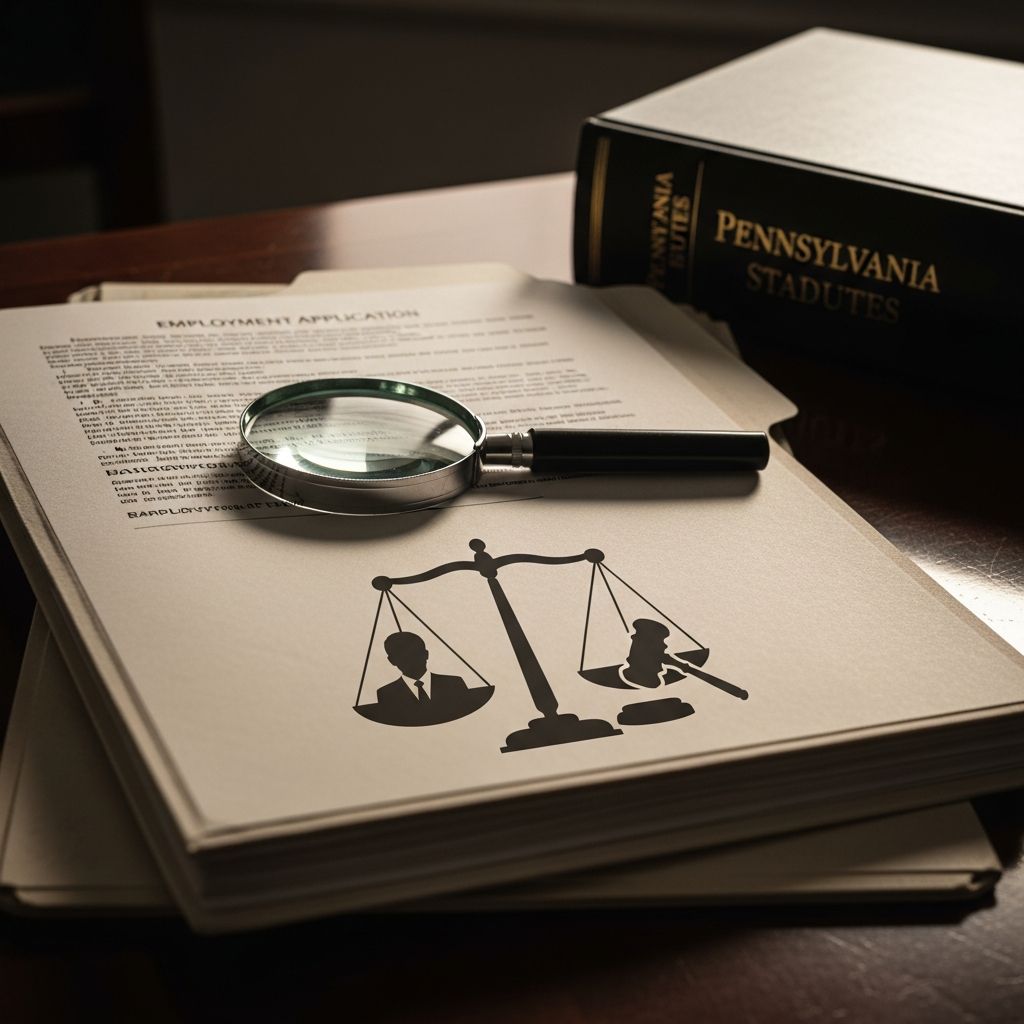
Pennsylvania employers must follow strict state and federal laws when evaluating applicants’ criminal histories during recruitment. These regulations promote fair hiring by limiting how arrest and conviction data can influence decisions, ensuring records are relevant and processes are transparent.
Core State Laws Shaping Background Screening
Pennsylvania’s framework balances employer needs for safety with applicant rights to rehabilitation. Key statutes prevent automatic disqualification based on past records unless directly tied to job duties.
Criminal History Record Information Act (CHRIA) Essentials
Under 18 Pa.C.S. § 9125, employers can only consider felony or misdemeanor convictions if they bear on the specific role’s suitability. Arrests without convictions, summary offenses, and unrelated proceedings must be ignored. If a criminal record factors into a no-hire decision, written notice to the applicant is mandatory.
- Relevance Test: Assess if the conviction type matches job risks, e.g., theft for financial roles.
- Notification Duty: Document and disclose criminal history’s role in rejections.
- Scope Limits: No blanket bans; individualized review required.
Clean Slate Law and Record Sealing
The Clean Slate initiative automatically seals certain non-conviction arrests and older misdemeanors from public view, typically after 10 years for misdemeanors or upon case closure for arrests without convictions. This restricts what appears in standard background checks, barring employers from accessing or using sealed data.
Recent expansions like Act 36 of 2023 (Clean Slate 3.0) shorten sealing timelines for some records to seven years post-disposition, aiding quicker reentry into the workforce. Employers must update policies to exclude sealed information, as it won’t surface in Pennsylvania State Police checks.
Federal Overlay: FCRA Compliance Mandates
The Fair Credit Reporting Act (FCRA) governs third-party background checks nationwide, including Pennsylvania. Employers must secure written consent before screening, provide pre-adverse action notices for concerning findings, allow dispute periods, and issue final adverse action letters if proceeding with rejection.
| FCRA Step | Requirement | Timeline |
|---|---|---|
| Consent | Standalone written permission | Before check |
| Pre-Adverse Notice | Copy of report + summary of rights | Upon negative findings |
| Dispute Window | Reasonable time to respond | 5+ business days |
| Adverse Action | Final notice with rights | After review |
Note: FCRA’s seven-year limit applies to civil suits, judgments, and some arrests for salaries under $75,000, but not criminal convictions.
Ban-the-Box Policies in Practice
Pennsylvania enforces ‘ban-the-box’ for public sector jobs, prohibiting criminal history questions on initial applications. Checks occur only post-conditional offer, with rescissions limited to job-related findings.
Philadelphia’s Fair Criminal Record Screening Standards Ordinance (FCRSSO) extends this citywide: no criminal inquiries on applications, seven-year lookback on convictions (with exceptions), and mandatory individualized assessments. Amendments effective January 2026 strengthen notice rules and rebuttal rights for pending charges or expunged records.[10]
- Philadelphia employers: Delay questions until post-interview or conditional offer.
- Individualized review: Weigh conviction age, rehabilitation evidence, job relevance.
- Exemptions: Rare, for roles with fiduciary duties or child safety.
Industry-Specific Screening Requirements
Certain sectors demand rigorous checks. Financial services applicants need Pennsylvania State Police and FBI fingerprint-based reviews via the Department of Banking and Securities.
Positions involving children or vulnerable adults require FBI checks. Federal contractors adhere to similar post-offer timing under federal guidelines.
Lookback Periods Clarified
No statewide cap on conviction age under CHRIA, but Clean Slate hides old misdemeanors, and Philadelphia caps at seven years. Employers should prioritize recent, relevant records.
Best Practices for Compliant Hiring
To minimize liability, develop clear policies, train HR on laws, and document decisions.
- Policy Development: Outline screening triggers, relevance criteria, and FCRA steps.
- Training: Educate staff on CHRIA, Clean Slate, and local rules like Philadelphia’s FCRSSO.
- Consent Processes: Use FCRA-compliant forms; retain records.
- Individual Assessments: Create templates evaluating conviction nature, time elapsed, and rehabilitation.
- Audits: Regularly review practices for disparate impact under Title VII, as broad exclusions may discriminate against protected groups.
Risks of Non-Compliance
Violations invite lawsuits: CHRIA allows damages for improper use; FCRA penalties reach $1,000+ per violation plus fees. Philadelphia’s ordinance adds private rights of action. EEOC scrutiny under Title VII targets policies with racial disparities.
Frequently Asked Questions
Can PA employers ask about criminal history on job applications?
For public jobs and Philadelphia employers, no—wait until after conditional offer or later stages. Private employers statewide face CHRIA limits on use, not timing.[10]
How far back can background checks go in Pennsylvania?
No limit on convictions under state law, but Clean Slate seals old misdemeanors/arrests; Philadelphia restricts to seven years.
What if a record is expunged or sealed?
Employers must not consider or inquire about them; they won’t appear in standard checks.
Does FCRA apply to all PA employers?
Yes, when using consumer reporting agencies for background checks.
Can convictions ever justify automatic rejection?
No—must relate to job suitability per CHRIA; always assess individually.
Navigating Local Variations
Philadelphia’s rules exceed state baselines: stricter timing, lookbacks, and notices. Statewide, focus on CHRIA and Clean Slate. Federal overlaps like FCRA apply universally.
Employers with multi-state operations must layer PA protections atop national standards.
References
- Pennsylvania Background Check Laws: How Far Back Do They Go? — GoodHire. 2025. https://www.goodhire.com/background-checks/pennsylvania/
- Employers’ Guide to Criminal Background Checks in Pennsylvania — Tucker Law. 2025-11-25. https://www.tuckerlaw.com/2025/11/25/employers-guide-to-criminal-background-checks-in-pennsylvania/
- New PA Law for Background Checks: What Employers Need to Know — BackgroundChecks.com. 2024-03-21. https://www.backgroundchecks.com/compliance-and-legislation/new-pa-law-for-background-checks-what-employers-need-to-know-1
- Criminal History Record Information Act — Abramson Employment Law. N/A. https://www.job-discrimination.com/pennsylvania-employment-laws/criminal-history-record-information-act/
- Pennsylvania Background Checks for Employment — iProspectCheck. N/A. https://iprospectcheck.com/pennsylvania-background-checks/
- Pennsylvania Law on Use of Criminal Records in Hiring — Nolo. N/A. https://www.nolo.com/legal-encyclopedia/pennsylvania-law-employer-use-arrest-conviction-records-hiring.html
- Section 9125 – Title 18 – CRIMES AND OFFENSES — Pennsylvania General Assembly. N/A. https://www.legis.state.pa.us/WU01/LI/LI/CT/HTM/18/00.091.025.000..HTM
Similar Articles







Read full bio of medha deb