
Parental Consent and Teen Body Piercing in New York
Understanding New York’s parental consent rules for teen body piercing, including exceptions, studio obligations, and health and safety risks.
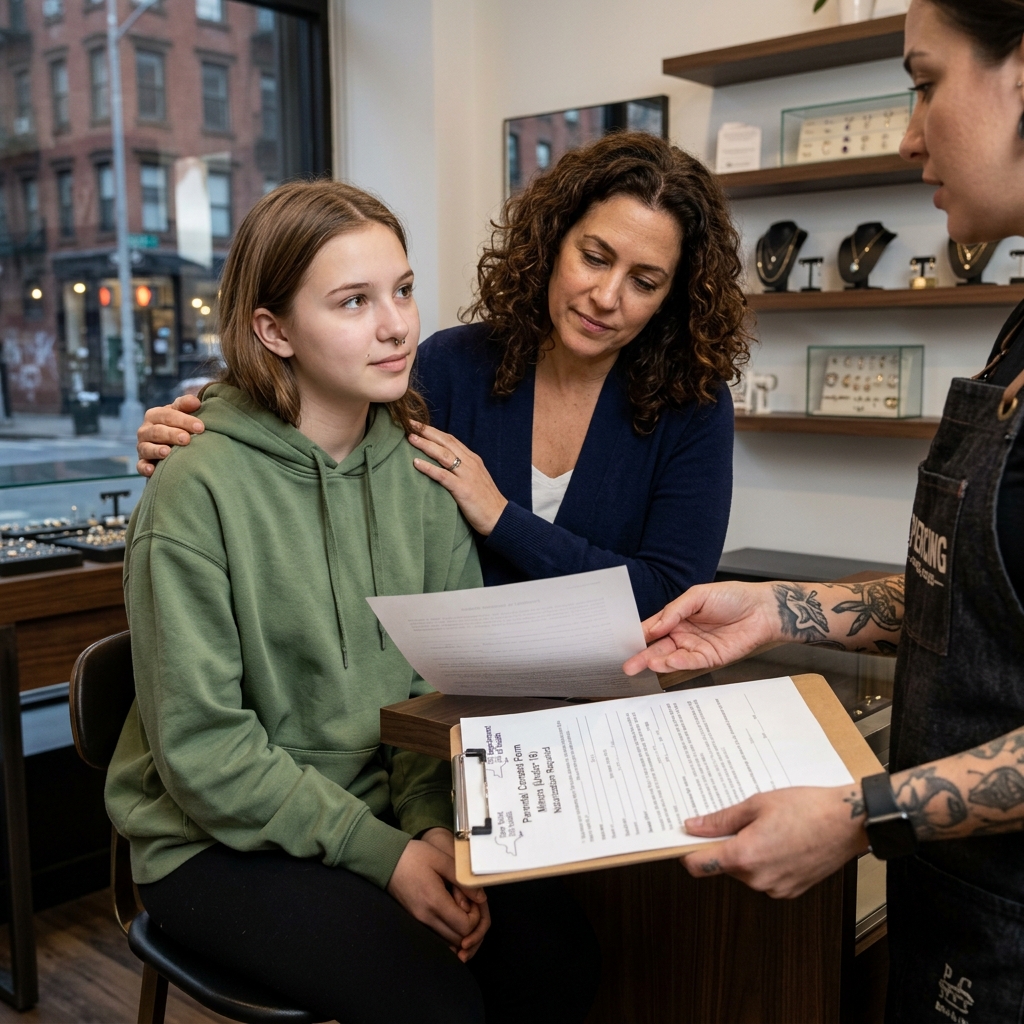
Body piercing has become a common form of personal expression for teenagers, but in New York the decision to get pierced is shaped not only by style and trends, but also by state law. New York’s body piercing rules for minors are designed to protect young people’s health and ensure parents are involved in decisions that can carry medical and legal consequences.
This guide explains how body piercing law works for minors in New York, when parental consent is required, which piercings are treated differently under the law, and what responsibilities studios have when piercing teenagers.
Why New York Regulates Teen Body Piercing
New York’s body piercing rules are grounded in public health concerns. Piercing breaks the skin and can expose minors to bloodborne infections, allergic reactions, scarring, and other complications if procedures are not performed safely.
- Infection risk: Unsterile equipment or poor aftercare can lead to local infections and, in severe cases, systemic illness.
- Bloodborne pathogens: Piercing carries a risk of transmission of diseases such as hepatitis B and C if hygiene standards are ignored.
- Allergic reactions: Nickel and other metals commonly used in jewelry can trigger allergic dermatitis and chronic skin problems.
- Scarring and keloids: Some individuals, particularly younger people, are prone to raised scars that may be permanent.
Because minors may underestimate these risks or feel pressured by peers, the legislature and health authorities have concluded that parents or legal guardians should play a formal role in authorizing most piercings.
Core Legal Framework: Public Health Law and Penal Law
New York regulates body piercing and tattooing of minors through two key legal tools:
- Public Health Law Article 4-A: Sets specific rules on body piercing of minors, including the requirement for written parental consent, storage of consent forms, and permitting of studios and artists.
- Penal Law on tattooing minors: Tattooing anyone under 18 is prohibited, even if a parent is willing to consent.
Together, these laws make clear that minors cannot be tattooed at all, and can only receive most body piercings when a parent or legal guardian formally approves the procedure.
Age Limits and Consent Requirements for Piercing Minors
For body piercing in New York, the main threshold is age 18. Individuals who are 18 or older can consent to piercings on their own. Those who are under 18 are treated differently, depending on the type of piercing involved.
General Rule for Under-18 Body Piercing
Under New York State Public Health Law Article 4-A, a body piercing studio may not pierce a person under 18 years of age unless the minor presents written consent from a parent or legal guardian.
This means:
- Minors cannot be pierced solely on their own say-so.
- Verbal parental approval over the phone is not enough.
- The parent or guardian must sign an official consent document at the time of piercing.
Ear Piercing Exception
New York law treats ear piercings differently from other types of body piercings. The statutory consent requirement for minors specifically exempts ear piercing, meaning written parental consent is not mandated by Article 4-A for ear lobes.
However, many studios and jewelry retailers voluntarily impose their own policies requiring a parent or guardian to be present for younger clients, even for ear piercings, as a matter of safety and liability management.
| Procedure | Age Group | Legal Requirement |
|---|---|---|
| Ear lobe piercing | Under 18 | No written consent required by state law, but studios may ask for parental presence or approval. |
| Body piercing (non-ear) | Under 18 | Written parental or guardian consent required; must be signed in person on an official form. |
| Tattooing | Under 18 | Prohibited regardless of parental consent; studios may not tattoo minors. |
| Any piercing or tattoo | 18 and older | Adult can consent independently, subject to studio policies and health regulations. |
How Parental Consent Must Be Given
New York does not treat parental consent as a casual note or a simple signature. The law requires a specific form of documentation and sets standards for how consent is obtained and stored.
Official Consent Form
Consent must be documented on an official New York State Department of Health form titled “Parent or Legal Guardian Consent for Body Piercing of a Person Under 18 Years of Age” (Form DOH-5072).
- Form content: Identifies the minor, the parent or guardian, and the type of body piercing being authorized.
- Availability: The form can be accessed online from health authorities or through local government websites.
In-Person Signature Requirement
The parent or legal guardian must sign this official consent form in the presence of the owner of the body art establishment or the piercing artist.
Key implications:
- A note brought in by the minor that was signed elsewhere is not sufficient.
- The adult must appear at the studio when the form is signed.
- The studio must reasonably verify the identity of the parent or guardian, often using photo identification.
Retention of Consent Forms
Once signed, the consent form must be kept on file by the studio for a legally specified period. New York requires the original consent document to be retained for 12 months after the piercing.
Some studios choose to keep records longer than the minimum requirement for risk management and documentation purposes.
Studio Obligations and Permitting Requirements
New York places responsibilities not only on parents and minors, but also on body piercing and tattoo establishments. Studios must comply with a range of health and licensing rules.
Permits for Studios and Artists
Body piercing and tattoo shops in New York need permits issued by the New York State Department of Health, and individual artists must also hold permits to perform body art.
- Studio permits: Authorize the business to operate and signal compliance with statewide health regulations.
- Artist permits: Demonstrate that practitioners have met training or regulatory standards before performing piercings or tattoos.
- Permit duration: In many jurisdictions, permits are valid for up to two years and must be renewed.
Health and Safety Practices
New York City’s health rules, which operate alongside state standards, emphasize safety measures that are critical when piercing minors.
- Use of new needles for every procedure to prevent cross-contamination.
- Proper sterilization or disposal of equipment after each use.
- Clear aftercare instructions provided to clients to reduce infection risk.
- Maintenance of a clean, hygienic environment and compliance with inspection requirements.
Recordkeeping and Identification
When piercing minors, studios often adopt detailed recordkeeping and identification practices that complement legal requirements.
- Checking identification for both the minor and the parent or guardian, typically through government-issued photo ID.
- Requesting a birth certificate or documentation if the minor’s and guardian’s last names differ, to confirm legal guardianship.
- Storing consent forms and client information to demonstrate compliance in case of complaints or inspections.
How New York Compares to Other States
New York is part of a broader national trend toward requiring parental consent for body piercing of minors. A majority of states have implemented similar rules, but the details vary.
- Many states require in-person consent and presence of a parent or guardian during the procedure.
- Some states, like Montana and New Hampshire, explicitly require parents to be present throughout the piercing.
- Numerous states prohibit tattooing minors outright, mirroring New York’s ban.
New York’s approach is broadly consistent with these national patterns, particularly in its insistence on written consent and official documentation for non-ear piercings.
Practical Tips for Parents and Teens
Understanding the law is only part of planning a safe piercing experience. Parents and teens can take additional steps to protect health and respect legal requirements.
For Parents
- Discuss motives: Talk with your child about why they want a piercing, what it means to them, and whether they understand long-term implications.
- Research studios: Look for establishments with valid permits, good hygiene practices, and experience working with minors.
- Attend the appointment: Plan to be present to sign the official consent form in person and observe the procedure.
- Review aftercare: Make sure your child understands aftercare instructions and has supplies needed to keep the piercing clean.
For Teens
- Know the law: Be aware that you cannot legally get most body piercings without your parent or guardian’s written consent.
- Avoid informal piercings: Home piercings or unlicensed providers can create significant health risks and may violate the law.
- Prepare for ID checks: Bring appropriate identification and cooperate with studio policies designed to confirm your age and guardianship.
- Follow aftercare: Carefully follow instructions to avoid infection and other complications.
FAQs: Teen Body Piercing Law in New York
Do minors always need parental consent for body piercing in New York?
Minors need written parental or guardian consent for most body piercings, except ear piercings, which are not covered by the formal consent requirement in Article 4-A. However, studios often set stricter policies and may require a parent for any piercing.
Can a minor bring a signed note from a parent instead of having them come to the studio?
No. The law requires that the official consent form be signed by the parent or guardian in person at the studio, in the presence of the owner or piercing specialist.
Is tattooing a minor allowed if a parent agrees?
No. New York Penal Law prohibits tattooing anyone under 18, even if a parent or guardian is willing to consent.
How long must studios keep parental consent forms?
Studios must retain the original signed consent forms for at least 12 months after the piercing. Some may choose to keep records longer for liability and documentation purposes.
Does New York require parents to be present during the whole piercing procedure?
State law requires parents or guardians to sign the consent form in person; whether they must remain during the entire procedure depends on studio policy and any local rules. Many studios prefer or require that parents stay through the process.
Are there special rules in New York City?
New York City follows state rules but adds its own health regulations. City guidelines emphasize permits, use of new needles for each procedure, and other safety practices when piercing minors.
References
- Body Piercing and Tattooing Guidelines — NYC Department of Health and Mental Hygiene. 2023-05-01. https://www.nyc.gov
- Parental Consent Required for Body Piercing of Minors — The Highlands Current. 2012-12-27. https://highlandscurrent.org/2012/12/27/parental-consent-required-for-body-piercing-of-minors/
- New York State Department of Health Consent Form Guidance — NYS Department of Health. 2012-10-28. https://www.health.ny.gov
- Legal Status of Tattooing in the United States (New York Section) — Summary of U.S. State Laws. 2021-01-01. https://en.wikipedia.org/wiki/Legal_status_of_tattooing_in_the_United_States
- Tattoo Regulation and Body Piercing — EQ Group Legal and Regulatory Overview. 2020-06-15. https://www.eqgroup.com/tattoo-regulation/
- Body Piercing of Minors Information — NYS Department of Health, Bureau of Community Environmental Health & Food Protection. 2022-09-01. https://www.health.ny.gov/community/
- Piercings for Minors — Policy Overview — Live By The Sword Tattoo. 2023-04-10. https://www.livebytheswordtattoo.com/piercings-for-minors-test
Similar Articles








Read full bio of medha deb


