Paralegals and the Crime-Fraud Exception
Understanding how the crime-fraud exception affects paralegals and legal ethics in practice.
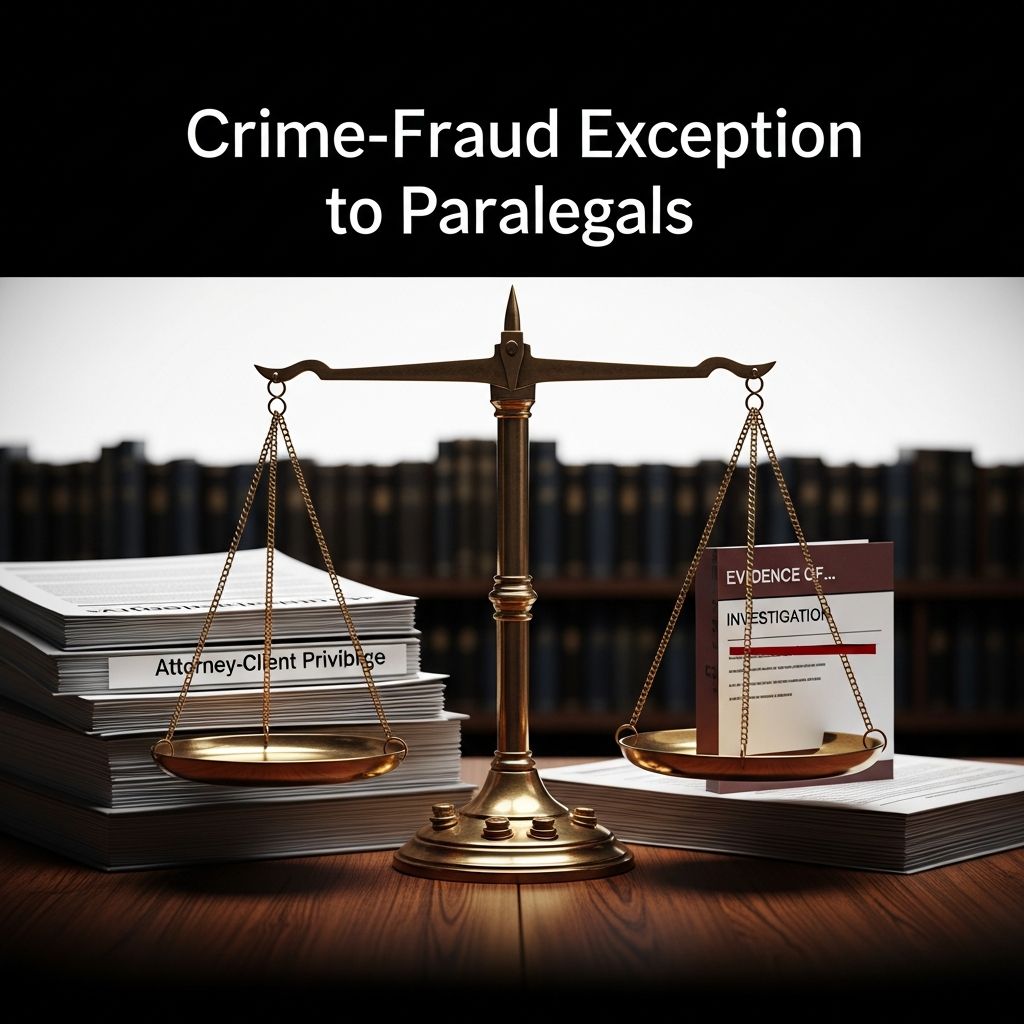
When Legal Advice Crosses the Line
In the legal profession, confidentiality is sacred. Lawyers and their support staff, including paralegals, are expected to protect client communications under the attorney-client privilege. But there’s a critical boundary: when those communications are used to plan or carry out a crime or fraud, the privilege no longer applies. This is known as the crime-fraud exception, and it has serious implications for everyone in a law firm, not just attorneys.
What Is the Crime-Fraud Exception?
The crime-fraud exception is a legal doctrine that removes protection from otherwise privileged communications when they are made in furtherance of a crime or fraud. It means that if a client consults a lawyer about how to commit a crime, hide assets, lie under oath, or otherwise deceive a court or third party, those conversations are not confidential. They can be disclosed in court or to law enforcement.
This exception is not about past crimes. Talking about something that already happened, like a past theft or a completed fraud, is generally still protected. The exception applies when the client is planning or actively carrying out illegal or fraudulent conduct and uses the attorney’s advice or services to advance that conduct.
Why the Exception Exists
The legal system protects attorney-client communications so clients can be honest and receive competent advice. But that protection is not meant to be a tool for wrongdoing. The crime-fraud exception exists to prevent the legal system from being used to facilitate or conceal illegal activity.
Without this exception, clients could use lawyers as shields to plan crimes, hide evidence, or manipulate courts. The exception ensures that privilege does not become a license to break the law. It also protects the integrity of the legal profession by making clear that lawyers and their staff cannot knowingly assist in criminal or fraudulent schemes.
How the Exception Is Triggered
Courts typically apply a two-part test to decide whether the crime-fraud exception applies:
- Prima facie evidence of crime or fraud: There must be enough evidence to show that the client was engaged in, or planning, criminal or fraudulent conduct when they sought legal advice.
- Communications in furtherance of that conduct: The communications with the lawyer must have been intended to help plan, carry out, or conceal the crime or fraud.
For example, if a client tells their lawyer, “I need to destroy these documents before the trial,” and the lawyer helps them do it, those communications are not protected. If a client asks how to hide money from a court-ordered judgment, and the lawyer helps structure a sham transaction, that advice falls under the exception.
Paralegals and the Scope of Privilege
Paralegals are not lawyers, but they often handle sensitive client information. They draft documents, organize files, communicate with clients and third parties, and assist in preparing for litigation. Because they work under the supervision of an attorney, many of the communications they are involved in are considered part of the attorney-client relationship and are therefore protected by privilege.
However, that protection is not absolute. If a paralegal is involved in communications that are part of a crime or fraud, those communications lose their privileged status. A paralegal who helps draft a false affidavit, fabricates evidence, or assists in hiding assets at the direction of a client and supervising attorney may be participating in conduct that falls under the crime-fraud exception.
What Paralegals Need to Know
Paralegals must understand that they are not just support staff—they are part of the legal team and are bound by ethical rules and professional standards. While they don’t have the same licensing obligations as attorneys, they can still face serious consequences if they participate in or assist with illegal or fraudulent conduct.
Key points for paralegals:
- Communications with clients and third parties, when done at the direction of an attorney, are often treated as part of the attorney-client relationship.
- Work product created by a paralegal, such as memos, research, and draft documents, may be protected by work-product doctrine, but not if it relates to a crime or fraud.
- Paralegals should never create or alter documents with the intent to deceive a court or third party, even if instructed to do so.
- If a paralegal suspects that a client or attorney is planning or engaging in illegal or fraudulent conduct, they should raise concerns with supervising counsel and, if necessary, consider their own ethical and legal exposure.
When Paralegal Work Falls Under the Exception
Not every task a paralegal performs is at risk of losing protection. Routine work like organizing files, drafting standard motions, or summarizing depositions is generally safe. But certain activities can cross the line:
- Helping a client transfer assets to avoid a judgment.
- Assisting in the creation of false records or backdated documents.
- Communicating with witnesses in a way that could be seen as witness tampering.
- Participating in efforts to hide or destroy evidence.
- Helping structure transactions designed to mislead regulators or courts.
In these situations, the paralegal’s work product and communications may be discoverable, and the paralegal could be called to testify about what they did and what they were told.
Practical Examples in Practice
Consider a few realistic scenarios:
- Family Law Case: A client tells the attorney they want to hide income and assets in a divorce. The attorney instructs the paralegal to help restructure bank accounts and create false records. Those communications and documents are not protected by privilege and could be disclosed in discovery or at trial.
- Business Litigation: A client admits they falsified contracts and asks the attorney to help them present those documents as genuine. The paralegal drafts correspondence and prepares exhibits based on those false contracts. Those materials may be subject to the crime-fraud exception.
- Criminal Defense: A client tells the attorney they plan to intimidate a witness. The attorney discusses strategy with the paralegal, who then drafts a letter to the witness. If that communication is part of an effort to obstruct justice, it may not be privileged.
In each case, the paralegal’s role in creating or transmitting the information makes them part of the chain of conduct that could fall under the exception.
How Courts Evaluate the Exception
Courts are cautious about piercing privilege. They require more than just suspicion or an allegation. The party claiming the crime-fraud exception must present enough evidence to support a reasonable belief that:
- The client was engaged in or planning criminal or fraudulent conduct.
- The communications with the attorney (and by extension, the paralegal’s work) were intended to further that conduct.
If that threshold is met, the court may order an in camera review of the materials to decide what, if anything, should be disclosed. Only the communications directly related to the crime or fraud are exposed; other privileged communications remain protected.
Paralegal Responsibilities and Risk Management
Paralegals can protect themselves and their firms by following a few key practices:
- Document instructions clearly: Keep clear records of what tasks are assigned and by whom, especially when dealing with sensitive or unusual requests.
- Ask questions when in doubt: If a request seems unethical or potentially illegal, discuss it with supervising counsel before proceeding.
- Refuse to participate in misconduct: Paralegals have the right—and in some cases, the duty—to refuse to assist in activities that could violate ethical rules or the law.
- Know the firm’s ethics policies: Understand how your firm handles conflicts, reporting concerns, and compliance with professional standards.
- Stay informed about the crime-fraud exception: Regular training on ethics and privilege helps paralegals recognize red flags and respond appropriately.
What Happens When the Exception Applies?
If a court determines that the crime-fraud exception applies, several things can happen:
- The otherwise privileged communications can be disclosed in discovery or at trial.
- The attorney may be required to withdraw from representation.
- The attorney may have an obligation to report the conduct to authorities, depending on the jurisdiction and the nature of the wrongdoing.
- Paralegals involved in the conduct may be subpoenaed to testify about what they did and what they were told.
Even if no criminal charges are filed, the exposure of these communications can severely damage a client’s case and the reputation of the law firm.
Best Practices for Law Firms
Law firms should take proactive steps to minimize the risk that the crime-fraud exception will be invoked against them or their staff:
- Clear engagement letters: Define the scope of representation and make clear that the firm will not assist in illegal or fraudulent conduct.
- Client screening: Conduct due diligence to identify red flags before taking on a new matter.
- Supervision and training: Ensure that attorneys properly supervise paralegals and that all staff receive regular training on ethics, privilege, and the crime-fraud exception.
- Internal reporting mechanisms: Establish clear procedures for staff to raise concerns about potential misconduct without fear of retaliation.
- Document retention policies: Maintain records in a way that supports legitimate legal work while minimizing the risk of preserving evidence of wrongdoing.
FAQs: Paralegals and the Crime-Fraud Exception
Can paralegals be held liable under the crime-fraud exception?
Paralegals themselves are not the holders of the attorney-client privilege, but their work product and communications can lose protection if they relate to a crime or fraud. In extreme cases, a paralegal who knowingly participates in illegal conduct could face disciplinary action, civil liability, or even criminal charges.
Are communications between a paralegal and a client always privileged?
Communications between a paralegal and a client are generally treated as part of the attorney-client relationship when the paralegal is acting under the supervision of an attorney. However, that protection disappears if the communications are in furtherance of a crime or fraud.
What should a paralegal do if they suspect a client is planning a crime or fraud?
The paralegal should immediately raise the concern with the supervising attorney. If the attorney appears to be complicit or unresponsive, the paralegal may need to consider escalating the issue within the firm or, in some cases, seeking independent legal advice about their own exposure.
Does the crime-fraud exception apply to civil fraud as well as criminal acts?
Yes. The exception applies to both criminal conduct and civil fraud. Courts have interpreted “fraud” broadly to include intentional misrepresentations, breaches of fiduciary duty, and other tortious conduct that is designed to deceive or harm others.
Can a paralegal be subpoenaed to testify about privileged communications?
Yes. If the crime-fraud exception applies, the court may order disclosure of otherwise privileged materials, and paralegals involved in those communications may be subpoenaed to testify about their role and what they know.
Conclusion
The crime-fraud exception is a powerful tool that ensures the legal system is not used to facilitate wrongdoing. For paralegals, it underscores the importance of ethical conduct, clear communication with supervising attorneys, and a solid understanding of privilege and confidentiality.
By recognizing the boundaries of privilege and knowing when to raise concerns, paralegals can protect themselves, their clients, and the integrity of the legal profession. Firms that invest in training, supervision, and clear policies create an environment where ethical issues are addressed early and the risk of crossing the line into crime or fraud is minimized.
References
- Restatement (Third) of the Law Governing Lawyers § 82 — American Law Institute. 2000. https://www.ali.org/publications/restatement-third-law-governing-lawyers/
- United States v. Zolin, 491 U.S. 554 (1989) — Supreme Court of the United States. 1989. https://supreme.justia.com/cases/federal/us/491/554/
- In re Grand Jury Proceedings, 417 F.3d 18 (1st Cir. 2005) — United States Court of Appeals for the First Circuit. 2005. https://casetext.com/case/in-re-grand-jury-proceedings-4
- Model Rules of Professional Conduct Rule 1.6 — American Bar Association. 2020. https://www.americanbar.org/groups/professional_responsibility/publications/model_rules_of_professional_conduct/model_rules_of_professional_conduct_table_of_contents/
- Chaudhry v. Gallerizzo, 174 F.3d 394 (4th Cir. 1999) — United States Court of Appeals for the Fourth Circuit. 1999. https://casetext.com/case/chaudhry-v-gallerizzo
Similar Articles








Read full bio of Sneha Tete