Introduction: The Crucible of Constitutional Rights
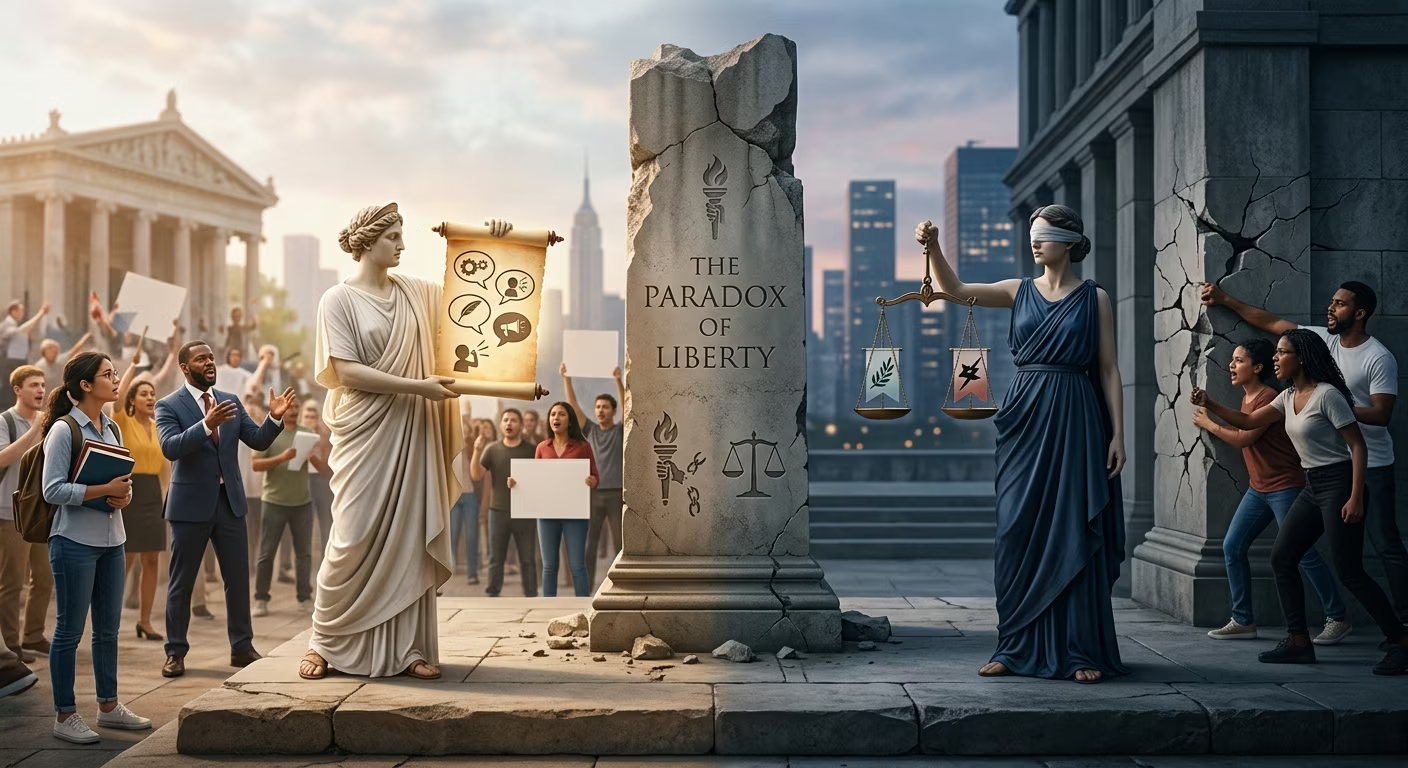
The foundation of any democratic society rests upon the strength of its bedrock principles, and perhaps none is more heavily scrutinized than the guarantee of free expression. The true measure of a society’s commitment to liberty is not found in its willingness to protect popular, harmless, or universally accepted ideas. Instead, the resilience of constitutional rights is tested in the crucible of extreme controversy, when the ideas being expressed are viscerally repugnant, deeply offensive, or inherently hateful. The First Amendment of the United States Constitution is purposefully designed to act as a blunt instrument against government censorship, demanding an uncompromising standard of objectivity.
When legal advocates, civil liberties organizations, and the courts stand up to defend the procedural rights of abhorrent actors, they are not endorsing the ideology of the speaker. Rather, they are defending the architectural integrity of the legal system itself. This paradox—that a free society must sometimes protect the speech of those who would willingly destroy it—remains one of the most misunderstood yet vital pillars of American jurisprudence. To compromise on this absolute standard is to invite the very mechanisms of authoritarian control that a free republic is designed to resist.
The Mechanics of Prior Restraint and the Skokie Precedent
In the late 1970s, the American legal system faced a profound stress test that would come to define modern First Amendment jurisprudence. The controversy centered on a planned demonstration in the Village of Skokie, Illinois, a municipality with a large Jewish population that included thousands of Holocaust survivors. When an extremist group, the National Socialist Party of America, announced its intention to march through the town wearing uniforms that displayed the swastika, local authorities moved swiftly to block the demonstration through targeted injunctions and emergency ordinances. The intense legal battle that ensued, culminating in the Supreme Court’s intervention, stripped away the emotional context of the proposed speech to examine the raw, underlying mechanics of prior restraint.
The highest court in the land recognized a fundamental, overarching danger: if local governments were permitted to use procedural delays, prohibitive insurance bonds, or subjective assessments of community offensiveness to deny appellate review and permanently block a demonstration, that exact same precedent would inevitably be wielded against other marginalized groups. The legal decisions stemming from this era dictated that if a state seeks to impose a prior restraint on protected speech, it must provide strict, immediate procedural safeguards. The Skokie controversy solidified the doctrine that the government cannot preemptively silence speakers based on the anticipated outrage or emotional distress their message might provoke. It forced the nation to grapple with the uncomfortable reality that constitutional protections are entirely indivisible.
Navigating the Heckler’s Veto
A crucial element that emerged from these historical legal battles is the prohibition of the “heckler’s veto.” This legal concept occurs when the government suppresses speech because of the anticipated hostile reaction of the audience. If the threat of public unrest were recognized as a valid legal justification for censorship, unpopular speakers could be silenced simply by the threat of mob violence. The courts have consistently ruled that the proper constitutional response to a controversial speaker is to provide adequate police protection to maintain order, rather than to silence the speaker. This ensures that the boundaries of free expression are dictated by the law, not by the volatility of a crowd.
Understanding the Doctrine of Viewpoint Neutrality
At the very core of this legal philosophy is the doctrine of viewpoint neutrality. This foundational principle mandates that the government cannot regulate, restrict, or burden speech based on the specific ideology, opinion, or perspective of the speaker. The public expression of ideas cannot be prohibited merely because the ideas themselves are deemed offensive to the prevailing majority or emotionally distressing to certain listeners. Viewpoint discrimination is considered uniquely toxic to a free and democratic society because it allows the state to manipulate the marketplace of ideas by selectively suppressing disfavored political or social views.
To understand the absolute necessity of viewpoint neutrality, one must consider the alternative: a judicial system where government officials, administrative judges, or local councils have the discretionary power to determine which speech is “acceptable” and which is “dangerous.” History has repeatedly and painfully demonstrated that such subjective power is inherently prone to abuse. The definition of what constitutes hateful, disruptive, or dangerous speech inevitably shifts alongside the prevailing political winds. By enforcing strict viewpoint neutrality, the First Amendment actively removes the government from the role of moral arbiter, ensuring that the power to censor is categorically denied to the state entirely.
The Institutional Toll of Defending the Indefensible
When civil liberties organizations take on the legal defense of deeply unpopular, extremist, or abhorrent groups, the public backlash is often swift, severe, and unrelenting. Defending the procedural rights of neo-Nazis, hate groups, or fringe provocateurs inevitably leads to widespread accusations of complicity and moral failing. The organizations that assume these legal burdens frequently face mass staff resignations, severe financial losses from withdrawn donor support, and relentless public condemnation in the media. The deliberate choice to expend limited resources defending bad actors is rarely popular, and it requires a steadfast, almost stoic commitment to the long-term health of the legal system over short-term public approval.
However, constitutional legal advocates understand a critical, unyielding reality: laws drafted with the intention of suppressing the worst elements of society are almost always eventually weaponized against the vulnerable. The legal institutions that bear the brunt of public outrage do so because they vividly recognize the slippery slope of censorship. If a town council can successfully ban a march by extremists by citing the potential for community disruption, a different town council in a different state can, and will, use that exact same legal precedent to ban a civil rights march, a labor union strike, or a peaceful anti-war protest. The institutional toll, while undeniably heavy, is viewed by these advocates as the necessary, unavoidable price to prevent the erosion of precedent that ultimately protects everyone.
Historical Parallels: Safeguarding the Best by Protecting the Worst
The jurisprudence forged in the defense of highly unpopular speech has repeatedly served as the essential legal shield for pivotal social justice movements. The interconnected nature of First Amendment precedent means that a legal victory for a fringe extremist group translates directly into an impenetrable legal defense for peaceful reformers. The specific legal arguments used to strike down unconstitutional injunctions against hateful demonstrations are the very same tools used to protect civil rights advocates challenging systemic, institutionalized injustice across the country.
The table below illustrates how the principles of free expression, established in highly controversial cases, apply across vastly different historical contexts to protect marginalized voices:
| Legal Concept | Historical Context | Constitutional Impact |
|---|---|---|
| Prior Restraint | Attempts by local municipalities to block controversial demonstrations using preemptive injunctions. | Established that the government bears an overwhelmingly heavy burden to justify any preemptive censorship of assembly. |
| Viewpoint Neutrality | Government agencies refusing to register trademarks or issue permits based on perceived offensiveness. | Reaffirmed that the state cannot legally act as an arbiter of what constitutes acceptable or moral expression. |
| The Heckler’s Veto | Arresting peaceful civil rights marchers under “breach of the peace” statutes due to hostile crowds. | Protected minority activists by ruling that an audience’s hostility cannot be used to justify silencing a speaker. |
These historical parallels highlight a crucial mechanism of American constitutional law. The rule of law operates on absolute consistency. A judge cannot selectively apply First Amendment protections based on their personal affinity for the speaker’s cause. By forcing the courts to protect the speech of those we naturally despise, we guarantee that the courts will protect the speech of those fighting for essential human progress.
The Price of Tolerance in a Democratic Society
Tolerance, in a strictly constitutional sense, is not synonymous with acceptance, endorsement, or moral approval. It is a highly pragmatic legal strategy designed specifically to prevent the dangerous concentration of censorious power within the government. Democracy inherently demands discomfort. It requires citizens to navigate a public square that is often chaotic, uncomfortably loud, and deeply offensive. The constitutional remedy for speech that is false, hateful, or destructive is not the heavy, blunt hand of state censorship, but rather the rapid proliferation of more speech.
When a society resorts to censorship to solve its social ailments, it invariably drives malignant ideologies underground. In the shadows, away from public debate, these ideologies can fester, radicalize, and grow without the necessary disinfectant of public scrutiny. By allowing hateful speech to occur in the open, society retains the critical ability to confront it directly, dismantle its flawed arguments, and visually demonstrate the overwhelming cultural opposition to its tenets. The appropriate answer to a hateful demonstration is a larger, louder, and more unified counter-demonstration. The ultimate answer to abhorrent ideas is a rigorous, unyielding public defense of equality, human dignity, and democratic values.
Frequently Asked Questions (FAQ)
What is prior restraint in the context of the First Amendment?
Prior restraint refers to government action that prohibits speech or expression before it can take place. In constitutional law, there is a heavy presumption against the validity of any prior restraint. The courts have established that the government must meet exceptionally high burdens of proof to justify stopping someone from speaking or publishing preemptively, as this is considered the most severe form of censorship.
What does viewpoint neutrality mean?
Viewpoint neutrality is a principle under the First Amendment dictating that the government cannot regulate or restrict speech based on the specific opinions or ideologies expressed. If the government opens a forum for public expression, it must allow all perspectives, even those that the majority of society finds deeply offensive or morally repugnant. It prevents the state from playing favorites in the marketplace of ideas.
How does the “heckler’s veto” affect free speech?
The “heckler’s veto” occurs when the government silences a speaker because it anticipates a hostile, disruptive, or violent reaction from the audience. Constitutional jurisprudence prohibits the heckler’s veto, reasoning that a speaker’s rights should not be held hostage by the lowest common denominator of crowd behavior. The government’s duty is to protect the speaker and manage the crowd, not to censor the speech to keep the peace.
Are there any exceptions to the First Amendment’s protection of speech?
Yes, the First Amendment is not entirely absolute. The Supreme Court has carved out very narrow, specific categories of unprotected speech. These include true threats, incitement to imminent lawless action, obscenity, and defamation. However, “hate speech” itself is not a legally defined exception to the First Amendment; speech cannot be banned simply because it expresses hatred or bigotry toward a particular group.
References
- National Socialist Party of America v. Village of Skokie, 432 U.S. 43 — Library of Congress. 1977-06-14. https://www.loc.gov/item/usrep432043/
- Matal v. Tam, 582 U.S. 218 — Supreme Court of the United States. 2017-06-19. https://www.supremecourt.gov/opinions/16pdf/15-1293_1o13.pdf
- Hurley v. Irish-American Gay, Lesbian and Bisexual Group of Boston, Inc., 515 U.S. 557 — Library of Congress. 1995-06-19. https://www.loc.gov/item/usrep515557/