
Louisiana Wills: Complete Guide To Succession And Forced Heirs
Understand how wills work in Louisiana, from legal formalities and heirs’ rights to probate, small successions, and common planning pitfalls.
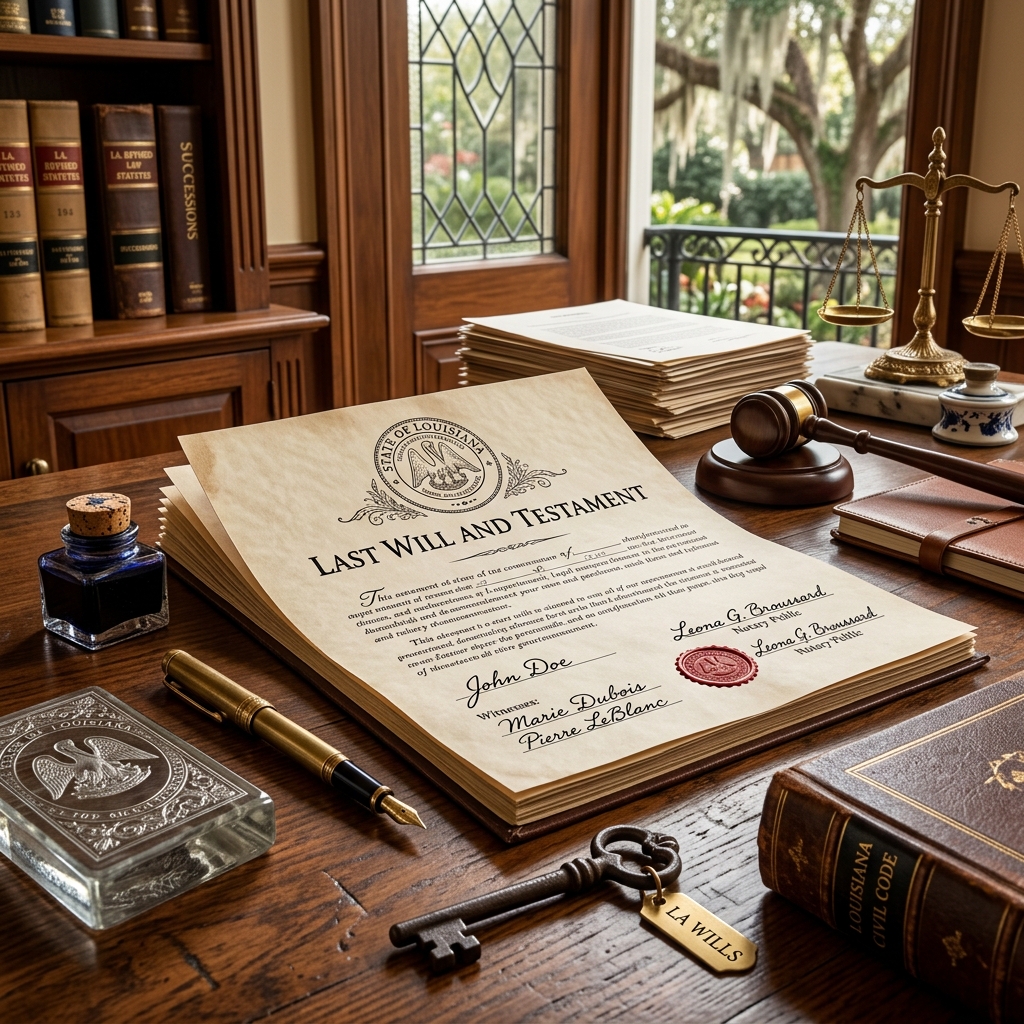
Louisiana uses a distinctive legal system rooted in civil law, and that uniqueness extends to how it treats wills, succession, and the transfer of property at death. Louisiana statutes specify who can make a will, what forms a will may take, how it must be signed and witnessed, and what happens if a person dies without one. This guide explains the fundamentals of Louisiana will laws so you can better plan your estate or understand your rights as an heir.
Why Louisiana Will Law Is Different
Most U.S. states follow common-law traditions, but Louisiana’s rules for wills and successions are heavily influenced by civil law and codified in the Louisiana Civil Code and related statutes. As a result, concepts such as forced heirship, usufruct, and community property have special importance and may lead to outcomes unfamiliar to residents of other states. Knowing these differences is essential for anyone with property or family ties in Louisiana.
- Civil law framework: Succession and wills are primarily governed by codified rules, not judge-made law.
- Community property: Married couples often own property jointly, affecting how estates are divided at death.
- Forced heirs: Certain descendants are legally protected and must receive a share of the estate under specific conditions.
- Limited will formats: Only two primary forms of testament are recognized: notarial and olographic.
Who Can Make a Will in Louisiana?
A Louisiana will is valid only if the person making it (the testator) has the legal capacity and intent at the time it is executed. Capacity generally involves age and mental competence, while intent requires a clear understanding that the document is meant to dispose of property at death.
Basic Capacity Requirements
To create a valid will in Louisiana, the testator must:
- Be an adult: The testator must meet the minimum age requirement established by Louisiana law (commonly age 18).
- Be mentally competent: The testator must understand the nature of their property and the consequences of making a will.
- Act voluntarily: The will must be executed without duress, coercion, or undue influence.
If a person lacks capacity or is improperly influenced, the will may later be challenged and annulled in court.
Recognized Forms of Wills in Louisiana
Louisiana law recognizes two principal forms of wills, often referred to as testaments:
- Notarial testament: A typewritten or printed will signed before a notary and two qualified witnesses.
- Olographic (holographic) will: A will written, dated, and signed entirely by the testator in their own handwriting.
Each format has its own formal requirements. Failure to comply with the required formalities can render the will invalid on its face and lead to intestate succession.
Notarial Testaments
A notarial testament is the most common and flexible will form in Louisiana, particularly for more complex estates. Louisiana Civil Code article 1576 sets the core requirements for such wills.
| Requirement | Description |
|---|---|
| Written and dated | The will must be in writing and bear a date that can be clarified if needed by external evidence. |
| Execution before notary and witnesses | The testator signs in the presence of a notary public and two witnesses. |
| Signatures | The testator, each witness, and the notary must sign the will. |
| Attestation clause | Generally, a clause confirming that all formalities were complied with is included at the end of the testament. |
If a testator cannot sign, Louisiana law allows alternatives, such as affixing a mark or directing another person to sign in the presence of the testator, provided specified conditions are met.
Olographic (Handwritten) Wills
An olographic will is a handwritten testament that dispenses with the need for a notary and witnesses, but it must strictly meet requirements regarding handwriting, dating, and signing.
- The entire body of the will must be written by the testator.
- The will must include a date, typically in the testator’s handwriting.
- The testator must sign the document, usually at the end.
Because olographic wills are often prepared without attorney involvement, they are more frequently challenged for lack of clarity or failure to satisfy formal requirements.
Key Formalities and Common Validity Issues
Louisiana courts strictly enforce formal requirements for wills. A will that fails to comply with these rules can be declared null, even if it clearly reflects the testator’s wishes.
Typical Formal Defects
Examples of defects that may lead to invalidation include:
- Missing signatures: For a notarial testament, failure of the testator or a witness to sign.
- Improper witnessing: Insufficient number of witnesses or use of witnesses who are beneficiaries, contrary to statutory requirements.
- Absence of a notary: Notarial wills must be executed before a notary; otherwise, they may be null.
- Olographic defects: Handwriting not entirely by the testator, missing date, or missing signature.
Formal defects are generally determined by examining the document itself rather than relying on testimony.
Substantive Grounds to Challenge a Will
In addition to formal problems, Louisiana law recognizes substantive grounds for contesting a will.
- Lack of testamentary capacity: The testator did not understand the nature or consequences of executing a will at the time of signing.
- Undue influence: Someone exerted improper pressure that overcame the testator’s free will.
- Fraud or forgery: The will or signatures are falsified.
Challenges are initiated in succession proceedings, and Louisiana law provides specific time limits for bringing such actions.
Forced Heirship and Heirs’ Rights
One of the distinctive features of Louisiana succession law is forced heirship. Certain descendants are entitled to a reserved portion of the estate that cannot be freely eliminated by will, except in narrow circumstances.
Who Is a Forced Heir?
Under Louisiana law, forced heirs typically include:
- Minor children below a specified age threshold.
- Adult children who are permanently disabled or incapacitated.
These individuals may be entitled to a portion of the estate regardless of what the will states, and complete disinheritance is generally ineffective unless statutory grounds are proven.
Impact on Estate Planning
Forced heirship can significantly affect how a testator structures their will, especially where substantial community property or business interests are involved. Estate plans must be crafted with these mandatory shares in mind to avoid later disputes or partial invalidation of testamentary dispositions.
Probate and Succession When There Is a Will
In Louisiana, the process by which a court recognizes and enforces a will is part of the broader succession procedure. The law requires that wills be probated before they can be given effect, except in limited situations involving small successions.
Opening a Succession
To begin probate of a Louisiana will, an interested party typically must:
- File the original will and relevant pleadings in the district court of the parish where the decedent resided at death, or where Louisiana real property is located if the decedent lived elsewhere.
- Request recognition of the will and appointment of an executor or personal representative if the will names one.
Louisiana succession law, starting with Civil Code article 871, governs how assets are identified and transferred to heirs or legatees.
Role of the Executor or Personal Representative
If the will designates an executor (personal representative), that person may be appointed by the court to manage the estate.
- Preparing an inventory or descriptive list of assets within the succession.
- Paying valid debts and taxes owed by the estate.
- Distributing remaining property in accordance with the will and applicable law.
In straightforward cases, successions can sometimes be opened and closed quickly, particularly when there are no disputes and the estate is modest.
Small Succession Affidavit
Louisiana provides a simplified process for smaller estates. If an estate is below a specified dollar threshold and certain conditions are met, heirs may use a small succession affidavit instead of full probate.
- Applicable when the value of the estate falls under a statutory limit.
- Useful when the distribution would be the same whether or not there is a will.
- Can reduce court filings, legal costs, and delays in transferring property.
What Happens If There Is No Valid Will?
When a person dies without a valid testament, they are said to die intestate. Louisiana’s intestacy rules then determine who inherits the estate, depending on whether property is classified as community or separate and the family relationships involved.
Community vs. Separate Property
Louisiana distinguishes between community property and separate property, and each category has its own order of succession.
| Property Type | Key Features |
|---|---|
| Community Property | Generally includes assets acquired during marriage. At death, the surviving spouse retains their share, and the decedent’s half is subject to intestacy rules. |
| Separate Property | Includes assets owned prior to marriage or acquired by inheritance or donation, typically not part of the marital community. |
Sample Intestate Order of Inheritance
Although the specific statutory provisions are detailed, Louisiana law generally provides the following patterns when there is no will:
- For community property:
- Children (or their descendants) inherit the decedent’s share, subject to a usufruct in favor of the surviving spouse under certain conditions.
- For separate property:
- Children or their descendants are first in line.
- In the absence of descendants, the surviving spouse, parents, siblings, and more remote relatives may inherit in a defined order.
If no heirs exist within the statutory order, property may eventually pass to the State of Louisiana.
Nonprobate Assets and Beneficiary Designations
Not all property passes through a will or succession. Some assets are classified as nonprobate assets because they transfer automatically according to beneficiary designations or contractual terms.
- Life insurance proceeds payable to named beneficiaries.
- Retirement accounts and annuities with designated beneficiaries.
- Certain joint accounts or payable-on-death arrangements, depending on governing documents and Louisiana law.
Because these assets bypass probate, it is important to coordinate beneficiary designations with will provisions to ensure consistency and avoid unintended results.
Practical Tips for Drafting a Louisiana Will
Given the strict formalities and unique concepts in Louisiana succession law, thoughtful planning and careful drafting are essential.
- Use the appropriate will form: Choose between notarial and olographic formats based on the complexity of your estate and your ability to meet formal requirements.
- Seek professional guidance: An attorney familiar with Louisiana civil law can help ensure your will satisfies statutory requirements and accounts for forced heirship and community property.
- Keep the original safe: Courts generally require the original will for probate, not a copy.
- Review periodically: Update your will when major life events occur, such as marriage, divorce, birth of children, or acquisitions of significant property.
- Coordinate with other documents: Align your will with powers of attorney, beneficiary designations, and any trusts you establish.
Frequently Asked Questions About Louisiana Wills
1. Do I need both a notary and witnesses for my will?
For a notarial testament, Louisiana law requires execution before a notary public in the presence of two witnesses, with signatures from all parties. An olographic will does not require a notary or witnesses but must be entirely handwritten, dated, and signed by the testator.
2. Can I disinherit a child in Louisiana?
Louisiana’s forced heirship rules restrict the ability to disinherit certain children, such as minors and permanently incapacitated adult children. While disinheritance is possible in limited circumstances, it must meet specific statutory grounds, and improper attempts may be ineffective.
3. What happens if the original will is lost?
Louisiana generally requires the original will for probate. If the original cannot be located, parties may need to rely on secondary evidence and special procedures, and in some cases the will may be treated as revoked or invalid. Safekeeping of the original document is therefore critical.
4. Is a handwritten note enough to count as a will?
A handwritten document may qualify as an olographic will only if it meets all statutory requirements: it must be wholly written, dated, and signed by the testator with clear testamentary intent. Informal notes that lack a date, signature, or clear indication of intent may not be accepted as a valid will.
5. How long do I have to challenge a will in Louisiana?
Louisiana law sets specific prescriptive periods (deadlines) for challenging a probated or unprobated will, often measured in years from the date of probate or death. Anyone considering a contest should consult legal counsel promptly to avoid missing these deadlines.
References
- Probate & Succession in Louisiana — Louisiana Governor’s Office of Elderly Affairs. 2019-01-01. https://goea.louisiana.gov/media/1w1lq3sz/probateandsuccession.pdf
- Art. 1576. Notarial testament; requirements of form — Louisiana State Legislature. 2023-01-01. https://www.legis.la.gov/legis/Law.aspx?d=108901
- Wills: Louisiana — Baker Donelson. 2021-06-01. https://www.bakerdonelson.com/webfiles/Bios/Wills%20Louisiana(w-009-0867)_CLEANED.pdf
- Challenging Validity of Last Will and Testament in Louisiana — Louisiana Succession Attorney Library. 2020-05-01. https://www.louisianasuccessionattorney.com/library/challenging-validity-of-last-will-and-testament-in-louisiana/
- Louisiana Probate Law: What Happens If There’s a Will? — Ciolino & Onstott. 2022-04-01. https://ciolinoonstott.modihost.com/blog/louisiana-probate-law-what-happens-if-theres-a-will
- Wills and Trusts in Louisiana: What You Need to Know — Baringer Law Firm. 2026-01-01. https://www.baringerlawfirm.com/wills-and-trusts-in-louisiana/
Similar Articles








Read full bio of Sneha Tete


