
Overtime Rules for Live‑In Caregivers Explained
A clear guide to how federal and state labor laws treat overtime pay for live-in and in-home caregivers, and what families and workers must know.
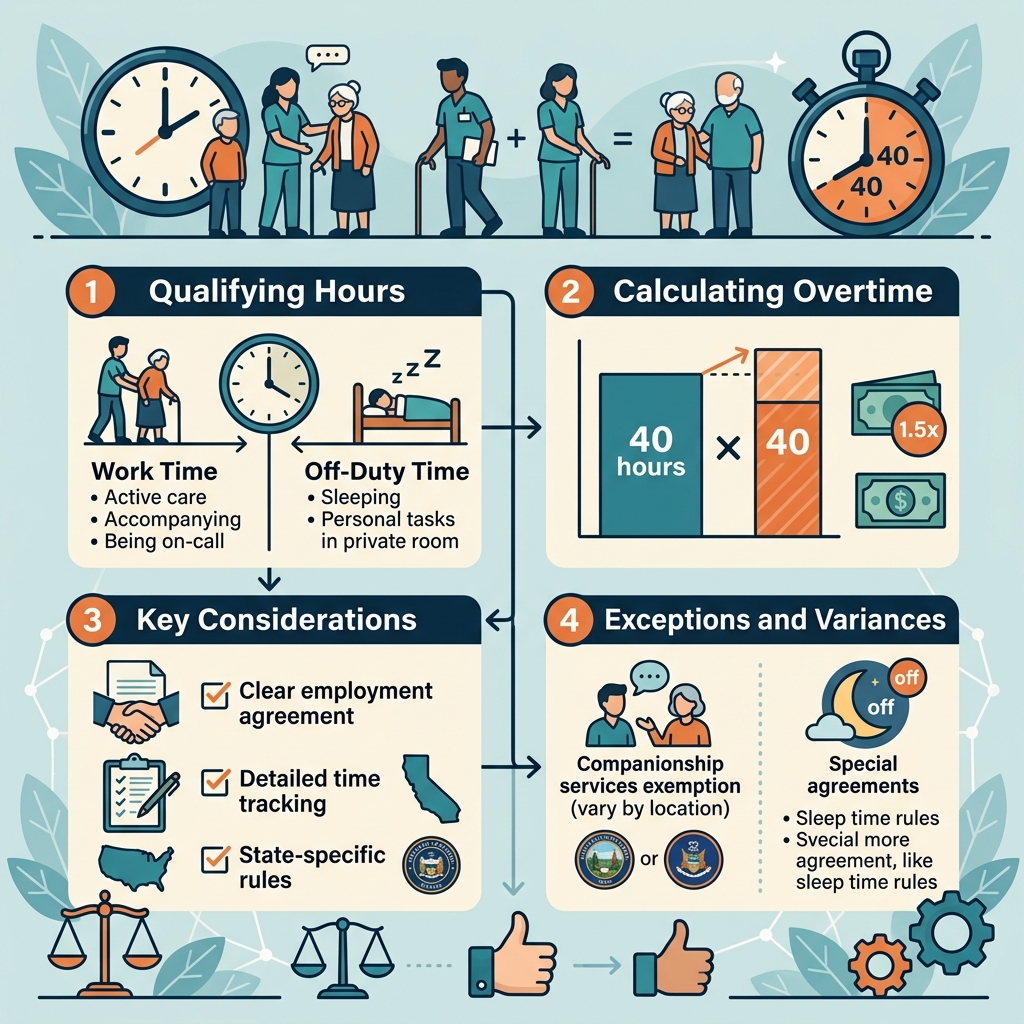
Families who rely on in-home caregivers often assume that providing room and board or a flat weekly wage is enough to satisfy legal obligations. In reality, caregiver pay rules are shaped by a detailed framework of federal and state labor laws that treat live-in work differently from standard hourly employment. Understanding when overtime is owed, and when exemptions apply, is essential for both workers and families.
This article offers an in-depth look at how overtime pay is handled for caregivers who live with or regularly stay in the client’s home, with a focus on U.S. law. It explains how the Fair Labor Standards Act (FLSA) applies, when live-in and companionship exemptions can remove the overtime requirement, and how state rules sometimes give caregivers stronger protections than federal law.
1. Why Overtime for Live‑In Caregivers Is Legally Complex
Caregiver arrangements often blur the line between home life and work. A live-in caregiver may cook, clean, assist with dressing and bathing, manage medications, and provide overnight monitoring. At the same time, they may share meals and downtime with the client in ways that feel more like family than employment. U.S. labor law attempts to separate these overlapping roles by defining which hours count as work and which do not, and by setting different rules for workers who reside in the home versus those who come and go.
- Domestic service worker: A caregiver who performs household services in or around a private home, such as personal care, housekeeping, cooking, or companionship.
- Live-in worker: A domestic service worker who resides on the employer’s premises for extended periods—often overnight and for multiple days per week.
- Companion vs. caregiver: Law distinguishes between companionship (fellowship and protection) and hands-on personal care. This distinction is crucial for overtime rights.
These categories determine whether a caregiver is covered by general overtime rules or falls under one of several exemptions that can limit or remove overtime obligations.
2. The FLSA Framework: Minimum Wage and Overtime Basics
The FLSA is the central federal law governing minimum wage and overtime in the United States. It covers many caregivers employed by agencies and by private households.
Under the FLSA, covered nonexempt employees are entitled to:
- Federal minimum wage for every hour worked.
- Overtime pay at one and one-half (1.5×) their regular rate of pay for all hours worked over 40 in a workweek.
- Accurate recordkeeping of hours and wages by the employer.
A workweek is any fixed, recurring period of 168 hours (seven consecutive 24‑hour days). If a caregiver’s total hours of compensable work exceed 40 in that period, overtime is normally owed unless a specific exemption applies.
3. Live‑In Domestic Worker Exemption: No Automatic Overtime
One of the major reasons overtime for live-in caregivers is controversial is the live-in domestic worker exemptionexempt from the FLSA overtime requirement, though they still must receive at least the federal minimum wage for hours worked.
| Caregiver Type | Minimum Wage | Overtime (Federal) | Typical Example |
|---|---|---|---|
| Live‑in domestic worker, hired directly | Required | Generally exempt from FLSA overtime | Caregiver who resides in client’s home 5+ days/week |
| Non‑live‑in domestic worker | Required | Time‑and‑a‑half after 40 hours/week | Caregiver who comes and goes daily |
| Live‑in caregiver employed by an agency | Required | Often covered; depends on classification and state law | Home health aide placed by home care agency |
The U.S. Department of Labor clarifies that live‑in domestic service workers employed by private households must be paid for all hours they are on duty, but federal law does not automatically require overtime premiums for hours over 40. Some guidance from payroll and caregiver compliance specialists notes that live-in workers who are not companions may need to be paid for each hour worked but are still treated differently from standard hourly employees for overtime purposes.
4. Companionship Exemption: When “Fellowship and Protection” Changes Rights
A second key exemption involves caregivers whose primary role is companionship. This exemption can affect both minimum wage and overtime, depending on the structure of employment and the tasks performed.
According to federal guidance and caregiver wage analyses:
- Domestic service workers who spend at least 80% of their time providing fellowship and protection to an elderly or infirm person, with no more than 20% devoted to hands‑on personal care (such as bathing, dressing, or feeding), may be considered companions.
- Once a caregiver crosses that 20% threshold of direct care work, they are treated as a nonexempt domestic service worker with full minimum wage and overtime protections.
This distinction matters for live‑in arrangements. A worker who truly functions mainly as a companion may fall into a narrower exemption, while one who regularly assists with activities of daily living, housekeeping, and supervision is far more likely to be viewed as a standard domestic worker entitled to wage protections.
5. Agency vs. Direct Hire: Who the Employer Is Matters
The identity of the employer is critical in determining overtime rights. Some legal analyses make the following distinctions:
- If a live‑in caregiver is hired directly by a client or family, federal law requires minimum wage but not overtime, due to the live‑in domestic worker exemption.
- If the caregiver is an employee of a home health agency, they are generally entitled to both minimum wage and overtime under the FLSA, because the agency is a covered employer and the live‑in exemption for private households may not apply in the same way.
These rules often surprise families who assume that working through an agency makes pay more flexible. In reality, it usually adds obligations: agencies are subject to federal wage rules and often to state regulations that mandate overtime pay when live-in workers exceed certain hour thresholds.
6. State-Level Protections: When Caregivers Gain Extra Overtime Rights
Many states build on federal standards and provide stronger overtime protections for domestic workers, including live‑in caregivers. California is a prominent example because of its Domestic Worker Bill of Rights and detailed wage orders.
California rules illustrate how state law can extend overtime rights beyond federal minimums:
- All domestic workers must receive at least the state minimum wage, which may be higher than the federal minimum.
- Non‑live‑in domestic workers who are not personal attendants receive overtime after eight hours in a day or 40 hours in a week, and double time after 12 hours in a day or more than eight hours on the seventh consecutive workday.
- Live‑in domestic workers who are not personal attendants receive overtime for hours over nine per day and for the first nine hours worked on the sixth and seventh days of a workweek, and double time beyond those thresholds on those days.
- Personal attendants in California receive overtime after nine hours in a day or 45 hours in a week.
California also grants live‑in workers 12 consecutive duty‑free hours per workday. Work performed during those off‑duty hours is generally compensated at overtime rates. These rules demonstrate that even when federal law permits live‑in caregivers to be exempt from overtime, state legislatures can choose to require overtime and additional protections.
7. Practical Scenarios: Live‑In vs. Live‑Out Caregiver Pay
To make these rules more concrete, consider several common caregiver arrangements and how overtime might apply.
7.1 Live‑Out Caregiver Working Long Hours
A caregiver who drives to the client’s home each day, works 10‑hour shifts, and goes home at night is usually a non‑live‑in domestic service worker. If they are an employee and not exempt as a companion, they must receive at least minimum wage for all working hours and overtime at 1.5× their regular rate for hours above 40 in a workweek.
7.2 Live‑In Caregiver Hired Directly by a Family
Where a caregiver resides in the client’s home five or more days per week and is hired privately, federal law treats them as a live‑in domestic service worker exempt from overtime, but not from minimum wage. Families must still:
- Define on‑duty vs. off‑duty hours.
- Ensure that the total on‑duty hours multiplied by the regular rate equals at least the federal (and any applicable state) minimum wage.
- Keep records showing how hours were calculated.
State law may add overtime rights even in this scenario, so families must check local regulations rather than relying solely on federal rules.
7.3 Live‑In Home Health Aide Employed by an Agency
Home health aides employed by agencies are generally nonexempt workers under the FLSA and entitled to overtime for hours over 40 per week, unless a narrow exemption applies. Some agency-based live‑in arrangements pay a weekly or daily rate, but if those hours effectively exceed 40 and no valid exemption applies, the employer may be required to calculate and pay overtime on top of that base compensation.
8. Key Compliance Steps for Families and Agencies
Misunderstanding or ignoring overtime rules can lead to back pay claims, penalties, and disputes. Families and agencies benefit from approaching caregiver pay systematically.
8.1 Classify the Worker Correctly
- Confirm whether the caregiver is an employee or an independent contractor. Many caregivers are employees under the FLSA, even if they are paid informally.
- Determine whether they are a domestic service worker, a companion, or another type of worker.
- Assess whether they qualify as a live‑in worker based on residence and schedule.
8.2 Track Hours Accurately
- Maintain written schedules distinguishing on‑duty and off‑duty periods.
- Document overnight responsibilities, such as being required to respond to calls or alarms during the night.
- Keep daily timesheets or logs, even in small household settings.
8.3 Apply Federal and State Rules Together
- Ensure compliance with the FLSA minimum wage and any applicable overtime requirements.
- Check state labor agencies or legal guidance to see whether additional domestic worker protections apply, as they do in California and other states.
- Adjust pay structures promptly if rules change or if a caregiver’s duties expand beyond companionship.
9. Frequently Asked Questions (FAQs)
Q1: Are all live‑in caregivers exempt from overtime?
No. Under federal law, live‑in domestic service workers hired directly by private households are generally exempt from FLSA overtime but must receive minimum wage for hours worked. However, caregivers employed by agencies, or those covered by specific state laws like California’s Domestic Worker Bill of Rights, may be entitled to overtime even if they live on the premises.
Q2: Does providing room and board replace the need to pay minimum wage?
It does not remove minimum wage obligations. While room and board can sometimes be counted as part of compensation under certain conditions, employers must still show that the total value of wages and allowed credits equals at least the applicable minimum wage for every hour of compensable work. Live‑in caregivers cannot lawfully be paid solely with housing and food.
Q3: How do I know if my caregiver is a “companion” under the law?
A worker may be considered a companion if most of their time is spent providing fellowship and protection, with no more than about 20% of their time devoted to hands‑on personal care, household tasks, or medically‑related services. If the caregiver’s duties regularly include bathing, dressing, toileting, meal preparation, or managing medications, they are more likely to be classified as a domestic service worker entitled to wage and overtime protections.
Q4: What happens if a caregiver’s duties expand over time?
Caregiver roles often evolve. A worker who starts as a companion may gradually take on more personal care and household responsibilities. Once their core tasks shift, they may no longer fit the companionship exemption and could gain full minimum wage and overtime rights. Employers should reassess classification and pay whenever job duties substantially change.
Q5: Do state laws always protect caregivers more than federal law?
Not always, but many states do provide stronger protections. For example, California requires overtime for certain live‑in domestic workers after daily and weekly thresholds, and grants specific duty‑free periods. Other states may have less comprehensive rules. Families and agencies should consult their state labor department or qualified counsel to understand local requirements.
10. Balancing Legal Compliance and Fair Treatment
Live‑in caregivers play a crucial role in allowing older adults and people with disabilities to remain at home. The legal framework around overtime aims to balance practical realities—such as shared living arrangements and the unpredictability of care needs—with the basic principle that workers deserve fair pay for the time they spend caring for others.
For families, this means taking the time to understand whether their caregiver is covered by the FLSA, whether live‑in and companionship exemptions apply, and whether state law adds extra obligations. For caregivers, it means staying informed about their rights to minimum wage, overtime, duty‑free periods, and accurate recordkeeping. Transparent agreements and careful documentation help ensure that both sides meet legal standards and maintain a sustainable, respectful working relationship.
References
- Fact Sheet #79B: Live-in Domestic Service Workers Under the FLSA — U.S. Department of Labor, Wage and Hour Division. 2013-10-01. https://www.dol.gov/agencies/whd/fact-sheets/79b-flsa-live-in-domestic-workers
- How Caregiver Compensation Is Treated Under Federal Labor Laws — PaidCare. 2023-05-10. https://paid.care/guides/how-caregiver-compensation-is-treated-under-federal-labor-laws
- Overtime Pay Rules for Private Caregivers — AgingCare. 2015-08-12. https://www.agingcare.com/articles/when-to-pay-overtime-to-private-caregiver-191451.htm
- The Domestic Worker Bill of Rights – Frequently Asked Questions — California Department of Industrial Relations. 2014-01-01. https://www.dir.ca.gov/dlse/DomesticWorkerBillOfRights-FAQ.html
- What Are the Caregiver Rights in California? — The Dominguez Firm. 2022-08-15. https://www.californialaborlawattorney.com/blog/what-are-the-caregiver-rights-in-california/
- Do I Need to Pay My Senior Caregiver Overtime or Minimum Wage? — Homework Solutions. 2021-03-01. https://www.homeworksolutions.com/knowledge-center/do-i-need-to-pay-my-senior-caregiver-overtime-or-minimum-wage/
- New Compensation Laws for Caregivers — Holliman Legal. 2015-09-15. https://hollimanlegal.com/new-compensation-laws-caregivers/
Similar Articles








Read full bio of Sneha Tete




