
Overtime Rights for Summer and Seasonal Employees
Understand when summer and seasonal workers earn overtime pay, who is exempt, and how to protect your wage rights.
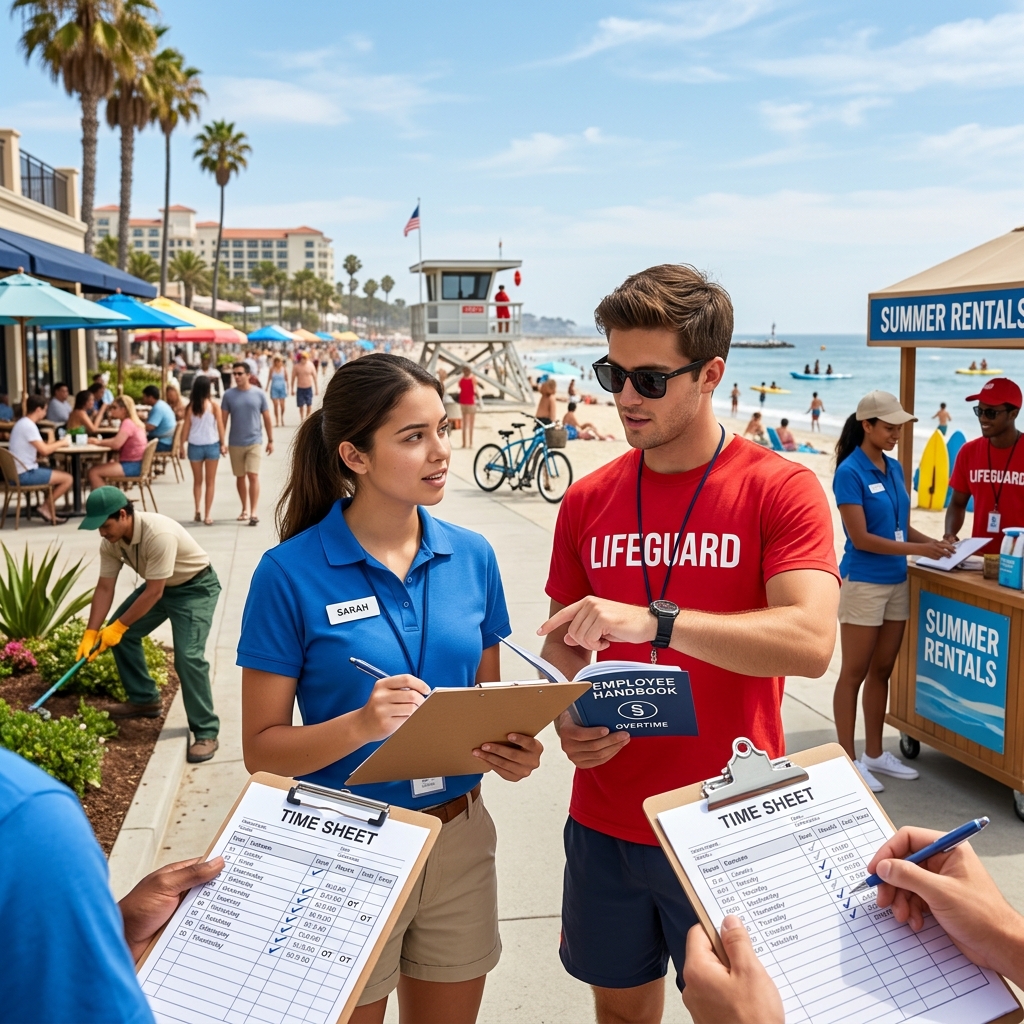
Many people take short-term jobs during busy seasons, especially in the summer, and wonder whether those extra hours should come with overtime pay. The answer depends on federal law, how your employer operates, and whether your position falls into one of several exempt categories. While a job may last only a few weeks or months, your wage rights do not disappear simply because the work is labeled “seasonal” or “summer-only.”
Understanding the Basics of Overtime Pay
In the United States, most overtime rights come from the Fair Labor Standards Act (FLSA), a federal law that sets minimum wage and overtime rules for covered employees. Under the FLSA, non-exempt workers must receive at least time-and-a-half (1.5 times their regular rate) for every hour worked over 40 hours in a workweek.
A workweek under the FLSA is a fixed period of 168 consecutive hours, typically described as seven consecutive 24-hour days. Employers can choose when the workweek starts, but once set, they must apply overtime rules consistently.
- Standard workweek: 40 hours of work in a recurring 7-day period.
- Overtime trigger: More than 40 hours worked in that same 7-day period.
- Required overtime rate: At least 1.5 times the employee’s regular hourly rate.
Importantly, weekend, night, or holiday work alone does not automatically create overtime; what matters is whether your total hours exceed 40 in the defined workweek.
Seasonal and Summer Jobs: Do Different Rules Apply?
Summer lifeguards, retail staff hired for tourist season, camp counselors, and temporary food-service workers all fall into the broad category of seasonal employees. Many of these workers are non-exempt under the FLSA and must be paid overtime when their weekly hours exceed 40.
Labeling a position as “part-time” or “seasonal” does not change the basic rule: if the employee is covered by the FLSA and is non-exempt, overtime is due for hours over 40 in a workweek. The law does not define part-time versus full-time status; instead, it focuses on total hours and job classification.
Seasonal Businesses vs. Seasonal Employees
Federal law distinguishes between a seasonal employee at a year-round business and an employee of a seasonal establishment that operates only part of the year. This difference matters because some seasonal establishments qualify for a specific exemption from the FLSA’s overtime requirements.
Under Section 13(a)(3) of the FLSA, certain amusement or recreational businesses and other seasonal operations may be exempt from paying overtime if they meet specific tests.
- The business operates fewer than seven months in a calendar year; or
- The business’s average receipts during any six months of the prior year are not more than 33 1/3% of its average receipts for the other six months.
Even when these tests are met, the exemption applies to employees of the seasonal establishment itself. Workers performing year-round functions such as maintenance or supply ordering may still be entitled to overtime, because their role is not strictly seasonal.
Key Takeaway for Summer Workers
- If you work for a year-round employer that simply hires extra staff for busy months, you are usually covered by normal overtime rules.
- If you work at a truly seasonal business that meets the FLSA’s tests, you may be in an exempt setting where overtime is not required.
- Your position may also be exempt from overtime for other reasons, discussed below.
Exempt vs. Non-Exempt: Why Your Job Duties Matter
Overtime eligibility depends heavily on whether you are classified as exempt or non-exempt. Non-exempt employees are generally entitled to overtime; exempt employees are not, as long as the exemption is properly applied.
Federal overtime exemptions typically look at two major criteria:
- Salary level — the employee must earn at least a set weekly amount to qualify for many white-collar exemptions.
- Duties test — the employee’s primary job responsibilities must fit into specific categories such as executive, administrative, or professional work.
As of recent federal rules, many exempt white-collar employees must earn at least $684 per week, or $35,568 annually, to qualify for an exemption from overtime under the FLSA. In addition, their job must meet detailed criteria related to management, judgment, or specialized professional skills.
| Category | Typical Requirements | Common Example Roles |
|---|---|---|
| Executive Exemption | Manages a department; directs at least two full-time employees; has input into hiring or firing decisions. | Store manager, operations manager |
| Administrative Exemption | Performs office or non-manual work tied to business operations; exercises independent judgment. | HR coordinator, office administrator |
| Professional Exemption | Work requires advanced knowledge in a field of science or learning; includes discretion and judgment. | Engineer, accountant, teacher |
| Creative Professional | Work requires invention, imagination, originality, or talent in an artistic field. | Graphic designer, writer, musician |
| Computer Exemption | Systems analysts, programmers, or similarly skilled computer professionals. | Software developer, systems architect |
| Outside Sales | Primarily makes sales away from the employer’s place of business. | Traveling sales representative |
Most typical summer jobs—such as serving in restaurants, working as cashiers, or staffing recreation venues—do not meet these exemption criteria and are therefore non-exempt. That means overtime should be paid when hours exceed 40 in a workweek.
Special Considerations for Summer Interns
Internships are common in the summer, and many are unpaid. Whether an unpaid summer intern must be paid minimum wage and overtime depends on whether the intern is legally considered an employee under the FLSA.
The U.S. Department of Labor uses a multi-factor test—often referred to as the “primary beneficiary” test—to evaluate whether the internship is primarily for the benefit of the intern, rather than the employer. When all factors favor the intern, the position may fall outside of the FLSA’s wage and overtime requirements.
- The training resembles what would occur in an educational environment.
- The internship is primarily for the intern’s educational or professional benefit.
- The intern does not displace regular employees and works under close supervision.
- The employer gains no immediate advantage from the intern’s activities and may occasionally be inconvenienced.
- There is no promise of a job at the end of the internship.
- Both parties clearly understand the intern is not entitled to wages for time spent in the program.
If these conditions are not met and the intern is effectively performing productive work like other employees, the FLSA likely treats the intern as an employee, meaning minimum wage and overtime rules apply.
Examples of Summer Employment and Overtime Outcomes
The following scenarios illustrate how rules might apply to typical summer situations. These are simplified examples; actual outcomes can depend on additional facts and state law:
- College student at a year-round retail store
Works 45 hours per week for two months, paid hourly. Because the store operates all year and the student is non-exempt, overtime pay is required for the 5 hours over 40 each week. - Camp counselor at a seasonal recreational camp
The camp operates only three months per year and meets the FLSA’s seasonal tests. Some counselor positions may be exempt from overtime if the camp qualifies and state law does not require overtime, but minimum wage rules may still apply. - Summer intern at a marketing firm
The intern shadows employees, attends training, and does limited productive work without replacing staff, and the firm gains little immediate benefit. If all primary-beneficiary factors are met, the intern may not be considered an employee, and FLSA overtime rules may not apply. - Assistant manager hired for the summer at a large store
If the assistant manager is paid a qualifying salary and truly manages staff, makes personnel decisions, and meets the executive exemption duties test, they might be exempt from overtime. If those responsibilities are not real or are overstated, the exemption may not be valid.
How State Law Can Enhance Overtime Rights
While this guide focuses on federal law, many states provide additional protections. For example, some states require overtime pay not only after 40 hours in a week, but also after a certain number of hours in a single day.
In states with daily overtime rules, a summer employee might earn overtime in situations where federal law alone would not require it. State law can also tighten exemption criteria or raise minimum salary thresholds for exempt employees, so the same job may be exempt in one state but non-exempt in another.
Because these rules vary widely, summer workers should check their state labor agency or legal aid organization to understand local overtime standards.
Practical Steps for Summer Workers to Protect Their Pay
If you suspect you are not being properly paid overtime, careful documentation and informed questions can help you evaluate your situation and take action if needed.
Track Your Hours Accurately
- Keep a personal log of start and end times for each workday.
- Note unpaid meal breaks and paid rest periods separately.
- Calculate total hours per workweek to see when you cross the 40-hour threshold.
Understand Your Classification
- Ask whether you are considered exempt or non-exempt.
- Confirm whether your employer claims a seasonal establishment exemption or a white-collar exemption.
- Compare your actual duties and pay to the criteria for exemptions; job titles alone do not determine legal status.
Raise Concerns Carefully
- Start by asking your supervisor or HR representative how overtime is calculated.
- Point to specific weeks where you believe you worked more than 40 hours without overtime pay.
- If internal discussions do not resolve the issue, you can review information from the U.S. Department of Labor or consult a qualified employment attorney.
Frequently Asked Questions (FAQs)
Does being a “summer employee” mean I am automatically exempt from overtime?
No. There is no blanket rule that summer workers are exempt from overtime. If you are a non-exempt employee of a covered employer and you work more than 40 hours in a workweek, you are generally entitled to overtime, regardless of whether your job is temporary or seasonal.
If I work 35 hours per week as a seasonal worker, do I get overtime?
No. Under federal law, overtime is triggered only when you work more than 40 hours in a workweek, unless state law provides additional protections. Working 35 hours in a week does not qualify for overtime simply because the job is seasonal.
Are all seasonal businesses exempt from overtime?
No. Only businesses that meet specific FLSA tests—for example, operating fewer than seven months per year or satisfying certain receipts tests—may qualify as exempt seasonal establishments. Many employers that hire extra staff during busy seasons are year-round businesses and must follow standard overtime rules.
Can my employer avoid paying overtime by calling me an intern?
Not legally, if you function like a regular employee. For an unpaid intern to fall outside the FLSA, the internship must primarily benefit you, resemble educational training, and not displace regular staff. If you are doing productive work like other employees and the business clearly benefits from your labor, you are likely an employee who is entitled to minimum wage and overtime.
Do I get overtime for working nights and weekends in the summer?
Not automatically. The FLSA does not require premium pay simply for night, weekend, or holiday shifts. Overtime depends on your total hours in the workweek. However, state law or employer policies may provide extra pay for certain shifts, so it is worth checking your employee handbook.
How do I find out if my employer is covered by the FLSA?
Most medium and large employers, and many small ones, are covered by the FLSA through enterprise or individual coverage rules. If you work for a business engaged in interstate commerce or with a certain level of annual sales, there is a strong chance the FLSA applies. When in doubt, consult official Department of Labor information or speak with an employment lawyer.
Summary: What Summer Workers Should Remember
- Overtime is generally due after 40 hours in a workweek for non-exempt employees of covered employers.
- Calling a job “seasonal” or “summer-only” does not erase overtime rights at year-round businesses.
- Some seasonal establishments and specific job categories are exempt, but these exemptions are narrow and require strict criteria to be met.
- Unpaid interns are exempt from wage and overtime rules only when the internship primarily benefits them and meets detailed legal factors.
- State law may provide extra protections, including daily overtime, that go beyond federal rules.
By understanding how overtime laws apply to seasonal and summer work, you can better evaluate your pay, spot potential violations, and take informed steps to protect your earnings.
References
- Overtime Pay — U.S. Department of Labor, Wage and Hour Division. Accessed 2024-10-01. https://www.dol.gov/agencies/whd/overtime
- Employee Hours & Overtime Labor Laws — OSHA Education Center. Accessed 2024-10-01. https://www.oshaeducationcenter.com/articles/employee-overtime/
- Are My Seasonal Employees Entitled to Overtime? — Horizon Payroll Solutions. 2021-06-10. https://www.horizonpayrollsolutions.com/blog/are-my-seasonal-employees-entitled-to-overtime
- Hiring Seasonal Employees for the Summer? Catch Up on the Latest in Federal Overtime Law — CSH Law. 2020-06-01. https://www.cshlaw.com/resources/hiring-seasonal-employees-for-the-summer-catch-up-on-the-latest-in-federal-overtime-law/
- Department of Labor Announces Overtime Rule Decision — American Camp Association. 2019-09-30. https://www.acacamps.org/news/news/department-labor-announces-overtime-rule-decision
- Overtime in California — Legal Aid at Work. 2022-03-15. https://legalaidatwork.org/factsheet/overtime-in-california/
- Are Summer Interns Subject to Minimum Wage and Overtime Pay? — TIG Advisors. 2018-05-29. https://tigadvisors.com/are-summer-interns-subject-to-minimum-wage-and-overtime-pay/
Similar Articles








Read full bio of Sneha Tete




