
OSHA and Railroad Workplace Safety Explained
Understand how OSHA, FRA, FELA, and FRSA work together to protect railroad workers’ safety, rights, and ability to report hazards.
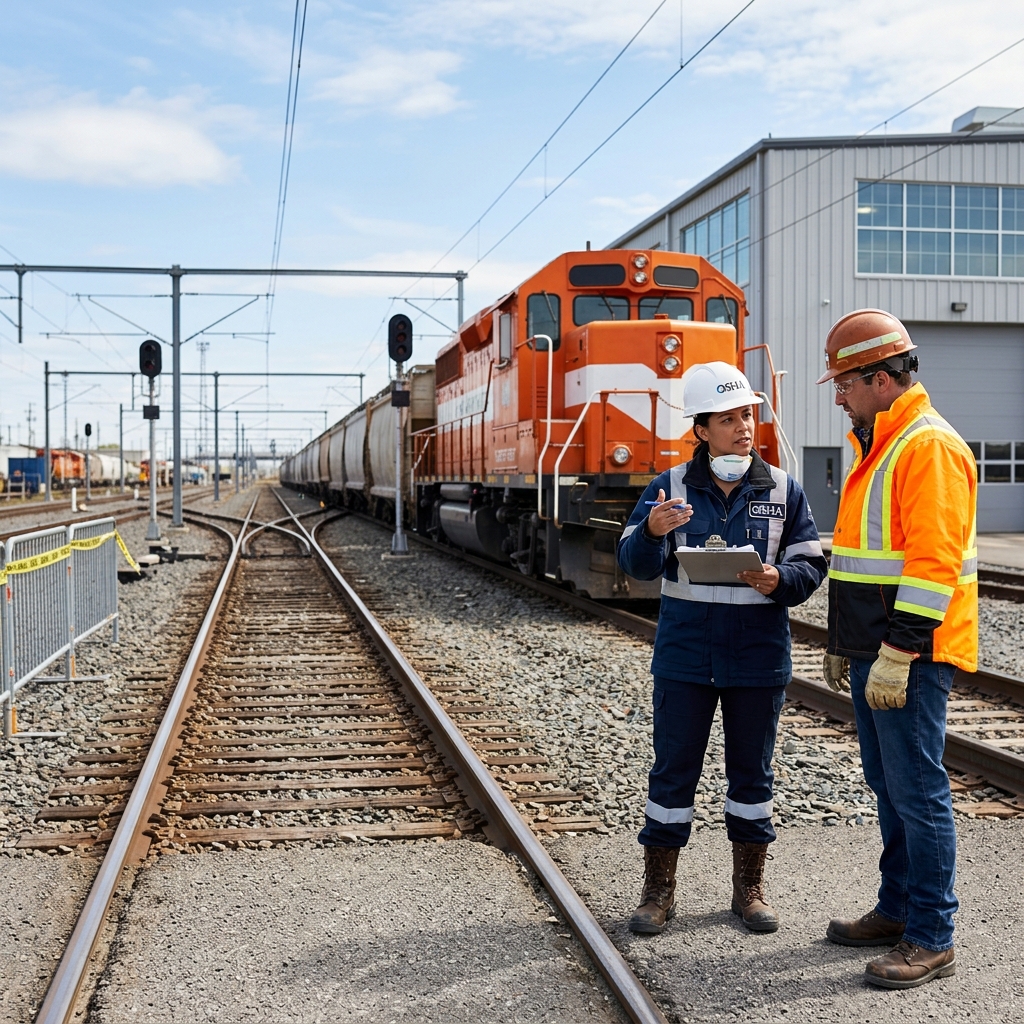
Railroad work remains one of the most physically demanding and hazardous occupations in the United States. Heavy equipment, moving railcars, high-voltage systems, and outdoor environments all increase the risk of serious injury. Federal law provides multiple layers of protection for railroad workers, including safety standards and legal remedies when something goes wrong. Understanding how these laws fit together is essential for workers, unions, and employers alike.
This guide explains how the Occupational Safety and Health Administration (OSHA) interacts with the Federal Railroad Administration (FRA), and how the Federal Employers’ Liability Act (FELA) and the Federal Railroad Safety Act (FRSA) protect workers who are injured or who report unsafe conditions.[10]
1. The Legal Safety Net for Railroad Workers
Railroad employees are not protected by a single law. Instead, several federal laws and agencies create a layered safety framework:
- OSHA: Sets and enforces workplace safety and health standards for most U.S. workers, including many railroad employees.
- FRA: Regulates railroad operations, track and equipment safety, and many hazards specific to railroad operations under Title 49 of the Code of Federal Regulations.[10]
- FELA: Allows injured railroad workers to sue their employer for negligence and recover damages for work-related injuries.
- FRSA: Protects railroad employees from retaliation when they report safety issues, violations, or injuries.
The key challenge is that these authorities overlap. FRA rules may preempt OSHA standards for certain railroad operations, while OSHA remains the primary regulator for hazards that FRA has not specifically addressed.
2. OSHA’s Role: General Workplace Safety on the Railroad
OSHA’s mission is to ensure safe and healthy working conditions by setting standards and enforcing them through inspections, citations, and penalties. Its rules cover a wide range of topics, including:
- Hazard communication for chemicals and hazardous materials
- Personal protective equipment (PPE)
- Machine guarding and lockout/tagout procedures
- Walking-working surfaces and fall protection
- Noise, ventilation, and ergonomics
For railroad workers, OSHA standards are especially relevant in environments like repair shops, maintenance facilities, warehouses, and offices—areas where FRA has not issued detailed safety regulations.
2.1 Workers’ Core Rights Under OSHA
Under the Occupational Safety and Health Act, railroad employees covered by OSHA have several fundamental rights:
- The right to a workplace that is free from recognized hazards likely to cause death or serious physical harm.
- The right to receive training in a language and format they understand about workplace hazards and safety procedures.
- The right to request and review records of injuries and illnesses, where applicable.
- The right to report unsafe conditions or violations to OSHA.
- The right to participate in OSHA inspections and speak privately with inspectors.
- The right to be free from discrimination or retaliation for raising safety concerns or filing OSHA complaints.
OSHA also enforces whistleblower protections in multiple statutes, including provisions tied to railroad safety reporting.
2.2 Examples of OSHA Standards Affecting Railroad Work
OSHA regulations may apply to railroad operations when the FRA has not exercised regulatory authority over a particular condition. Examples include:
- Railroad facilities in marine terminals: OSHA’s marine terminal standard for railroad facilities requires that work be performed in railcars only when floors are visibly safe for the work being done and equipment being used.
- Hazard communication for train crews handling hazardous materials: FRA recognizes that OSHA’s Hazard Communication Standard applies to train crews performing work as hazardous materials employees, such as when they handle chemicals requiring labeling and safety data sheets.
- Shop and yard work: Tasks in repair shops or locomotive maintenance facilities may fall under OSHA if FRA has not issued specific rules for those working conditions.
| Work Setting | Typical Hazards | Relevant OSHA Focus |
|---|---|---|
| Repair shops and maintenance facilities | Machinery, electrical hazards, chemicals, noise | Machine guarding, lockout/tagout, hazard communication, PPE |
| Warehouses and terminals | Forklifts, falls, struck-by incidents | Powered industrial trucks, walking-working surfaces, training |
| Railcars in marine terminals | Floor openings, unstable surfaces | Railroad facility safety requirements in marine terminal rules |
| Hazmat handling by train crews | Chemical exposure, spills | Hazard communication (labels, SDS, training) |
3. FRA and OSHA: Dividing Safety Responsibilities
Railroad safety regulation is unusual because the FRA is a specialized agency that directly governs many aspects of railroad operations. OSHA defers to the FRA when FRA has exercised its authority over a specific working condition.
3.1 When FRA Rules Take Priority
FRA issues detailed regulations under 49 CFR Part 214, Railroad Workplace Safety, designed to prevent accidents and casualties among employees who perform inspection, maintenance, and construction on railroad infrastructure.[10] These rules address, for example:
- Roadway worker protection around moving trains
- Bridge worker fall protection and rescue planning[10]
- Scaffolding and working over water for bridge work
When FRA has established a specific standard for a condition (such as fall protection for workers on a railroad bridge), that standard generally preempts OSHA regulations for the same risk in that railroad context.[10]
3.2 When OSHA Steps In
If FRA has not written rules or otherwise exercised authority over a particular hazard or work activity, OSHA standards typically apply. Courts and agencies have recognized that many shop and facility hazards are appropriately regulated by OSHA. In such cases, OSHA may inspect, cite violations, and require abatement.
However, the boundary is not always clear. For example, a federal appellate court held that OSHA lacked statutory jurisdiction to regulate fall hazards on top of railcars, concluding that those working conditions fell within the scope of the Federal Railroad Act and FRA’s authority. This decision illustrates how jurisdictional disputes can arise and why legal guidance is often needed.
3.3 Shared Goal, Different Tools
While OSHA and FRA sometimes overlap, their underlying goal is the same: to reduce injuries and fatalities. The differences are in approach:
- OSHA sets broad industry-wide standards that apply across many sectors.
- FRA issues rail-specific rules tailored to unique railroad operations and equipment.[10]
For workers, this means that at almost any railroad job site, either OSHA or FRA will have enforceable rules governing key safety conditions.
4. FELA: Compensation for Injured Railroad Workers
The Federal Employers’ Liability Act (FELA) is a cornerstone of railroad worker protection. Unlike traditional workers’ compensation systems, FELA is a fault-based statute: the injured employee must show that the railroad’s negligence caused or contributed to the injury.
4.1 How FELA Differs from Workers’ Compensation
- Negligence requirement: The worker must prove that the railroad failed to provide reasonably safe working conditions, equipment, or supervision.
- Broader damages: Successful FELA claims can recover medical expenses, lost wages, future earning capacity, pain and suffering, and other losses.
- Comparative negligence: A worker’s own carelessness may reduce, but does not necessarily eliminate, recovery.
- Civil lawsuit: Claims are typically filed in state or federal court rather than through an administrative workers’ compensation board.
4.2 Using Safety Violations in FELA Claims
Safety violations can play a crucial role in FELA litigation:
- FRA violations: When an injury is caused by a violation of an FRA regulation, many courts treat that violation as automatic evidence of negligence (“negligence per se”).[10]
- OSHA violations: A violation of an OSHA standard usually does not automatically establish negligence in a FELA case, but it can be admitted as evidence that the railroad failed to provide a safe workplace.
In practice, attorneys often investigate both FRA and OSHA standards to determine whether any safety rules were violated and how that might support the worker’s claim.
5. FRSA and OSHA Whistleblower Protections
Safety regulations are only effective if workers can report hazards without fear. The Federal Railroad Safety Act (FRSA), enforced in part through OSHA’s whistleblower program, protects railroad employees who engage in certain “protected activities.”
5.1 Protected Activities Under FRSA
Protected activities generally include:
- Reporting a work-related injury or illness.
- Reporting a violation of any federal railroad safety or security law.
- Reporting hazardous safety or security conditions.
- Refusing to work when confronted with a hazardous safety or security condition, under certain circumstances.
- Accurately reporting hours of duty.
When a worker engages in these activities, the railroad may not retaliate by firing, disciplining, demoting, or otherwise discriminating against the worker because of the report.
5.2 OSHA’s Role in Enforcing Whistleblower Protections
OSHA investigates whistleblower complaints under FRSA and other statutes. If OSHA finds that unlawful retaliation occurred, it can order remedies such as:
- Reinstatement to the same or equivalent position
- Back pay with interest
- Compensatory damages for emotional distress
- Payment of attorney’s fees and costs
Railroad employees generally must file these complaints within a strict deadline after the retaliatory act, so prompt action is crucial.
6. Practical Steps for Railroad Workers Concerned About Safety
Knowing the law is only the first step. Railroad workers can take specific actions to protect themselves and their coworkers.
6.1 On-the-Job Safety Practices
- Follow all safety rules and procedures, including FRA and company-specific requirements.
- Use required PPE such as hard hats, high-visibility vests, hearing protection, fall arrest systems, and eye protection.
- Review and understand safety briefings before starting a job, especially when working near live tracks or on bridges.[10]
- Ask for clarification or additional training if instructions are unclear.
6.2 Reporting Hazards and Injuries
- Report unsafe conditions immediately to a supervisor or safety representative and document the report.
- If hazards persist or are ignored, consider contacting OSHA for guidance or filing a complaint.
- Report all work-related injuries and illnesses promptly, even if they seem minor at first.
- Keep copies of incident reports, medical records, and any communications related to the event.
6.3 When to Seek Legal Advice
Because the interaction among OSHA, FRA, FELA, and FRSA can be complex, many workers consult an attorney when:
- They suffer a serious injury at work.
- The employer disputes whether the injury is work-related.
- They believe a safety rule was violated and may support a FELA claim.
- They experience discipline or termination after reporting a hazard or injury.
An attorney experienced in railroad law can help determine which laws apply, whether OSHA or FRA standards were breached, and what remedies may be available.
7. Frequently Asked Questions (FAQs)
Does OSHA always apply to railroad workers?
No. FRA regulations govern many railroad-specific operations, and when FRA has exercised authority over a particular working condition, its rules typically take priority over OSHA standards. OSHA usually applies in areas where FRA has not issued specific regulations, such as some shop and facility hazards.
Can a railroad worker file both an OSHA complaint and a FELA lawsuit?
Yes, these are separate processes. An OSHA complaint addresses safety violations and retaliation, while a FELA lawsuit seeks compensation for injuries caused by the railroad’s negligence. Evidence of OSHA or FRA violations can be relevant in a FELA case, even though OSHA does not directly award personal injury damages.
Are OSHA violations automatic proof of negligence in a FELA case?
Most courts do not treat OSHA violations as automatic negligence (negligence per se). Instead, OSHA violations are typically admissible as evidence that the railroad did not provide a reasonably safe workplace. FRA violations, by contrast, more often support a negligence per se theory.
What should a worker do if their safety complaint leads to punishment?
If a railroad worker is demoted, disciplined, or fired after reporting a safety hazard or injury, they may have a whistleblower retaliation claim under FRSA. OSHA’s whistleblower program investigates such complaints, and strict filing deadlines apply, so workers should act quickly.
How do FRA bridge safety rules protect workers?
FRA’s workplace safety regulations for bridge workers require comprehensive fall protection measures, training, and rescue planning to reduce the risk of fatal falls and other bridge-related hazards.[10] These rail-specific rules often preempt general OSHA fall protection standards in that context.
References
- Railroad Workplace Safety: OSHA Protections — FindLaw. 2024-01-10. https://www.findlaw.com/injury/workers-compensation/osha-and-railroad-workplace-safety.html
- 49 CFR Part 214 — Railroad Workplace Safety — Federal Railroad Administration / eCFR. 2023-07-01. https://www.ecfr.gov/current/title-49/subtitle-B/chapter-II/part-214
- Railroad Workplace Safety Compliance Manual — Federal Railroad Administration. 1996-12-01. https://railroads.dot.gov/sites/fra.dot.gov/files/2020-07/1996-12_Railroad_Workplace_Safety.pdf
- Standard Interpretations: OSHA jurisdiction over railroad employers with regards to the Hazard Communication standard — Occupational Safety and Health Administration. 2014-12-23. https://www.osha.gov/laws-regs/standardinterpretations/2014-12-23-2
- 1917.17 Railroad facilities — Occupational Safety and Health Administration. 1997-07-25. https://www.osha.gov/laws-regs/regulations/standardnumber/1917/1917.17
- Do OSHA regulations apply to the railroad? — Doran & Murphy, PLLC. 2023-03-15. https://doranandmurphy.com/blog/does-osha-apply-to-the-railroad/
- Do OSHA Regulations Apply to the Railroad Industry? — Heller, Maas, Moro & Magill Co., LPA. 2023-05-09. https://hmnlaw.com/do-osha-regulations-apply-to-the-railroad-industry/
Similar Articles








Read full bio of medha deb




