
Online Poker and U.S. Law: A Modern Legal Guide
Understand where and how online poker is legal in the United States, and what every player should know before logging in.
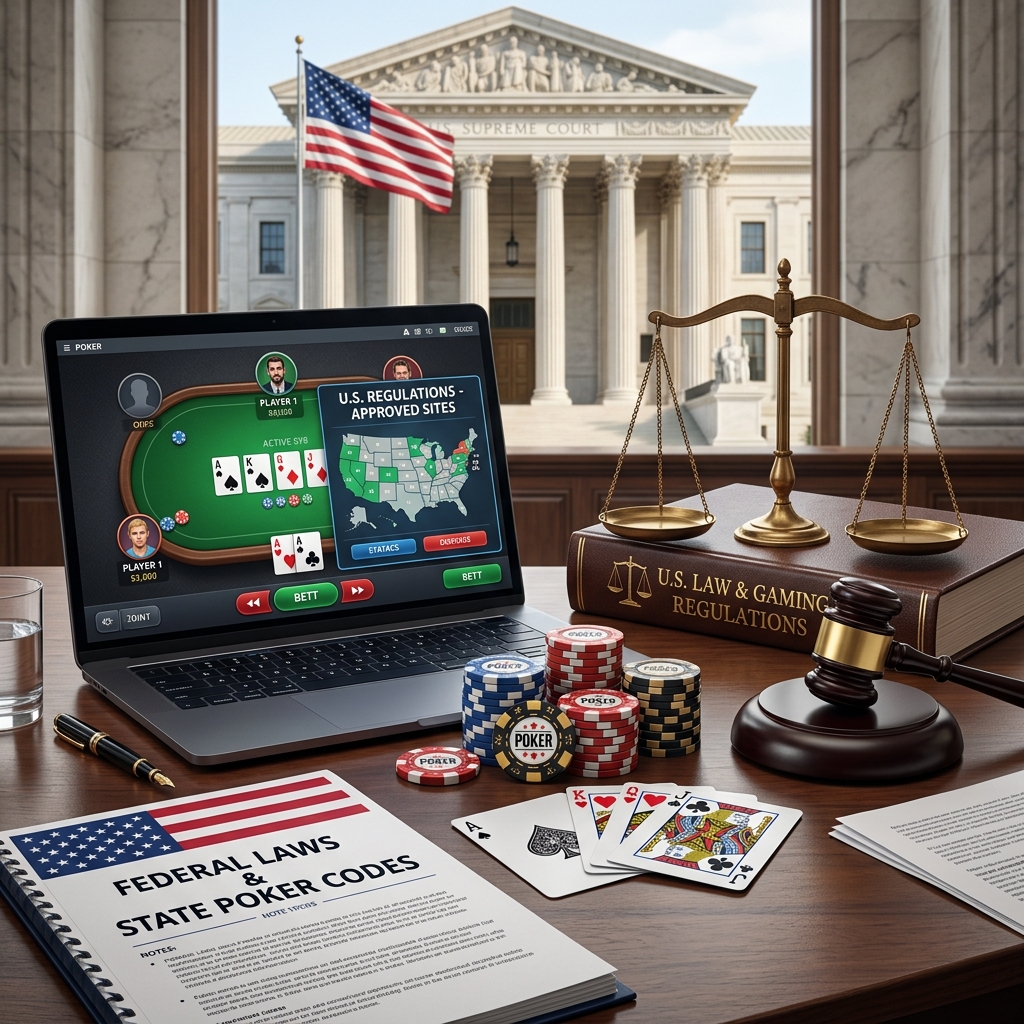
Online poker in the United States sits at the intersection of technology, gambling regulation, and state sovereignty. While there is no single federal law that universally bans or permits online poker nationwide, several federal statutes and a patchwork of state laws collectively determine whether, where, and how Americans can legally play poker on the internet.
This guide explains the key legal concepts behind online poker in the U.S., summarizes which states have legalized and regulate real-money online poker, and offers practical considerations for players who want to participate lawfully and responsibly.
1. How Online Poker Became a Legal Puzzle
The rise of online poker began in the late 1990s and early 2000s, when offshore sites offered real-money games to U.S. players with very little domestic oversight. As participation grew, federal authorities and state regulators faced new questions: Was online poker gambling? Which government had the power to regulate it? And how could laws drafted before the internet era apply to digital card rooms?
Several major legal developments shaped today’s landscape:
- The Wire Act (1961) – Originally aimed at sports betting across state lines, this law prohibits certain interstate transmissions related to gambling. For online poker, it mainly affects the movement of bets and pools between states.
- State authority over gambling – In the U.S., gambling is primarily regulated at the state level. Legislatures decide whether to allow casinos, lotteries, and online games, including poker.
- Recognition of poker’s skill element – In 2012, a federal judge in New York held that poker is predominantly a game of skill rather than chance when interpreting federal gambling laws. While this decision did not transform poker’s status nationwide, it influenced how some policymakers think about the game.
These factors combined to produce today’s system: online poker can be legal, but only under rules set by individual states, and usually restricted to players physically located within those states.
2. Federal Rules: What Washington Actually Controls
Contrary to popular belief, there is no broad federal ban on playing online poker for real money. Instead, federal law targets specific aspects of gambling, especially interstate activity and certain financial transactions.
2.1 The Wire Act and Intrastate Poker
The Wire Act of 1961 was drafted decades before online poker existed. It restricts the use of wires (now interpreted to include electronic communications) to transmit bets or related information across state lines in the context of certain gambling.
The U.S. Department of Justice has clarified that intrastate transactions—activities conducted wholly within a single state—are not covered in the same way. As a result:
- States can authorize online poker within their own borders.
- Licensed sites must keep real-money games limited to players physically located inside the authorizing state.
- Multi-state poker networks are possible only through carefully structured agreements and compliance measures.
2.2 Financial and Consumer Protection Laws
Federal law also influences online poker through regulation of financial transactions and consumer protections. Payment processors, banks, and operators must comply with rules on anti-money laundering, identity verification, and other obligations when handling gambling-related funds.
While these rules do not specifically target poker, they shape how legal operators design their platforms, requiring:
- Robust player identity checks and age verification.
- Clear procedures for deposits and withdrawals.
- Compliance programs aimed at preventing fraud and abuse.
3. State-by-State Legalization: Where Online Poker Is Legal
Because states control most gambling policy, the legality of online poker varies across the country. A limited number of states have chosen to explicitly legalize and regulate real-money poker sites, while others either prohibit or do not address online poker directly.
3.1 States with Legal and Operational Online Poker
As of recent reporting, real-money online poker is both legal and operational in the following states, meaning authorized platforms accept players who are physically present there:
- Delaware
- Michigan
- Nevada
- New Jersey
- Pennsylvania
- West Virginia
These jurisdictions have enacted specific regulatory frameworks, issued licenses to online operators, and set oversight mechanisms to monitor games, protect players, and collect tax revenue.
3.2 States Where Online Poker Is Legal but Not Yet Operating
Some states have passed laws permitting online poker but do not yet have active, licensed sites. Recent coverage notes states such as Arkansas, Connecticut, Maine, and Rhode Island in this category, where legislation exists but platforms have not launched.
In these states, online poker may be legal in principle, but players still lack locally regulated websites to use. Operators may be evaluating market size, regulatory requirements, or technical hurdles before entering.
3.3 States Without Explicit Legalization
In many other states, online poker is neither clearly authorized nor comprehensively regulated. The legal status can range from explicit prohibition to a gray area where laws are silent or ambiguous.
Key points for these states include:
- Some states broadly ban most forms of online gambling, potentially including poker.
- Others focus enforcement on operators rather than individual players, leaving participation risks less defined.
- Players who use offshore sites in such states may face legal or financial risks, including difficulty resolving disputes or withdrawing funds.
3.4 Overview Table: Legal Online Poker by State Category
| State Category | Examples | Legal Status | Player Access |
|---|---|---|---|
| Legal & operational online poker | Delaware, Michigan, Nevada, New Jersey, Pennsylvania, West Virginia | Explicitly legalized and regulated; licenses issued. | Players 21+ may play on licensed sites while inside the state. |
| Legal but not yet operational | Arkansas, Connecticut, Maine, Rhode Island | Laws allow online poker, but platforms not launched. | No practical access to state-licensed poker sites yet. |
| No explicit legalization / mixed rules | Numerous other states | Varies; some prohibit online gambling, others do not address poker specifically. | Players may face legal uncertainty, especially on offshore platforms. |
4. Common Requirements in Legal Online Poker States
Where online poker is licensed and regulated, states generally impose similar basic conditions on both operators and players to protect consumers and comply with federal constraints.
4.1 Age and Location Rules
Across all states with legal online poker markets, two rules are nearly universal:
- Minimum age: 21 years – Players must typically be at least 21 to participate in regulated online poker games.
- Physical presence requirement – You do not need to be a resident of the state, but you must be physically located within its borders while playing.
To enforce these rules, licensed platforms rely on:
- Geolocation technologies to confirm the player’s position.
- Identity verification procedures to confirm age and prevent fraud.
4.2 Licensing and Oversight of Operators
States that authorize online poker issue licenses to companies that operate digital card rooms. These licenses come with regulatory obligations, such as:
- Compliance with technical standards to ensure fair dealing and honest randomization of cards.
- Policies for responsible gambling, including self-exclusion and limit-setting tools.
- Reporting requirements and audits to demonstrate integrity and financial stability.
State gaming commissions or equivalent agencies oversee these operations, investigating complaints and enforcing rules to protect players.
5. Legal vs. Offshore Sites: Risk Considerations
Players in states without regulated online poker sometimes turn to offshore sites hosted outside U.S. jurisdiction. These platforms may accept U.S. players but operate beyond direct state oversight.
5.1 Advantages of Licensed U.S. Sites
Using a state-licensed platform offers several legal and practical benefits:
- Clear legality – Playing on a site authorized by your state reduces legal ambiguity.
- Dispute resolution – Regulators can intervene if there are issues with payouts or game integrity.
- Consumer protections – Operators must adhere to rules on fairness, data security, and responsible gambling.
5.2 Risks of Unregulated and Offshore Platforms
By contrast, offshore or unregulated sites can present meaningful risks:
- Limited or uncertain legal recourse if disputes arise.
- Potential conflicts with state laws that restrict online gambling.
- Less transparent oversight of game fairness and funds security.
For these reasons, players who wish to minimize legal and financial risk generally favor platforms that are clearly licensed by a U.S. state where online poker is legal.
6. Practical Steps to Play Online Poker Legally
For individuals interested in playing online poker while respecting U.S. laws, several practical steps can help ensure lawful participation.
6.1 Confirm Your State’s Rules
Before creating an account on any poker site, start by checking current information about your state:
- Identify whether your state has legalized online poker.
- Determine whether licensed sites are currently operating there.
- Review any age or location requirements posted by state regulators or trusted legal resources.
6.2 Choose a Licensed Platform
Once you know that online poker is legal and active in your state, focus on platforms that clearly show:
- Their state-issued license number and regulatory authority.
- Transparent terms and conditions, including responsible gambling policies.
- Secure payment options and clear information on deposits and withdrawals.
6.3 Complete Verification and Use Safe Practices
Licensed online poker sites typically require players to complete account verification to comply with legal and regulatory standards.
Common steps include:
- Submitting proof of identity, such as a government-issued ID.
- Providing personal details (e.g., date of birth) to confirm age and identity.
- Allowing geolocation checks to confirm physical presence in the authorized state.
Players can further protect themselves by:
- Setting personal deposit and time limits.
- Using secure internet connections and strong passwords.
- Regularly reviewing account statements and game histories.
7. Future Trends in U.S. Online Poker Regulation
The legal landscape for online poker continues to evolve. Some states have recently expanded internet gambling to include casino games, poker, and other offerings, while others have shown little interest in changing existing rules.
Several trends may influence future developments:
- Interstate cooperation – States with legal online poker may explore shared player pools through formal agreements, potentially increasing game variety and liquidity while staying within federal constraints.
- Integration with online casinos – In states that authorize online casino games, poker may be offered alongside slots and table games under a unified regulatory framework.
- Policy debates over revenue and consumer protection – Legislatures continue to weigh tax benefits against concerns about gambling-related harms.
Players and businesses seeking to participate in online poker markets need to monitor state-level legislation and regulatory announcements, as the list of legal jurisdictions can change over time.
8. Frequently Asked Questions (FAQs)
8.1 Is online poker legal everywhere in the United States?
No. Online poker is legal and operational in a limited set of states, including Delaware, Michigan, Nevada, New Jersey, Pennsylvania, and West Virginia. Other states may have legalized poker but not yet launched sites, or may not allow online poker at all.
8.2 Do I have to live in a state where online poker is legal to play there?
Typically, you do not need to be a resident. What matters is your physical location when you play. Licensed operators use geolocation technology to ensure that real-money games are available only to players within state lines.
8.3 What is the usual minimum age to play online poker legally?
In states with regulated online poker markets, the minimum age is commonly 21 years, consistent with broader gambling and casino rules.
8.4 Are offshore online poker sites legal for U.S. players?
The legality of using offshore sites depends on state law and can be complex. Many states focus enforcement on operators rather than players, but offshore platforms may not comply with U.S. regulatory standards or provide reliable legal protections. Players who want to minimize risk usually choose state-licensed sites where online poker is clearly authorized.
8.5 How can I verify that an online poker site is properly licensed?
Reputable online poker platforms typically list their licensing details—such as the name of the issuing state authority and license number—on their websites. Players can cross-check this information with public records or official regulator pages to confirm the site’s authorization.
References
- Online poker — Wikipedia (background reference; not directly cited). 2024-03-10. https://en.wikipedia.org/wiki/Online_poker
- Is Online Poker Legal in the US? (2026 State-by-State Guide) — Worldpokerdeals. 2026-01-15. https://worldpokerdeals.com/is-online-poker-legal-us
- Why location matters when playing poker online: legality by US states — Locance. 2025-09-02. https://www.locance.com/blog/geolocation-matters-when-playing-poker-online-legality-by-us-states/
- Best Online Poker Sites for US Players (2026 Update) — PokerNews. 2026-04-01. https://www.pokernews.com/us-poker/best-us-online-poker-sites.htm
- US Online Poker Sites 2026: Legal Poker Apps & Bonuses — BettingUSA. 2026-03-20. https://www.bettingusa.com/poker/
- U.S. online casinos: Here is where all 50 states currently stand on legalizing internet gambling casino play — CBS Sports. 2024-08-30. https://www.cbssports.com/betting/news/u-s-online-casinos-here-is-where-all-50-states-currently-stand-on-legalizing-internet-gambling-casino-play/
Similar Articles








Read full bio of Sneha Tete


