
Oklahoma Overtime: When Time-And-A-Half Is Required For Workers
A practical guide to overtime pay, exemptions, and employee rights in Oklahoma.
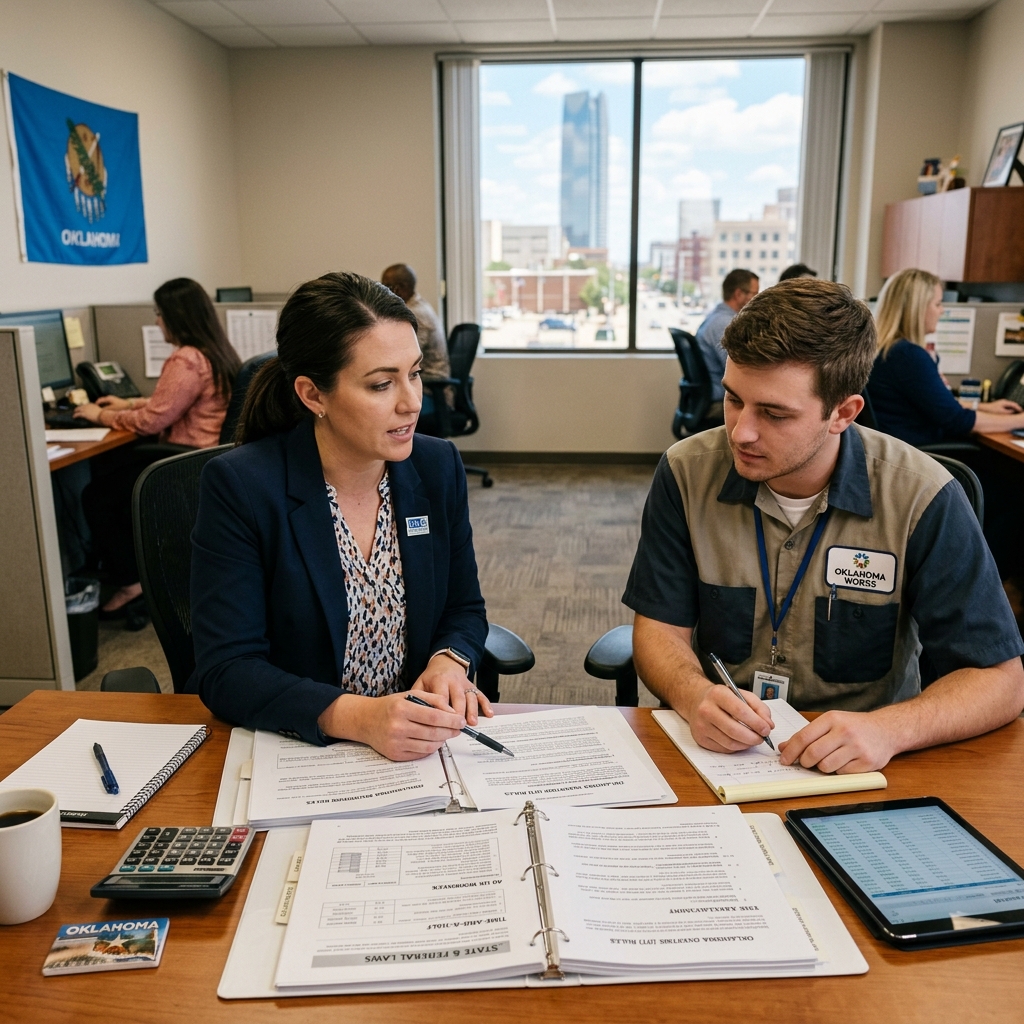
Oklahoma employees often ask when extra hours must be paid at a premium rate, and the answer is rooted in federal law. Because Oklahoma does not have a separate overtime statute that differs from the federal standard, most overtime questions in the state are answered by the Fair Labor Standards Act (FLSA) and the U.S. Department of Labor’s rules.
In practical terms, most non-exempt workers in Oklahoma are owed time-and-a-half when they work more than 40 hours in a single workweek. That rule sounds simple, but the details matter: not every employee qualifies, overtime is measured weekly rather than daily, and the regular rate of pay may include more than a base hourly wage.
How overtime works in Oklahoma
Under the federal overtime framework used in Oklahoma, the key threshold is 40 hours in a seven-day workweek. Once a covered, non-exempt employee crosses that line, the employer generally must pay at least 1.5 times the employee’s regular rate for the extra hours.
This means Oklahoma does not require daily overtime simply because a worker had a long shift. An employee who works 12 hours in one day but stays under 40 hours for the week may not be owed overtime under the standard rule. The law focuses on the total hours worked in the workweek, not on whether the employee exceeded eight hours in a single day.
| Topic | Oklahoma Rule |
|---|---|
| Overtime threshold | More than 40 hours in one workweek |
| Overtime rate | At least 1.5 times the regular rate |
| Daily overtime | Not generally required |
| Governing law | Federal FLSA rules |
Who is covered and who is exempt
Not every worker is entitled to overtime pay. The FLSA creates categories of employees who may be exempt from overtime requirements if they meet the legal tests for exemption. These exemptions are often based on the employee’s job duties, salary level, and manner of compensation.
Common exemption categories include executive, administrative, and professional employees, as well as certain commissioned outside sales workers. Some other workers, such as agricultural employees, workers in private homes, nonprofit volunteers, and some transportation-related employees, may also fall outside the ordinary overtime rules depending on their circumstances.
Because exemptions depend on specific job duties and pay structures, a job title alone is not enough to determine whether overtime applies. An employee labeled “manager” may still be entitled to overtime if the actual duties do not satisfy the exemption standards.
How the regular rate of pay is calculated
Overtime is not always based only on an hourly wage. Federal guidance explains that the regular rate can include multiple forms of compensation, such as certain commissions, nondiscretionary bonuses, and other earnings that are part of the employee’s ordinary pay package.
For workers paid by salary, piece rate, commission, or another non-hourly method, the overtime calculation still has to identify the employee’s regular hourly equivalent before the premium rate is applied. In other words, employers must convert total pay into the correct hourly rate for the week, then add the overtime premium where required.
For example, if an employee receives a salary that covers 40 hours and then works additional hours, the employer may need to determine what portion of the salary represents the regular hourly rate before paying the extra half-time premium for overtime hours.
Comp time in public employment
Some public-sector workers in Oklahoma may receive compensatory time, often called “comp time,” instead of immediate overtime pay. Comp time generally means paid time off earned in place of cash overtime, and Oklahoma’s state guidance recognizes that non-exempt public employees may accrue compensatory time under FLSA-based rules.
This option is not generally available to private-sector employers as a substitute for legally required overtime wages. In private employment, overtime is usually paid in money rather than banked as time off, unless a narrow legal exception applies.
Public employers that use comp time must still follow federal rules about accrual, authorization, and use. The existence of comp time does not erase the employer’s overtime obligations; it changes the form of compensation in limited public employment settings.
Common mistakes employers make
Overtime problems often arise when employers misunderstand the workweek concept or fail to include all compensable hours. A few recurring errors include:
- Counting overtime by day instead of by week
- Leaving bonuses or commissions out of the regular rate
- Assuming salaried employees are always exempt
- Failing to track all hours worked, including off-the-clock time
- Using comp time in the private sector instead of paying wages
Another frequent mistake is believing that an employee’s willingness to work extra hours eliminates the overtime obligation. Under the FLSA, if the employer requires or permits the work, those hours generally must be counted.
What employees should watch for
Employees can protect themselves by keeping their own records of hours worked, schedules, pay stubs, and any messages showing that extra work was requested or accepted. This is especially useful when an employer rounds time entries, uses irregular scheduling, or counts only scheduled hours rather than actual time worked.
Workers should also review whether their pay includes items that may affect the overtime rate, such as nondiscretionary bonuses or commissions. If the employer calculated overtime using only base pay when other earnings should have been included, the worker may have been underpaid.
If a worker believes overtime was miscalculated, the first step is often to compare the hours worked in a single seven-day workweek with the amount paid on the relevant paycheck. If the numbers do not match the legal standard, the worker may want to raise the issue promptly with payroll, human resources, or a legal adviser.
Overtime and the minimum wage connection
Oklahoma follows the federal minimum wage standard, and overtime calculations build on that wage structure. That means an employee who is legally entitled to overtime must receive at least one and one-half times the regular rate, even if the worker is already being paid at or above the minimum wage.
Minimum wage and overtime are related but separate concepts. A worker can earn the minimum wage and still be entitled to overtime, or earn more than minimum wage and still be owed overtime if the employee is non-exempt and works past 40 hours in the week.
When overtime is due and when it is paid
Federal guidance says overtime earned in a workweek is normally paid on the regular payday for the pay period in which the wages were earned. Employers therefore should not delay overtime payment simply because the hours were worked in a prior pay cycle if the wages are already due under the applicable payroll schedule.
The FLSA also makes clear that overtime does not depend on whether the extra hours were worked on a weekend, a holiday, or a day off. The core issue remains the total number of hours worked during the workweek.
Quick comparison of exempt and non-exempt work
| Employee type | Overtime eligibility | Typical basis |
|---|---|---|
| Non-exempt employee | Usually eligible after 40 hours | Hourly, salary, or other pay with overtime rules applied |
| Executive employee | Often exempt if tests are met | Usually salaried and duty-based |
| Administrative employee | Often exempt if tests are met | Salary and primary duty considerations |
| Professional employee | Often exempt if tests are met | Advanced knowledge or specialized work |
This table is only a general guide. The actual legal test is more detailed, and employers should analyze the employee’s duties and compensation before deciding whether overtime is owed.
Frequently asked questions
Does Oklahoma require overtime after eight hours in a day?
No. The general rule used in Oklahoma is weekly, not daily. Overtime is usually triggered only after more than 40 hours in a single workweek.
Can a salaried employee get overtime?
Yes. Salary alone does not automatically make a worker exempt. If the employee does not meet an overtime exemption, the worker may still be entitled to overtime pay even if paid a salary.
Does an employer have to pay overtime for weekend work?
Not just because the work was done on a weekend. Overtime depends on the total number of hours worked in the week, not the day of the week.
Can a private employer offer comp time instead of overtime pay?
Generally no. Compensatory time is recognized for certain public-sector employees, but private employers ordinarily must pay overtime wages when required.
What if the employer did not count bonuses correctly?
Because the regular rate can include certain bonuses and commissions, an incorrect calculation may understate overtime pay. Employees should review pay records carefully if compensation includes more than base wages.
Why the workweek definition matters
The legal workweek is a fixed and recurring period of 168 hours, or seven consecutive 24-hour days. Employers can choose when that week begins, but once established, the chosen schedule controls overtime calculations unless it is changed lawfully and consistently.
This detail matters because shifting one extra shift from one week to another can change whether overtime is owed. For workers with irregular schedules, the workweek definition can make the difference between ordinary wages and premium pay.
Understanding the workweek also helps explain why two employees working the same total number of hours in different patterns may have different overtime outcomes. The legal standard is not simply how many hours were worked over several days, but how those hours fall within the defined seven-day period.
Practical steps if overtime seems wrong
If overtime appears to be missing or underpaid, start by gathering the facts. Compare time records, pay stubs, work schedules, and any messages about after-hours tasks or extra shifts. Then confirm whether the employee is truly exempt or non-exempt under the FLSA.
If the issue appears to involve a misclassification, an incorrect regular rate, or unpaid hours, the employee may need to speak with the employer first or seek outside advice. Wage and hour disputes often turn on small details, so a careful record review can make a major difference.
Employers, for their part, reduce risk by classifying workers correctly, maintaining accurate records, and paying overtime when required. In a state like Oklahoma, where federal overtime law governs most cases, compliance depends on applying the FLSA correctly from the start.
References
- Oklahoma Overtime Laws — FindLaw. n.d. https://www.findlaw.com/state/oklahoma-law/oklahoma-overtime-laws.html
- Oklahoma Overtime Laws — WorkforceHub. n.d. https://www.workforcehub.com/hr-laws-and-regulations/oklahoma/oklahoma-overtime-laws/
- Oklahoma.gov Fair Labor Standards Act Overview — Oklahoma Office of Management and Enterprise Services. n.d. https://oklahoma.gov/content/dam/ok/en/omes/documents/FLSA.pdf
- Fact Sheet #23: Overtime Pay Requirements of the FLSA — U.S. Department of Labor, Wage and Hour Division. 2008-07-24. https://www.dol.gov/agencies/whd/fact-sheets/23-flsa-overtime-pay
- Fair Labor Standards Act — Oklahoma Office of Management and Enterprise Services. n.d. https://oklahoma.gov/content/dam/ok/en/omes/documents/FLSA.pdf
- Overtime Pay — U.S. Department of Labor, Wage and Hour Division. n.d. https://www.dol.gov/agencies/whd/overtime
Similar Articles








Read full bio of Sneha Tete




