
Ohio School Backpack Searches and the Fourth Amendment
How an Ohio Supreme Court ruling reshaped the balance between student privacy rights and school safety in backpack searches.
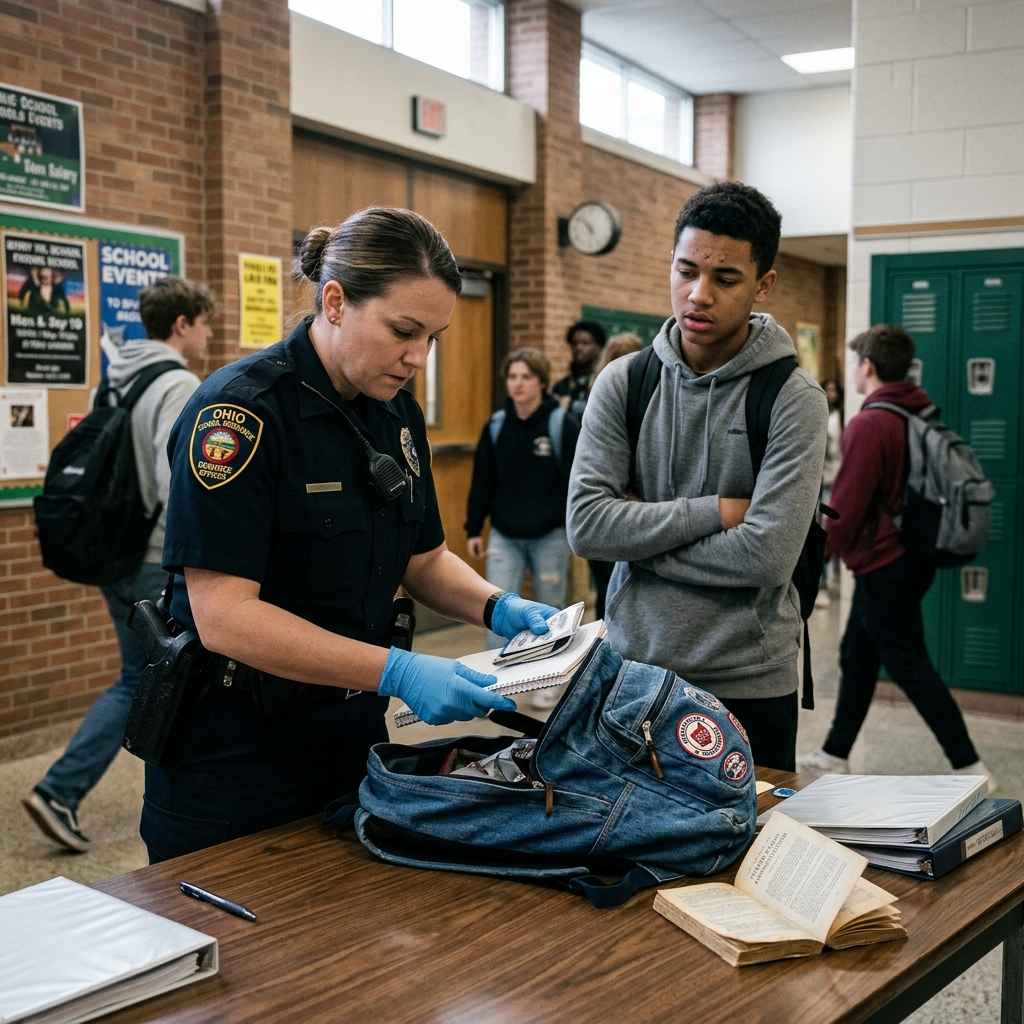
The Supreme Court of Ohio has upheld a school district’s warrantless search of a student’s unattended backpack, ruling that the search was reasonable under the Fourth Amendment because it followed a safety protocol designed to protect students from harm. This decision highlights how courts balance student privacy against the need for secure school environments in an era of heightened concern about weapons on campus.
Understanding this ruling requires a look at constitutional search standards, the special rules that apply in schools, and what this means for students, families, and administrators in Ohio and beyond.
Background: The Case Behind Ohio’s Backpack Ruling
The decision centers on a student whose unattended book bag was found on a school bus and then searched by school personnel following a district safety protocol. Inside the bag, staff discovered ammunition, which led them to search another bag associated with the same student and ultimately find a handgun.
The student argued that these warrantless searches violated his Fourth Amendment rights and moved to suppress the evidence, contending that school officials needed a warrant or stronger justification. The intermediate appellate court agreed with the student initially, but the Supreme Court of Ohio unanimously reversed that decision, holding that the search protocol and its execution were constitutionally reasonable.
Key Elements of the Situation
- An unattended backpack was discovered on a school bus.
- School staff followed a pre-established protocol requiring searches of unattended bags to identify the owner and check for dangerous items.
- During the search, ammunition was found, prompting further searches connected to the same student.
- A handgun was later discovered in a different bag belonging to the student.
- The student challenged the searches as unconstitutional under the Fourth Amendment.
The Ohio Supreme Court evaluated both the protocol and its application, focusing on whether the searches were reasonable given the school’s safety responsibilities.
The Fourth Amendment and School Searches: Core Principles
The Fourth Amendment to the U.S. Constitution protects people from unreasonable searches and seizures by the government. In general, this protection requires warrants supported by probable cause before law enforcement may search a person or their belongings.
Schools operate differently. The U.S. Supreme Court in New Jersey v. T.L.O. held that the Fourth Amendment applies to public school officials, but they do not need warrants or full probable cause to search students. Instead, school searches are judged under a more flexible standard: overall reasonableness under the circumstances.
The T.L.O. Reasonableness Test
In New Jersey v. T.L.O., the U.S. Supreme Court adopted a two-part test to evaluate school searches.
- Justified at inception: School officials must have reasonable suspicion that a student violated a law or school rule, or that a search is necessary to maintain order or safety.
- Reasonable in scope: The search must be related to the objectives that justified it and must not be excessively intrusive in light of the student’s age, sex, and the nature of the suspected infraction.
Reasonable suspicion is a lower standard than probable cause, allowing school officials more flexibility in responding quickly to potential threats or misconduct.
Student Privacy Versus School Safety
Courts recognize that students retain some expectation of privacy at school, but this expectation is reduced compared to adults outside the school context. Student rights must be balanced against the school’s interest in maintaining an orderly environment and protecting students from harm.
- Students have a legitimate interest in keeping personal items private.
- Schools have a compelling interest in preventing weapons, drugs, and other dangerous items from entering campus.
- Because schools act as agents of the state, their actions are subject to the Fourth Amendment.
Ohio’s backpack ruling applies these broader principles in a context where unattended property and potential weapons intersect.
Ohio’s Ruling: Why the Backpack Search Was Held Constitutional
The Supreme Court of Ohio framed the case around two key questions: whether the school’s protocol for searching unattended bags serves a compelling governmental interest, and whether the student’s expectation of privacy in an unattended backpack is significantly diminished.
Compelling Interest in School Safety
The court emphasized that schools have a compelling interest in protecting students from physical harm, including threats posed by weapons and other dangerous items. In its analysis, the court noted that contemporary concerns about school shootings and campus violence make proactive safety measures, such as protocols for checking unattended bags, legally significant.
Because unattended bags could conceal weapons or hazardous materials, a school policy requiring limited searches to identify the owner and verify the safety of contents directly serves this protective interest.
Diminished Privacy in Unattended Property
The Ohio Supreme Court stressed that a student’s expectation of privacy is greatly reduced when they leave a backpack unattended on a school bus or elsewhere on school grounds. In this context, the bag is separated from its owner, increasing the risk that its contents could pose danger to others.
Under Ohio law, property left unattended in a public setting may even be treated as abandoned, which significantly reduces privacy protections. Although the court did not rely solely on abandonment doctrine, it drew on the notion that leaving a bag unattended alters the balance of privacy and safety concerns.
| Context | Student Privacy Expectation | School Safety Concern |
|---|---|---|
| Backpack kept with student in classroom | Moderate expectation of privacy; search usually requires reasonable suspicion. | Safety concern present, but bag location is controlled and visible. |
| Unattended backpack on bus or hallway | Greatly diminished expectation of privacy, particularly under safety protocols. | Heightened safety concern due to unknown ownership and contents. |
Reasonableness of the Search Protocol Itself
The court examined the school’s written protocol, which directed staff to search unattended book bags for two limited purposes: to identify the owner and to ensure that the contents were not dangerous.
Because the protocol was narrowly tailored to these safety-related objectives and did not authorize broad or exploratory searches unrelated to safety, the court found it reasonable under the Fourth Amendment. When staff followed the protocol by checking the bag for identifying information and dangerous items, they stayed within constitutional limits.
Application of T.L.O. in Ohio’s Decision
Although T.L.O. primarily addresses searches based on reasonable suspicion, the Ohio court’s decision extends the reasonableness analysis to safety protocols for unattended items. The search was justified not by suspicion of wrongdoing by a particular student, but by the school’s broader obligation to ensure that unattended bags do not contain dangerous items.
In this framework:
- Justification: The presence of an unattended bag on a bus created a safety concern and triggered the protocol.
- Scope: Staff limited the search to what was necessary to identify the owner and check for dangerous contents, not for general evidence-gathering.
The court concluded that, as executed, the search was reasonable and did not violate the Fourth Amendment.
Implications for Ohio Schools, Students, and Families
The ruling carries practical consequences for how schools create and implement search policies, and how students and parents understand privacy rights in school environments.
What This Means for School Administrators
Administrators in Ohio can take the decision as validation of carefully crafted search protocols that prioritize safety and limit discretion.
- Schools may adopt written policies allowing searches of unattended backpacks to identify their owners and confirm contents are safe.
- Protocols should clearly state limited purposes and avoid broad exploratory language.
- Training staff on when and how to apply such policies is essential to remain within constitutional bounds.
- Documenting protocols and implementation can help defend searches if challenged in court.
Beyond unattended bags, the decision reinforces the importance of linking any search policy to student safety, not general surveillance.
What This Means for Students
Students should understand that their bags and belongings are subject to school search policies, especially when left unattended.
- Leaving a backpack unattended reduces privacy protections and increases the likelihood that school officials may lawfully search it under safety protocols.
- Searches of items kept with the student typically require reasonable suspicion or consent, though the standard is still lower than probable cause.
- School officials must keep searches reasonably related to their purpose and avoid overly intrusive methods.
Students in Ohio can consult guidance materials on school searches to better understand their rights and the limits of school authority.
Guidance for Parents and Guardians
Families may wish to discuss school search policies with their children so they are prepared if a search occurs.
- Review district policies on searches of lockers, bags, and electronic devices.
- Explain that school officials can search student belongings without a warrant in certain situations.
- Encourage children not to leave backpacks unattended and to comply respectfully with lawful search requests.
- Advise students to ask reasonable questions during a search, such as what officials are looking for and why.
The Ohio Bar Association recommends that students comply with school searches but seek clarification and, if necessary, legal advice afterward.
Comparisons and Broader Trends in School Search Law
Ohio’s approach fits within a wider pattern of courts allowing warrantless school searches when they are closely connected to safety and constrained by clear policies.
Other Examples of Safety-Based School Searches
- Courts have upheld backpack searches carried out under individualized safety plans created after prior student misconduct, emphasizing that such plans are tailored to prevent future harm.
- Legal analyses show that school administrators may search student belongings without probable cause as long as the search is reasonable at its inception and in scope.
These decisions indicate judicial recognition that schools have unique responsibilities that sometimes justify searches that would be impermissible in other settings.
Lockers, Phones, and Other Belongings
While Ohio’s case concerns backpacks, similar principles apply to lockers and electronic devices.
- Lockers may be subject to periodic or random inspections if school policy clearly informs students that lockers are school property and may be searched.
- Searches of student phones generally require stronger justification and should be limited to situations where officials reasonably believe the device contains evidence of a safety threat.
Schools should apply the same two-part reasonableness test—justification and scope—across all types of searches.
Practical Tips for Building Constitutional Search Protocols
For districts seeking to update or refine search policies in light of the Ohio decision, several practical guidelines can help align procedures with constitutional standards.
Key Design Principles for School Search Policies
- Connect policies to safety: Clearly state that search protocols aim to prevent harm and protect students, not to conduct broad surveillance.
- Define triggers and procedures: Explain when searches are permissible (for example, unattended bags, reasonable suspicion of rule violations, emergencies).
- Limit scope: Specify that searches should be no more intrusive than necessary to serve the safety or disciplinary objective.
- Provide notice: Include search provisions in student handbooks and discuss them with staff, students, and parents.
- Train personnel: Offer regular training so staff understand legal standards and how to document searches appropriately.
By following these principles, schools can strengthen safety while respecting student rights and reducing legal risk.
Frequently Asked Questions (FAQs)
1. Can Ohio schools search my backpack without a warrant?
Yes, in certain circumstances. Public school officials in Ohio do not need a warrant to search a student’s backpack, but the search must be reasonable under the Fourth Amendment. Reasonableness is assessed based on justification (such as safety concerns or reasonable suspicion of rule violations) and scope.
2. What happens if I leave my backpack unattended at school?
If your school has a safety protocol like the one approved by the Ohio Supreme Court, staff may lawfully search an unattended backpack to identify its owner and check for dangerous items. Your expectation of privacy is reduced when you leave your bag unattended, particularly on school buses or in common areas.
3. Are school officials considered law enforcement for Fourth Amendment purposes?
Public school officials are treated as state actors when they conduct searches, meaning the Fourth Amendment applies to their actions. However, they operate under a special standard that does not require warrants or probable cause, but instead focuses on overall reasonableness in light of school safety and discipline.
4. Can a school search my phone the same way as my backpack?
Courts are generally more cautious with phone searches because of the sensitive personal information devices contain. A school may search a phone when there is reasonable belief that the device holds information about a serious safety threat, and the search must be limited to that purpose. Routine or exploratory searches of phones without a strong safety justification are discouraged.
5. What should I do if I believe a school search violated my rights?
You may wish to document what happened, including who conducted the search, what they were looking for, and whether they explained their reasons. In Ohio, guidance from legal organizations suggests complying with search instructions but later consulting an attorney or legal aid if you believe the search was unlawful.
Summary: The Evolving Balance Between Safety and Privacy
The Ohio Supreme Court’s ruling on warrantless backpack searches reinforces a broader trend in school law: courts allow flexible, safety-driven search protocols as long as they are limited in purpose and executed reasonably. Students retain constitutional rights in school, but those rights are shaped by the reality that schools must respond quickly to potential threats and maintain a secure learning environment.
For Ohio schools, the decision provides guidance on how to structure policies around unattended property and other safety concerns. For students and parents, it underscores the importance of understanding how privacy expectations shift in the school setting and how constitutional protections operate differently than they do outside the classroom.
References
- Book Bag Search that Led to Discovery of Gun at School Was Constitutional — Supreme Court of Ohio / Court News Ohio. 2017-05-11. https://www.courtnewsohio.gov/cases/2017/SCO/0511/160271.asp
- State v. Polk, 2017-Ohio-2735 (Slip Opinion) — Supreme Court of Ohio. 2017-05-11. https://www.supremecourt.ohio.gov/rod/docs/pdf/0/2017/2017-ohio-2735.pdf
- Ohio Court Upholds Search of Unattended Backpack — Education Week. 2017-05-23. https://www.edweek.org/leadership/ohio-court-upholds-search-of-unattended-backpack/2017/05
- Supreme Court of Ohio Supports School’s Bag Search in Legal Assistance Fund Case — Ohio School Boards Association. 2017-05-12. https://www.ohioschoolboards.org/blogs/legal-ledger/supreme-court-ohio-supports-schools-bag-search-legal-assistance-fund-case
- Facts and Case Summary: New Jersey v. T.L.O. — Administrative Office of U.S. Courts. 2019-01-01 (educational resource). https://www.uscourts.gov/about-federal-courts/educational-resources/educational-activities/fourth-amendment-activities/new-jersey-v-tlo/facts-and-case-summary-new-jersey-v-tlo
- What Are My Rights During School Searches? — Ohio State Bar Association. 2018-01-01. https://www.ohiobar.org/globalassets/my-ohio-rights/docs-and-pdfs/school-searches.pdf
- An Overview of the Law of Searches by School Administrators — Committee for Public Counsel Services (Massachusetts). 2012-01-01. https://www.publiccounsel.net/wp-content/uploads/2014/08/school-search-and-seizure.pdf
- To Search or Not to Search? — National Association of Elementary School Principals. 2016-09-01. https://www.naesp.org/resource/to-search-or-not-to-search/
Similar Articles








Read full bio of medha deb




