
Off-the-Clock Work: What Employees and Employers Must Know
Understand why unpaid off-the-clock work is treated as wage theft, when it is illegal, and how to protect your rights under U.S. labor laws.
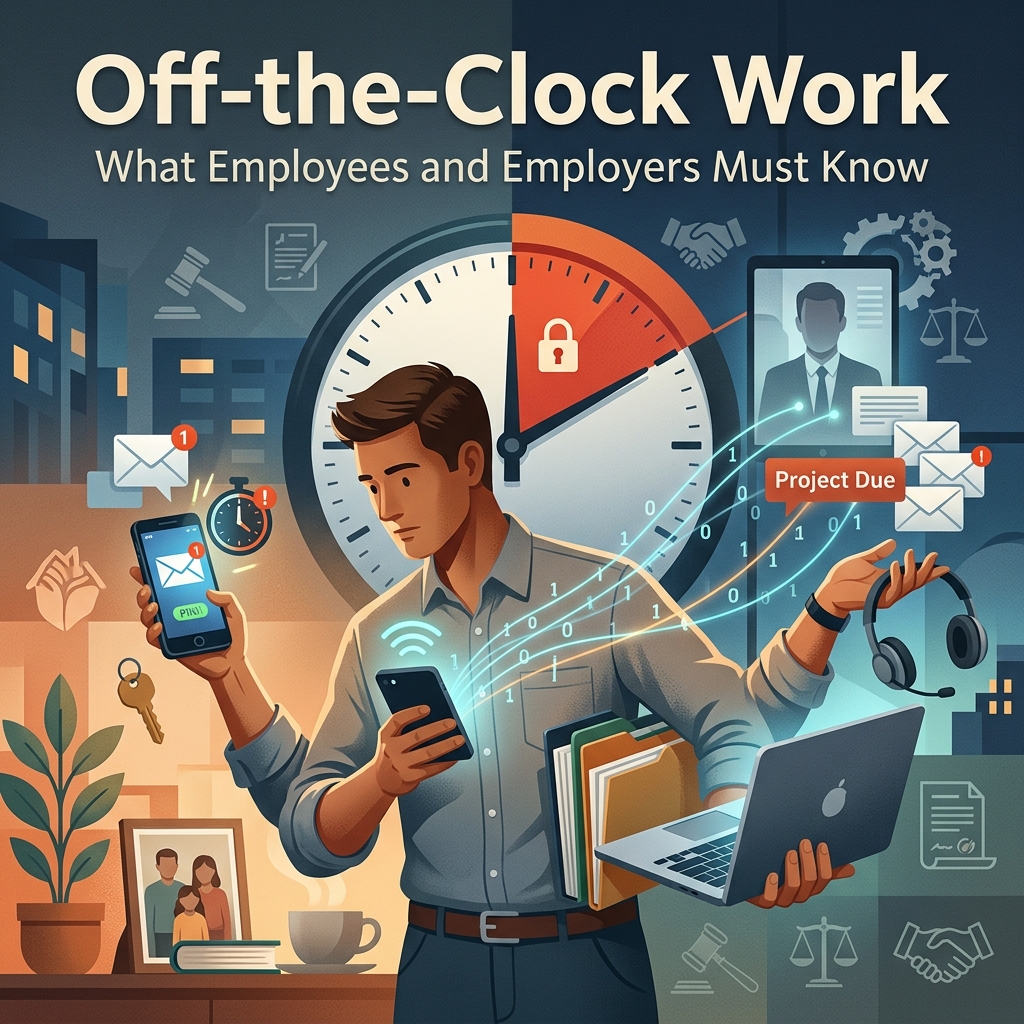
Off-the-clock work is a common but risky practice in many workplaces. When employees perform job-related tasks without being clocked in or properly paid, it can amount to unlawful wage theft and expose employers to significant liability under U.S. federal and state wage laws.
This article explains what off-the-clock work is, why it is usually illegal for non-exempt workers, how overtime fits in, and what practical steps both employees and employers can take to handle these situations responsibly.
What Does “Off-the-Clock” Work Mean?
At its core, off-the-clock work refers to any job-related activity performed without recording the time and without pay for those minutes or hours. Under the Fair Labor Standards Act (FLSA), employers must pay covered non-exempt employees for all hours worked, which includes time when employees are on duty or otherwise “suffered or permitted” to work for the employer’s benefit.
- On duty or required to be present: Time spent on the employer’s premises or a required work site.
- Work the employer allows or benefits from: Even if not explicitly ordered, if the employer knows or should know that work is being done, it generally must be paid.
- Non-recorded tasks: Work before clocking in, after clocking out, or outside standard systems (such as informal “volunteer” work that clearly benefits the business).
In legal terms, the notion of being “suffered or permitted” to work means that employers cannot simply turn a blind eye to extra hours and later claim they did not authorize them. If the work was allowed to happen and benefited the business, it must be counted as hours worked and compensated.
Typical Examples of Off-the-Clock Work
Off-the-clock work can occur in almost any industry, but it tends to appear in specific patterns. Below are everyday examples that frequently raise legal concerns.
- Pre-shift preparation – Changing into mandatory uniforms, setting up equipment, or preparing workstations before the official start time.
- Post-shift cleanup or closing – Completing closing procedures, cleaning, or balancing cash registers after employees have already clocked out.
- Unpaid training or meetings – Attending mandatory training sessions, staff meetings, or briefings without the time being logged or paid.
- After-hours communications – Responding to work emails, messages, or calls at home when those tasks are part of job duties.
- Travel between job sites – Driving from one assigned location to another during the day without compensation for that travel time.
While small increments of time may seem trivial, they add up. Regular 10- or 15-minute unpaid tasks can generate substantial unpaid hours over weeks or months, especially when they push total work time beyond forty hours in a week.
Non-Exempt vs. Exempt Employees
The legal consequences of off-the-clock work differ sharply based on whether a worker is classified as non-exempt or exempt under the FLSA.
| Classification | Typical Pay Structure | Overtime Requirement | Effect of Off-the-Clock Work |
|---|---|---|---|
| Non-exempt | Hourly wages; often lower to mid-range positions | Must receive at least 1.5 times regular rate for hours over 40 per week | Unpaid off-the-clock work is generally illegal; employers must pay for all hours worked and any owed overtime. |
| Exempt | Salaried; often executive, administrative, or professional roles | Not entitled to statutory overtime under FLSA | Employers may legally require work beyond 40 hours with no extra pay, as long as salary meets legal standards and classification is correct. |
Most off-the-clock disputes involve non-exempt employees. For them, off-the-clock time is typically unlawful precisely because it is unpaid time that should be counted toward minimum wage and overtime calculations.
How Overtime Law Interacts with Off-the-Clock Work
Under federal law, covered non-exempt workers must receive at least time-and-a-half (1.5 times their regular rate of pay) for all hours worked beyond 40 in a workweek. When off-the-clock work pushes an employee over that threshold, the unpaid time often triggers both minimum wage and overtime violations.
Key points about overtime and off-the-clock work include:
- All hours count – Employers must include off-the-clock work in total hours worked, whether or not those hours were officially “authorized.”
- Unauthorized overtime is still payable – Employers can discipline employees for violating internal policies but typically cannot refuse to pay for work actually performed.
- State rules may be stricter – Some states, such as California, require overtime after a certain number of hours per day (e.g., beyond eight) and may impose double-time rates in some situations.
Because overtime is a major cost driver, some businesses try to curb expenses by informal practices that encourage unpaid extra work. These strategies often lead directly to illegal off-the-clock arrangements.
Is Off-the-Clock Work Illegal?
For most non-exempt employees, working off the clock is effectively illegal in the sense that employers must pay for all hours worked and cannot lawfully avoid wages and overtime by keeping those hours off the books. FLSA enforcement treats unpaid compensable work as wage violations, and many states explicitly outlaw requiring employees to work off the clock.
However, it is important to distinguish between who is violating the law:
- Employer liability – The employer is generally the party legally responsible for failing to record and pay for all hours worked.
- Employee conduct – Employees themselves are not usually subject to criminal penalties for simply performing unpaid work, but they may face workplace consequences such as discipline or termination.
In short, off-the-clock work is typically not a crime for the worker, but it is often a breach of wage and hour laws for the employer, and courts may force employers to pay back wages, overtime, and sometimes additional damages.
Federal and State Legal Framework
The main federal law governing off-the-clock work is the Fair Labor Standards Act (FLSA), which requires that covered non-exempt employees receive at least the minimum wage and overtime for hours over 40. It defines “hours worked” broadly to capture all time the employee must be on duty or is allowed to work.
Many states have adopted wage and hour laws that are equal to or more protective than the FLSA. For example:
- California – Employers must pay for all time they know or should know an employee is working, even if that time was not formally authorized, and they may owe overtime after 8 hours in a day or 40 in a week.
- Minnesota – Off-the-clock work is treated as wage theft under state law, and employers must compensate employees for tasks performed outside scheduled hours if they are for the employer’s benefit.
Because state-specific rules can vary, employees and employers should check both federal and local law when evaluating off-the-clock practices.
Consequences for Employers
Employers who allow or require off-the-clock work without proper pay may face substantial legal and financial consequences.
- Back wages – Courts can order payment of unpaid hours and overtime going back up to several years, depending on the statute of limitations and whether violations were willful.
- Liquidated or double damages – In many cases, employees may recover an additional amount equal to the unpaid wages as liquidated damages.
- Government investigations – Complaints filed with the U.S. Department of Labor or state agencies can trigger audits and broader enforcement actions.
- Attorney’s fees and costs – Employers may be required to pay the legal fees of employees who successfully sue for wage violations.
- Reputational harm – Persistent off-the-clock practices can damage an organization’s reputation and make recruitment and retention more difficult.
These risks give employers a strong incentive to actively prevent unpaid off-the-clock work through clear policies, training, and accurate timekeeping systems.
Practical Steps for Employees
Employees who suspect they are performing off-the-clock work without pay can take several steps to protect their rights and build a clear record.
- Document your time – Keep a personal log of dates, start and end times, and tasks performed off the clock. Save emails, messages, schedules, or instructions that show work expectations.
- Compare with pay records – Review pay stubs and timesheets to identify gaps between actual hours worked and recorded hours.
- Raise the issue internally – When safe to do so, speak with a supervisor or HR and ask for clarification on pay for specific tasks. Written communication can help create a record.
- Seek legal advice – If the problem persists or is widespread, consult an employment attorney familiar with wage and hour law in your state.
- Consider filing a complaint – In some cases, employees may file complaints with the U.S. Department of Labor’s Wage and Hour Division or relevant state agencies.
Because every situation is fact-specific, professional legal advice is crucial before taking formal action or deciding whether to join or start a lawsuit.
Best Practices for Employers
From the employer perspective, preventing off-the-clock problems is both a legal necessity and a way to build trust. Effective controls usually combine clear policies with practical oversight.
- Written timekeeping policies – Establish that all work time must be recorded, and explicitly prohibit off-the-clock work for non-exempt employees.
- Training for managers – Supervisors should understand that they cannot ask or allow employees to “help out” off the clock or ignore extra hours because they were “unauthorized.”
- Reliable systems – Use time clocks, software, or other mechanisms that make recording all work time straightforward and consistent.
- Monitor workloads – Unrealistic staffing or deadlines can encourage unpaid extra work. Adjust staffing levels or schedules to match the actual demand.
- Respond quickly to complaints – Take employee concerns about unpaid time seriously, audit records, and correct any issues promptly, including paying back wages when necessary.
When employers show that they are actively working to comply with wage laws, they not only reduce legal exposure but also foster a culture of fairness and transparency.
FAQs About Off-the-Clock Work
Do I have to be paid for work I do before clocking in or after clocking out?
If the tasks are part of your job and your employer knows or should know you are performing them, those minutes generally count as hours worked and must be paid for non-exempt employees.
Can my employer say the extra time was “unauthorized” and refuse to pay?
Employers may enforce policies against unauthorized overtime, but they usually cannot refuse to pay for work you actually performed for their benefit. They can discipline you for violating policies, but they still must pay for the time.
Is off-the-clock work ever legal?
For exempt employees who are properly classified, employers can require work beyond 40 hours a week without extra pay, as long as the salary and job duties meet FLSA criteria. For non-exempt workers, unpaid off-the-clock work is generally a violation of wage and hour laws.
What should I do if I think I am a victim of wage theft?
Document your hours and tasks, review your pay records, and consider speaking with both your employer and an experienced employment lawyer. Depending on the circumstances, you may have claims for unpaid wages and overtime.
Can multiple employees sue together over off-the-clock practices?
Yes. If off-the-clock work is widespread, employees may bring collective or class actions under the FLSA or state law, seeking back wages and other remedies for everyone affected.
References
- Off-the-Clock References — U.S. Department of Labor, Wage and Hour Division. 2023-03-01. https://www.dol.gov/agencies/whd/flsa/off-the-clock
- California Off-The-Clock Work Law — Gibbs Law Group LLP. 2024-01-15. https://www.classlawgroup.com/california-off-the-clock-work-law
- Off-the-Clock Work: What You Need to Know About Your Rights — Nichols Kaster, PLLP. 2025-06-10. https://www.nka.com/news-articles/2025/june/off-the-clock-work-what-you-need-to-know-about-y/
- Legal Consequences of Working off the Clock — Applied Legal Insight. 2023-09-20. https://appliedlegalinsight.com/practice-areas/legal-consequences-of-working-off-the-clock/
- Is Working Off the Clock Illegal? — Employment and Commerce Law Group. 2022-11-05. https://eclaw.com/unpaid-overtime-lawyer/working-off-the-clock/
Similar Articles








Read full bio of Sneha Tete




