
Obama’s Constitutional Legacy: 6 Key Precedents, Controversies
Examining the transformative legal precedents set by President Obama's administration on executive power, civil rights, and national security.
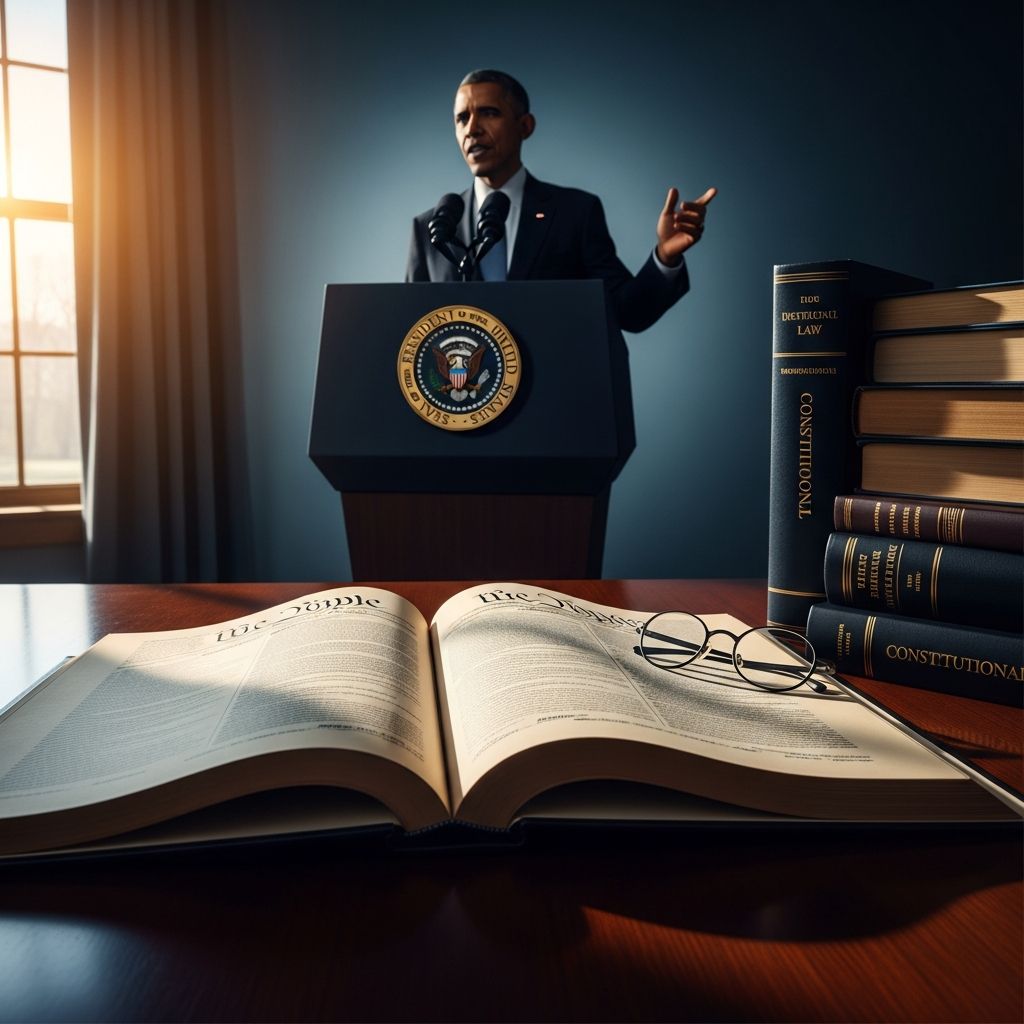
President Barack Obama’s two terms in office from 2009 to 2017 left an indelible mark on American constitutional law. His administration pushed the boundaries of executive authority, influenced landmark Supreme Court decisions, and sparked debates over the separation of powers that continue to resonate. This article explores the major precedents, weighing achievements against criticisms from legal scholars and courts.
Expansion of Executive Authority in Immigration Policy
One of the most debated aspects of Obama’s legacy involves his use of executive orders to address immigration. In 2014, Obama announced Deferred Action for Parents of Americans (DAPA) and expanded Deferred Action for Childhood Arrivals (DACA), offering temporary relief from deportation to millions of undocumented immigrants. These measures prioritized enforcement against public safety threats while deferring action for others, drawing on longstanding prosecutorial discretion principles affirmed by the Supreme Court in cases like Arizona v. United States.
Supporters, including over 100 immigration law professors and the Congressional Research Service, argued these actions fell within the president’s constitutional duty to faithfully execute laws passed by Congress, which had not mandated removal of every removable alien. Historical precedents, such as deferred action after Hurricane Katrina in 2005 and parole for those fleeing disasters, bolstered this view.
Critics, however, saw DAPA as an unconstitutional overreach, violating the Take Care Clause of Article II, which requires the president to enforce laws without suspending them. Stanford Law scholars likened it to royal dispensing powers rejected in English common law cases like the Case of Proclamations. The Fifth Circuit and Supreme Court ultimately blocked DAPA, highlighting limits on executive lawmaking.
| Perspective | Key Argument | Supporting Precedent |
|---|---|---|
| Pro-Executive Action | Prosecutorial discretion allows prioritization | Arizona v. US (2012) |
| Anti-Executive Action | Violates Take Care Clause; equates to legislation | Steel Seizure Case (1952) |
Military Interventions and War Powers Controversies
Obama’s approach to military engagements further tested constitutional boundaries. The 2011 Libya intervention stands out: without congressional authorization, the administration conducted missile strikes and air missions, claiming they constituted ‘kinetic military action’ rather than ‘war,’ thus evading the War Powers Resolution of 1973. This echoed claims by prior presidents that the resolution unconstitutionally limits executive commander-in-chief powers under Article II.
Legal analysts from the Cato Institute criticized this as a violation of checks and balances, noting every president since 1973 has challenged the law, but Obama’s reframing escalated the imperial presidency trend. The Heritage Foundation documented broader patterns of unilateral action, arguing Obama abdicated duties like defending laws in court, as seen in the administration’s refusal to enforce the Defense of Marriage Act (DOMA) before its 2013 invalidation.
- Libya Operation: 2011 airstrikes without 60-day congressional notice.
- Drone Strikes: Expanded targeted killings, raising due process questions for U.S. citizens abroad.
- Syria Airstrikes: Later actions continued the pattern of executive-led engagements.
These moves set precedents for future presidents, prioritizing executive flexibility in national security over legislative oversight.
Recess Appointments and Administrative Overreach
Obama’s 2012 recess appointments to the National Labor Relations Board (NLRB) and Consumer Financial Protection Bureau (CFPB) were ruled unconstitutional by federal courts. The Supreme Court unanimously held in NLRB v. Noel Canning (2014) that the appointments during a brief pro forma Senate session violated the Recess Appointments Clause, which permits fillings only during recesses longer than 10 days.
The D.C. Circuit similarly struck down the CFPB structure as unconstitutionally insulating its director from presidential removal. These rulings reinforced Senate advice-and-consent requirements and separation of powers, curbing executive maneuvers around congressional recesses.
Advancements in Civil Rights and Equal Protection
Not all of Obama’s legacy faced rebuke; his administration advanced civil liberties. The decision not to defend DOMA in court paved the way for United States v. Windsor (2013), where the Supreme Court struck down key provisions under the Fifth Amendment’s Due Process Clause. This indirectly fueled Obergefell v. Hodges (2015), establishing a constitutional right to same-sex marriage nationwide.
Obama’s policies also strengthened protections in federalism, property rights, and religious liberties through litigation outcomes, despite initial intentions. Judicial appointments, noted for professional caliber and progressive leanings, influenced lower courts long-term.
Other Flashpoints: Bailouts, IRS, and Obamacare
The 2009 Chrysler bailout exemplified early constitutional tensions. The administration pressured secured creditors to accept diminished recoveries, favoring unions, in violation of bankruptcy’s absolute priority rule and Takings Clause protections. Implementation delays in Obamacare via executive forbearance similarly bent statutory timelines.
IRS targeting of conservative groups raised First Amendment concerns, while broader unilateralism—documented in Harvard Law analyses—prompted accusations of lawlessness.
| Issue | Constitutional Concern | Outcome |
|---|---|---|
| Chrysler Bailout | Takings & Due Process | Creditor subordination upheld temporarily |
| Obamacare Delays | Faithful Execution | Implemented via waivers |
| IRS Profiling | First Amendment | Investigations, no convictions |
Long-Term Implications for Presidential Power
Obama’s tenure amplified debates over an ‘imperial presidency.’ Critics like those at Heritage argued it unbound executive actions from Article I limits. Yet, court backstops like Noel Canning and DAPA’s block preserved balances.
Positively, same-sex marriage recognition endures as a landmark equal protection victory. Immigration precedents, though partially halted, influenced DACA’s survival and ongoing reforms.
Scalia Law School assessments predict a mixed, controversial legacy, with unilateral war initiations as the most perilous precedent.
Frequently Asked Questions (FAQs)
Did Obama’s immigration orders violate the Constitution?
Opinions divide: supporters cite prosecutorial discretion, while opponents argue Take Care Clause breaches. Courts blocked DAPA but upheld similar discretion historically.
Were Obama’s recess appointments legal?
No; the Supreme Court ruled them unconstitutional in 2014, limiting appointments to true recesses.
How did Obama influence same-sex marriage rights?
By not defending DOMA, his DOJ enabled Windsor (2013), leading to Obergefell (2015).
Was the Libya intervention constitutional?
Controversial; lacked congressional approval, relying on Article II powers, but evaded War Powers Resolution.
What is Obama’s overall constitutional impact?
Mixed: expanded executive tools but faced judicial limits; advanced civil rights enduringly.
References
- President Obama’s Executive Orders are Constitutional — Marquette Law Faculty Blog. 2014-11-20. https://law.marquette.edu/facultyblog/2014/11/president-obamas-executive-orders-are-constitutional/
- Obama’s Unconstitutional Immigration Order — Stanford Law School. 2016-04-18. https://law.stanford.edu/2016/04/18/obamas-unconstitutional-immigration-order/
- An Executive Unbound: The Obama Administration’s Unilateral Actions — The Heritage Foundation. N/A. https://www.heritage.org/the-constitution/report/executive-unbound-the-obama-administrations-unilateral-actions
- Top 10 Ways Obama Violated the Constitution — Cato Institute. N/A. https://www.cato.org/commentary/top-10-ways-obama-violated-constitution-during-presidency
- Obama’s Constitutional Legacy — Antonin Scalia Law School. 2017. https://www.law.gmu.edu/pubs/papers/ls17_18
- The Obama Administration’s Unprecedented Lawlessness — Harvard Journal of Law & Public Policy. 2015. https://journals.law.harvard.edu/jlpp/wp-content/uploads/sites/90/2015/02/Cruz_Final.pdf
Similar Articles








Read full bio of medha deb




