
When a Technicality Erases $26M in NYC Parking Tickets
How a small legal detail forced New York City to void hundreds of thousands of parking tickets and refund millions.
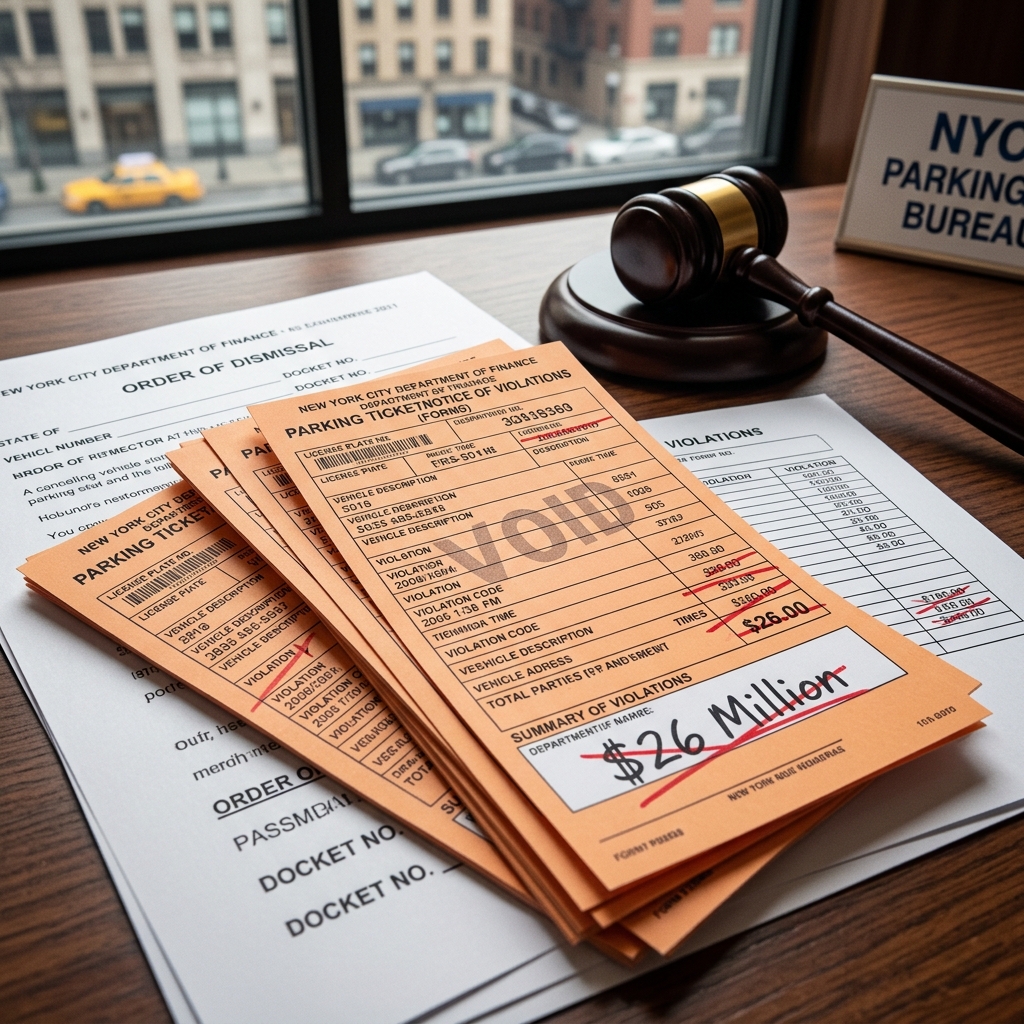
Parking tickets are a routine part of urban life, but in New York City a seemingly minor bureaucratic error once triggered the dismissal of roughly half a million tickets and wiped away about $26 million in expected revenue. What looked like a mundane code-number mistake turned into a case study in how precise laws, accurate paperwork, and vigilant drivers can dramatically alter the outcome of mass enforcement.
This article explains what happened in New York City, why those tickets were legally defective, and what lessons every driver can learn about using technical details to challenge unfair or incorrect fines. It also places that incident in the broader context of how parking enforcement works, how to dispute tickets, and why legal accuracy matters as much as fairness.
The Incident: Half a Million Tickets, One Small Error
Between April and July of a particular year, New York City issued approximately 500,000 parking tickets tied to muni-meter violations that later turned out to be invalid. The underlying issue was not that drivers parked legally, nor that meters malfunctioned. Instead, the defect arose because the tickets referenced an ordinance code that no longer matched the law in force.
According to news coverage at the time, the city updated its meter parking ordinance—essentially changing the way the rule was numbered—but enforcement paperwork did not immediately follow. Many tickets still listed the old code number rather than the revised one. That mismatch made the tickets vulnerable to challenge, and ultimately the city acknowledged the error and voided them.
In financial terms:
- About $18 million in fines were refunded to motorists who had already paid.
- An additional $8 million in tickets were dismissed before payment, totaling around $26 million in lost revenue.
What appeared to be a minor bureaucratic oversight became a large-scale example of how strict compliance with legal requirements is essential for enforceable penalties.
Why the Tickets Were Legally Defective
Parking enforcement relies on clear, properly drafted laws and accurate citations. When an officer issues a ticket, it must correctly identify the violation, including the applicable statute or ordinance. If that information is wrong or incomplete, the ticket can be considered defective and subject to dismissal.
In the NYC case, the following elements combined to make the tickets defective:
- Changed ordinance number: The city revised the numbering of its meter parking rule but continued to print the old number on tickets for a period of time.
- Inconsistent paperwork: The written notice given to drivers did not accurately reflect the law that was supposedly violated, blurring the legal basis for the fine.
- Due process concerns: Drivers have the right to be informed of the specific law they are accused of breaking. Incorrect citations can undermine that right and provide grounds for dismissal.
Municipal agencies are generally given some flexibility in enforcement, but courts and hearing officers often require basic accuracy in documentation. When a city itself acknowledges that its tickets are based on outdated or misdescribed law, mass cancellation becomes almost unavoidable.
How NYC Parking Enforcement Normally Works
To understand the impact of this technical error, it helps to look at how New York City’s parking enforcement usually operates. The Department of Finance (DOF) primarily handles parking ticket processing, collecting payments, and managing disputes. Enforcement officers in several agencies—such as the police department and other authorized bodies—issue tickets, which then flow through DOF systems.
Once a ticket is issued, the typical process involves:
- Entry into the system: Computer-generated tickets often appear in online records within a few business days, while handwritten tickets may take 10–14 days or more to be processed.
- Payment or dispute: The driver can pay the fine or request a hearing to contest the ticket. Paying is treated as an admission of liability, so disputing requires withholding payment while the case is reviewed.
- Penalties over time: If the fine is not resolved, penalties accrue—an extra $10 after 30 days, $20 after 60 days, $30 after 90 days—and after about 100 days, the violation can be entered into judgment, subject to 9% simple interest per year.
Because penalties escalate, many drivers pay quickly to avoid extra costs. In a situation where tickets are later declared defective, those early payments can translate into large refund obligations, as happened in the $18 million that had to be returned.
Common NYC Parking Violations and Their Costs
To grasp the scale of $26 million in tickets, it helps to compare typical fines. Parking penalties in NYC vary based on location and type of violation. Even a single error repeated across hundreds of thousands of tickets can add up quickly.
| Violation Type | Approximate Fine Range (USD) | Example Impact |
|---|---|---|
| Expired meter | $35–$65 depending on area | Half a million tickets at $50 each would total $25 million. |
| No parking zone | Typically around $60 or higher | Frequent in dense commercial districts. |
| Double parking | About $115 | Common near schools and loading areas. |
| Blocking fire hydrant | About $115 | Strictly enforced due to safety concerns. |
| No standing / no stopping | Roughly $95–$150 | Often near bus stops, schools, or major avenues. |
Given these ranges, a large batch of defective meter tickets can quickly reach tens of millions of dollars. The NYC incident demonstrates that even widely issued, routine violations are not immune to legal scrutiny.
Lessons for Drivers: Spotting Technical Defects in Tickets
Most drivers assume a ticket is valid if an officer issued it. However, the NYC experience shows that careful review can make a substantial difference. Common technical issues that may justify a challenge include:
- Incorrect law or code cited: If the ticket lists a code section that does not match the actual restriction on the sign or meter, or if that code is outdated or misnumbered, it may be contestable.
- Missing or inaccurate details: Errors in license plate number, location, date, or time can undermine the reliability of the ticket.
- Confusing or conflicting signs: If multiple signs impose overlapping restrictions and the ticket does not clearly reflect which rule applies, drivers may argue ambiguity.
- Permit or authorization ignored: For disabled parking permits or other authorizations, drivers can submit evidence showing they were legally allowed to park.
In New York City, disputes usually require a written or online submission, explaining why the ticket is incorrect and attaching supporting evidence. By pointing out technical problems—such as a wrong code—drivers may obtain a dismissal even when the underlying conduct would otherwise have been a violation.
How to Challenge a Parking Ticket in NYC
The procedure for contesting a parking ticket in NYC is structured but accessible. The key is to act promptly and provide clear, organized information. According to city guidance, drivers who want to dispute a ticket should avoid paying until the dispute is resolved because payment is treated as an admission of guilt.
General steps to challenge a ticket include:
- Check the ticket details: Confirm that your license plate, location, date, time, and vehicle information are correctly listed.
- Review the alleged violation: Read the code section or description cited on the ticket and compare it with posted signs or meter rules.
- Gather evidence: Take photographs of signs, meters, and your vehicle position; keep receipts from pay-by-meter transactions; and collect copies of any permits.
- Submit a dispute: Request a hearing online or in writing, including the ticket number, license plate, and a concise statement explaining why the ticket is wrong.
- Monitor deadlines: File the dispute before late penalties and interest begin to accrue, ideally within the first 30 days.
While specialized apps and services exist to help drivers contest tickets, the official channels through the NYC Department of Finance remain the authoritative route for formal challenges.
Policy Implications: Accuracy, Trust, and Revenue
From the city’s perspective, the $26 million dismissal raised major policy questions. Parking enforcement serves multiple goals: managing traffic flow, ensuring safety, and generating revenue. When technical defects invalidate large numbers of tickets, each of these goals is affected.
Key implications include:
- Administrative accuracy: Municipal agencies must keep enforcement documents synchronized with legal changes. Even a minor renumbering of an ordinance requires prompt updates to ticket forms and software.
- Public trust: When tickets are thrown out due to errors, drivers may question the fairness and reliability of the system. Transparent correction and refunds can help rebuild confidence.
- Budget impact: Parking fines represent a significant revenue stream for many cities. Sudden losses can push officials to reassess processes to prevent similar mistakes.
- Oversight and audits: Independent agencies or internal auditors may review enforcement practices to ensure that outdated information is not being used to issue new tickets, as highlighted in later investigations of NYC’s ticketing systems.
Ultimately, the incident underscores that rule-of-law principles apply even to everyday matters like parking. Governments must meet their own standards of precision if they expect residents to comply.
Preventing Tickets: Practical Tips for NYC Drivers
While technicalities can occasionally lead to mass dismissals, the most reliable strategy for avoiding tickets is simple: park legally and stay informed about local rules. Resources on New York parking violations offer practical guidance.
Some common-sense measures include:
- Monitor meter time limits: Check the maximum parking duration and set reminders to move your vehicle before time expires.
- Follow the strictest sign: When multiple signs are posted, obey the most restrictive instructions to avoid confusion.
- Stay clear of hydrants: Keep at least 15 feet away from fire hydrants; violations are both expensive and a safety hazard.
- Avoid bike lanes and crosswalks: Never park where you block pedestrians or cyclists; enforcement in these areas is especially vigilant.
- Keep documents current: Up-to-date registration and insurance help prevent additional fines or complications.
Even in a city where a paperwork error once erased hundreds of thousands of tickets, prevention remains far more dependable than hoping for a technicality.
Frequently Asked Questions
Can a parking ticket be dismissed just because of a minor error?
Yes, in some cases. If the error affects core information—such as the law cited, vehicle identification, or location—the ticket may be considered defective and subject to dismissal. The NYC case involving an outdated ordinance number is a vivid example.
Is paying a ticket the same as admitting guilt?
In New York City, paying a parking ticket is treated as an admission of liability, meaning you concede that the violation occurred. Drivers who intend to contest a ticket should avoid paying until the dispute is resolved.
How quickly do late penalties and interest start?
Additional penalties begin 30 days after the ticket date, with further increases at 60 and 90 days. After about 100 days, unpaid violations may be entered into judgment and accrue 9% simple interest per year.
Where can I find official information about NYC parking tickets?
The primary official resource is the New York City Department of Finance, which provides information on payments, disputes, and services related to parking tickets and camera violations. The NYC 311 system also offers detailed guidance on hearing requests and procedures.
Could a similar technicality erase tickets again?
It is possible but less likely if agencies maintain accurate, up-to-date systems and audit their forms and codes regularly. The scale of the past $26M dismissal created strong incentives for the city to tighten controls and avoid repeating such errors.
References
- Parking Ticket or Camera Violation Assistance — NYC 311 (City of New York). 2024-03-01. https://portal.311.nyc.gov/article/?kanumber=KA-02348
- Parking Ticket Services — New York City Department of Finance. 2023-11-15. https://www.nyc.gov/site/finance/vehicles/services.page
- New York Parking Ticket Violations: Costs and How to Avoid Tickets — New York Safety Council. 2022-08-10. https://www.newyorksafetycouncil.com/articles/new-york-parking-tickets/
- 500K NYC parking tickets refunded or dismissed — WABC-TV / ABC7 New York. 2012-09-28. https://www.youtube.com/watch?v=0NstKlmWdRY
- Long Island man’s parking ticket fight exposes larger issue in NYC — CBS News New York. 2023-10-05. https://www.youtube.com/watch?v=T-ythb3XDtM
Similar Articles








Read full bio of medha deb


