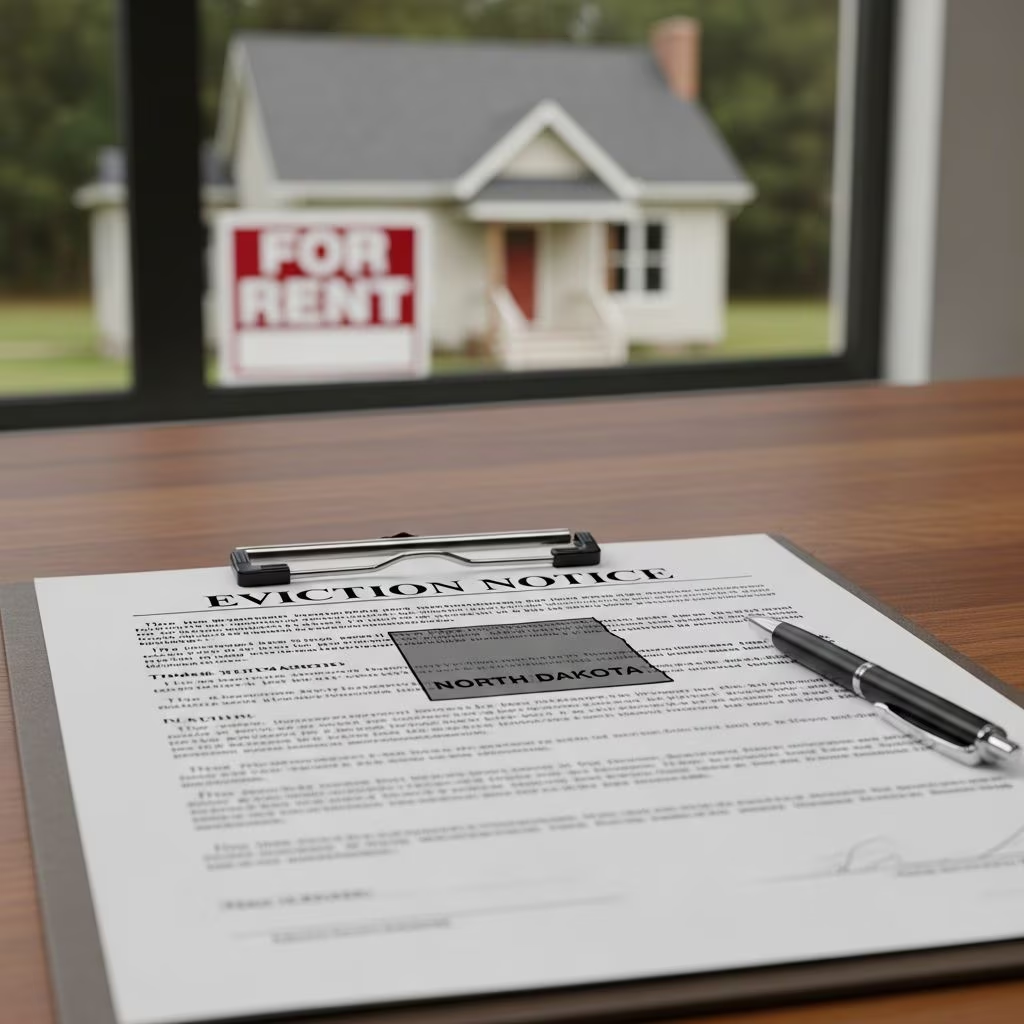
Property owners in North Dakota must adhere to precise statutory procedures when removing tenants from rental properties. These rules, outlined in the North Dakota Century Code (N.D. Cent. Code § 47-32), protect both parties and prevent unlawful actions that could lead to lawsuits.
Legal Grounds Justifying Tenant Removal
Evictions require specific justifications under state law. Landlords cannot terminate tenancies arbitrarily; valid causes include financial defaults, contractual breaches, or threats to property and safety.
- Nonpayment of Rent: Failure to pay rent on time is the primary trigger. Tenants must receive opportunity to remedy before escalation.
- Lease Violations: Breaches like unauthorized pets, excessive noise, or property damage qualify, provided they violate rental terms.
- Criminal Acts: Drug-related activities, violence, or other illegal conduct on premises justify swift action.
- Holdover Tenancy: Staying beyond lease end without renewal or permission.
- Property Nuisance: Actions disturbing neighbors or endangering the unit.
Understanding these grounds ensures landlords build airtight cases, minimizing court dismissals.
Initial Notification Requirements
Before court involvement, landlords serve formal notices demanding compliance or departure. A uniform 3-day notice applies across most scenarios, starting the clock after rent due date or violation discovery.
| Eviction Type | Notice Period | Key Contents |
|---|---|---|
| Nonpayment | 3 days to pay or quit | Exact amount due, payment instructions, move-out deadline |
| Lease Breach | 3 days to cure or quit | Description of violation, remedy steps, landlord signature |
| Criminal/Repeat Offenses | Immediate 3-day quit | No cure option; vacate only |
Notices must be written, dated, and delivered via personal service, mail, or posting. Electronic service is permitted with proof. Tenants curing issues (e.g., paying rent) halt proceedings, but landlords may proceed if desired.
Court Filing and Summons Procedures
If tenants ignore notices, landlords file an eviction complaint in district court. This initiates formal litigation, with fees around $80-$100 depending on county.
- Prepare Complaint: Detail grounds, notice served, lease copy, and damages claimed.
- File with Clerk: Submit to local district court; receive case number.
- Serve Summons: Sheriff or process server delivers to tenant, scheduling hearing within 10 business days.
Tenants have limited response time, typically 24-48 hours to contest. Failure to appear often results in default judgment for landlords.
Court Hearings: Preparation and Outcomes
Hearings demand thorough evidence presentation. Landlords should arrive with organized documents to prove claims.
- Bring lease agreements, payment records, photos of damage, witness statements.
- Present chronologically: notice service, violation proof, tenant non-compliance.
- Judges rule immediately; favorable decisions grant restitution judgment and writ issuance.
Tenants may counter with defenses like improper notice or habitability issues, but landlords prevail with solid proof.
Enforcement: Writs and Sheriff Involvement
Post-judgment, courts issue a writ of restitution, served by sheriff for ~$30 fee. Tenants usually get 24 hours to several days to vacate voluntarily.
Hardship claims (e.g., family impact, excluding nuisance cases) allow up to 5-day stays. Non-compliance triggers sheriff return ($50 fee) for forced removal, changing locks if needed.
Landlords must avoid self-help evictions like utility shutoffs, risking penalties.
Timelines and Cost Breakdown
Full processes span 2-6 weeks, varying by tenant response and court backlog.
| Step | Typical Duration | Estimated Cost |
|---|---|---|
| Notice Period | 3 days | $0-$20 (posting/printing) |
| Court Filing | 1-2 days | $80-$100 |
| Hearing to Judgment | 3-10 days | $0 |
| Sheriff Service/Writ | 1-5 days | $30-$50 |
| Forced Removal | 1 day | $50 |
Total costs: $150-$250, plus lost rent. Expedited for urgencies.
Unique Rules for Special Properties
Mobile Homes/Rural Units: Extended notices or federal overlays apply; check local ordinances.
Squatters: Adverse possession rare (20 years continuous, or 10 with taxes/title). Standard notices suffice for recent occupants.
Recent 2025-2026 Legal Updates
North Dakota refined processes: mandatory tenant rights in notices, electronic serving, 5-day cure extensions, 10-day hearings, strict documentation. These enhance fairness while streamlining for compliant landlords.
Landlord Best Practices and Pitfalls
Success hinges on documentation. Maintain rent ledgers, repair logs, communication records.
- Consult attorneys for complex cases.
- Screen tenants rigorously pre-lease.
- Offer mediation to avoid courts.
Avoid: Accepting partial rent post-notice, verbal agreements, illegal lockouts.
Frequently Asked Questions
Can tenants pay rent after notice to stop eviction?
Payment cures nonpayment but not other violations; landlords may reject if proceeding.
How soon must courts hear eviction cases?
Within 10 business days of filing.
What if tenant claims hardship?
Court may delay up to 5 days, excluding disturbances.
Are self-evictions allowed?
No; only sheriffs enforce, or face lawsuits.
Does electronic notice work?
Yes, with consent and records.
This guide equips landlords for compliant, efficient evictions. For personalized advice, contact legal professionals or North Dakota courts.
References
- North Dakota Eviction Process [2025] — Innago. 2025. https://innago.com/north-dakota-eviction-process/
- North Dakota Evictions | Laws and Protections — TenantCloud. 2025. https://www.tenantcloud.com/laws/eviction-laws-north-dakota
- The Eviction Process in North Dakota: Rules for Landlords — Nolo. 2025. https://www.nolo.com/legal-encyclopedia/the-eviction-process-north-dakota-rules-landlords-property-managers.html
- Eviction for Tenants — North Dakota Courts (.gov). 2025. https://www.ndcourts.gov/legal-self-help/eviction-for-tenants
- Tenant Rights — North Dakota Attorney General (.gov). 2025. https://attorneygeneral.nd.gov/consumer-resources/tenant-rights/