
North Dakota Divorce: A Practical Guide to Requirements and Process
Understand residency, legal grounds, paperwork, and court decisions involved in ending a marriage in North Dakota.
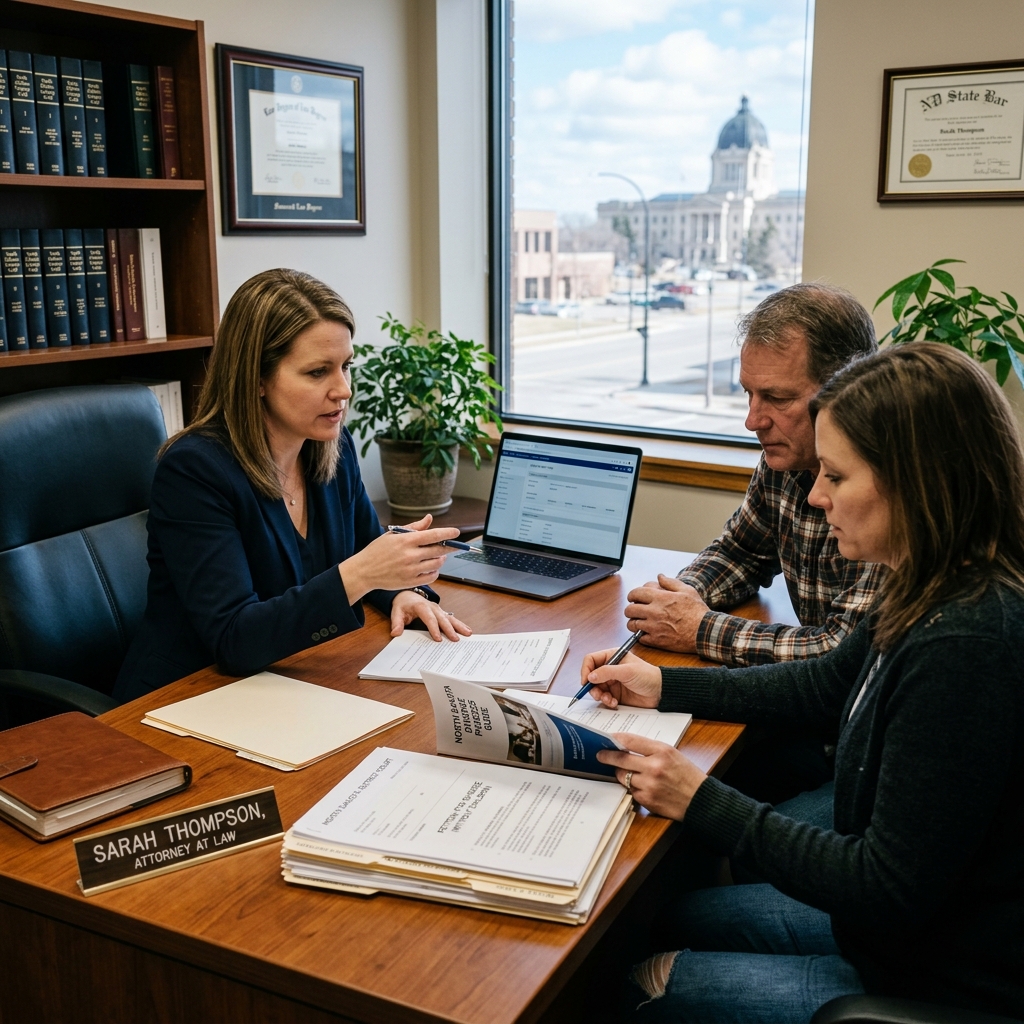
Ending a marriage is both an emotional and a legal process. North Dakota has specific rules about who can file for divorce, what reasons are legally acceptable, and how judges divide property, assign parental responsibilities, and decide financial support. This guide explains those rules in plain language so you can better understand what to expect if you pursue a divorce in North Dakota.
Overview of Divorce in North Dakota
North Dakota allows both no-fault and fault-based divorces. A no-fault divorce is based on irreconcilable differences, while a fault-based divorce relies on legally defined misconduct by one spouse. The same court system handles both types, and the overall process—filing paperwork, serving the other spouse, exchanging information, and either reaching a settlement or going to trial—is largely similar.
Key features of North Dakota divorce law include:
- A residency rule requiring a connection to the state.
- Specific grounds for ending the marriage.
- Equitable (fair, not necessarily equal) division of property and debts.
- The possibility of child custody, child support, and spousal support orders.
- Formal court procedures for notice, evidence, and final judgment.
Residency Requirement and Where to File
Who Qualifies to File in North Dakota?
To use North Dakota’s divorce courts, the filing spouse must satisfy the state’s residency requirement. North Dakota law requires that the spouse who files (often called the plaintiff) be a resident of the state for a specified period before the court issues the divorce decree. Courts look at factors such as where you live, vote, and work to determine residency.
Important residency points include:
- The filing spouse must have been a North Dakota resident for at least six months before the judge issues the final divorce decree.
- You may file before the six months are fully completed, but the court cannot finalize the divorce until the residency period has been met.
- Your spouse does not need to live in North Dakota; only the filing spouse must meet the residency requirement.
Choosing the Correct County
Divorce cases in North Dakota are heard in the State District Court. In most situations, you file in the county where the non-filing spouse (the defendant) lives. If your spouse lives outside the state, you typically file in the county where you live.
| Spouse Residence Situation | Typical Filing Location |
|---|---|
| Both spouses live in North Dakota | District Court in county where non-filing spouse lives |
| Non-filing spouse lives outside North Dakota | District Court in county where filing spouse lives |
| Filing spouse recently moved to North Dakota | County of current residence, but final decree only after 6 months residency |
No-Fault and Fault-Based Grounds for Divorce
North Dakota law defines the legal reasons—called grounds—that can justify a divorce. You must choose at least one ground when you file. The choice between no-fault and fault-based grounds can affect the level of conflict and the type of evidence required.
No-Fault Divorce: Irreconcilable Differences
The only no-fault ground in North Dakota is irreconcilable differences. This term describes a breakdown in the marriage where the spouses can no longer reasonably continue the relationship.
When you rely on irreconcilable differences:
- You do not need to prove misconduct, such as adultery or cruelty.
- The focus is on the fact that the marriage cannot be repaired.
- This approach can reduce conflict because it avoids assigning blame in court filings.
Fault-Based Divorce: Misconduct Grounds
North Dakota also allows divorces based on specific fault grounds, all defined in state law. Choosing a fault ground requires you to present evidence of misconduct and may increase how contested your case becomes.
Recognized fault grounds include:
- Adultery – one spouse has sexual relations outside the marriage.
- Extreme cruelty – serious physical harm or severe mental suffering caused by one spouse to the other.
- Willful desertion – serious, intentional abandonment, including refusing to live with the spouse or to have marital relations for a year without valid reason.
- Willful neglect – failing to provide basic necessities or support despite being able to do so.
- Abuse of alcohol or controlled substances – substance use severe enough to harm business or cause significant mental suffering to the other spouse.
- Conviction of a felony – the spouse is imprisoned in state or federal prison for a felony at the time of filing.
For some grounds like desertion, neglect, or habitual substance abuse, the conduct must continue for at least one year before it qualifies as a legal ground for divorce.
Uncontested vs. Contested Divorce
Beyond the legal grounds, North Dakota divorces are often described as uncontested or contested. This describes the level of agreement between the spouses.
Uncontested Divorce
An uncontested divorce means the spouses have already worked out all major issues—including property division, debts, custody, parenting time, and support—and present a complete settlement agreement to the court.
Common features of uncontested cases:
- A written settlement resolving property, debts, children, and support.
- Required court forms such as a summons, complaint, property and debt listing, and proposed judgment.
- Less time in court and fewer disputes because the key decisions are pre-agreed.
Contested Divorce
In a contested divorce, spouses disagree about one or more major issues. The case usually involves formal discovery (exchange of information) and may go to trial.
Contested cases often include:
- Disputes about asset values, responsibility for debts, or who should keep the family home.
- Disagreements about child custody, parenting time, or support amounts.
- Witness testimony and documentary evidence presented at a court hearing.
Step-by-Step: Filing for Divorce in North Dakota
Preparing and Filing the Initial Papers
The spouse who starts the case prepares several court documents, often called the “divorce paperwork.” Typical documents include a summons and complaint, a listing of property and debts, and a proposed judgment in uncontested cases.
Key filing steps:
- Complete the required court forms carefully, following instructions.
- Sign and date forms; some must be signed in front of a notary or court clerk.
- File the documents with the District Court and pay the filing fee (around $80 as of 2022).
- If you cannot afford the fee, request a waiver by filing a Petition for Waiver of Fees.
Serving the Other Spouse
After filing, you must legally notify your spouse by serving copies of the filed papers. You cannot serve the documents yourself. Instead, someone at least 18 years old who is not a party to the case must deliver them.
Acceptable service methods in North Dakota include:
- Personal delivery by a sheriff or process server.
- Other court-approved methods when personal service is not possible.
Information Exchange and Case Development
Once the case has begun, both spouses exchange information about income, property, debts, and other relevant issues. This phase, often called discovery, may involve sharing tax returns, employment and pay records, pension information, and lists of assets and liabilities.
In many cases:
- Spouses prepare joint or separate property and debt listings.
- Both sides disclose financial information to ensure fair decisions about division and support.
Settlement Negotiations or Trial
After discovery, the case moves toward either settlement or trial. If the spouses reach an agreement, they submit a written settlement to the judge for approval. If they cannot agree, the court holds a trial where each side presents evidence and arguments.
At the end of either path, the judge issues a written divorce decree, which:
- Legally ends the marriage.
- Orders division of property and debts.
- Sets child custody and parenting arrangements when relevant.
- Establishes child support and possibly spousal support.
Property and Debt Division
Equitable Distribution Standard
North Dakota follows an equitable distribution approach to property and debt. “Equitable” means fair in light of the couple’s circumstances, not necessarily a 50/50 split. The court considers all marital property and debts and assigns them between the spouses based on fairness.
The judge may look at factors such as:
- Length of the marriage.
- Each spouse’s income and earning capacity.
- Non-financial contributions, such as homemaking or child care.
- Health and age of each spouse.
- Whether one spouse will be the primary caregiver for children.
Responsibility for Debts
When the court assigns certain debts to each spouse, this determines who must pay which obligations between the two of you. However, it does not change your obligations to creditors. Lenders may still pursue either spouse who signed for a loan, even if the divorce decree places the debt on only one party.
Child Custody, Parenting Time, and Support
Court Decisions About Children
When minor children are involved, the court must decide custody, parenting time, and child support. The guiding principle is the best interests of the child. Judges look at factors such as each parent’s relationship with the child, the child’s needs, and the ability of each parent to provide a stable environment.
Common orders include:
- Legal custody (decision-making about education, health care, and major life issues).
- Physical custody (where the child primarily lives).
- Parenting schedule specifying time with each parent.
- Child support payments based on state guidelines and the parents’ incomes.
Spousal Support and Other Relief
In addition to child support, the court may award spousal support (alimony) and other forms of relief when appropriate. The goal is to address financial imbalance created by the divorce.
Possible additional orders include:
- Spousal support for a limited period or longer, depending on circumstances.
- Health insurance coverage for one spouse or children paid by the other spouse.
- Designation of children as beneficiaries on a life insurance policy.
Frequently Asked Questions About North Dakota Divorce
Do I have to prove fault to get divorced in North Dakota?
No. You can file a no-fault divorce based on irreconcilable differences and do not need to prove misconduct. Fault-based options exist, but they are not required.
Can I file for divorce if my spouse lives in another state?
Yes. As long as you meet North Dakota’s residency requirement, you may file for divorce even if your spouse lives elsewhere. You will normally file in the county where you live when your spouse is out of state.
How long does it take to get divorced?
The timeline depends on residency, how contested the case is, and court scheduling. The court cannot issue a final decree until the filing spouse has been a resident for six months, and contested cases can take significantly longer due to discovery and trial.
Will our property be split 50/50?
Not necessarily. North Dakota uses equitable distribution, meaning the court focuses on fairness rather than strict equality. For some couples, a fair division will be close to equal; for others, it may be noticeably different.
What happens if we reach a settlement agreement?
If you and your spouse agree on all major issues and submit a complete written settlement, the judge will review it. If the agreement appears fair and consistent with law and the children’s best interests, the court will usually incorporate it into the final divorce decree.
Practical Tips for Navigating a North Dakota Divorce
Because divorce involves legal rights and long-term financial and parenting consequences, careful preparation is important. Consider the following practical steps:
- Gather key documents early, including pay stubs, tax returns, bank statements, and retirement account information.
- Keep records of major marital assets and debts.
- Think through parenting arrangements that might best serve your children’s needs.
- Consult a qualified family law attorney, especially if your case involves significant assets, complex custody questions, or allegations of abuse.
- Explore settlement options to reduce the cost and stress of litigation where possible.
References
- North Dakota Legal Requirements for Divorce — FindLaw. 2021-08-23. https://www.findlaw.com/state/north-dakota-law/north-dakota-legal-requirements-for-divorce.html
- Filing for Divorce in North Dakota — Legal Services of North Dakota. 2019-03-01. https://lsnd.org/filing-for-divorce-in-north-dakota/
- How Do I File for Divorce in North Dakota? — DivorceNet (Nolo). 2022-05-10. https://www.divorcenet.com/resources/filing-for-divorce/north-dakota.htm
- North Dakota Century Code Chapter 14-05: Divorce — North Dakota Legislative Branch. 2023-01-01. https://ndlegis.gov/cencode/t14c05.pdf
- North Dakota Divorce — WomensLaw.org. 2023-06-15. https://www.womenslaw.org/laws/nd/divorce/all
Similar Articles








Read full bio of Sneha Tete


