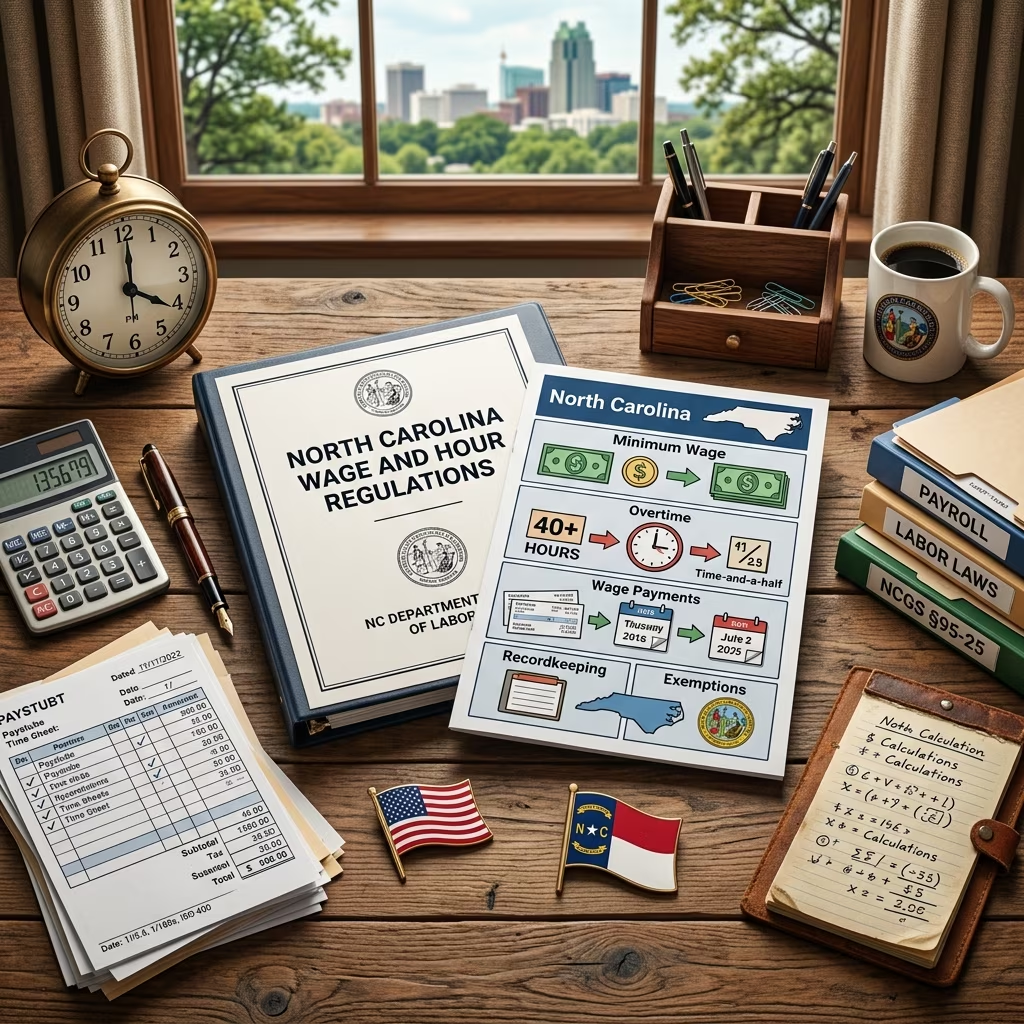
North Carolina’s wage and hour rules come mainly from the North Carolina Wage and Hour Act, which works alongside the federal Fair Labor Standards Act (FLSA) to set baseline protections for most workers in the state. Understanding these rules helps employees know when they are being paid correctly and helps employers avoid costly violations.
This guide explains the core topics covered by North Carolina wage and hour law: minimum wage, overtime pay, youth employment limits, breaks and hours of work, and how and when wages must be paid. It is written in practical language and organized for quick reference, but it is not legal advice.
1. Legal Framework: How State and Federal Rules Interact
North Carolina does not operate in a vacuum. Wage and hour protections are shaped by both state statutes and federal law, and employers must follow whichever standard gives the worker more protection.
- North Carolina Wage and Hour Act (NCWHA) – The primary state law, found in Chapter 95, Article 2A of the North Carolina General Statutes, governs minimum wage, overtime, wage payment, recordkeeping, and youth employment.
- Fair Labor Standards Act (FLSA) – The major federal law that sets the nationwide minimum wage, overtime rules, and special categories such as agricultural workers and certain exempt employees.
- General rule – If state and federal law differ, employers must apply whichever rule results in higher pay or stronger protection for the employee.
Many employers in North Carolina are covered by the FLSA because they are engaged in interstate commerce or meet revenue thresholds. In practice, this means businesses often must comply with both the federal and state framework.
2. Minimum Wage in North Carolina
North Carolina’s minimum wage is tied directly to the federal minimum wage. The state statute requires employers to pay the higher of a specific state minimum or the FLSA minimum.
| Type of worker | Minimum wage rule | Key notes |
|---|---|---|
| Most non‑tipped employees | At least the federal minimum wage (currently $7.25/hour). | Employers cannot agree to pay less, even with employee consent. |
| Tipped employees | May receive a lower cash wage if tips bring total earnings up to at least $7.25/hour. | If tips do not cover the gap, the employer must make up the difference. |
| Some youth, students, apprentices | Federal law allows certain sub‑minimum rates in limited circumstances. | Employers must carefully follow federal requirements before paying reduced rates. |
Under North Carolina law, employers must pay at least the minimum wage to covered employees unless a specific statutory exemption applies (for example, certain executive, administrative, or professional roles defined by the FLSA).
Key Points About Minimum Wage Compliance
- Minimum wage applies per hour worked in a workweek, not as an average over months.
- Employers must keep accurate records of hours and wages to show compliance.
- Employees who are improperly paid below minimum wage can bring claims for unpaid wages and, in some cases, additional damages.
3. Overtime Pay: When Time-and-a-Half Is Required
For most covered employees, overtime pay is required when they work more than 40 hours in a defined workweek. The workweek does not have to match the calendar week, but it must be a fixed and regularly recurring period of 168 hours.
Standard Overtime Rule
North Carolina law closely tracks the FLSA. Employers must pay at least 1.5 times the employee’s regular rate of pay for all hours worked over 40 in a workweek.
- Regular rate of pay includes hourly wages and certain nondiscretionary bonuses that must be factored into the overtime calculation.
- Overtime is calculated per workweek; employers cannot average hours over multiple weeks to avoid paying overtime.
- Some employees are exempt from overtime under the FLSA, such as bona fide executive, administrative, professional, and certain outside sales employees.
Selected Exemptions and Special Cases
Not every worker is entitled to state overtime protections. North Carolina’s statutes and the FLSA exclude specific categories:
- Agricultural workers – Often exempt from state overtime requirements under both the NCWHA and FLSA.
- Domestic workers – Certain babysitters and companions, as defined by federal law, may fall outside standard coverage.
- Seasonal amusement or recreational establishments – State law may allow overtime only after more than 45 hours in a week, instead of 40.
- Executive, administrative, professional, and outside sales – When they meet detailed FLSA duty and salary tests, they can be exempt from overtime.
Because exemptions are technical, employers should avoid treating someone as exempt based on job title alone; the actual job duties and pay structure determine coverage.
4. Youth Employment and Child Labor Protections
North Carolina places specific limits on the employment of minors to protect their health, safety, and schooling. These rules address age‑based eligibility, permitted jobs, and the number of hours and times of day minors can work.
Basic Age Rules
- Under 13 – Generally cannot work for most employers, with narrow exceptions such as newspaper delivery for certain ages under federal law.
- Ages 14–15 – May work in limited, non‑hazardous jobs and are subject to strict hour limits, especially while school is in session.
- Ages 16–17 – Can work in a wider range of jobs, but North Carolina law restricts late‑night work on school days and prohibits certain hazardous occupations.
Breaks and Hours for Younger Workers
North Carolina specifically requires rest breaks for some youth workers. Any minor under 16 must receive a 30‑minute break after five consecutive hours of work.
- For under‑16 workers, the break must occur after no more than five hours without interruption.
- Many employers also follow federal child labor rules that limit the number of hours per day and per week during school weeks.
- North Carolina restricts employment of 16‑ and 17‑year‑olds between 11 p.m. and 5 a.m. on school nights unless there is written permission from parents and the school principal.
Violations involving minors can trigger enforcement actions by the North Carolina Department of Labor (NCDOL) and may lead to civil penalties.
5. Breaks, Hours of Work, and Timekeeping
Aside from special rules for younger workers, North Carolina law does not generally require meal or rest breaks for adult employees. However, the way employers handle breaks can affect how hours are counted for wage and overtime purposes.
Rest and Meal Periods
- Adults (16 and older) – The state does not mandate rest or meal breaks; employers may choose to offer them as a matter of policy.
- Paid vs. unpaid breaks – Short breaks (for example, 5–20 minutes) are typically treated as paid time under federal rules, while longer, off‑duty meal breaks may be unpaid if the employee is fully relieved from work duties.
- Youth under 16 – Must receive a 30‑minute break after five consecutive hours of work, as discussed above.
Counting Time Worked
Accurate tracking of time worked is essential for minimum wage and overtime compliance.
- Employers should maintain reliable records of start and stop times, total hours, and pay rates for each employee.
- Work‑related activities such as required training, meetings, and certain on‑call time may count as hours worked under federal law.
- Employees who are not paid for all compensable hours can request assistance from the NCDOL Wage and Hour Bureau.
6. Payment of Wages, Paydays, and Final Checks
North Carolina law regulates when and how wages must be paid, including regular pay periods and the timing of final pay when an employee leaves a job.
Regular Paydays and Permitted Pay Periods
- Employers must establish a regular payday and pay all wages and tips due to employees on that day.
- Pay periods can be daily, weekly, bi‑weekly, semi‑monthly, or monthly, as long as they are consistent and communicated to employees.
- Wages based on bonuses, commissions, or other calculations may be paid less frequently (such as annually) when this schedule is disclosed beforehand.
Final Pay When Employment Ends
North Carolina requires employers to pay all wages due on or before the next regular payday after an employee’s employment ends, whether the separation is voluntary or involuntary.
- Final pay must be provided through the normal pay method, or, if the employee requests in writing, by trackable mail.
- Where wages depend on commissions, bonuses, or similar calculations, they must be paid on the first regular payday after the amounts become determinable.
- Employers should clearly communicate policies on vacation and paid time off (PTO) payout; North Carolina allows written “use‑it‑or‑lose‑it” policies if employees are informed in advance.
Promised Wages and Benefits
In addition to base pay, the NCWHA covers promised wages and benefits, such as accrued vacation pay when company policy treats it as earned wages. If an employer promises certain payments, it must follow its written policies consistently.
7. Enforcement, Complaints, and Employee Remedies
The North Carolina Department of Labor Wage and Hour Bureau is responsible for enforcing the state’s wage and hour laws. Employees who believe they have not been paid correctly can seek help through this agency or through private legal counsel.
Role of the North Carolina Department of Labor
- Investigates complaints about unpaid wages, minimum wage, overtime, and youth employment violations.
- Can require employers to pay back wages and may assess civil penalties in certain cases.
- Provides educational resources on workplace rights to both employees and employers.
Filing a Wage Complaint
To obtain assistance with a wage dispute, an employee usually must file a formal complaint with the Wage and Hour Bureau.
- Complaints typically include information about the employer, the period of work involved, and the nature of the alleged unpaid wages.
- The Bureau reviews the claim and may contact the employer to obtain records and explanations.
- In some situations, employees may also file civil suits in court to recover unpaid wages, overtime, and related damages.
Employers who comply with recordkeeping and clearly written policies are better positioned to respond to investigations; employees who keep personal notes and copies of pay stubs can more easily demonstrate underpayment.
8. Common Employer Pitfalls and Practical Tips
Even well‑intentioned employers can run afoul of wage and hour rules. Many problems stem from misunderstandings about overtime exemptions, paying youth workers, or how breaks affect hours worked.
Frequent Problem Areas
- Misclassifying employees as exempt – Treating workers as executive or professional exempt without confirming that their job duties and salary comply with FLSA tests.
- Not counting all hours worked – Failing to pay for required training, short meetings before or after shifts, or certain on‑call time that qualifies as working hours.
- Improper youth scheduling – Allowing minors to work too many hours during school weeks or beyond permitted nighttime limits.
- Inconsistent application of PTO policies – Enforcing “use‑it‑or‑lose‑it” rules or payout terms differently for different employees.
Practical Tips for Compliance
- Develop written policies covering work hours, overtime approval, meal and rest breaks, PTO accrual and payout, and youth employment.
- Train supervisors on basic wage and hour rules so they do not unintentionally approve unlawful schedules or off‑the‑clock work.
- Periodically review job classifications and payroll practices with HR or legal counsel, especially after changes in federal or state law.
- Maintain clear communication with employees about pay rates, paydays, and how concerns can be raised without retaliation.
9. Frequently Asked Questions (FAQs)
Do all North Carolina workers receive overtime pay?
No. Most non‑exempt workers must receive time‑and‑a‑half for hours over 40 in a workweek, but some categories, such as certain executive, administrative, professional, agricultural, and seasonal workers, may be exempt under state and federal law.
Is North Carolina’s minimum wage higher than the federal minimum?
Currently, North Carolina does not set a higher independent minimum wage; instead, it adopts at least the federal rate. Employers must pay the higher of the state or federal minimum, but at present they are the same.
Are employers required to give lunch breaks to adults?
For workers age 16 and older, North Carolina law does not require meal or rest breaks, though many employers choose to provide them. Minors under 16 must receive a 30‑minute break after five consecutive hours of work.
How quickly must I be paid after leaving a job?
When employment ends for any reason, North Carolina requires that all wages owed be paid on or before the next regular payday using the usual pay method, or by trackable mail if the employee makes a written request.
Where can I get help if I think my employer violated wage and hour laws?
You can file a complaint with the North Carolina Department of Labor’s Wage and Hour Bureau, which investigates wage disputes and can require payment of unpaid wages where violations are found.
References
- North Carolina General Statutes, Chapter 95, Article 2A (Wage and Hour Act) — North Carolina General Assembly. 2023-01-01. https://www.ncleg.net/enactedlegislation/statutes/html/byarticle/chapter_95/article_2a.html
- Employee Rights Regarding Time Worked and Wages Earned — North Carolina Department of Labor. 2022-06-01. https://www.labor.nc.gov/workplace-rights/employee-rights-regarding-time-worked-and-wages-earned
- Workplace Rights — North Carolina Department of Labor. 2021-09-15. https://www.labor.nc.gov/workplace-rights
- North Carolina Wage and Hour Act: Protections for North Carolina Employee Pay — Coffield Law. 2020-05-01. https://coffieldlaw.com/north-carolina-wage-and-hour-act-protections-for-north-carolina-employee-pay/
- Wage and Hour Laws: North Carolina — Smith Anderson. 2019-10-01. https://www.smithlaw.com/media/publication/361_Wage_and_Hour_Laws_North_Carolina_-_Susan_Parrott_Megan_Black.pdf
- North Carolina Employment and Labor Laws — Paylocity. 2024-02-01. https://www.paylocity.com/resources/tax-compliance/state-laws/north-carolina/
- Quick and Easy Guide to Labor & Employment Law: North Carolina — Baker Donelson. 2023-03-01. https://www.bakerdonelson.com/easy-guide-north-carolina