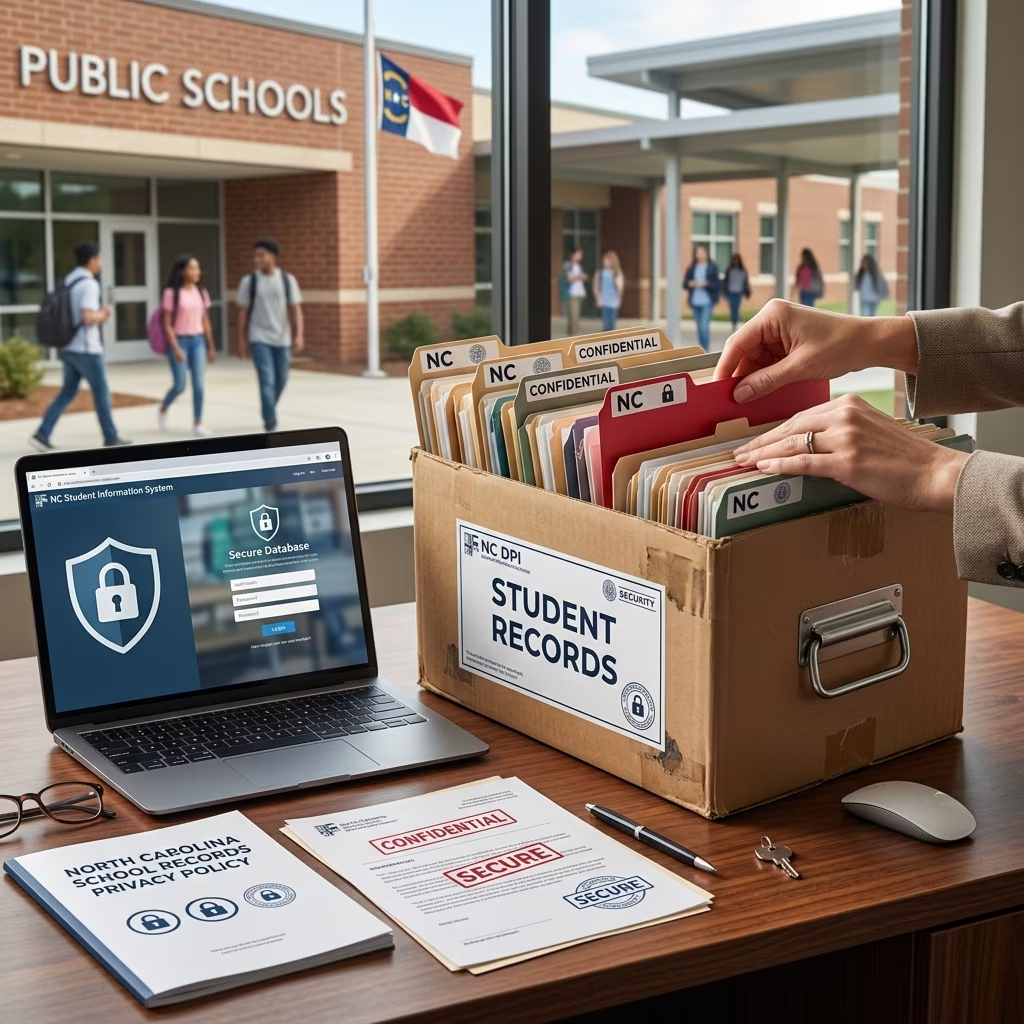
Student records contain some of the most sensitive information schools maintain, from academic performance to health and disciplinary data. In North Carolina, the privacy of these records is governed by a combination of federal law, especially the Family Educational Rights and Privacy Act (FERPA), and state statutes that specify how public schools must collect, store, and disclose student information. Together, these rules aim to balance transparency with families and the need to protect students against unwarranted public exposure or misuse of their data.
Foundations of Student Records Privacy
North Carolina’s approach to school records privacy is built around three core principles: confidentiality, limited access, and parental rights of review and correction. These principles mirror federal protections under FERPA while adding more detail about how public schools in the state must manage records.
- Confidentiality: Student education records are treated as private documents and are not open to public inspection.
- Controlled access: Only certain individuals and entities can lawfully view or receive student information, usually with consent or under specific legal exceptions.
- Parental and student rights: Parents, and later the students themselves, have defined rights to inspect, obtain copies of, and request changes to the records.
At the state level, North Carolina General Statutes Chapter 115C include provisions on the maintenance, contents, and confidentiality of student records, which apply to public schools across the state. These provisions operate alongside FERPA, which sets nationwide minimum standards for education record privacy.
What Counts as a Student Education Record?
Understanding what qualifies as an education record is crucial for families and school personnel. Under FERPA and North Carolina law, an education record generally means any record that is:
- Directly related to a student, and
- Maintained by an educational agency or institution, or a party acting for the institution.
This broad definition covers both paper and electronic records and extends to information held by school districts, individual schools, and some contracted service providers. Typical entries in an official student record may include:
- Enrollment history and attendance data
- Report cards, transcripts, and other academic records
- Standardized testing results and minimum competency scores
- Behavior and disciplinary reports
- Special education evaluations and individualized education program (IEP) documents
- Health information maintained by the school, such as immunization records
North Carolina law treats these records as confidential, meaning they are not subject to open public records requests in the same way many other government documents are. This confidentiality helps ensure that sensitive student information cannot be freely viewed or distributed without appropriate legal authority.
Directory Information vs. Protected Data
One important distinction in school privacy law is between directory information and other personally identifiable information in education records. FERPA allows schools to designate certain types of information as “directory” and share them without prior consent, provided parents and eligible students are informed and given a chance to opt out.
Common examples of directory information include:
- Student name
- Address and telephone listing
- Date and place of birth
- Major field of study
- Participation in officially recognized activities and sports
- Dates of attendance and grade level
- Honors and awards received
In North Carolina, school districts typically provide annual notices describing which items they treat as directory information and how parents can block disclosure. If a parent or eligible student submits a timely opt-out, those data elements become protected and must be treated as confidential personally identifiable information (PII). PII includes any detail that could reasonably identify a specific student, such as a full name, Social Security number, student ID, or a combination of indirect identifiers like birth date plus address.
Access Rights of Parents and Students
Both state law and FERPA grant strong rights for parents and, later, students themselves to inspect and review education records. These rights are central to fairness and accountability in the school system.
Who May Access Their Own Records?
- Parents or guardians of minors: Have the right to see and request copies of their child’s education records.
- Eligible students: Once a student turns 18 or attends a postsecondary institution, FERPA rights transfer to the student.
North Carolina school policies explain how a parent or eligible student can request access, often by submitting a written request to the principal or records office. Schools must provide an opportunity to review the records within a reasonable time, typically not more than 45 days from the request.
Requesting Corrections and Amendments
If a parent or eligible student believes information in a record is inaccurate, misleading, or violates the student’s privacy rights, they may request that the school correct or amend the record. If the school refuses, FERPA requires that the parent or student be given an opportunity for a hearing to challenge the content.
Important points about amendment requests include:
- Requests must generally identify the specific part of the record and explain why it is incorrect or harmful.
- Schools are not required to change grades or scores simply because a parent disagrees with the evaluation, but they must consider claims that records are factually wrong or unfair.
- If a hearing officer decides not to amend the record, the parent or student can place a statement in the file explaining their view, which must be included whenever the record is disclosed.
Who Else Can See Student Records?
While records are confidential, there are several categories of people and organizations that may lawfully access student information under North Carolina law and FERPA, either without consent or under strict conditions.
School Officials with a Legitimate Educational Interest
Within a school system, not all staff may view a student’s records. Only school officials with a legitimate educational interest may access these files. Typically this includes teachers, principals, counselors, and support staff who need the information to fulfill their professional duties.
Examples of legitimate educational interests:
- A teacher reviewing academic and behavioral history to plan instruction and interventions.
- A counselor accessing records to provide guidance or to coordinate special education services.
- An administrator examining discipline records to ensure policy compliance and safety.
Disclosures Without Parental Consent
FERPA identifies specific situations where schools may share personally identifiable information from education records without prior written consent. These commonly include:
- To other school officials within the district or at another school where the student seeks or intends to enroll.
- To appropriate officials in health and safety emergencies when information is needed to protect a student or others.
- To comply with a judicial order or lawfully issued subpoena; in some child welfare cases, additional notice to parents may not be required.
- To certain state and local authorities within the juvenile justice system, consistent with applicable law.
- To authorized representatives of federal, state, and local education authorities for audit or evaluation purposes.
North Carolina districts often adopt specific procedures to document these disclosures and to ensure that third parties receiving student information agree not to redisclose it, except as permitted by law.
Counselor Communications and Privileged Information
North Carolina gives particular attention to the confidentiality of school counseling records. Communications between students and school counselors are generally treated as privileged, meaning they receive heightened protection and are not easily disclosed to outside parties.
This privilege serves several important purposes:
- Encourages students to seek help and speak openly about academic, social, and emotional challenges.
- Helps build trust between students and school personnel.
- Reduces the risk that sensitive discussions will be misused in disciplinary or legal contexts without careful consideration.
Although counseling records may be part of a student’s broader educational file, their privileged nature means that schools must handle them with particular care and may face stricter rules about disclosure compared to general academic records.
Student Data Privacy Beyond the Paper File
Modern school systems rely heavily on electronic data systems and third-party technology providers to store and process student information. North Carolina has enacted additional protections focused on student data privacy, including the treatment of personally identifiable student data (PII) and limitations on data collection.
Under state law and guidance:
- Schools and the State Board of Education must maintain secure data systems with clear access controls.
- Personally identifiable student data includes both direct identifiers (name, student number) and indirect identifiers (date of birth, mother’s maiden name) that a reasonable person could use to identify the student.
- There are restrictions on collecting sensitive categories of data in statewide systems, such as biometric identifiers, political affiliation, religious affiliation, and voting history.
These rules supplement FERPA by addressing evolving privacy challenges posed by large-scale data analytics, vendor contracts, and cloud-based record storage.
Complaints and Enforcement
When parents or students believe their rights under FERPA have been violated—for example, if a school refuses access to records, improperly releases information, or fails to allow an opportunity to seek amendments—they may file a complaint with the U.S. Department of Education.
| Issue | Typical First Step | Possible External Agency |
|---|---|---|
| Denied access to education records | Discuss with principal or district records officer | Family Policy Compliance Office (U.S. Department of Education) |
| Unauthorized disclosure of student information | File written complaint with school or district | Family Policy Compliance Office; state education agency |
| Disagreement over amendment of record | Request hearing under FERPA procedures | Family Policy Compliance Office if procedures not followed |
FERPA is primarily enforced through oversight of federal funding. Schools and districts that repeatedly violate privacy rules may risk federal sanctions, including loss of eligibility for certain funds. At the same time, many North Carolina districts encourage informal resolution by urging parents to raise concerns promptly with school administrators.
Practical Tips for Families in North Carolina
Parents and students can take several steps to make sure their rights are respected and to better understand how records are used.
- Review annual privacy notices: Schools typically provide yearly FERPA and directory information notices. Read these documents carefully to understand default practices and opt-out deadlines.
- Keep written records of requests: When requesting access or amendments, submit written requests and keep copies for your own files.
- Ask about third-party vendors: Inquire how the district uses technology providers and what safeguards are in place for data security and privacy.
- Discuss concerns early: If you have privacy worries, meet with school staff before problems escalate, especially if sensitive issues are involved, such as health, disability, or disciplinary matters.
- Use formal complaint channels when needed: If informal resolution fails, use the written complaint processes available through the district and the U.S. Department of Education.
Frequently Asked Questions
Are North Carolina public school records open to the general public?
No. Student education records in North Carolina public schools are not subject to general public inspection. They are confidential and may be accessed only by authorized individuals, such as parents, eligible students, and certain school officials or agencies under defined legal circumstances.
Can I see my child’s school records, and how long does it take?
Yes. Parents of minor students have the right to inspect and review their child’s education records, and eligible students have the same right for their own records. Schools must provide access within a reasonable period, often not more than 45 days after receiving a written request.
What is meant by “directory information,” and can schools share it without asking me?
Directory information refers to certain basic details about a student—such as name, address, phone number, dates of attendance, and participation in activities—that FERPA allows schools to disclose without prior consent. However, schools must inform parents and eligible students of their directory information policy and give them a chance to opt out, after which those items must be treated as confidential.
Are conversations with school counselors private?
Communications between students and school counselors are generally considered privileged under North Carolina law, meaning they receive heightened protection against disclosure. Schools must handle counselor records with particular care and typically cannot share them freely without legal justification or appropriate consent.
Where can I file a complaint if I believe my child’s privacy rights were violated?
Parents and eligible students may file complaints with the Family Policy Compliance Office of the U.S. Department of Education if they believe FERPA rights have been violated. Complaints usually must be submitted in writing and should describe the alleged violation and the school or district involved. Families can also raise concerns through local district grievance procedures and, where appropriate, with state education authorities.
References
- FERPA General Guidance for Parents — U.S. Department of Education. 2024-01-10. https://studentprivacy.ed.gov/ferpa
- North Carolina General Statutes Chapter 115C, Article 29 (Student Records) — North Carolina General Assembly. 2023-01-01. https://www.ncleg.gov/enactedlegislation/statutes/pdf/byarticle/chapter_115c/article_29.pdf
- North Carolina Privacy of School Records Laws — FindLaw. 2023-05-15. https://www.findlaw.com/state/north-carolina-law/north-carolina-privacy-of-school-records-laws.html
- FERPA: Frequently Asked Questions — Disability Rights North Carolina. 2022-06-01. https://disabilityrightsnc.org/resources/ferpa-frequently-asked-questions/
- All About North Carolina’s Student Data Privacy Act (G.S. 115C-402.5) — Cybernut. 2023-09-12. https://www.cybernut.com/blog/nc-student-data-privacy-act-guide
- 4700 Student Records Policy (Sample District Policy) — University of North Carolina Wilmington / DC Virgo Preparatory Academy. 2021-08-01. https://uncw.edu/academics/colleges/wce/partnerships-centers/school-partnerships/dc-virgo/policies/students/4700-student-records-dcvpa
- Sharing Records: FERPA and Confidentiality — UNC School of Government (Natalie Bacon). 2018-02-01. https://www.sog.unc.edu/sites/default/files/course_materials/T2-0001-PPT-Natalie%20Bacon%20-%20Sharing%20Records_0.pdf