
North Carolina Consumer Tax Rules Explained
A practical guide to North Carolina consumer sales, use, and income tax rules for everyday taxpayers and shoppers.
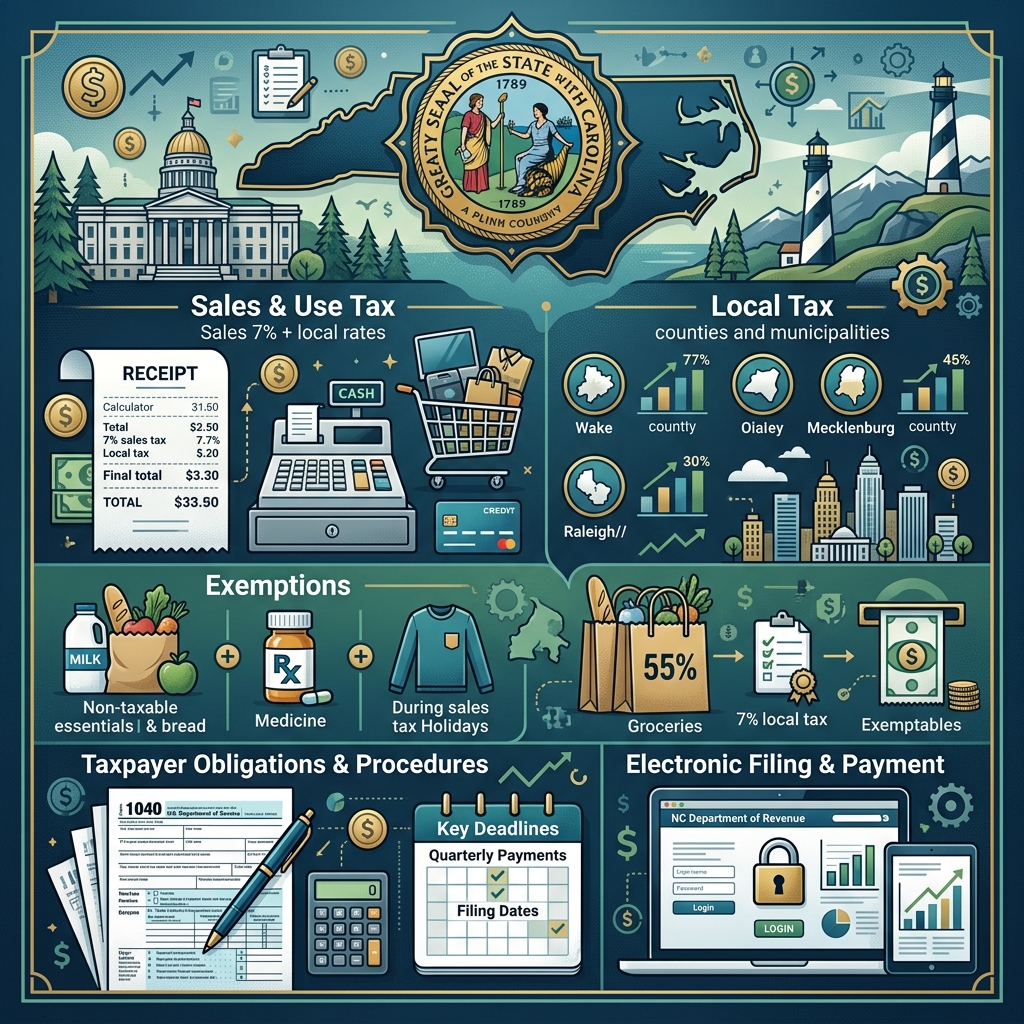
North Carolina relies on a mix of consumer taxes to fund public services, including sales tax on purchases, use tax on untaxed items brought into the state, and individual income tax on earnings. Understanding how these taxes work helps residents avoid unexpected bills, penalties, and interest while staying compliant with state law.
Overview of Consumer Taxation in North Carolina
Consumer tax law in North Carolina is largely found in Chapter 105 of the North Carolina General Statutes, which covers sales and use taxes, income tax, and the administration of these taxes. The North Carolina Department of Revenue (NCDOR) administers and enforces these laws, publishes forms, and provides guidance for taxpayers.
From the perspective of an individual consumer, three main types of state-level taxes are most relevant:
- Sales and use tax on purchases and taxable services
- Consumer use tax on items bought without sales tax but used in North Carolina
- Individual income tax on wages, self-employment income, and other taxable earnings
Sales Tax: What Shoppers Need to Know
North Carolina imposes a statewide sales and use tax rate of 4.75%, and local jurisdictions can add their own rates, bringing total combined rates to roughly 7% or higher in some areas. This tax applies to most purchases of tangible personal property and certain services.
What Is Subject to Sales Tax?
The state taxes many everyday items, as well as some services specifically listed in statute or administrative guidance. Common examples include:
- Most retail goods such as clothing, electronics, and household items
- Prepared food and beverages from restaurants and similar businesses
- Prewritten computer software and certain digital products
- Telecommunication services like phone and certain internet-based services
- Some installation, repair, and maintenance services specifically designated as taxable
Retailers are responsible for collecting sales tax from consumers at the time of sale and remitting it to the state and relevant local governments. The tax is calculated based on the taxable sales price defined by law, which may exclude certain discounts and financing charges if properly stated.
Sales Tax Rates Across the State
North Carolina uses a base state rate of 4.75% for sales and use tax. Counties and other local jurisdictions may add additional local sales taxes, including transit-related add-ons, which vary by location.
| Component | Approximate Range | Who Imposes It |
|---|---|---|
| State sales and use tax | 4.75% | State of North Carolina |
| Local sales tax | Up to about 2.25% | Counties/local jurisdictions |
| Transit/local add-ons | 0.25%–0.50% | Some counties |
| Total combined rate | Generally 4.75%–7.5% | Depends on location |
Because local rates differ, consumers may pay slightly different tax totals depending on where they shop within North Carolina.
Sales Tax Exemptions That Affect Consumers
Not all transactions are taxable. State law and administrative rules list a variety of exemptions for certain products, services, and purchasers. These exemptions help reduce the tax burden on essential items and certain organizations.
Common categories of exempt items or sales include:
- Most services, unless specifically listed as taxable in state law
- Certain basic food items and ingredients
- Prescription drugs and qualifying medical equipment
- Some agricultural inputs and equipment
- Sales for resale (when a retailer buys items to resell later)
Additionally, sales to certain entities are often exempt when they meet specific qualifications, such as recognized charities, religious organizations, schools, and government agencies. Consumers who purchase on behalf of these organizations usually must provide appropriate documentation or exemption certificates to the seller.
Consumer Use Tax: When Sales Tax Was Not Collected
North Carolina imposes a consumer use tax on items purchased without North Carolina sales tax that are stored, used, or consumed in the state. This tax ensures that buying goods from out-of-state or online sellers does not avoid state tax obligations when the goods are ultimately used in North Carolina.
When Use Tax Applies
Use tax commonly applies in situations like:
- Purchasing taxable goods from an out-of-state seller that does not collect North Carolina sales tax
- Buying items in a state with a lower sales tax rate and bringing them back to North Carolina
- Ordering products online from a seller that is not required to collect North Carolina tax
If the seller does not charge North Carolina sales tax, the consumer usually owes the use tax at the same rate that would have applied if the purchase occurred in-state. The tax is based on the purchase price and is due when the item is first stored, used, or consumed in North Carolina.
How Consumers Report Use Tax
Individuals typically report unpaid use tax on their state income tax return or using other forms allowed by the Department of Revenue. Businesses may report use tax alongside sales tax on periodic returns, depending on their filing requirements.
To calculate the amount owed, a consumer should:
- Determine the purchase price of the taxable item
- Apply the appropriate combined state and local rate for their place of residence or use
- Subtract any legally imposed sales tax already paid to another state, if allowable
Keeping receipts and invoices for out-of-state purchases helps document whether sales tax was charged and supports accurate reporting of any use tax obligations.
Income Tax Basics for North Carolina Residents
Beyond sales and use taxes, North Carolina residents must also consider the state’s individual income tax on wages and other earnings. The state uses a flat income tax rate, meaning the same rate applies to all taxable income levels.
Current Individual Income Tax Rate
North Carolina imposes a single, statewide individual income tax rate on taxable income, set around 4.25% for upcoming tax years, with scheduled reductions toward 3.99% according to recent policy changes. Because the rate is flat, a taxpayer’s total liability depends primarily on the amount of taxable income rather than income brackets.
For example, a taxpayer with $100,000 in taxable income would owe approximately $4,250 of North Carolina income tax at a 4.25% rate, in addition to any federal income tax and payroll taxes owed.
Filing Requirements and Deadlines
Residents generally must file a state income tax return if their gross income exceeds the North Carolina standard deduction for their filing status. Filing statuses and threshold amounts mirror federal categories and include single, married filing jointly, married filing separately, head of household, and qualifying surviving spouse.
Key points for consumers include:
- Filing deadline: Typically April 15, matching the federal income tax deadline
- Extensions: Available, but amounts paid after the deadline generally accrue interest
- Basis of calculation: Starts from federal income, adjusted for state-specific additions, deductions, and credits
Understanding the interaction between federal and state rules, including the standard deduction and available credits, helps consumers reduce their overall tax liability while remaining compliant.
Business Obligations That Affect Consumers
While businesses bear the responsibility for collecting and remitting sales tax, the rules governing business registration and nexus indirectly affect consumers by determining whether tax is charged at checkout.
Physical and Economic Nexus
A business must generally register with the NCDOR and collect sales tax if it has a physical presence in the state or meets economic nexus thresholds based on sales volume. Remote sellers with significant sales into North Carolina—often $100,000 or more in a year—are required to collect and remit North Carolina sales tax on taxable transactions.
From a consumer perspective, this means more online and out-of-state vendors now charge North Carolina tax at the time of sale. However, if tax is not charged when it should have been, the consumer may still owe use tax to the state.
Registration and Filing
Every business engaged in taxable sales in North Carolina must obtain a certificate of registration and file periodic returns, often using the E-500 form through the state’s electronic system. Accurate business compliance helps ensure consumers are charged the correct tax and reduces the likelihood of later assessments or disputes.
Practical Tips for North Carolina Consumers
Consumers can take several practical steps to handle North Carolina tax obligations responsibly:
- Review receipts: Confirm that correct sales tax is charged on taxable items and removed for exempt items.
- Track online purchases: Keep records of out-of-state and online purchases, noting whether sales tax was charged.
- Check exemptions: If you purchase on behalf of a qualifying nonprofit or government entity, ensure you have proper documentation.
- Plan for income tax: Consider withholding levels and estimated payments so that your state income tax is fully covered by the filing deadline.
- Use official resources: Consult the North Carolina Department of Revenue website for the latest forms, instructions, and rate changes.
Frequently Asked Questions (FAQs)
Do I owe North Carolina tax on items bought online?
If an online seller collects North Carolina sales tax, you generally do not owe additional tax on that purchase. If the seller does not collect state tax and the item is taxable, you may owe consumer use tax on the purchase price when you use or store the item in North Carolina.
Are groceries fully exempt from sales tax?
Many basic food items and ingredients receive favorable tax treatment or partial exemptions under North Carolina law, but prepared food and restaurant meals remain taxable. Consumers should review their receipts and state guidance for details on which items are taxed at the full rate and which are treated differently.
What happens if I don’t pay use tax on untaxed purchases?
Failing to pay required consumer use tax can lead to assessments, interest, and penalties if discovered by the Department of Revenue. Keeping accurate records and reporting owed use tax on your return helps avoid these consequences.
Is the North Carolina income tax rate the same for all income levels?
Yes. North Carolina uses a flat individual income tax rate that applies equally to all taxable income, rather than graduated brackets. The amount of tax owed therefore increases proportionally with taxable income.
Where can I find official information about North Carolina tax laws?
Official information is available from the North Carolina Department of Revenue and the North Carolina General Assembly. Statutes are primarily located in Chapter 105 of the General Statutes, and the Department of Revenue provides forms, instructions, and administrative guidance on its website.
References
- North Carolina General Statutes, Chapter 105, Article 5 (Sales and Use Tax) — North Carolina General Assembly. Accessed 2026-07-10. https://www.ncleg.net/EnactedLegislation/Statutes/HTML/ByArticle/Chapter_105/Article_5.html
- Sales and Use Tax Laws — North Carolina Department of Revenue. Accessed 2026-07-10. https://www.ncdor.gov/taxes-forms/sales-and-use-tax/sales-and-use-tax-laws
- Consumer Use Tax — North Carolina Department of Revenue. Accessed 2026-07-10. https://www.ncdor.gov/taxes-forms/sales-and-use-tax/consumer-use-tax
- North Carolina Sales Tax Guide: Rates, Exemptions & Filing — Sovos. 2024-04-01. https://sovos.com/blog/sut/north-carolina-sales-tax-guide/
- North Carolina Sales Tax Guide 2026: Rates and Rules — Numeral. 2024-07-01. https://www.numeral.com/blog/north-carolina-sales-tax-guide
- North Carolina Income Tax Guide — Steward Ingram & Cooper PLLC. Updated for 2026. https://stewardingram.com/north-carolina-income-tax-guide/
- Tax Law: North Carolina Resources — University of North Carolina Libraries. Accessed 2026-07-10. https://guides.lib.unc.edu/c.php?g=869632&p=6358947
Similar Articles








Read full bio of medha deb


