
Child Custody In North Carolina: Practical Guide For Parents
A clear guide to custody rules, court standards, and the path parents follow in North Carolina.
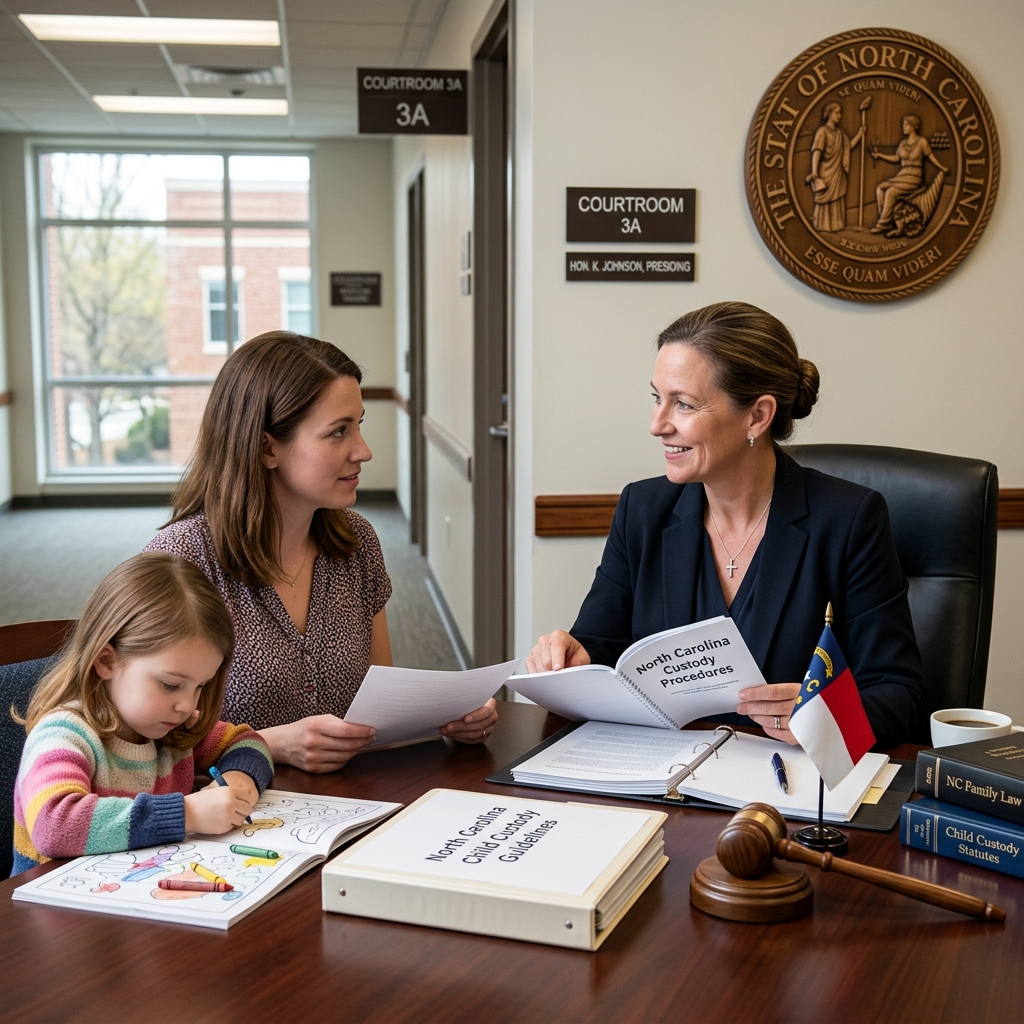
When parents separate or divorce, one of the most important legal questions is how decisions will be made for their child and where the child will live. In North Carolina, custody disputes are resolved in district court using a standard centered on the child’s welfare, not on automatically favoring either parent. The law gives judges broad authority to shape parenting arrangements that serve the child’s needs, whether the issue is legal custody, physical custody, visitation, or later changes to an existing order.
This overview explains how custody works in North Carolina, what courts consider when parents cannot agree, how mediation fits into the process, and what parents should know about emergency relief and modifications. It is designed to give a practical, plain-language understanding of the system rather than a legal strategy for any one case.
What North Carolina Courts Focus On
North Carolina custody decisions are built around the best interests of the child. That means the judge looks at the child’s well-being first and then decides which arrangement is most likely to support stability, safety, development, and healthy family relationships. The state does not use a default rule that automatically gives custody to mothers or fathers.
In practice, judges may consider each parent’s ability to care for the child, the child’s home life, school routine, emotional needs, and the parents’ willingness to cooperate. The court’s job is not to reward or punish either parent, but to create a workable arrangement that protects the child’s interests.
| Issue | What it means |
|---|---|
| Legal custody | The authority to make important decisions about the child’s health, education, and general welfare. |
| Physical custody | Where the child lives and which parent provides day-to-day care. |
| Visitation | The schedule for the parent who does not have primary physical custody to spend time with the child. |
How Custody Is Decided When Parents Disagree
If parents can agree on a parenting plan, they may submit it to the court for approval in the proper case. If they cannot agree, either parent may ask the district court to decide the matter. A custody case can be filed even if the parents are still married, and a custody order may be entered before or after divorce.
Once the case is before the court, the judge can issue temporary orders while the dispute is pending and later enter a final order after hearing evidence. The court may consider testimony, documents, school records, medical information, and other evidence that helps show the child’s needs and each parent’s role in the child’s life.
North Carolina law does not require a parent to prove that the other parent is a bad person to receive custody. The central question is simply which arrangement best serves the child.
Joint Parenting and Sole Custody
North Carolina recognizes that children often benefit from continuing relationships with both parents when that is safe and practical. For that reason, judges may approve arrangements where parents share responsibilities, even if the schedule is not evenly divided.
At the same time, shared parenting requires communication and a workable level of cooperation. When parents have a high-conflict relationship, the court may decide that one parent should have primary authority or primary placement, with the other parent receiving structured visitation. The specific arrangement depends on what the evidence shows will work best for the child.
- Joint legal custody means both parents share decision-making authority.
- Primary physical custody usually means the child lives mostly with one parent.
- Split or shared schedules can be used when they fit the child’s needs and the parents can manage them responsibly.
Visitation and Parenting Time
When one parent has primary physical custody, the other parent is commonly given visitation or parenting time. North Carolina courts generally favor meaningful contact with both parents unless there is a reason to limit it. The child benefits from ongoing involvement with each parent when that involvement is safe, stable, and consistent.
Visitation can be tailored in many ways. Some orders use a detailed schedule with weekends, holidays, school breaks, and summer time. Others use a more flexible arrangement if the parents are able to cooperate. The court may also impose limits, supervised visits, or other safeguards if there are concerns about safety or the child’s well-being.
A well-written parenting schedule often addresses transportation, pick-up and drop-off locations, holiday rotation, vacation notice, phone or video contact, and how disputes over scheduling will be handled. The more specific the order, the easier it is to follow.
Mediation and Settlement Before Trial
North Carolina generally requires parents in custody disputes to attend mediation before the case proceeds to a hearing, unless the court excuses mediation for a good reason. Mediation gives parents a chance to reach their own agreement with the help of a neutral third party, often saving time, stress, and expense.
This process is especially useful when the main disagreement is about schedule details rather than deep safety concerns. Parents who resolve custody privately usually have more control over the outcome than they would in a contested trial. If mediation succeeds, the agreement can be turned into a court order. If it fails, the case continues and a judge decides the unresolved issues.
- Benefits of mediation include lower conflict, faster resolution, and more flexibility.
- Possible limits include situations involving domestic violence, intimidation, or a major imbalance in bargaining power.
- Result can be a full settlement or a narrowed dispute for the court to decide.
Emergency Custody and Urgent Situations
Sometimes a parent needs immediate help because a child may be in danger. North Carolina law allows emergency custody relief in serious situations, including threats of harm, abuse, neglect, or other circumstances that cannot wait for a standard hearing. Emergency orders are not routine custody orders; they are designed to address immediate risk.
A court considering emergency relief may act quickly to protect the child and may order temporary placement, schedule a hearing, or authorize other urgent measures. Because these requests are serious, a parent seeking emergency custody should be prepared to explain the danger clearly and provide as much supporting information as possible.
Emergency jurisdiction can also matter when a family has recently moved. A child’s home state usually has the main authority to hear a custody case, but North Carolina may still be able to step in temporarily when there is an immediate safety issue.
Filing a Custody Case in North Carolina
To begin a custody case, a parent typically files a complaint in district court in the county where the child lives or where jurisdiction otherwise exists under North Carolina law. The filing starts the court process and creates the opportunity for temporary orders, mediation, and a final hearing if needed.
In many counties, court staff or self-help resources can explain the forms required to start the case, but they cannot give legal advice. Parents must make sure they file the correct paperwork and follow local rules about service, deadlines, and hearing procedures. Filing fees are usually required unless the court waives them for a person who qualifies as indigent.
The early stage of the case often matters a great deal because temporary orders can shape the child’s routine for months while the dispute is pending. Parents who want to protect their position should pay close attention to every deadline and court notice.
What Judges May Consider in a Custody Dispute
North Carolina judges have wide discretion and may consider any relevant factor that helps them understand the child’s needs. The law does not use a rigid checklist, but common issues include the child’s adjustment to home and school, each parent’s caregiving history, the parents’ communication, and any conduct that affects the child’s safety or stability.
If there are concerns about domestic violence, substance misuse, neglect, criminal behavior, or repeated interference with parenting time, the court may weigh those facts carefully. The key question is not whether a parent has made a mistake in the past, but whether the child is likely to be better off under one arrangement rather than another.
- Who has been the child’s primary caregiver.
- How well each parent supports school, medical, and daily routines.
- Whether the child has a stable living environment.
- Whether either parent has safety or trust issues that affect parenting.
Modifying an Existing Custody Order
A custody order is not always permanent. If circumstances change significantly, a parent may ask the court to modify the order. North Carolina generally requires a showing of a substantial change in circumstances that affects the child’s welfare before a judge will alter an existing arrangement.
Examples may include a parent relocating, major changes in the child’s needs, repeated violations of the order, or new safety concerns. The court does not reopen custody simply because one parent is unhappy with the current schedule. There must be a meaningful change and a reason why a new order would better serve the child.
When asking for a modification, parents should bring updated evidence rather than re-arguing the same facts that were already decided. Documentation showing how the child is doing under the current order can be especially important.
Practical Steps for Parents
Parents involved in a custody case often improve their position by staying organized and child-focused. Judges tend to respond well to parents who show consistency, cooperation, and attention to the child’s actual needs.
- Keep records of school events, medical appointments, and caregiving duties.
- Follow existing court orders carefully.
- Communicate respectfully in writing when possible.
- Avoid using the child as a messenger or putting the child in the middle.
- Prepare a realistic schedule that fits work, school, and transportation needs.
These steps do not guarantee an outcome, but they help show the court that a parent is focused on stability and the child’s best interests.
Frequently Asked Questions
Do North Carolina courts automatically prefer mothers over fathers? No. The court’s focus is the child’s best interests, not the parent’s gender.
Can custody be decided before the divorce is final? Yes. A custody order can be entered before or after divorce, depending on the case.
Does the court always require a trial? No. Many cases settle through mediation or agreement before a final hearing is needed.
Can grandparents or other non-parents seek custody? In some circumstances, yes, but the rules are different and the case is often more complex than a parent-versus-parent dispute.
Can a custody order be changed later? Yes, if there has been a substantial change in circumstances affecting the child’s welfare.
Why Custody Planning Matters
Child custody decisions can shape a family’s routine for years. A good order does more than assign time; it creates structure, reduces conflict, and helps children maintain relationships that are stable and predictable. In North Carolina, judges have the flexibility to build an arrangement that fits a particular child’s needs, but the quality of the result often depends on the quality of the information the court receives.
For parents, the most effective approach is usually the one that keeps the child’s routine intact as much as possible while addressing safety, communication, and long-term parenting responsibilities in a realistic way.
References
- North Carolina Child Custody Laws — The Mast Law Firm. n.d.. https://www.mastfirm.com/family-law-attorney/nc-child-custody-laws/
- Child Custody in North Carolina: What Every Parent Needs to Know — Tharrington Smith. n.d.. https://tharringtonsmith.com/blog/child-custody-in-north-carolina-what-every-parent-needs-to-know/
- North Carolina Custody — Women’s Law. n.d.. https://www.womenslaw.org/laws/nc/custody/all
- North Carolina General Statutes, Chapter 50A — North Carolina General Assembly. n.d.. https://www.ncleg.net/EnactedLegislation/Statutes/PDF/ByChapter/Chapter_50a.pdf
- Child Custody and Visitation — North Carolina State Bar. n.d.. https://www.ncbar.gov/for-the-public/legal-assistance-for-military-personnel/nc-military-law-articles-take-1-handouts/child-custody-and-visitation/
- North Carolina Custody — Legal Aid of North Carolina. n.d.. https://www.lawhelpnc.org/custody
- NC Child Custody Self-Help Clinic — Legal Aid of North Carolina. n.d.. https://legalaidnc.org/video/nc-child-custody-self-help-clinic/
Similar Articles








Read full bio of medha deb


