
Noise Exposure at Work: Hearing Loss and Your Legal Options in New Jersey
A practical guide for New Jersey workers facing ongoing loud noise on the job, hearing damage, and workers’ compensation claims.
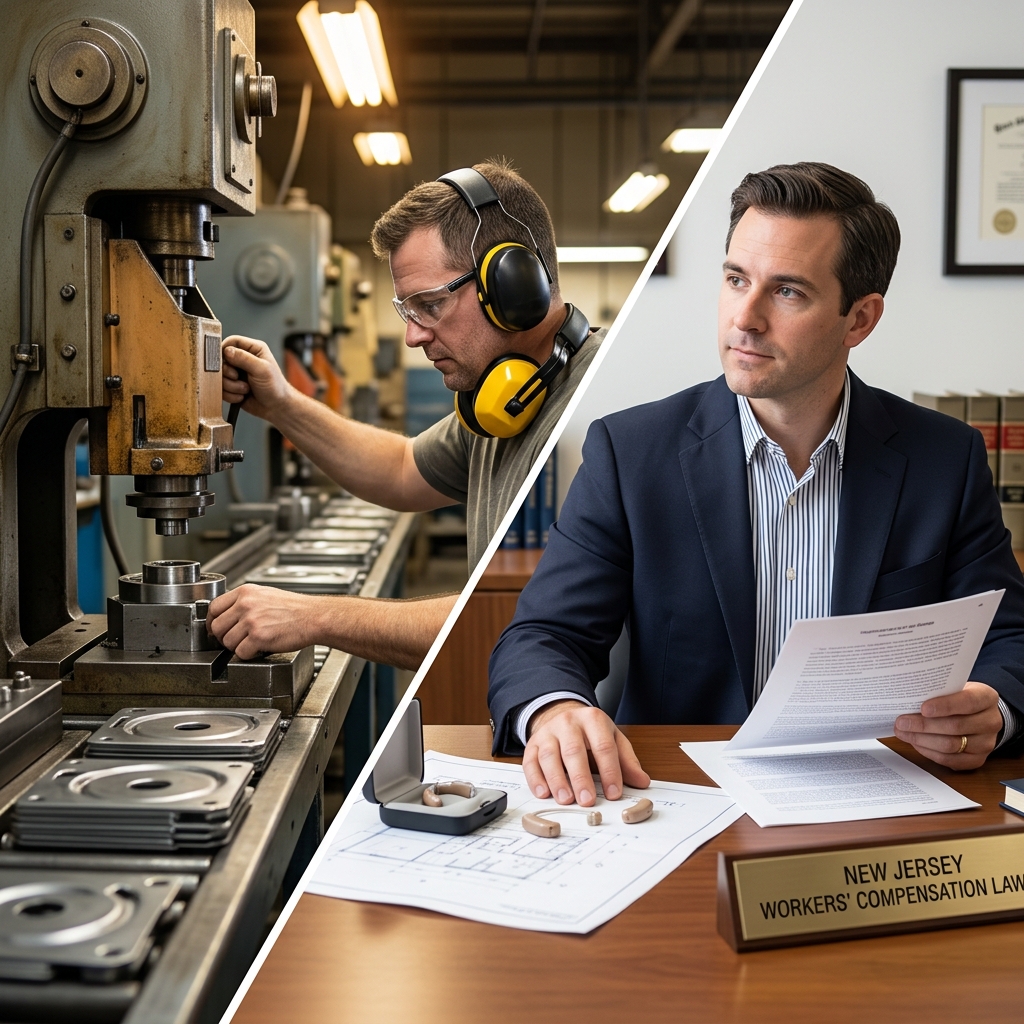
Loud, persistent noise is an everyday reality in many New Jersey workplaces—from construction sites and factories to transportation hubs and entertainment venues. Over time, that noise can cause permanent hearing damage. When this happens, workers are often unsure whether they can sue, file a workers’ compensation claim, or do both. This article explains how New Jersey law treats occupational hearing loss, what counts as hazardous noise exposure, how to prove your claim, and when a lawsuit beyond workers’ compensation might be available.
Understanding Occupational Hearing Loss
Occupational hearing loss is not usually the result of a single loud event but of repeated, long-term exposure to harmful noise levels on the job. New Jersey law specifically recognizes noise-induced occupational hearing loss as a compensable occupational disease when certain conditions are met.
Key characteristics of work-related hearing loss include:
- Gradual onset – Hearing often worsens slowly over months or years, making it easy to ignore early signs.
- Bilateral loss – New Jersey’s statutory definition focuses on permanent loss in both ears (bilateral), typically of the sensorineural type.
- Connection to workplace noise – The hearing damage must be tied to prolonged, habitual exposure to hazardous noise in employment rather than a single accident or non-work factors.
Sudden hearing loss from a one-time event such as an explosion is generally treated as an injury by accident rather than an occupational disease and is still potentially covered under workers’ compensation, but under different rules.
What Counts as Hazardous Noise Exposure?
Not every annoying sound at work qualifies as legally hazardous. Regulators and lawmakers use objective measurements—decibels and duration—to determine when noise becomes dangerous to hearing. In New Jersey, statutes refer to prolonged and habitual exposure to hazardous noise when defining occupational hearing loss.
Prolonged and Habitual Exposure Defined
Under New Jersey law:
- Prolonged exposure generally means exposure to hazardous workplace noise for at least one year.
- Habitual exposure means exposure exceeding the allowable daily dose at least three days each week, for at least 40 weeks per year.
These statutory thresholds underscore that occupational hearing loss is typically the result of long-term patterns, not occasional loud moments.
OSHA Noise Limits
The federal Occupational Safety and Health Administration (OSHA) sets enforceable workplace noise standards. OSHA’s regulation on occupational noise exposure (29 C.F.R. 1910.95) establishes maximum allowable noise levels based on duration, measured in A-weighted decibels (dBA).
| Noise Level (dBA) | Maximum Daily Exposure |
|---|---|
| 90 dBA | 8 hours |
| 95 dBA | 4 hours |
| 100 dBA | 2 hours |
| 105 dBA | 1 hour |
| 110–115 dBA | 30 minutes or less |
Regular exposure above these thresholds can lead to permanent hearing damage and may support a workers’ compensation claim if the exposure is job-related and adequately documented.
New Jersey Workers’ Compensation and Hearing Loss
New Jersey’s workers’ compensation system is designed as a no-fault remedy for injuries and occupational diseases. That means you generally do not have to prove employer negligence; instead, you must show that your hearing loss is connected to your employment.
Occupational Disease vs. Accidental Injury
Noise-induced occupational hearing loss is classified as an occupational disease when it meets the statutory definition. Compensation for this type of hearing loss is governed by specific provisions and schedules in the New Jersey workers’ compensation law.
- Occupational disease (noise-induced hearing loss) – Covers permanent bilateral hearing loss due to prolonged, habitual exposure to hazardous noise.
- Injury by accident (single event) – Covers sudden hearing damage caused by a one-time event such as an explosion or acoustic trauma.
Regardless of classification, the general workers’ compensation rules for medical benefits and disability payments apply, unless specifically modified by the hearing loss statutes.
Types of Benefits Available
If you successfully prove that your hearing loss is work-related under New Jersey law, you may be entitled to several categories of benefits.
- Medical treatment – Payment for reasonable and necessary medical care, including evaluations, audiometric testing, hearing aids, and related treatment.
- Temporary disability benefits – Wage replacement, typically at 70% of your average weekly wage (within statutory minimums and maximums), if you are unable to work while receiving treatment.
- Permanent disability benefits – Compensation based on the percentage of permanent hearing loss and scheduled awards. New Jersey provides 200 weeks of compensation for total loss of hearing, with partial disability paid proportionally.
Permanent disability awards consider whether the loss is in one ear or both, and the degree of disability measured through standardized hearing tests.
How Hearing Loss is Measured for Claims
Demonstrating occupational hearing loss requires objective medical evidence. New Jersey law and workers’ compensation practice rely heavily on audiometric testing and formal hearing threshold calculations.
Audiograms and Hearing Thresholds
Hearing loss is typically evaluated using an audiogram, which plots your hearing sensitivity at different frequencies. For compensation purposes, New Jersey’s statute focuses on specific speech-related frequencies.
In general:
- Thresholds at 1,000, 2,000, and 3,000 Hertz (Hz) are measured and averaged for each ear.
- A baseline level (such as 30 decibels) is subtracted to determine the extent of disability.
- A percentage loss of hearing is calculated, which is used to determine your weekly benefit duration and total compensation.
These calculations help distinguish between normal age-related changes and occupationally induced hearing loss.
Medical Documentation Needed
To support a claim, you will generally need:
- Audiogram results showing the pattern and degree of hearing loss.
- Occupational history describing your job duties, equipment used, and duration of noise exposure.
- Physician or audiologist opinion linking the hearing loss to workplace noise rather than solely aging or non-work factors.
- Any workplace noise measurements, OSHA records, or prior safety complaints documenting hazardous noise levels.
The stronger your objective medical and workplace evidence, the more likely your claim will be accepted or successfully litigated.
Can You Sue for Continued Noise Exposure at Work?
Many workers ask whether they can file a civil lawsuit for ongoing exposure to loud noise at work, especially when ear protection is inadequate or not enforced. The answer often depends on who is legally responsible and how New Jersey workers’ compensation laws interact with other remedies.
Workers’ Compensation as the Primary Remedy
In most cases involving employer-caused occupational hearing loss, workers’ compensation is the exclusive remedy. New Jersey’s system generally bars direct negligence lawsuits against employers for work-related injuries, including occupational diseases, in exchange for guaranteed, no-fault benefits.
Workers’ compensation focuses on:
- Compensating medical costs and wage loss.
- Providing scheduled disability benefits for permanent hearing loss.
- Covering occupational diseases without requiring proof of employer negligence.
Therefore, if your hearing loss stems from continued exposure to noise provided by your employer in the course of your job, your primary route is a workers’ compensation claim.
Third-Party Claims: When a Lawsuit May Be Possible
In some situations, someone other than your employer may share responsibility for harmful noise exposure. For example, a manufacturer might supply defective equipment that generates unsafe noise levels, or a property owner might fail to address known noise hazards. In such cases, a third-party personal injury claim may be possible in addition to your workers’ compensation case.
Third-party claims can potentially allow recovery for:
- Full lost income beyond workers’ compensation wage limits.
- Pain and suffering, which is not covered by workers’ compensation.
- Loss of enjoyment of life and other non-economic damages.
Determining whether you have a viable third-party case requires a careful review of how and why the hazardous noise exists and who controlled or created the conditions.
Limits and Defenses Employers May Raise
Even when medical evidence supports hearing loss, there are potential limits on compensation and defenses employers or insurers may assert.
Failure to Use Hearing Protection
New Jersey law allows employers to avoid paying compensation in certain hearing loss cases if they can properly document that an employee repeatedly and willfully refused to use effective hearing protection that was provided.
Specifically, no compensation is payable for hearing loss caused by hazardous noise after the effective date of the statute if:
- The employer furnished suitable protective devices capable of reducing hearing damage.
- The employer repeatedly warned the worker about using the devices.
- The worker willfully failed to use the protection properly.
This makes it important for workers to follow hearing conservation rules and also for employers to document protective measures and training.
Time Limits for Filing Claims
Workers’ compensation claims in New Jersey must be filed within specific time frames. For occupational hearing loss, the clock generally starts when the worker knew or reasonably should have known that the hearing loss was job-related.
Practical implications include:
- Do not delay medical evaluation if you suspect work-related hearing changes.
- Report the condition to your employer promptly and in writing.
- Consult an attorney early if there is any doubt about deadlines or your rights.
Steps to Take If You Suspect Work-Related Hearing Loss
If you are regularly exposed to loud noise at work and notice ringing in your ears, difficulty hearing speech, or needing to turn up the volume on devices, you should act quickly to protect your health and legal options.
Immediate Actions
- Notify your employer – Put your concerns about hearing loss and workplace noise in writing. Keep a copy of any reports.
- Seek a hearing evaluation – Schedule an exam with a licensed audiologist or ear specialist and obtain a detailed report.
- Request a workers’ compensation form – Ask your employer or the New Jersey Division of Workers’ Compensation for the necessary claim paperwork.
- Document noise exposure – Record where, when, and how you are exposed to loud noise. Note any equipment used, hours of exposure, and whether hearing protection is provided.
- Consult a workers’ compensation attorney – Especially if your claim is disputed, your hearing loss is severe, or you believe a third party may be liable.
Taking these steps early helps establish the occupational link and ensures you do not miss critical filing deadlines.
Frequently Asked Questions
1. Do I have a case if my hearing loss developed slowly over many years?
Yes. New Jersey’s workers’ compensation system specifically recognizes gradual, noise-induced occupational hearing loss as an occupational disease when it results from prolonged and habitual exposure to hazardous noise at work. As long as you can provide objective medical evidence and an occupational history that ties the loss to your job, you may have a compensable claim.
2. What if my employer says my hearing loss is just due to aging?
Age-related hearing changes are common, but they do not automatically exclude occupational causes. Audiometric analysis and medical opinion can distinguish patterns typical of noise exposure from those expected with aging. A workers’ compensation judge will weigh expert testimony and supporting documentation.
3. Can I still get benefits if I used earplugs or muffs at work?
Yes, it is possible. Even with hearing protection, noise levels or duration might exceed safe limits, or the protection may be inadequate for the environment. However, if an employer can prove you willfully refused to use suitable protection after repeated warnings, your hearing loss compensation could be denied for post-warning exposure.
4. Is workers’ compensation my only option for hearing loss?
Workers’ compensation is usually the exclusive remedy against your employer, but if a third party (such as a product manufacturer or property owner) contributed to hazardous noise, you may have a separate personal injury claim for broader damages. An attorney can review the facts to determine whether such a claim is viable.
5. How long do I have to file a claim in New Jersey?
For occupational hearing loss, New Jersey generally allows claims to be filed within two years of the date you knew—or reasonably should have known—that your hearing loss was related to your job. Because this standard can be disputed, it is wise to report symptoms and seek legal advice as soon as possible.
References
- Occupational Noise Exposure Standard (29 CFR 1910.95) — Occupational Safety and Health Administration (OSHA). 2023-05-01. https://www.osha.gov/laws-regs/regulations/standardnumber/1910/1910.95
- New Jersey Workers’ Compensation Law (Noise-Induced Hearing Loss Provisions) — New Jersey Department of Labor and Workforce Development. 2024-01-01. https://www.nj.gov/labor/workerscompensation/assets/PDFs/Forms/wc_law.pdf
- New Jersey Revised Statutes §34:15-35.10 — State of New Jersey. 2025-01-01. https://law.justia.com/codes/new-jersey/title-34/section-34-15-35-10/
- New Jersey Statutes Title 34: Habitual Exposure Definition — FindLaw / State of New Jersey. 2025-01-01. https://codes.findlaw.com/nj/title-34-labor-and-workmens-compensation/nj-st-sect-34-15-35-11/
- Work-Related Hearing Loss Claims: What You Need To Know — Petro Cohen & Associates. 2023-06-15. https://petrocohen.com/blog/work-related-hearing-loss-claims-what-you-need-to-know/
- Hearing Loss at Work: When You Can File for Workers’ Compensation in NJ — Brandon J. Broderick, Attorney at Law. 2023-09-20. https://www.brandonjbroderick.com/new-jersey/hearing-loss-work-when-you-can-file-workers-compensation-nj
- Can I Collect Workers’ Compensation for Hearing Loss? — Shebell & Shebell, LLC. 2022-11-30. https://shebell.com/can-i-collect-workers-compensation-for-hearing-loss/
Similar Articles








Read full bio of Sneha Tete




