
Ninth Circuit’s Uber Arbitration Ruling and the Gig Economy
How a key Ninth Circuit decision requiring Uber drivers to arbitrate reshapes worker classification battles in the gig economy.
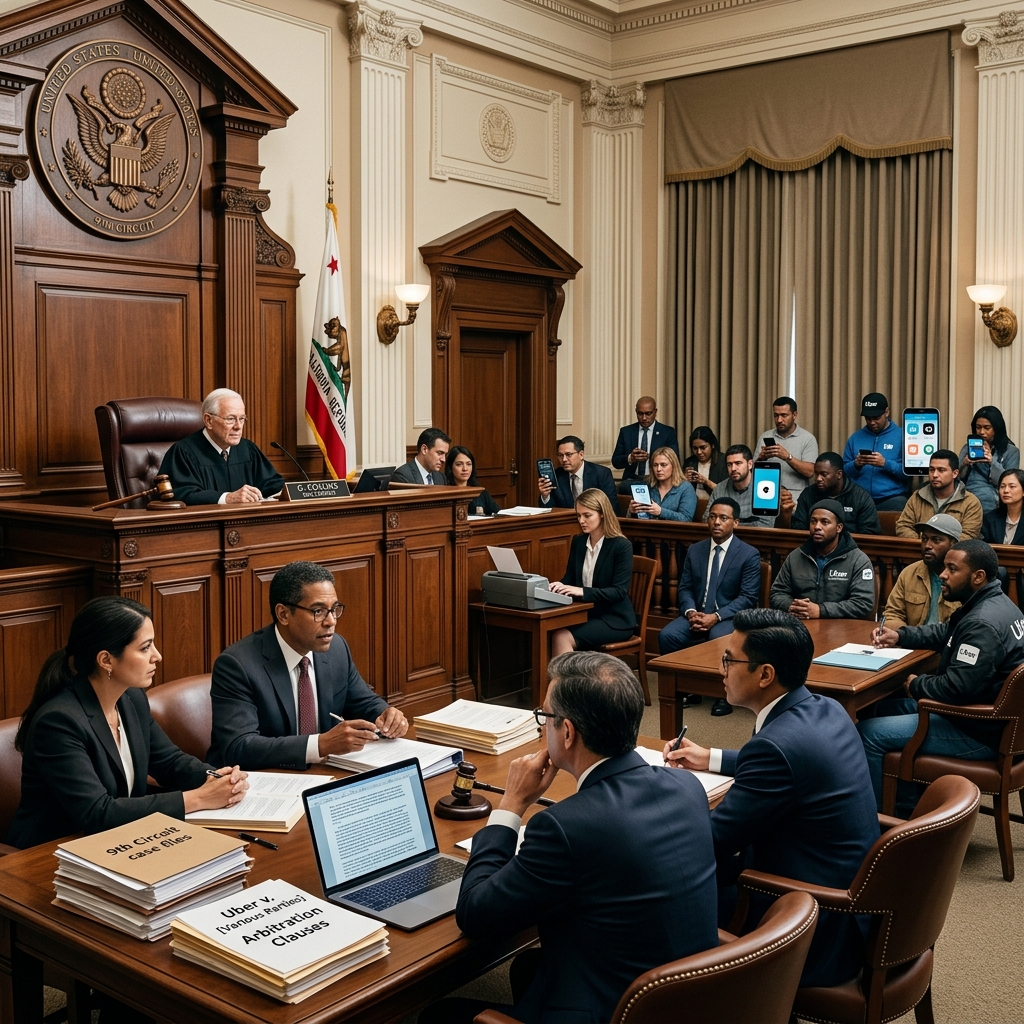
The Ninth Circuit Court of Appeals has played a central role in defining how disputes between Uber and its drivers are resolved, particularly in battles over whether drivers are employees or independent contractors. One of its key decisions held that Uber drivers challenging their classification must proceed in individual arbitration rather than in court, because they are not part of a “class of workers engaged in foreign or interstate commerce” under the Federal Arbitration Act (FAA). That outcome represents a significant victory for Uber and for companies that rely on arbitration agreements in the gig economy.
Background: Uber, the Gig Economy, and Worker Classification
Uber’s business model depends on treating drivers as independent contractors rather than employees, avoiding many of the costs and obligations associated with traditional employment, such as overtime, benefits, and certain tax and insurance requirements. In response, drivers have filed numerous lawsuits seeking to be reclassified as employees and to recover unpaid wages, benefits, and other damages.
These classification suits typically raise questions such as:
- Whether Uber exercises enough control over drivers to make them employees under state or federal law.
- Whether drivers should receive minimum wage and overtime pay.
- Whether they are entitled to reimbursement of expenses such as fuel, vehicle maintenance, and insurance.
- Whether they should receive protections under statutes like California’s labor code.
Uber has responded by relying heavily on mandatory arbitration agreements in its driver contracts, which direct most disputes away from public courts and into private arbitration forums. Multiple federal appellate decisions, including in the Ninth Circuit, have addressed how those agreements interact with the FAA and state law.
The Federal Arbitration Act and Its Transportation Worker Exemption
The Federal Arbitration Act, enacted in 1925, generally requires courts to enforce written arbitration agreements as they would other contracts. However, Section 1 of the FAA contains an important exemption: it excludes “contracts of employment of seamen, railroad employees, or any other class of workers engaged in foreign or interstate commerce.”
Workers who fall within this exemption are not bound by the FAA’s enforcement rules, and courts have more room to decline arbitration even when a contract calls for it. For Uber drivers, the key question became whether their work places them in such a “class of workers” engaged in interstate commerce.
Courts interpreting this exemption have emphasized that:
- The exemption applies to transportation workers whose work is centrally focused on interstate or foreign commerce.
- Occasional or incidental interstate trips are usually not enough to qualify.
- The analysis considers the class of workers as a whole, not the rare activities of a few individuals.
Key Ninth Circuit Decision: Uber Drivers Must Arbitrate
In a prominent case involving Uber drivers seeking a preliminary injunction and litigating classification claims, the Ninth Circuit considered whether those drivers were covered by the FAA exemption. The court affirmed a district court order compelling arbitration and rejected the drivers’ argument that they were interstate transportation workers.
The drivers claimed that their work included transporting passengers to airports or across state lines, and therefore constituted engagement in interstate commerce. The Ninth Circuit disagreed, emphasizing the predominantly local nature of Uber’s service.
According to the Ninth Circuit:
- Uber drivers as a nationwide class primarily carry passengers on intrastate trips within a single state.
- Any interstate travel or airport-related trips are typically incidental to a mostly local transportation service.
- Because interstate commerce is not central to the drivers’ role, they do not fall within the FAA Section 1 exemption and remain subject to mandatory arbitration.
On this basis, the Ninth Circuit concluded that the drivers’ classification claims must be resolved through arbitration rather than in court. This prevented the drivers from pursuing broad, court-based relief and kept disputes largely within private arbitration forums.
Comparison: Similar Rulings from Other Circuits
The Ninth Circuit’s reasoning did not arise in isolation. Other federal appellate courts reached similar conclusions regarding ride-share drivers and the FAA exemption.
| Court | Case | Key Holding on Uber Drivers |
|---|---|---|
| Ninth Circuit | Capriole v. Uber Technologies Inc. | Drivers are not a class of workers engaged in interstate commerce; arbitration agreements are enforceable. |
| Third Circuit | Singh v. Uber Technologies Inc. | Uber drivers are subject to the FAA because interstate carriage is not central to their work. |
The Third Circuit in Singh emphasized that only workers whose engagement in foreign or interstate commerce is “significant or central” qualify for the exemption. Like the Ninth Circuit, it found that car-service drivers whose work is mostly intrastate remain subject to arbitration under the FAA.
Impact on Class Actions and Collective Litigation
One major consequence of enforcing Uber’s arbitration agreements is the restriction of class actions and other collective litigation in court. When drivers must arbitrate their claims individually:
- Large, unified lawsuits challenging worker classification become harder to pursue.
- Drivers must file separate arbitration demands, which can be costly and time-consuming.
- Public judicial precedents that might clarify classification rules are less likely to emerge.
Earlier Ninth Circuit decisions in cases such as O’Connor v. Uber Technologies, Inc. and Mohamed v. Uber Technologies, Inc. reinforced this trend by holding that Uber’s arbitration agreements were valid and that disputes over their enforceability belonged in arbitration. Collectively, these rulings have had the effect of breaking up or limiting class actions brought by drivers against Uber.
The shift from class actions to arbitration has encouraged new strategies, such as mass arbitration, where thousands of individual arbitration demands are filed simultaneously to exert settlement pressure. This approach, however, brings its own procedural and cost challenges for both drivers and the company.
Why the Ninth Circuit Found Uber’s Service Primarily Intrastate
The Ninth Circuit’s conclusion that Uber drivers are not engaged in interstate commerce rested on several practical observations.
- Trip patterns: Most Uber rides begin and end within the same state and often within the same metropolitan area.
- Business design: Uber markets itself as a local, on-demand transportation service focused on short-distance travel rather than interstate journeys.
- Limited interstate trips: While some drivers may occasionally cross state borders or serve airport routes linked to interstate travel, those trips form a small fraction of total rides.
From a legal perspective, this analysis follows Supreme Court and appellate case law that treats the FAA exemption as targeted at transportation workers whose jobs are integral to interstate commerce, such as truck drivers hauling goods across state lines or railroad workers moving passengers between states. Local transportation providers, by contrast, typically fall outside the exemption even if their work sometimes intersects with interstate systems.
Practical Consequences for Uber Drivers
For drivers, the Ninth Circuit’s arbitration ruling has several practical implications:
- Forum of dispute resolution: Most disputes with Uber, including classification challenges, must be raised in arbitration under the terms of the driver agreement.
- Procedural rules: Arbitration may involve different discovery rules, confidentiality provisions, and evidentiary standards than public court proceedings.
- Costs and fees: Although many arbitration clauses shift some fees to the company, drivers still face individual filing and representation costs.
- Limited public precedent: Outcomes in arbitration are usually private, limiting their value as legal precedent for other drivers.
At the same time, arbitration can sometimes move faster than court litigation and may provide a more streamlined process for individual claims. Whether this is beneficial depends on each driver’s circumstances and the specifics of the arbitration agreement.
Implications for Gig Economy Platforms
The Ninth Circuit’s reasoning is relevant not just to Uber, but to many other gig economy platforms that rely on local, app-based services and classify workers as independent contractors. Companies offering rides, deliveries, or services within confined geographic areas may argue that their workers are not engaged in interstate commerce and thus fall under the FAA’s arbitration enforcement framework.
Key implications include:
- Platforms can design arbitration agreements with confidence that courts may enforce them where work is mostly intrastate.
- Workers in these sectors may find it difficult to bring class actions for wage-and-hour or classification disputes.
- Legal strategy will likely focus on the substance of arbitration clauses—such as opt-out mechanisms, cost allocations, and scope of covered claims—rather than on the FAA exemption.
Nevertheless, state laws, public policy debates, and legislative developments (such as state-level statutes defining employee status) continue to influence rights and obligations in the gig economy. Arbitration decisions do not address all aspects of worker protection but they strongly shape how disputes over those protections are litigated.
Frequently Asked Questions (FAQs)
Are Uber drivers considered interstate transportation workers under the FAA?
No. The Ninth Circuit held that Uber drivers, as a nationwide class, are not engaged in foreign or interstate commerce within the meaning of the FAA’s Section 1 exemption, because their work is predominantly local and intrastate.
Does this mean Uber drivers cannot sue in court over classification issues?
In general, where drivers signed arbitration agreements governed by the FAA, their classification claims must proceed in arbitration rather than in court, unless some separate contract or statutory basis allows court litigation.
How did other federal courts view similar arguments?
Other circuits, such as the Third Circuit in Singh v. Uber Technologies Inc., agreed that Uber drivers are subject to the FAA because interstate commerce is not central to their work. These decisions show a growing consensus that ride-share drivers typically do not fall within the transportation worker exemption.
What happens to class actions brought by Uber drivers?
Enforced arbitration clauses generally prevent drivers from pursuing large class actions in court. Instead, they must file individual arbitration demands or rely on mass arbitration strategies to aggregate claims procedurally.
Does arbitration affect whether drivers are employees or independent contractors?
Arbitration changes the forum in which classification disputes are heard, but not the underlying legal standards. Arbitrators must still apply relevant state and federal law to determine whether drivers are employees or independent contractors.
References
- Ninth Circuit Provides Victory for Uber and Arbitration — Columbia Journal of Law & Social Problems. 2018-10-24. https://jlsp.law.columbia.edu/2018/10/24/ninth-circuit-provides-victory-for-uber-and-arbitration/
- Ninth Circuit Rules Uber Drivers Must Arbitrate Classification Claims Because They Are Not Interstate Transportation Workers — Seyfarth Shaw LLP. 2021-08-09. https://www.wagehourlitigation.com/2021/08/ninth-circuit-rules-uber-drivers-must-arbitrate-classification-claims-because-they-are-not-interstate-transportation-workers/
- Uber Arbitration Agreements Deliver a Blow to Drivers in Class Action — Klinedinst PC. 2016-09-20. https://klinedinstlaw.com/uber-arbitration-agreements-drivers-class-action/
- Capriole v. Uber Technologies Inc. — U.S. Court of Appeals for the Ninth Circuit. 2021-08-02. https://cdn.ca9.uscourts.gov/datastore/opinions/2021/08/02/20-16030.pdf
- Third Circuit Holds Uber Drivers Are Subject To The Federal Arbitration Act (FAA) — Bressler, Amery & Ross. 2019-08-22. https://www.bressler.com/news-Third-Circuit-Holds-Uber-Drivers-Are-Subject-To-The-Federal-Arbitration-Act-FAA
- O’Connor v. Uber Technologies, Inc. — U.S. Court of Appeals for the Ninth Circuit (via Justia). 2018-09-25. https://law.justia.com/cases/federal/appellate-courts/ca9/14-16078/14-16078-2018-09-25.html
- The Merits and Pitfalls of Mass Arbitration for Uber and Uber Drivers — Miller Shah LLP. 2020-03-04. https://millershah.com/blog/mass-arbitration-uber/
Similar Articles








Read full bio of Sneha Tete




