
Ninth Circuit: Pre-Employment Drug Tests and Discrimination Limits
How the Ninth Circuit views pre-employment drug testing, disability protections, and the legality of strict one-strike rules for job applicants.
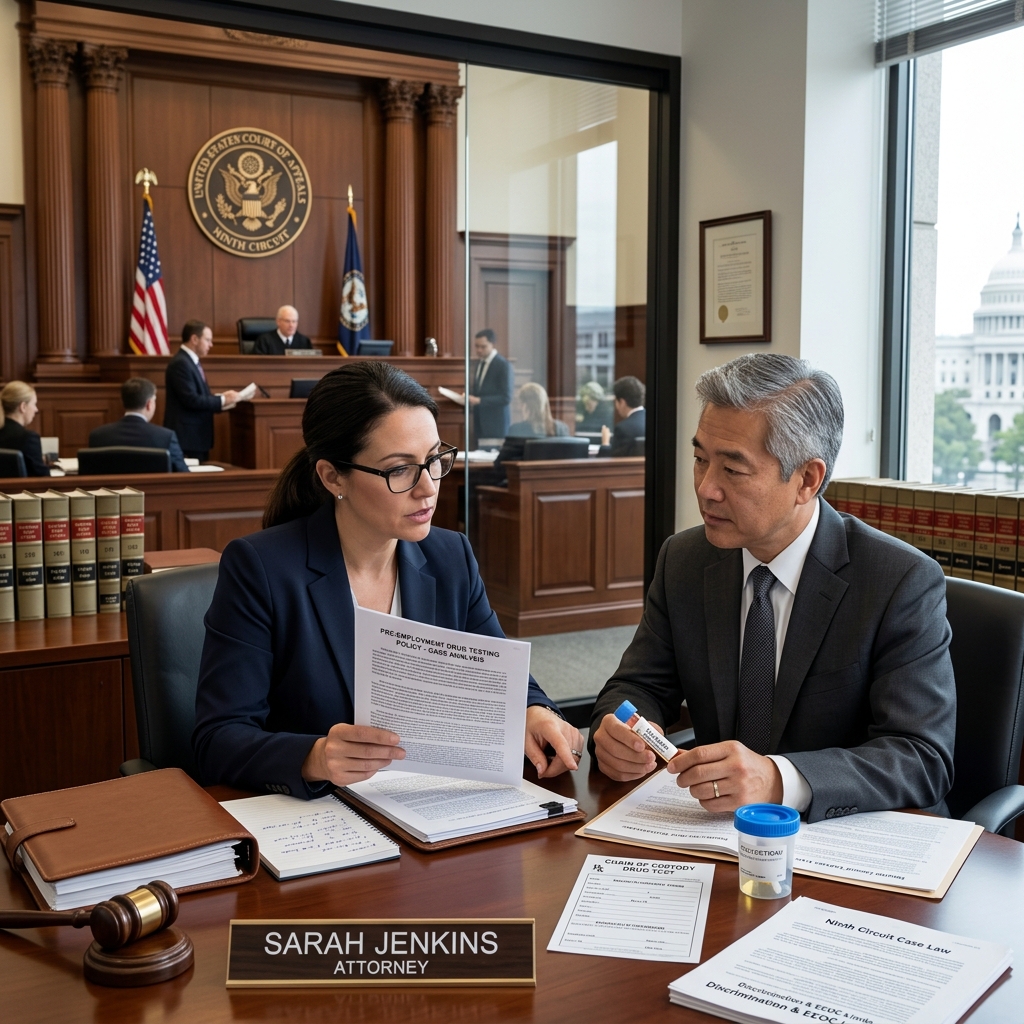
Pre-employment drug testing has become a routine part of many hiring processes, especially in safety-sensitive industries. Employers frequently ask whether strict drug screening policies risk violating disability discrimination laws, particularly when applicants include individuals recovering from substance addiction. The United States Court of Appeals for the Ninth Circuit has addressed these concerns in multiple decisions, clarifying when such policies are lawful and when they may cross legal boundaries.
This article explains how the Ninth Circuit analyzes pre-employment drug tests under the Americans with Disabilities Act (ADA) and California’s Fair Employment and Housing Act (FEHA), focusing on neutral screening rules, recovering addicts’ protections, and the limits imposed by constitutional privacy principles in the public sector.
Legal Background: Drug Testing and Disability Discrimination
To understand the Ninth Circuit’s approach, it is important to distinguish several overlapping areas of law:
- ADA: A federal statute prohibiting discrimination against qualified individuals with disabilities in employment, including hiring decisions.
- California FEHA: A state law providing similar, often broader, protections against disability and other forms of discrimination in the workplace.
- Constitutional protections: For public employers, drug testing can implicate the Fourth Amendment’s protection against unreasonable searches, requiring special justification for testing certain applicants.
Under both the ADA and FEHA, people who are currently using illegal drugs are not protected as disabled, but individuals who have a history of addiction and are in recovery may be recognized as having a disability. The key issue is whether a hiring policy targets those protected individuals because of their disability or instead applies equally to all applicants regardless of medical status.
Recovering Addicts and Pre-Employment Drug Tests
Both the ADA and FEHA restrict employers from discriminating against qualified applicants who have successfully completed rehabilitation and are no longer using illegal drugs. The concern some employers have is that strict pre-employment drug tests and “zero tolerance” rules might indirectly disqualify a disproportionate number of recovering addicts, raising questions about disparate treatment or disparate impact discrimination.
The Ninth Circuit has made an important distinction between the status of being a recovering addict and the conduct of failing a drug test. A person in recovery who tests negative is treated the same as any other applicant; there is no automatic exclusion based on past addiction alone.
Where an applicant fails a test, the court has emphasized that this result reflects actual drug use at the time of testing, not the mere existence of a prior addiction. From the court’s perspective, this difference matters: anti-discrimination laws protect against decisions made because of disability, not decisions based on general rules that apply to everyone who engages in certain conduct, such as illegal drug use.
Neutral Screening Rules: The One-Strike Policy
One of the most frequently discussed policies in Ninth Circuit case law is the “one-strike” rule in pre-employment drug screening. Under such a rule, any applicant who tests positive on a pre-employment drug screen is permanently barred from employment with the company, regardless of whether the positive result stems from addiction, occasional recreational use, or a one-time experiment.
In reviewing a one-strike policy, the Ninth Circuit has focused on whether the rule treats all applicants equally and whether it is motivated by legitimate, non-discriminatory reasons such as workplace safety. Where the policy applies identically to every applicant and is not selectively enforced against people with known histories of addiction, the court has characterized it as facially neutral rather than discriminatory.
For example, the court has pointed out that such rules:
- Remove all applicants who test positive for drugs, regardless of their medical or addiction status.
- Are justified by safety or reliability concerns rather than a desire to exclude people with disabilities.
- Do not automatically identify or target recovering addicts as a group; instead, they screen for the presence of drugs at a particular moment in time.
From an ADA standpoint, the court has relied on the principle that disability laws prohibit decisions made because of a person’s disability, not decisions made because of a factor merely related to that disability. A drug test focuses on current drug use, which is conduct; the disability laws focus on protected status. This distinction is central to the court’s reasoning.
Disparate Treatment vs. Disparate Impact
Discrimination claims under the ADA and FEHA generally fall into two categories:
| Type of claim | Core question | Implications for drug testing policies |
|---|---|---|
| Disparate treatment | Did the employer intentionally treat a protected person less favorably because of disability? | Evidence would need to show that recovering addicts are singled out or targeted differently from other applicants. |
| Disparate impact | Does a neutral policy disproportionately harm a protected group, without adequate business justification? | Evidence would involve statistical proof that recovering addicts are excluded at much higher rates than similarly qualified non-addicts. |
In the one-strike context, the Ninth Circuit has rejected disparate treatment arguments where the policy applies identically to all applicants and there is no proof of targeting people with addiction histories.
Disparate impact claims require more than speculation. An applicant must show reliable data indicating that the rule results in significantly fewer recovered addicts being employed compared to non-addicts in the relevant labor market, and that this impact is not justified by legitimate business or safety needs. In the cases considered, plaintiffs have not been able to provide such evidence, and courts have therefore upheld the rules as lawful.
Safety Justifications and Employer Business Needs
Safety considerations play a major role in the Ninth Circuit’s analysis of pre-employment drug testing. Employers often cite reasons such as:
- Operating heavy machinery or equipment.
- Working in environments where impairment could cause serious harm to co-workers or the public.
- Handling sensitive materials or performing tasks requiring high levels of attention and judgment.
When employers implement strict testing policies, including one-strike rules, to address these risks, courts have generally accepted these purposes as legitimate and non-discriminatory. In the cases involving neutral policies, the Ninth Circuit has noted that the safety rationale provides a lawful business reason for screening out applicants who test positive.
However, the presence of a safety reason does not automatically make every drug testing policy lawful, particularly for public employers, which must also satisfy constitutional requirements.
Public Employers and Constitutional Limits on Drug Testing
When the employer is a government entity, pre-employment drug tests raise additional constitutional issues. The U.S. Supreme Court has recognized that drug testing can constitute a search under the Fourth Amendment, implicating privacy rights and requiring a sufficient justification beyond general interest in a drug-free workplace.
The Ninth Circuit has applied these principles in cases where a city required applicants for certain positions to submit to drug testing. In one notable decision, the court held that the city’s policy was unconstitutional as applied to an applicant for a library page position because the city failed to demonstrate a special need justifying suspicionless testing for that low-risk role.
The court did not declare all pre-employment drug testing by public employers unconstitutional. Instead, it indicated that:
- Jobs involving public safety or law enforcement (for example, police officers) may justify mandatory pre-employment testing due to heightened risks.
- Positions with minimal safety implications may require stronger justification before suspicionless testing can be lawfully imposed.
Public employers therefore must carefully assess the nature of each position and the risks associated with drug use when designing their testing policies. A one-size-fits-all approach to drug screening may be vulnerable to constitutional challenge if applied to low-risk roles without adequate support.
Frequently Asked Questions
Does a strict pre-employment drug test automatically count as disability discrimination?
No. According to Ninth Circuit decisions, routine, neutral drug tests that screen all applicants for current drug use do not automatically constitute disability discrimination under the ADA or California FEHA. The key is that the test must apply equally to all candidates and not be used to target individuals because of their disability status.
Are recovering drug addicts protected under the ADA and FEHA?
Yes. Individuals who have successfully rehabilitated from drug addiction and are not currently using illegal drugs can be considered disabled and protected from discrimination under both federal and California law. However, these laws do not shield them from neutral rules that disqualify any applicant who fails a drug test, regardless of the reason for the positive result.
What is a one-strike rule, and is it lawful?
A one-strike rule is a policy under which any applicant who tests positive for illegal drugs during pre-employment screening is permanently barred from being hired. The Ninth Circuit has held that such a policy does not violate the ADA when it is neutral, applies to all applicants, and is supported by legitimate reasons such as workplace safety. The court has rejected claims that the rule inherently targets recovering addicts as a protected class.
Can a public employer drug test all job applicants?
Not always. For public employers, drug testing is treated as a search under the Fourth Amendment, which means the government must demonstrate a “special need” to justify suspicionless testing. The Ninth Circuit has ruled that broad pre-employment testing can be unconstitutional when applied to low-risk positions without adequate justification, even though it may remain lawful for safety-sensitive roles.
Does failing a drug test give rise to a disability claim?
Courts distinguish between adverse actions taken because of disability and adverse actions taken because of conduct, such as failing a drug test. Failure based on current illegal drug use generally is not protected under the ADA. However, in some circumstances, an employee or applicant may argue that the employer’s response to the failure is tied to disability discrimination; these cases depend heavily on specific facts and evidence.
Key Takeaways for Employers and Applicants
From the Ninth Circuit’s decisions, several practical lessons emerge:
- Neutral application is critical: Policies must apply equally to all applicants and should not single out individuals with known disabilities.
- Safety-based justifications help support testing: Employers are on stronger legal footing when they can point to concrete safety or operational reasons for their testing rules.
- Public employers face added constitutional scrutiny: Government entities must show a special need for suspicionless testing, particularly for positions not tied to public safety.
- Recovering addicts are protected, but not exempt: Employment laws protect qualified recovering addicts from status-based discrimination, yet they do not exempt them from neutral, uniformly applied drug screening policies.
Overall, the Ninth Circuit’s case law affirms that pre-employment drug testing, including strict one-strike rules, can be lawful when carefully designed and neutrally enforced. At the same time, public employers must remain mindful of constitutional limits, and all employers should regularly review their policies to ensure they align with evolving legal standards and guidance.
References
- Americans with Disabilities Act of 1990, as amended — U.S. Equal Employment Opportunity Commission. 2024-01-01. https://www.eeoc.gov/statutes/americans-disabilities-act-1990-ada
- Enforcement Guidance on the ADA and Psychiatric Disabilities — U.S. Equal Employment Opportunity Commission. 2008-03-01. https://www.eeoc.gov/laws/guidance/enforcement-guidance-ada-and-psychiatric-disabilities
- California Fair Employment and Housing Act Overview — California Civil Rights Department. 2023-06-15. https://calcivilrights.ca.gov/fair-employment-housing-act/
- Lanier v. City of Woodburn, 518 F.3d 1147 (9th Cir. 2008) — ACLU of Oregon Case Summary. 2008-03-13. https://www.aclu-or.org/cases/lanier-v-woodburn
- Legal Alert: Public Employers: Drug Screening All Applicants Held Unconstitutional — FordHarrison LLP. 2008-04-01. https://www.fordharrison.com/legal-alert-public-employers-drug-screening-all-applicants-held-unconstitutional
- Ninth Circuit Holds “One-Strike” Drug Testing Rule Does Not Violate ADA — Stoel Rives World of Employment. 2011-03-15. https://www.stoelrivesworldofemployment.com/2011/03/articles/news/ninth-circuit-holds-one-strike-drug-testing-rule-does-not-violate-ada/
Similar Articles








Read full bio of Sneha Tete




