
New York Wage And Hour Law: 2025 Employer Compliance Checklist
A practical overview of pay rules, overtime, breaks, and worker protections in New York.
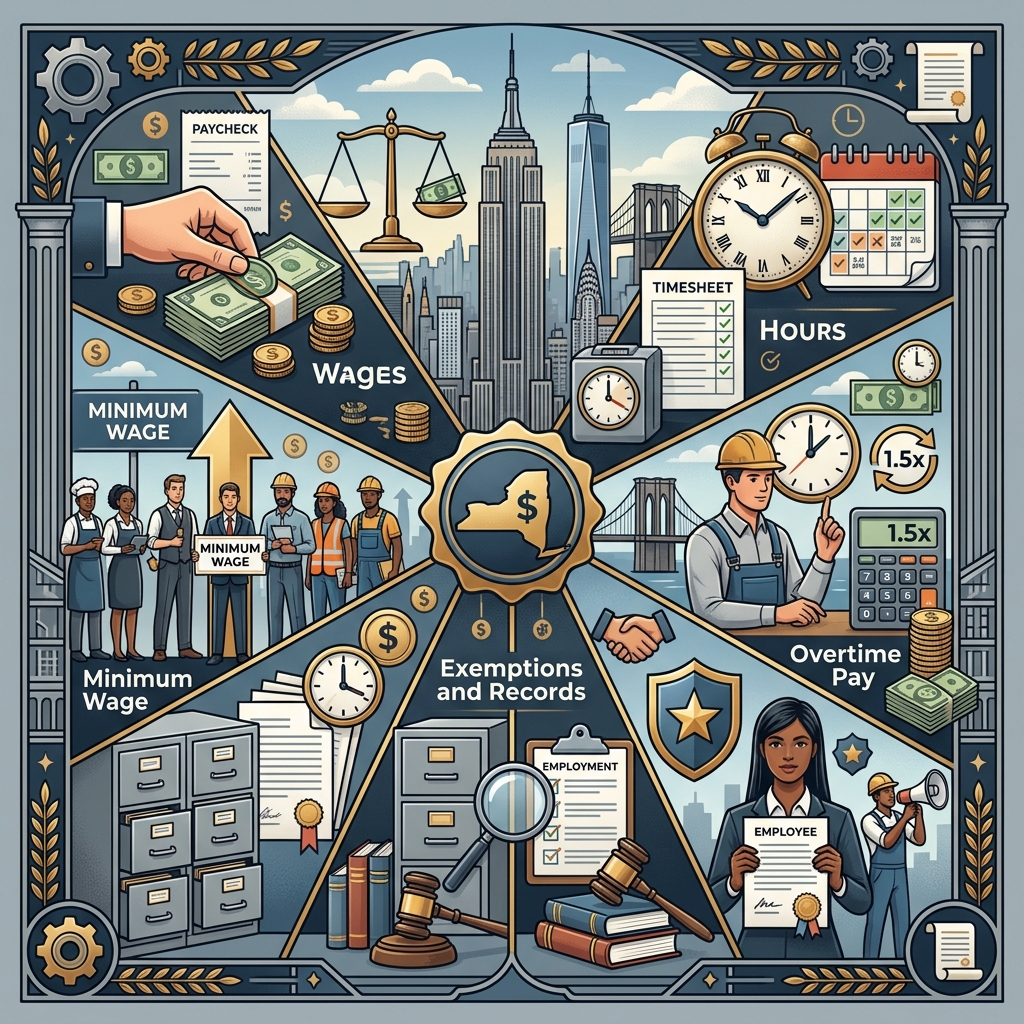
New York wage and hour law sets the baseline rules for how workers must be paid, when overtime applies, and what kinds of rest and meal periods employers must provide. The system is built to protect employees from underpayment while also giving employers clear payroll obligations under state law.
These rules affect many parts of the employment relationship: hourly pay, salary classifications, tipped work, farm labor, and the timing of paychecks. Because New York also has regional minimum wage rates and special rules for certain industries, employers must pay close attention to where work is performed and what type of work is involved.
How New York’s pay rules are organized
New York wage law is not limited to a single minimum wage number. Instead, it uses a mix of statewide standards and local adjustments that depend on the employee’s location and job category.
- Different minimum wage rates may apply in New York City, Long Island, Westchester, and the rest of the state.
- Some jobs, such as tipped service work and food service work, can use a tip credit system if the employer follows the legal requirements.
- Overtime rules generally require extra pay after 40 hours in a workweek, but agriculture has a separate threshold.
- Employers must also follow rules on pay frequency, deductions, and meal periods.
Minimum wage: the foundation of lawful pay
The minimum wage is the lowest hourly rate an employer may lawfully pay for covered work. Cornell’s labor law summary reports that New York sets a statewide base minimum wage of $15 per hour, with a higher $16 per hour rate in New York City, Long Island, and Westchester. Other sources note later scheduled increases, showing that New York’s wage floors change over time and must be checked against the current effective date.
For many employers, the practical lesson is simple: payroll compliance depends on both geography and timing. A worker performing the same task may be subject to different wage floors depending on whether the work is done in New York City or elsewhere in the state.
| Location | General minimum wage cited in the sources | Notes |
|---|---|---|
| New York City, Long Island, Westchester | $16.00 per hour | Higher regional minimum wage applies. |
| Remainder of New York State | $15.00 per hour | Statewide floor outside the higher-cost regions. |
| Fast food and tipped work | Special rules apply | Tip credits and industry-specific rates may change the calculation. |
Some materials also show upcoming or recent increases, which means the correct number must always be matched to the specific effective date. For that reason, employers should not rely on a single historical wage chart without checking the current state guidance.
Overtime pay for hours beyond the standard workweek
In New York, nonexempt employees generally earn overtime pay at one and one-half times their regular rate for hours worked over 40 in a workweek. This is one of the most important wage rules because it affects both hourly workers and some salaried employees who do not qualify for an exemption.
When an employee is paid at different rates during the week, overtime is usually based on the regular rate, which may need to be calculated using the worker’s average earnings for that period. That means employers cannot avoid overtime obligations simply by changing the pay mix or splitting tasks into separate rates if the employee remains nonexempt.
Farm workers are treated differently. Cornell’s summary notes that farm employees may receive overtime only after 56 hours instead of 40. This special threshold reflects New York’s separate treatment of agricultural labor and should not be confused with the standard overtime rule for most other workers.
Exempt employees and salary thresholds
Not every employee is entitled to overtime. New York, like federal law, recognizes exemptions for certain employees in executive, administrative, and professional roles when salary and duty tests are met. However, exemption status is narrow and depends on both job duties and pay level, not just a title.
Sources discussing 2025 thresholds show that the salary level for overtime-exempt workers may vary by region, with a higher threshold in New York City and surrounding counties than in the rest of the state. This makes classification reviews especially important for employers with office, managerial, or professional staff.
Rules for paydays and methods of payment
New York law also regulates how often employees must be paid. The state Department of Labor lists wage topics that include methods of payment, frequency of pay, and notices to employees, reflecting the broader payroll compliance framework employers must follow.
In practical terms, payroll mistakes can create serious liability when wages are late, underpaid, or delivered in the wrong form. Employees should receive wages on the schedule required by law and by any valid company policy, and deductions must be lawful.
- Employers should maintain a regular payday schedule.
- Pay records should clearly show hours worked, rate changes, and overtime calculations.
- Illegal deductions can lead to wage claims and enforcement action.
Meal periods, breaks, and time away from work
New York requires meal periods in several situations. Cornell’s summary states that employees who work a shift longer than six hours are entitled to a meal period, and farm employees are entitled to a full 24-hour day of rest each week. The state labor department also identifies day of rest and meal period rules as core wage and hour topics.
The exact length and timing of a break can depend on when the shift starts, how long it lasts, and whether the work crosses the lunch period or nighttime hours. That means employers should not assume that a single break policy fits every schedule.
For workers, meal-period rules matter because they can affect both rest and pay. In some situations, a break must be provided and may be unpaid only if it truly qualifies under the law. If the break is too short or interrupted by work duties, it may not count as a valid unpaid meal period.
Special categories of employees
New York wage and hour law includes a number of special rules for specific groups. Tipped workers are a major example. Employer guidance and labor-law summaries show that service employees and food service workers may be paid different base wages because employers can claim a tip credit when the legal conditions are met.
Farm employees also stand apart, with special overtime and rest-day rules. In addition, the state has industry-specific or status-specific pay treatment for certain jobs, including rules that can affect salary floors, breaks, and how overtime is measured.
Worker protections beyond hourly pay
Although wage and hour law focuses on pay, it sits within a broader system of worker protections. NYC311’s labor-law information notes that workers in New York have rights related to wages, hours of work and overtime, leave, safety and health, and discrimination. That broader enforcement landscape matters because wage theft often appears alongside other employment violations.
Pay-related rights also connect to equal pay and transparency rules. Paylocity’s summary notes that New York law restricts unequal pay for substantially similar work and includes pay transparency requirements for covered job postings. Even though those issues go beyond classic minimum wage and overtime rules, they shape how compensation is designed and communicated in the state.
What employers should document
Strong payroll records are one of the best ways to avoid disputes. Because wage claims often turn on hours worked, job classification, and the timing of breaks, employers should keep complete and accurate records.
- Time records showing daily hours and weekly totals.
- Documentation of wage rates, tip credits, and rate changes.
- Written policies on meal periods, paydays, and deductions.
- Job descriptions supporting exemption classifications.
For employees, personal records can be equally useful. Keeping copies of schedules, pay stubs, and notes about missed breaks or unpaid hours can help identify whether pay matched the legal requirements.
How wage and hour disputes are usually resolved
Most wage disputes begin with a payroll error, a missed overtime payment, or a disagreement over whether an employee was properly classified. The New York Department of Labor is the central state agency that oversees wage and hour enforcement, and the NYC labor information portal points workers to state resources for complaints and assistance.
Depending on the facts, a worker may seek unpaid wages, overtime, spread-of-hours pay if applicable, penalties, interest, or other remedies allowed by law. The exact outcome depends on the claim type, the employer’s records, and whether the employee is covered by a specific exemption or special rule.
FAQs
Does every employee in New York get overtime?
No. Most nonexempt employees do, but exempt executives, administrators, professionals, and certain other workers may be excluded if they meet the legal tests.
How many hours can I work before overtime starts?
For most workers, overtime begins after 40 hours in a workweek. Farm employees have a different threshold.
Are meal breaks required in New York?
Yes, meal-period rules apply in many situations, especially when a shift lasts more than six hours or falls within certain time windows.
Can my employer pay me less because I receive tips?
Possibly, but only if the employer complies with New York’s tip-credit and notice requirements. The rules differ by worker type and location.
Where do workers turn for help?
Workers can use the New York State Department of Labor and related state labor resources for wage and hour guidance and enforcement information.
References
- New York State Employment Laws — Cornell ILR School. 2026-07-10. https://www.ilr.cornell.edu/labor-and-employment-law-program/new-york-state-employment-laws
- New York Labor Laws – The Complete Guide for 2026 — Employer Pass. 2026-01-01. https://www.employerpass.com/employer-insights/new-york-labor-laws
- Wage and Hour Laws — New York State Department of Labor. 2026-07-10. https://dol.ny.gov/wage-and-hour-laws
- Labor Law — NYC311 / NYC.gov. 2026-07-10. https://portal.311.nyc.gov/article/?kanumber=KA-02488
- Quick and Easy Guide to Labor & Employment Law: New York — Baker Donelson. 2026-01-01. https://www.bakerdonelson.com/easy-guide-new-york
- New York Employment and Labor Laws — Paylocity. 2026-01-01. https://www.paylocity.com/resources/tax-compliance/state-laws/new-york/
Similar Articles








Read full bio of medha deb




