
New York Drug Trafficking Laws Explained
A clear guide to New York’s drug trafficking, sale, and manufacturing laws.
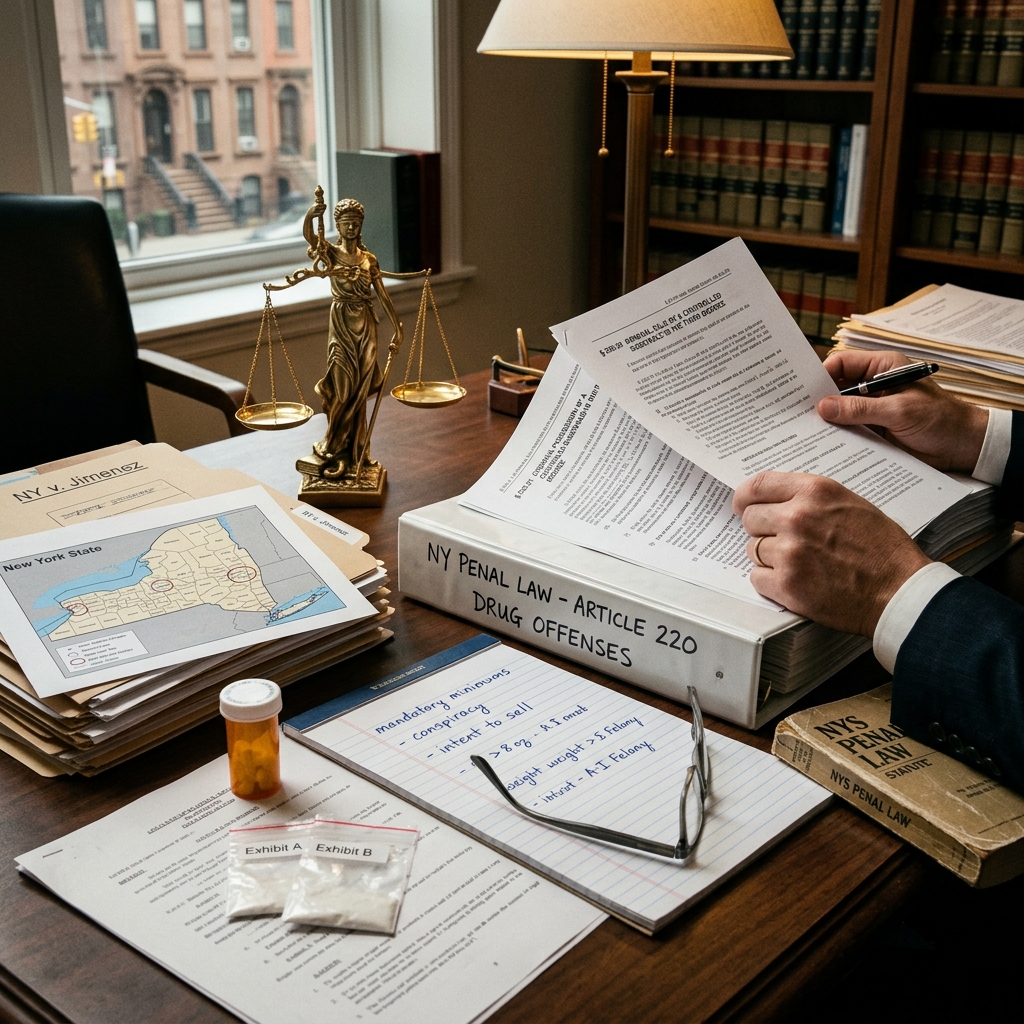
New York treats drug trafficking as a serious felony matter, and prosecutors often use a range of statutes to address sales, possession with intent to sell, transportation, and illegal manufacturing. The legal theory is broader than street-level selling: a person can face severe charges even when no hand-to-hand transaction is observed, so long as the evidence suggests a plan to move controlled substances for profit or distribution. Federal law also criminalizes the manufacture and distribution of controlled substances, but New York applies its own penalties and charging rules under state law.
This article breaks down how New York generally approaches drug distribution cases, what conduct can trigger criminal liability, how quantity and drug type affect the charge, and why trafficking investigations often lead to multiple overlapping counts. It also explains the difference between trafficking and simple possession, along with the kinds of evidence prosecutors commonly rely on in these cases.
What New York Means by Drug Trafficking
In everyday conversation, “drug trafficking” is a broad term for the illegal movement, sale, or production of controlled substances. In New York practice, the term is often used to describe conduct that includes selling drugs, transporting them, possessing them with intent to sell, or manufacturing them. Because the law focuses on the underlying conduct, a case may be labeled trafficking even if the formal charge is one of criminal sale or criminal possession with intent to sell.
That broad approach matters because police and prosecutors do not need to prove a completed large-scale shipment in every case. Instead, they may rely on quantity, packaging, communications, cash, scales, ledgers, or other circumstantial evidence to show a distribution operation rather than personal use.
Common Charges Used in Trafficking Cases
New York drug prosecutions often involve several overlapping charges rather than one single offense. The exact count depends on the substance, the amount, and what investigators believe the person was doing with it.
- Criminal sale of a controlled substance: charges based on selling or offering to sell illegal drugs, with degree levels that vary by drug type and quantity.
- Criminal possession with intent to sell: charges brought when the prosecution believes a person held drugs for distribution rather than personal use.
- Manufacturing offenses: charges involving producing, preparing, compounding, or operating a lab connected to controlled substances.
- Major trafficker allegations: the most serious cases, sometimes described as “kingpin” prosecutions, reserved for large-value drug operations.
These charges can appear together in a single indictment. For example, a person accused of running a distribution network may face sale, possession, conspiracy, and related financial charges at the same time.
How Prosecutors Prove Intent to Sell
One of the most important issues in a drug trafficking case is intent. A prosecutor must usually show more than simple possession; the state must connect the defendant to a plan to sell, distribute, or manufacture controlled substances.
Because intent is often not proven by direct testimony, prosecutors rely on surrounding facts. Common indicators include:
- Multiple baggies or packages of the same drug
- Digital scales or cutting agents
- Large amounts of cash, especially in small bills
- Texts, call logs, or app messages suggesting sales
- Ledgers, customer lists, or delivery records
- Weapons or security measures tied to drug storage or transport
These facts do not automatically prove trafficking, but they often help the state argue that possession was commercial rather than personal.
Why Drug Type and Quantity Matter So Much
New York law grades drug crimes heavily by both the substance involved and the amount. The law does not treat every drug the same, and a relatively small quantity of one controlled substance may produce a much harsher charge than the same amount of another.
As a result, two people accused of similar conduct can face very different outcomes depending on the substance, the weight, and the alleged role each person played. The penalties become more severe as the amount rises, and large-scale operations can trigger mandatory prison exposure and major fines.
Trafficking Versus Local Drug Dealing
People often use the words “trafficking” and “dealing” interchangeably, but the law may treat them differently. Local dealing usually refers to smaller-scale sales in a neighborhood or limited area, while trafficking suggests a broader operation involving larger quantities, greater movement, or organized distribution.
| Issue | Local Drug Dealing | Drug Trafficking |
|---|---|---|
| Scale | Smaller or neighborhood-based | Broader or organized |
| Quantity | Lower amounts | Higher amounts or repeated transactions |
| Typical proof | Single sales, limited cash, witness testimony | Packaging, records, transport evidence, network activity |
| Exposure | Serious felony penalties | Often much harsher felony penalties |
The distinction is not just semantic. Once prosecutors frame a case as trafficking, sentencing exposure, bail concerns, and plea leverage can all increase sharply.
Manufacturing and Production Offenses
Drug manufacturing laws punish more than the finished product. They can reach conduct such as preparing controlled substances, operating an unlawful lab, mixing ingredients, or participating in a production pipeline for illegal drugs.
Manufacturing cases are especially serious when law enforcement believes the activity involved dangerous chemicals, significant quantities, or repeated production. In some investigations, the manufacturing allegation is paired with sale or trafficking charges because the same operation both produces and distributes the drugs.
The Role of the Major Trafficker Law
New York’s most severe trafficking prosecutions may proceed under the major trafficker statute, sometimes compared to a kingpin law. This type of case is aimed at people accused of managing large-scale narcotics operations rather than isolated sales.
According to the available reporting on New York practice, a major trafficker case can involve allegations tied to very large drug values over a limited period, and convictions can bring extremely long prison sentences, including life exposure in the most serious circumstances.
These cases are often built around evidence of organization: repeated deliveries, coordinated packaging, controlled stash locations, or communications showing a structured distribution network.
Sentencing and Other Penalties
Drug trafficking convictions in New York can bring prison, fines, and long-term supervision. Even lower-level felony drug cases may carry meaningful custodial sentences, while major trafficking convictions can lead to much longer incarceration and substantial financial penalties.
- Felony convictions are common in trafficking cases.
- Fines may begin in the thousands of dollars and increase with the seriousness of the offense.
- Post-release supervision can follow a prison term in many felony cases.
- Enhanced punishment may apply for repeat offenders or aggravating facts.
Penalties also rise when the alleged conduct involves larger amounts, stronger narcotics, prior convictions, or circumstances the law treats as especially harmful. Federal penalties can be even more severe when the case falls within federal jurisdiction, especially for major quantities.
When Federal Law May Also Apply
Drug trafficking is not only a state issue. Federal law prohibits knowingly manufacturing, distributing, dispensing, or possessing controlled substances with intent to do so. The federal penalty structure is highly quantity-driven, and larger drug amounts can result in very long prison terms.
Federal involvement is more likely when the alleged conduct crosses state lines, involves larger organizations, or connects to interstate transport. New York cases may still remain entirely in state court, but the existence of a federal system means defendants can face separate legal exposure depending on the facts.
Possible Defense Themes in a Trafficking Case
Every case depends on the facts, but several defense themes frequently appear in New York drug prosecutions. The right defense strategy depends on the evidence, the search and seizure history, and the specific charge level.
- Lack of knowledge: arguing the defendant did not know drugs were present.
- No intent to sell: challenging the state’s claim that the drugs were meant for distribution.
- Unlawful search or seizure: seeking suppression if police violated constitutional rules.
- Possession by another person: showing the drugs belonged to someone else.
- Weak circumstantial proof: attacking the state’s interpretation of cash, packaging, or messages.
In some cases, the key issue is not whether the police found drugs, but whether the prosecution can legally connect the defendant to those drugs and prove the required mental state beyond a reasonable doubt.
Why These Cases Often Become Complex Quickly
Drug trafficking prosecutions can expand fast because the evidence tends to reach beyond a single incident. A search of a car, apartment, cell phone, or storage unit may uncover multiple alleged offenses, and investigators may then trace suppliers, couriers, customers, or financial records.
That complexity means defendants may face not only the underlying drug charge, but also conspiracy, weapon, or money-related allegations. The presence of several charges can increase pressure to accept a plea deal, even when the facts are disputed.
What To Do If You Are Facing a Charge
Anyone accused of drug trafficking, distribution, or manufacturing should treat the case as urgent. Early legal advice matters because statements to police, consent to searches, and device access can affect the case long before trial.
A careful defense team will usually review the stop or search, examine lab reports, test whether the weight calculations are reliable, and assess whether the state can really prove intent to sell. In trafficking cases, small factual differences can change the degree of the charge and the sentencing range.
Frequently Asked Questions
Is drug trafficking the same as drug possession?
No. Simple possession means having drugs for personal use or without proof of distribution, while trafficking-related charges usually involve sale, transportation, manufacturing, or possession with intent to sell.
Can someone be charged without being caught selling drugs?
Yes. Prosecutors may rely on quantity, packaging, cash, messages, and other circumstantial evidence to argue that the drugs were intended for sale rather than personal use.
Does manufacturing have to mean a large lab?
No. Manufacturing can include a range of illegal production activity, not just a large laboratory setup. The seriousness of the charge depends on the facts and the controlled substance involved.
Are trafficking cases always felonies in New York?
Drug trafficking-related cases in New York are commonly prosecuted as felonies, and the charge level depends on the drug, amount, and alleged conduct.
Can federal charges happen too?
Yes. Federal law separately prohibits manufacturing, distributing, dispensing, or possessing controlled substances with intent to do so, especially when the conduct involves larger quantities or interstate activity.
References
- Minimum Sentences for Drug Trafficking — Fast Law. 2026-07-10. https://fastlawpc.com/criminal-defense/drug-crimes/trafficking/
- New York Drug Trafficking Lawyer | Drug Distribution Defense NYC — Barket Epstein Kearon Aldea & LoTurco, LLP. 2026-07-10. https://www.barketepstein.com/criminal-defense/drug-crimes/drug-trafficking-distribution/
- New York City Drug Distribution Lawyer — Jeffrey Lichtman Attorney at Law. 2026-07-10. https://jeffreylichtman.com/new-york-city-drug-lawyer/distribution/
- New York Drug Charges: Difference Between Trafficking and Dealing — Sayegh & Sayegh Law. 2026-07-10. https://www.sayeghandsayeghlaw.com/drug-charges-trafficking-dealing
- Drug Trafficking and Drug Distribution — FindLaw. 2026-07-10. https://www.findlaw.com/criminal/criminal-charges/drug-trafficking-distribution.html
- Drug Trafficking | Wex — Legal Information Institute, Cornell Law School. 2026-07-10. https://www.law.cornell.edu/wex/drug_trafficking
- Overview – New York Drug Threat Assessment — U.S. Department of Justice. 2026-07-10. https://www.justice.gov/archive/ndic/pubs2/2580/overview.htm
Similar Articles








Read full bio of medha deb




