
New York’s DNA Databank: All-Conviction Collection Explained
How New York’s all-crimes DNA collection policy works, who it covers, and what it means for civil liberties and law enforcement.
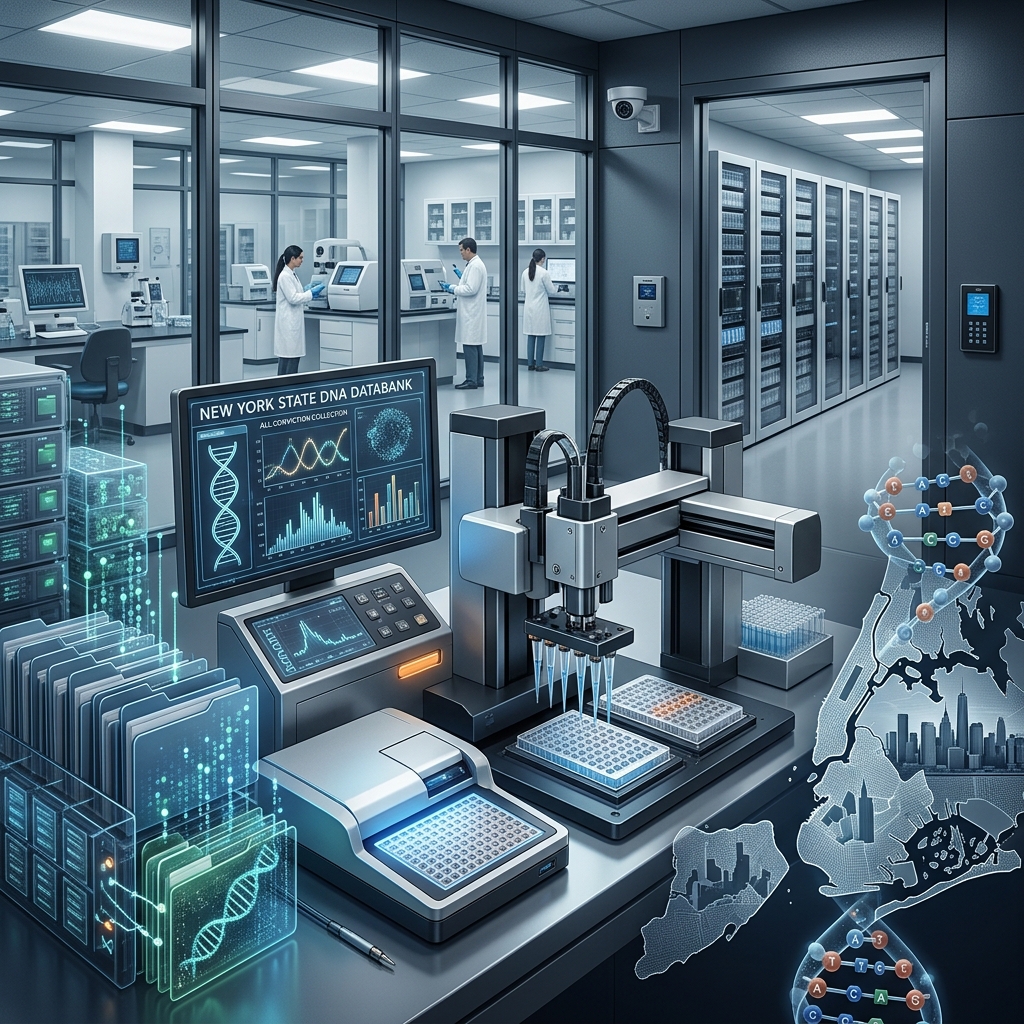
New York is one of the few states that requires DNA collection from virtually every person convicted of a felony or Penal Law misdemeanor, creating one of the most comprehensive offender DNA databanks in the United States. This expansive system plays a major role in criminal investigations, but it also raises significant questions about privacy, fairness, and the reach of government surveillance.
This article explains how New York’s DNA databank works, the laws that support it, the practical benefits for law enforcement, and the civil liberties concerns that have emerged as the databank continues to grow.
From Limited Collection to All-Conviction Coverage
New York’s approach to offender DNA collection has evolved over several decades, moving from highly targeted sampling to a broad, all-conviction framework.
- 1990s beginnings: DNA was initially collected from people convicted of the most serious crimes, such as homicide and specified sex offenses.
- Early expansions: Legislative changes in 1999 and 2004 added more crimes but still covered only a fraction of total convictions in the state.
- Pre-2012 coverage: By the mid-2000s, less than half of individuals convicted of Penal Law offenses were required to submit DNA samples.
- 2012 all-crimes reform: A major expansion, effective August 1, 2012, mandated DNA collection from anyone convicted of a New York State felony or Penal Law misdemeanor, with narrow exceptions for juvenile delinquents and individuals granted youthful offender status.
As a result, New York and Wisconsin are frequently cited as having some of the broadest convicted-offender DNA collection policies, extending to nearly all felony and misdemeanor convictions.
Who Is Required to Provide DNA in New York?
Under current New York law, DNA collection is tied to convictions rather than arrests. The rules are relatively straightforward, but the reach is wide.
| Category | DNA Required? | Notes |
|---|---|---|
| Felony conviction (Penal Law) | Yes | All felony offenses under the Penal Law require DNA submission. |
| Misdemeanor conviction (Penal Law) | Yes | All Penal Law misdemeanors require DNA submission since August 1, 2012. |
| Juvenile delinquent (Family Court) | No | Cases handled in Family Court are generally excluded. |
| Youthful offender status | Generally no | DNA is not collected where the conviction is sealed as youthful offender, except in limited circumstances allowed by law. |
| Arrest without conviction | No (as of current law) | DNA upon arrest has been proposed but is not widely implemented in New York. |
Importantly, the requirement applies to anyone convicted on or after August 1, 2012, meaning even relatively minor criminal convictions can lead to inclusion in the state DNA databank.
How DNA Samples Are Collected and Stored
The process of collecting DNA from convicted offenders is standardized and designed to be quick, minimally invasive, and reliable.
Collection Process
- DNA is typically obtained using a buccal swab (a cotton swab rubbed inside the cheek), rather than blood draws.
- The sample is sent to a certified forensic laboratory, where technicians extract and analyze specific markers on the DNA known as STRs (short tandem repeats).
- Only non-coding regions of DNA are used to generate the profile, meaning they do not reveal medical or genetic health information.
Creation of a DNA Profile
Once the sample reaches the laboratory, analysts create a numerical profile that represents the pattern of STR markers.
- The resulting profile is a series of numbers corresponding to different loci (positions) on the DNA.
- This profile is uploaded into CODIS (Combined DNA Index System), the national database used by law enforcement agencies across the U.S.
- New York’s state databank is integrated with CODIS, allowing searches and comparisons beyond state borders.
According to state data, the New York DNA databank contains hundreds of thousands of offender profiles and has generated thousands of investigative “hits” connecting crime scene evidence to convicted individuals.
What the DNA Databank Is Used For
New York’s DNA databank serves several crucial investigative and prosecutorial functions, all centered on linking individuals to crime scene biological evidence.
Core Uses
- Identifying suspects: When DNA is recovered from a crime scene, it is compared against the databank to find potential matches to convicted offenders.
- Connecting cases: DNA can reveal that multiple crimes were committed by the same person, even if that person is not yet identified, helping law enforcement recognize patterns.
- Exonerating the innocent: DNA evidence can clear individuals wrongly suspected or convicted of crimes by showing they are not the source of the biological material.
- Cold case resolution: Old, unsolved cases can be revived when stored DNA evidence is tested and matched against the growing databank.
These uses underscore why the state promotes the databank as a powerful public safety tool, often citing its role in solving serious violent crimes such as sexual assaults and homicides.
Familial DNA Searches: Extending Beyond the Convicted Individual
An especially controversial aspect of New York’s system is the use of familial DNA searches, where law enforcement looks for partial matches that might indicate a relative of the true source of the crime-scene DNA.
How Familial Searches Work
- When a full match is not found in the databank, investigators may search for partial matches that suggest a close biological relationship (e.g., sibling or parent-child).
- The state’s regulations permit law enforcement, in limited circumstances, to infer that a relative of the convicted person could be the crime-scene contributor.
- These searches are designed to be used only after other investigative avenues have been exhausted and with oversight from forensic science commissions.
New York’s highest court has upheld the legality of these familial search regulations, concluding that the state’s forensic science commission and DNA subcommittee acted within their statutory authority when authorizing them.
While supporters emphasize the potential to solve serious crimes that otherwise would remain unsolved, critics argue that familial searches extend surveillance and suspicion to individuals who have never been convicted of any offense, simply because they are related to someone who has.
Legal Framework and Enforcement Mechanisms
New York’s DNA databank system is grounded in state statutes that set out who must provide DNA, how samples are collected, and which agencies manage the databank.
Key Legal Features
- Statutory mandate: Executive Law provisions and Penal Law amendments require DNA sampling for all felony and Penal Law misdemeanor convictions.
- Retroactive application: Expansions have, at times, been applied retroactively to individuals already serving sentences, further enlarging the databank.
- Penalties for non-compliance: Legislative proposals have included making it a criminal offense to knowingly refuse to provide a sample, with potential impacts on probation or parole status.
State agencies, including the Division of Criminal Justice Services (DCJS), are responsible for maintaining the databank, setting technical standards, and ensuring the integrity of laboratory procedures.
Civil Liberties and Privacy Concerns
The expansion of DNA collection to cover nearly all convicts has prompted strong reactions from civil liberties groups, defense lawyers, and some policymakers.
Major Points of Concern
- Scope of government surveillance: Critics argue that collecting DNA from people convicted of minor, non-violent misdemeanors is disproportionate to the public safety benefits.
- Risk of misuse over time: Some fear that once DNA is collected, future law or policy changes could repurpose this data for uses beyond criminal investigation, such as immigration enforcement or broad population screening.
- Impact on marginalized communities: Because criminal justice systems disproportionately affect certain racial and socioeconomic groups, comprehensive DNA collection policies may deepen existing inequalities by concentrating genetic surveillance on those communities.
- Familial implications: Familial DNA searches can place scrutiny on relatives who have never been convicted of any crime, raising questions about fairness and consent.
Civil liberties organizations have suggested alternative approaches, such as limiting DNA collection to serious violent crimes, setting clearer rules for expungement (removal of profiles), and strengthening independent oversight of databank operations.
Benefits Cited by Law Enforcement and Supporters
On the other side of the debate, prosecutors and law enforcement officials emphasize the significant benefits of a broad DNA databank, often pointing to solved cases and prevented crimes.
Arguments in Favor
- Deterrence: Knowing that even minor convictions will result in DNA collection may discourage individuals from committing future crimes.
- Efficiency: Having a larger pool of offender profiles increases the probability of quickly identifying suspects, reducing investigative time and cost.
- Accuracy: DNA evidence can be more reliable than eyewitness testimony, which is vulnerable to error; databanks help bring this evidence into more investigations.
- Victim-focused outcomes: Supporters argue that expanding DNA collection is justified by the number of victims whose cases are solved or reopened thanks to databank hits.
Public safety advocates frequently frame the debate as a trade-off: accepting a higher level of government collection of personal identifiers in exchange for reduced crime and improved accuracy in the justice system.
New York in the National Context
Every U.S. state collects DNA from at least some convicted offenders, but New York’s all-crimes policy sets it apart.
- Most states collect DNA from all felony convicts, but only some collect DNA for misdemeanors.
- New York and Wisconsin are notable for requiring DNA from essentially all felonies and misdemeanors, not just select offenses.
- Federal law also supports DNA collection from certain federal offenders and arrestees, integrated through CODIS.
This positioning means New York’s experience is often used as a reference point when other states consider expanding their own DNA collection policies, whether following similar paths or deciding to draw stricter limits.
Key Takeaways for Defendants and the Public
For individuals involved in the criminal justice system in New York—or simply concerned about privacy—it is important to understand what the state’s DNA policies mean in practice.
- If you are convicted of a felony or Penal Law misdemeanor, you should expect to be required to provide a DNA sample that will be stored in the state databank.
- Your DNA profile will be searchable for matches to crime scene evidence, including across state lines through CODIS.
- Your relatives could, in limited situations, come under investigative scrutiny through familial searches, even if they have no criminal record.
- Civil liberties organizations continue to challenge and critique these policies, so legal standards and practices may evolve over time.
Frequently Asked Questions
1. Does New York collect DNA from everyone who is arrested?
No. Under current law, New York generally collects DNA from individuals convicted of felonies and Penal Law misdemeanors, not from everyone who is merely arrested. Proposals to mandate DNA collection upon arrest have been introduced but have faced opposition and are not fully implemented statewide.
2. What happens if someone refuses to provide a DNA sample after conviction?
Refusal to provide a DNA sample can lead to legal consequences. Legislative measures have contemplated making “knowing” failure to submit DNA a separate offense and authorizing revocation of probation or parole for non-compliance. Courts may also issue orders compelling collection.
3. Can DNA profiles be removed from the databank?
New York law does allow for some forms of removal or expungement, such as when a conviction is overturned or vacated, but the process is limited and often requires formal action or notification. For individuals who remain lawfully convicted, profiles generally stay in the databank.
4. Does the DNA profile reveal medical or genetic health information?
No. The profile stored in the databank is based on non-coding regions of DNA, which are selected specifically because they do not disclose medical or health-related information. The profile functions as an identifier rather than a genetic health record.
5. Are innocent people ever affected by familial DNA searches?
Yes, in the sense that relatives of convicted individuals can come under investigative scrutiny if their family member’s DNA shows a partial match to crime-scene evidence. While this does not mean they are presumed guilty, it expands the circle of people potentially investigated based on their biological relationship rather than their own conduct.
References
- NYS DNA Databank and Combined DNA Index System (CODIS) — New York State Division of Criminal Justice Services. Accessed 2024-03-01. https://www.criminaljustice.ny.gov/forensic/dnadatabank.htm
- DNA Sampling Following a Criminal Conviction in New York — Dupee & Monroe P.C. Accessed 2024-03-01. https://www.dupeelaw.com/new-york-criminal-law-articles/dna-sampling-following-a-criminal-conviction/
- Legislative Memo: DNA Databank Expansion — New York Civil Liberties Union. 2012-02-15. https://www.nyclu.org/resources/policy/legislations/legislative-memo-dna-databank-expansion
- Convicted Offender DNA Laws — National Conference of State Legislatures. 2016-04-01. https://archive.legmt.gov/content/Committees/Interim/2015-2016/Law-and-Justice/Meetings/Apr-2016/Exhibits/ncsl-convicted-offender-dna-laws-april-2016.pdf
- DNA All Crimes Podcast Transcript — New York State Division of Criminal Justice Services. Accessed 2024-03-01. https://www.criminaljustice.ny.gov/pio/podcasts/dna-all-crimes-podcast-transcript.html
- New York’s High Court Greenlights Using Convicted Criminals’ DNA to Find Family Members — Courthouse News Service. 2023-06-14. https://www.courthousenews.com/new-yorks-high-court-greenlights-using-convicted-criminals-dna-to-find-family-members/
- DNA Collection Upon Arrest: Expansion of the New York State DNA Databank — New York State Senate. 2009-08-01. https://www.nysenate.gov/sites/default/files/DNA%20upon%20arrest%20%202-09_0.pdf
Similar Articles








Read full bio of medha deb




