
New York Computer Crimes: 8 Key Points Every User Should Know
A practical, plain-language guide to New York’s main computer and cyber crime offenses, penalties, and key legal concepts.
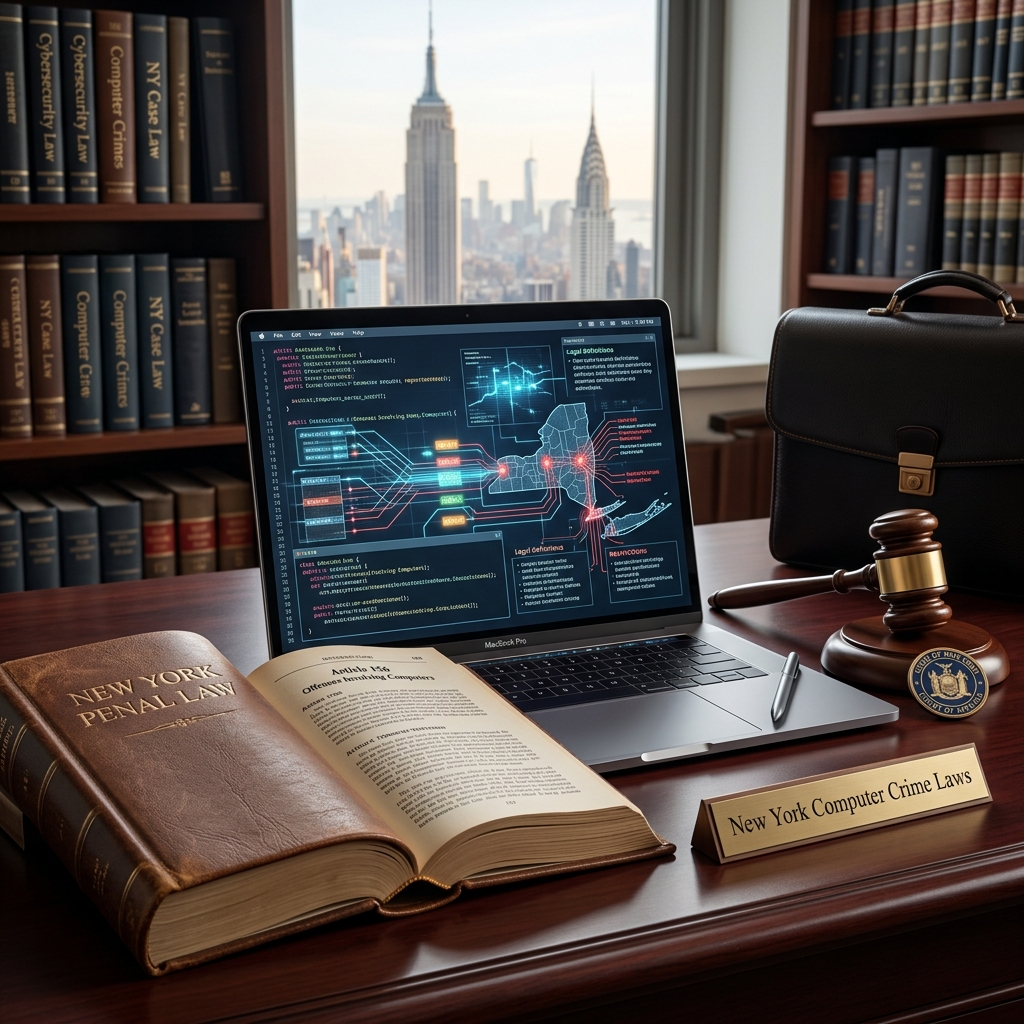
New York’s criminal code contains a dedicated framework for
computer and cyber offenses
, recognizing that data and digital systems are now as valuable as physical property. These laws apply not only to traditional desktop computers, but to virtually any device capable of storing, processing, or transmitting data, such as laptops, servers, smartphones, and connected devices.This article offers a clear, practical overview of the main New York computer crimes, how they are defined, and what penalties may result from a conviction. It is intended for informational purposes and is not a substitute for legal advice.
1. Legal Framework for Computer Crimes in New York
New York regulates computer-related offenses primarily through
Article 156 of the Penal Law
, titled “Offenses Involving Computers.” Related crimes, such as identity theft and fraud, appear in other articles but are frequently charged together with Article 156 offenses.1.1 Core Computer Offenses Under Article 156
The main computer-specific crimes recognized in New York include:
- Unauthorized use of a computer (NY Penal Law § 156.05)
- Computer trespass (NY Penal Law § 156.10)
- Computer tampering in various degrees (NY Penal Law §§ 156.20, 156.25, 156.26, 156.27)
- Unlawful duplication of computer-related material (NY Penal Law §§ 156.29, 156.30)
- Criminal possession of computer-related material (NY Penal Law § 156.35)
These provisions cover a range of conduct, from rudimentary unauthorized access to sophisticated data theft and large-scale digital damage.
1.2 Common Companion or Overlapping Offenses
Computer crimes frequently intersect with other parts of New York’s Penal Law, such as:
- Identity theft (Article 190)
- Forgery (Article 170)
- Grand larceny (Article 155)
- Fraud and deceptive practices (various provisions in Article 190)
- Harassment or stalking by electronic means (Articles 120 and 240)
When charged together, these offenses can sharply increase potential penalties and the complexity of a case.
2. Key Legal Definitions: Access, Authorization, and Computer Material
Understanding New York computer crime laws begins with several core definitions used across Article 156.
2.1 What Counts as a “Computer”?
Under New York law, a computer is broadly understood as any electronic device that can process or store data. This can include:
- Desktop and laptop computers
- Tablets and smartphones
- Servers and networked systems
- Embedded systems or other digital devices capable of data manipulation
Because the definition is technology-neutral, new digital devices can fall within Article 156 even if not specifically named in the statute.
2.2 “Without Authorization”
The phrase “without authorization” is central to most computer crimes. New York law describes it as accessing or using a computer, computer service, or network without the permission of the owner or other authorized party, particularly after the person knows their access is not allowed or has been revoked.
Important implications include:
- Access can be unauthorized even if no password protection is used.
- Authorization can be limited by purpose (e.g., work-only use), time, or scope; exceeding these limits can lead to liability.
- Continuing to access a system after being told to stop may satisfy the “without authorization” requirement.
2.3 “Computer Material,” Data, and Programs
Article 156 distinguishes between various types of digital content, such as computer data, computer programs, and computer material (which often refers to data or information made confidential or restricted by the system owner).
In practice, this can include:
- Customer records, personnel files, and trade secrets
- Financial and payment information
- Proprietary software or source code
- Other restricted or confidential electronic information
3. Major Computer-Related Offenses and Their Elements
Below is an overview of how New York defines the most common computer crimes and the conduct that may satisfy each offense.
3.1 Unauthorized Use of a Computer (NY Penal Law § 156.05)
Unauthorized use of a computer occurs when a person knowingly uses, causes to be used, or accesses a computer, computer service, or computer network without authorization. Even a single step in accessing the device can be enough to satisfy the statute.
Key features:
- No need to show data was stolen, altered, or destroyed
- No requirement of financial loss or damage
- Focus is on intentional, unauthorized access itself
This offense is classified as a Class A misdemeanor.
3.2 Computer Trespass (NY Penal Law § 156.10)
Computer trespass is a more serious offense than unauthorized use and requires both unauthorized access and an additional aggravating factor.
A person may be guilty of computer trespass if they knowingly access a computer or computer service without authorization and either:
- Do so with an intent to commit, attempt to commit, or further the commission of any felony, or
- Knowingly gain access to computer material (such as confidential or restricted data).
Computer trespass is a Class E felony.
3.3 Computer Tampering (NY Penal Law §§ 156.20, 156.25, 156.26, 156.27)
Computer tampering focuses on altering or destroying data or programs without authorization. The statute is divided into multiple degrees, which escalate based on the seriousness of the conduct and the resulting harm.
3.3.1 Fourth Degree Computer Tampering
Computer tampering in the fourth degree occurs when a person, having no right to do so, intentionally alters or destroys the computer data or program of another. This is a
Class A misdemeanor
.3.3.2 Higher Degrees of Computer Tampering
The third, second, and first degrees add factors such as:
- Prior criminal history relating to computer tampering
- Monetary loss or damage beyond specified thresholds
- Impact on public services, health, safety, or large-scale systems
At higher degrees, computer tampering becomes a felony, with potential penalties of several years in prison, depending on the classification (E, D, C, or B felony).
3.4 Unlawful Duplication and Possession of Computer-Related Material
New York law also prohibits:
- Unlawful duplication of computer-related material (NY Penal Law §§ 156.29, 156.30), which targets copying or reproducing data or programs without authorization, especially where trade secrets or significant economic value are involved.
- Criminal possession of computer-related material (NY Penal Law § 156.35), which applies when a person knowingly possesses unlawfully copied data or programs with intent to benefit themselves or another person other than the owner.
These offenses are often charged in corporate or commercial contexts where proprietary information or confidential customer data is taken or retained unlawfully.
4. Penalties and Sentencing Ranges
Penalties for computer crimes in New York range from relatively minor misdemeanors to serious felonies that can carry lengthy prison sentences.
4.1 Misdemeanor vs. Felony Computer Crimes
New York law classifies offenses by degree and by misdemeanor or felony status, which determines the maximum sentence available:
- Class A misdemeanor – up to 1 year in jail; often applies to unauthorized use and basic computer tampering.
- Class E felony – up to 4 years in prison; includes computer trespass and some forms of computer tampering.
- Class D, C, B felonies – higher degrees of tampering or related large-scale computer crimes can carry sentences of up to 7, 15, or even 25 years for the most serious conduct.
4.2 Maximum Sentences by Offense Level
| Offense Level | Typical Computer-Related Crimes | Maximum Incarceration | Typical Maximum Fine |
|---|---|---|---|
| Class A misdemeanor | Unauthorized use of a computer; basic computer tampering | Up to 1 year jail | Up to $1,000 |
| Class E felony | Computer trespass; certain tampering or duplication offenses | Up to 4 years prison | Up to $5,000 or double the gain |
| Class D felony | More serious tampering causing significant loss or affecting key systems | Up to 7 years prison | Up to $5,000 or double the gain |
| Class C felony | High-value or high-impact computer crimes | Up to 15 years prison | Up to $5,000 or double the gain |
| Class B felony | Most serious computer-related offenses with extensive harm | Up to 25 years prison | Up to $5,000 or double the gain |
In addition to incarceration and fines, a conviction for any computer-related crime can result in:
- A permanent criminal record
- Restitution orders to compensate victims for financial losses
- Professional or licensing consequences
- Restrictions on future employment, especially in IT, finance, or security roles
5. Typical Scenarios and Associated Risks
Computer crime prosecutions can arise from a wide variety of situations, including relatively simple actions that may not initially seem criminal. While each case depends on specific facts, some recurring patterns include:
- Accessing a former employer’s system after termination using old credentials, especially to retrieve data or disrupt operations.
- Guessing or using someone else’s password to read private email, social media messages, or files.
- Copying proprietary business files (customer lists, pricing data, source code) to bring to a new employer.
- Installing unauthorized software or malware that disrupts normal system operation or exposes confidential data.
- Participating in online schemes that use hacked accounts, stolen credentials, or fraudulent transactions.
Even where no money is stolen or obvious damage occurs, unauthorized access alone can be enough to trigger a criminal charge.
6. Defense Considerations and Legal Issues
Defending a computer crime case is highly fact-specific and often requires both legal and technical expertise. The following themes frequently arise in New York computer crime litigation:
6.1 Authorization and Consent
One of the most important defense issues is whether the accused had permission to access the system or data. Potential arguments may include:
- The system owner gave explicit authorization for access.
- The person reasonably believed they had consent, based on workplace policies or prior practice.
- The prosecution cannot prove the lack of authorization beyond a reasonable doubt.
6.2 Intent and Knowledge
Many Article 156 offenses require proof that the accused acted knowingly or with a particular intent (such as an intent to commit a felony or to benefit from copied material). Defense strategies can focus on:
- Challenging whether the accused knew the access was unauthorized
- Contesting claims of malicious or fraudulent purpose
- Showing that any data access or copying was accidental or incidental
6.3 Scope of Damage and Loss
For higher degrees of computer tampering and related offenses, the amount of damage or loss can determine the degree of the charge and potential sentence. Disputes may arise over:
- How to calculate financial loss or value of data
- Whether claimed damages were directly caused by the alleged conduct
- The reliability of forensic or accounting methods used to estimate loss
6.4 Search and Seizure of Digital Evidence
Because computer crime investigations often involve extensive digital evidence,
Fourth Amendment
issues (unreasonable searches and seizures) can be critical.[10] Defense counsel may challenge:- The validity or scope of search warrants for digital devices
- How data was collected, preserved, and analyzed
- Whether the government exceeded the permissible scope of the warrant
Improperly obtained evidence may sometimes be suppressed, significantly weakening the prosecution’s case.
7. Frequently Asked Questions About New York Computer Crimes
7.1 Is simply guessing someone’s password a crime in New York?
If guessing or using someone’s password results in
unauthorized access
to their computer, email, or online accounts, it can support a charge such as unauthorized use of a computer or computer trespass, depending on what data is accessed and for what purpose. Intent and knowledge of lack of permission are key factors.7.2 Do I have to steal money for it to be a “computer crime”?
No. Many New York computer offenses focus on access itself, or on altering or copying data, regardless of whether money is taken. However, if the conduct also involves fraud, theft, or identity misuse, additional charges may be brought under other articles of the Penal Law.
7.3 Are workplace policy violations always criminal?
Not necessarily. Violating an employer’s computer-use policy may lead to disciplinary action, termination, or civil claims, but it does not automatically constitute a crime. The issue in criminal cases is whether the conduct meets the statutory requirements, including lack of authorization, specific intent, or resulting harm as defined in Article 156.
7.4 Can minors be charged under New York’s computer crime laws?
Yes. Minors who engage in hacking, data theft, or other computer-related misconduct may face delinquency proceedings in Family Court or, in serious cases, criminal charges in adult court. The same statutes generally apply, though procedures and consequences differ for juveniles.
7.5 What should I do if I am accused of a computer crime?
Anyone under investigation or charged with a computer offense should avoid discussing the case with non-lawyers and should seek advice from a qualified criminal defense attorney familiar with New York’s computer crime statutes and digital evidence issues. The specific facts and technical details of the alleged conduct often determine both exposure and defense strategy.
8. Practical Takeaways for Individuals and Businesses
Because cyber activity is embedded in daily life and business operations, understanding the legal boundaries of computer use is essential. Some practical points include:
- Clarify authorization: Make sure it is clear who may access which systems, under what conditions.
- Document policies: Written computer-use policies can help both prevent misuse and clarify expectations for employees.
- Secure systems and data: Strong authentication, access controls, and logging can reduce risk and provide evidence if a breach occurs.
- Train staff: Explain the difference between harmless curiosity and potentially criminal access.
- Respond promptly to incidents: Timely internal investigation, legal consultation, and where appropriate, law enforcement contact can limit harm.
New York’s computer crime laws are designed to adapt to evolving technology, so unauthorized or harmful use of digital systems can have serious criminal consequences even when traditional property is never touched.
References
- New York Penal Law Article 156 – Offenses Involving Computers — New York State Senate. Accessed 2026. https://www.nysenate.gov/legislation/laws/PEN/P3TJA156
- New York: Statutory Criminal Law – Computer Offenses Summary — Without My Consent. Accessed 2026. https://withoutmyconsent.org/50state/state-guides/new-york/statutory-criminal-law/
- Computer Crimes: NY Penal Law Article 156 — New York Criminal Lawyer (Saland Law). Accessed 2026. https://www.new-york-lawyers.org/practice-areas/white-collar-crimes/computer-crimes_2/
- Offenses Involving Computers; Definition of Terms — YPD Crime / New York Penal Law Article 156 Text. Accessed 2026. https://ypdcrime.com/penal.law/article156.php
- Computer Cyber Network Crime Defense — Hacker Murphy LLP. Accessed 2026. https://www.hackermurphy.com/practice-areas/criminal-defense/computer-cyber-network-crime-defense/
- Computer Crimes in New York — MANCILLA + FANTONE LLP. Accessed 2026. https://law-mf.com/computer-crimes-in-new-york
- New York Cyber Crimes Frequently Asked Questions — 1800NYNYLaw.com. Accessed 2026. https://criminaldefense.1800nynylaw.com/faqs/new-york-cyber-crimes-frequently-asked-questions/
Similar Articles








Read full bio of medha deb


