
New Jersey Service Dogs and ESA Laws Guide
Comprehensive guide to New Jersey regulations on service dogs, emotional support animals, rights, access, and recent legislative updates.
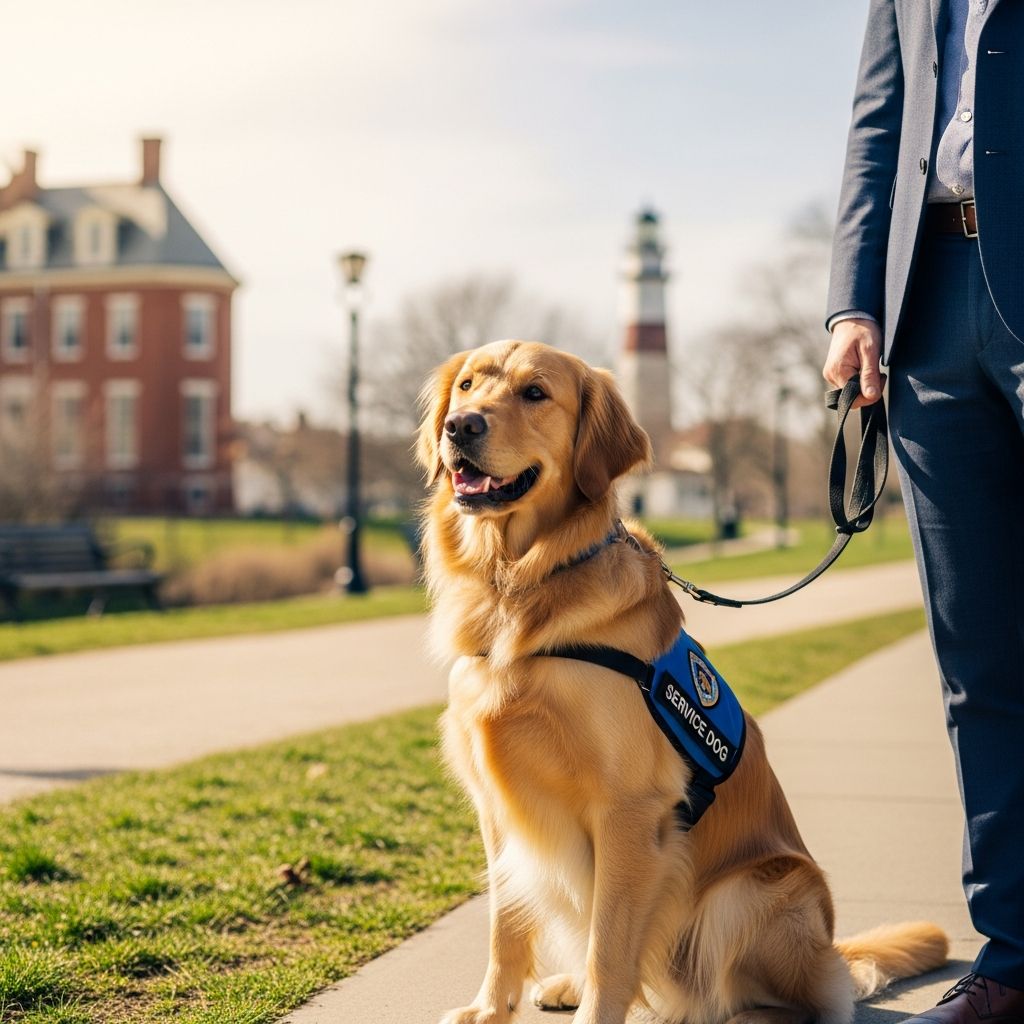
In New Jersey, individuals with disabilities rely on service dogs to navigate daily challenges, while emotional support animals (ESAs) offer comfort in private settings. State and federal laws provide robust protections for service animals in public areas, housing, and workplaces, but clear distinctions exist between trained service dogs and ESAs. This guide details access rights, handler duties, business obligations, and emerging legislation strengthening enforcement.
Defining Service Animals Under New Jersey and Federal Guidelines
New Jersey aligns with the Americans with Disabilities Act (ADA) in recognizing service animals primarily as dogs individually trained to perform specific tasks for people with disabilities. These tasks might include guiding the visually impaired, alerting to seizures, retrieving items, or providing stability for mobility issues. Miniature horses can qualify in limited cases if trained similarly.
The New Jersey Law Against Discrimination (LAD) expands this to encompass dogs trained for physical, mental, developmental, or psychological disabilities, broadening protections beyond federal standards. Guide dogs, a subset, are specially trained for blind or deaf individuals by accredited programs like The Seeing Eye in Morristown, the nation’s oldest guide dog school.
In contrast, emotional support animals provide emotional comfort without specific task training. They lack public access rights under ADA or LAD, permitted mainly in housing under the federal Fair Housing Act (FHA).
- Service Dog Criteria: Individually trained for disability-related tasks; under handler control; housebroken.
- ESA Criteria: Provides comfort; no task training required; documentation from a healthcare provider often needed for housing.
- Key Exclusion: Pets, therapy dogs, or comfort animals do not qualify as service animals.
Public Access Protections for Service Dogs in New Jersey
Service dogs must be allowed in all public accommodations, including restaurants, stores, hotels, theaters, and government buildings, regardless of no-pet policies. Businesses cannot charge extra fees, demand identification, or isolate handlers.
Staff may ask two questions only: “Is this a service animal required because of a disability?” and “What tasks is it trained to perform?” No proof, vests, or certifications are mandated. Dogs must be removed if they pose a direct threat, are out of control, or not housebroken, but handlers get a chance to correct minor issues first.
| Scenario | Allowed? | Business Action Permitted |
|---|---|---|
| Restaurant dining with service dog | Yes, under table | None; no extra charge |
| Hospital visit | Yes, in most areas | Limit to non-sterile zones if safety risk |
| Retail store | Yes, full access | Remove only if disruptive |
| Emotional support dog | No | Treat as pet; deny if no-pet policy |
Recent reports highlight denials in ride-sharing, prompting legislative responses. Educational campuses like Passaic County Community College enforce these rules, allowing service dogs campus-wide but prohibiting unattended animals or those showing aggression.
Housing Rights for Service Dogs and ESAs
Under the FHA, housing providers must make reasonable accommodations for service dogs and ESAs, waiving no-pet fees or breed restrictions. No-pet policies do not apply. For service dogs, no documentation is needed; handlers self-identify the need. ESAs require a letter from a licensed mental health professional verifying the disability and necessity.
Landlords can deny if the animal poses a direct threat, causes substantial damage, or creates undue burden, but must prove it with evidence. Handlers remain liable for damage beyond normal wear.
- Service Dog Housing: Full access to units, common areas; no fees.
- ESA Housing: Same, with provider letter; single-family homes exempt if owner occupies.
- Eviction Risks: Only for verified threats or damage; not for mere complaints.
Workplace Accommodations and Transportation Rules
Employers must reasonably accommodate service dogs under ADA and LAD unless it causes undue hardship, evaluating case-by-case. Transportation providers, including buses and taxis, cannot refuse service dogs. A pending bill by Sen. Anthony Bucco proposes fines up to $500 for first offenses and $1,000 for repeats when ride-shares like Uber deny access, allowing police ticketing instead of civil suits.
Puppy raisers training future service dogs gain public access rights under proposed amendments to LAD (S573). Organizations training assistance dogs for disabled veterans must register with the Division of Consumer Affairs (S897).
Handler Responsibilities and Animal Control Standards
Owners ensure service dogs are vaccinated, licensed, leashed (except when task performance requires otherwise), house-trained, and well-behaved. Unruly behavior like excessive barking or aggression leads to removal and potential bans.
Cleaning Duties: Handlers clean up waste immediately and cover vet costs.
In educational settings, dogs cannot be left in cars or chained outside; repeated issues trigger disciplinary reviews.
Recent Legislative Developments Supporting Service Animals
New Jersey’s legislature actively bolsters protections:
- S600: Enables ID cards for guide/service dog owners, with $100,000 funding.
- SJR25: Designates March 16 as “Paws Healing Heroes Day” honoring service dogs.
- Bucco’s Bill: Criminalizes transportation discrimination with municipal court fines.
These build on NJ’s designation of the Seeing Eye dog as the state dog, emphasizing commitment to disability rights.
Frequently Asked Questions (FAQs)
What if a business asks for service dog papers?
They cannot; only the two ADA questions are allowed. Requesting proof violates law.
Can ESAs go into stores like service dogs?
No; ESAs lack public access rights and are treated as pets.
What happens if my service dog barks occasionally?
Minor incidents allow correction; persistent disruption justifies removal.
Do housing rules apply to roommates?
FHA covers shared housing if rental; roommates may negotiate separately.
Are there fines for denying service dogs rides?
Proposed bills introduce $500-$1,000 fines via police tickets.
Training Organizations and Resources
Accredited programs ensure quality training. NJ supports registration for veteran assistance dog trainers. Handlers can procure state ID cards under new laws. For disputes, contact the NJ Division on Civil Rights or file LAD complaints.
Staying informed prevents violations; businesses benefit from ADA training resources.
References
- Service Animals – PCCC — Passaic County Community College. 2026 (Accessed). https://pccc.edu/accessibility-services/handbook/service-animals/
- NJ bill boosts penalties for service dog discrimination — NJ1015.com. 2026 (Accessed). https://nj1015.com/new-jersey-service-animal-legislation/
- Bill Text: NJ S897 | 2026-2027 — NJ Legislature via LegiScan. 2026-01-17. https://legiscan.com/NJ/text/S897/2026
- S600 – Allows dog owners to procure identification cards — NJ Legislature. 2026 (Introduced). https://pub.njleg.gov/Bills/2026/S1000/600_I1.HTM
- Bill Text: NJ S573 | 2026-2027 — NJ Legislature via LegiScan. 2026 (Introduced). https://legiscan.com/NJ/text/S573/2026
Similar Articles








Read full bio of medha deb


