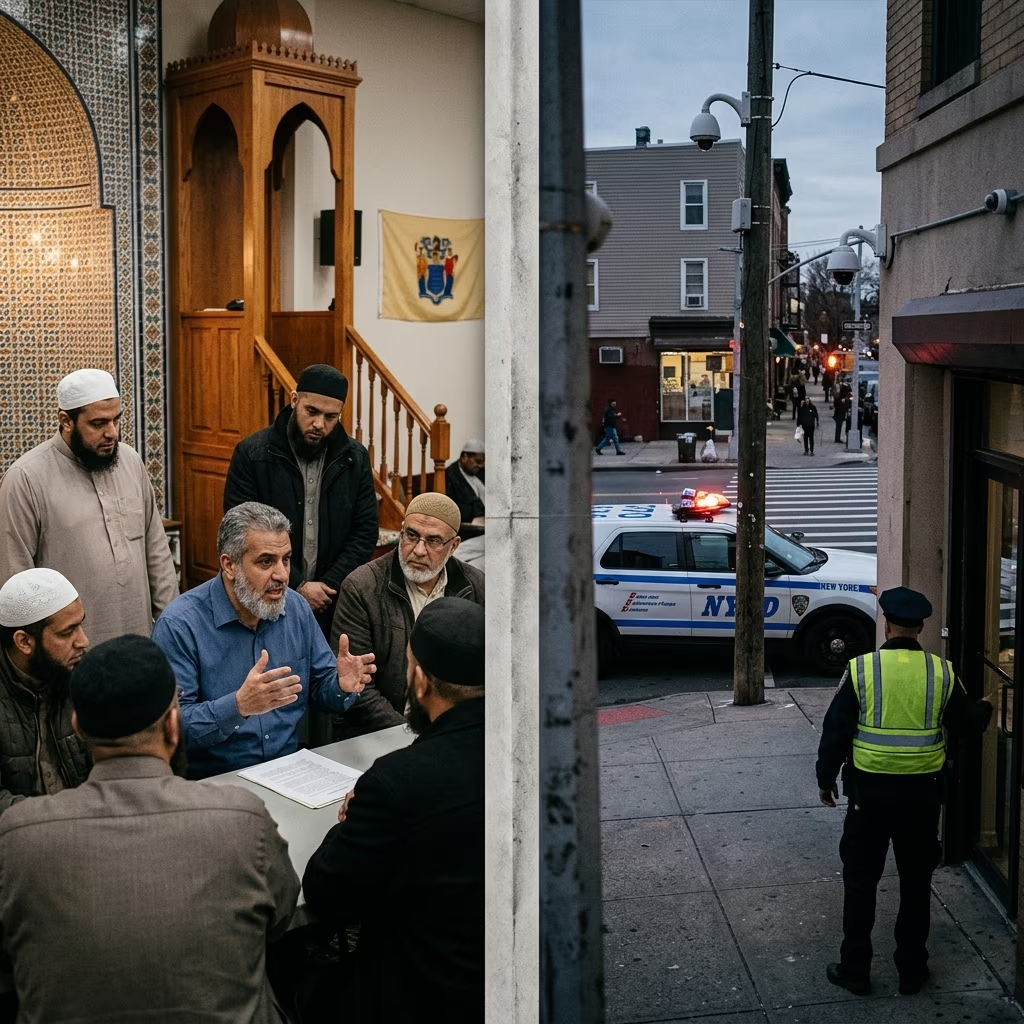
In the years following the September 11 attacks, the New York City Police Department (NYPD) developed an extensive intelligence program that focused heavily on Muslim communities in New York, New Jersey, and other parts of the Northeast. The disclosure of this program sparked a major legal battle led by New Jersey Muslims, culminating in landmark constitutional rulings, settlements, and reforms to police surveillance practices.
This article examines how New Jersey Muslims challenged the NYPD’s surveillance of their everyday lives, the constitutional issues at stake, and what this struggle reveals about civil rights, religious freedom, and national security in the United States.
Background: How the NYPD Muslim Surveillance Program Emerged
After 9/11, the NYPD built a large intelligence division that operated far beyond traditional policing, targeting the ordinary religious activity of Muslims. Investigative reporting by the Associated Press later uncovered that officers and informants were monitoring mosques, restaurants, schools, and student groups, mapping Muslim neighborhoods and tracking daily routines such as where people worshiped and socialized.
- Muslim communities in New York and New Jersey were treated as potential security threats based on religion alone.
- Surveillance extended to religious institutions, businesses, and university Muslim Student Associations.
- Many of those monitored were never accused of committing any crime, nor was individualized suspicion required.
The program was sometimes described as a Muslim Surveillance Program, highlighting that its scope and focus were tied directly to religious identity rather than specific criminal investigations.
The New Jersey Lawsuit: Hassan v. City of New York
In response to the revelations about NYPD spying, New Jersey Muslims and allied organizations filed a federal lawsuit challenging the program’s legality. The case, known as Hassan v. City of New York, was brought on behalf of a diverse set of plaintiffs affected by the surveillance.
Plaintiffs included:
- Local mosques and religious leaders concerned about worship being monitored.
- Muslim-owned businesses suffering economic harm after being identified in NYPD documents.
- Students and educators connected to Muslim schools and student associations.
- A decorated Iraq war veteran and other community members who felt stigmatized by suspicionless surveillance.
The lawsuit alleged that the NYPD’s program violated core constitutional protections by treating Muslims as inherently suspect, without evidence of wrongdoing, solely because of their faith.
Constitutional Claims at the Heart of the Case
The legal challenge to the NYPD surveillance program rested on key provisions of the U.S. Constitution that safeguard religious liberty and equality. Plaintiffs and supporting organizations argued that the program infringed multiple constitutional rights.
| Constitutional Provision | Core Protection | Relevance to NYPD Surveillance |
|---|---|---|
| First Amendment – Free Exercise Clause | Protects the right to practice religion without government interference. | Surveillance of religious spaces and activities was alleged to chill worship and religious participation. |
| First Amendment – Establishment Clause | Prevents government from targeting or favoring particular religions. | A program singling out Muslims for scrutiny raised concerns of state hostility toward a specific faith. |
| Fourteenth Amendment – Equal Protection Clause | Requires government to treat similarly situated people equally. | Monitoring Muslims as a group, absent individualized suspicion, suggested unlawful religious and ethnic profiling. |
| Fourth Amendment – Protection against unreasonable searches | Guards against unreasonable government intrusion into privacy. | Electronic surveillance and data collection in places of worship and community life raised questions about unreasonable searches. |
Legal analysis of the program emphasized that the government must demonstrate a compelling interest and use the least restrictive means when its actions infringe fundamental rights—a standard known as strict scrutiny. Critics argued that treating all Muslims as potential threats failed this test and violated constitutional norms.
Harms Claimed by the New Jersey Muslim Community
Beyond abstract constitutional principles, the Hassan plaintiffs and community members described concrete harms resulting from the surveillance. Their experiences illustrate how suspicionless monitoring can reshape daily life and erode trust in public institutions.
Social and Religious Impacts
- Chilling effect on worship: Knowing that police might be listening, recording, or infiltrating mosques discouraged some people from attending prayers or religious study.
- Self-censorship: Community members reported changing what they discussed in religious and social settings, fearing that ordinary conversations could be misinterpreted.
- Distrust of institutions: The presence of informants and undercover officers inside mosques and student groups undermined trust between worshipers, leaders, and law enforcement.
Economic and Reputational Harm
- Business losses: Muslim-owned establishments named in NYPD documents alleged that customers stayed away once they learned that the locations were under surveillance, leading to financial losses.
- Stigma and dignitary harm: Plaintiffs argued that being targeted solely because of religion inflicted a dignitary injury—communicating that Muslims are less trustworthy or more dangerous than other groups.
Psychological and Community-Level Harm
- Fear and anxiety about being watched in everyday settings, including schools, businesses, and community events.
- Fragmentation of community ties as people withdrew from organizations perceived as under scrutiny.
- Reduced civic participation due to concerns that activism or political speech might draw further surveillance.
These harms played an important role in the legal arguments, countering claims that surveillance was harmless if no arrests followed. The plaintiffs insisted that being singled out and monitored by the state is itself a serious injury under civil rights law.
The Role of Civil Rights Organizations
The lawsuit and related challenges were supported by a wide network of civil rights groups, legal advocates, and community organizations. Their involvement highlighted the broader significance of the case for civil liberties in the post‑9/11 environment.
Key contributions included:
- Litigation support from organizations such as the ACLU, the ACLU of New Jersey, and partner projects committed to protecting political and religious freedom.
- Amicus briefs filed to explain the constitutional stakes and historical context of religious profiling, urging appellate courts to reinstate and uphold claims dismissed at earlier stages.
- Public education campaigns informing affected communities and the broader public about the nature of the surveillance and their rights under the Constitution.
These organizations emphasized that allowing suspicionless surveillance based on religion would set a dangerous precedent, potentially undermining protections for all minority communities.
Appellate Ruling and the Significance of Hassan
Initially, the federal district court dismissed the Hassan case, accepting arguments that the surveillance was justified by national security concerns. On appeal, however, the U.S. Court of Appeals for the Third Circuit reversed that dismissal, issuing a ruling that has been described as historic for American Muslims.
The appellate court’s decision is significant for several reasons:
- It recognized that targeting Muslims for surveillance solely on the basis of religion states a valid claim under the Constitution.
- It rejected the idea that generalized references to terrorism automatically shield government actions from judicial review.
- It underscored that government surveillance programs are not immune from equal protection and First Amendment scrutiny.
Advocates view the ruling as the first clear precedent affirming that American Muslims should be free from suspicionless surveillance grounded only in their religious identity, even when the government invokes national security.
Settlement and Reforms to NYPD Surveillance Practices
Following litigation and parallel suits in New York, including Raza v. City of New York, settlements were reached that required changes to NYPD policies and practices related to political and religious surveillance.
Key Elements of Reform
Under court-approved agreements, the NYPD made commitments intended to prevent discriminatory and unjustified surveillance of Muslims and other communities.
- Ending suspicionless surveillance on the basis of religion, race, or ethnicity.
- Requiring articulable factual information before opening investigations into political or religious activity.
- Limiting the use of undercover officers and informants to situations where information cannot reasonably be obtained through less intrusive means.
- Imposing time limits and regular reviews on ongoing investigations to prevent open-ended monitoring.
- Creating a Civilian Representative within the NYPD to oversee compliance with safeguards and report violations to the court.
- Removing a discredited analytical report that had portrayed Muslim religious practices as indicators of radicalization, with an explicit commitment not to rely on it for investigations.
In addition, the Hassan settlement provided for compensation to plaintiffs for economic and dignitary harms, and opened the door to face‑to‑face meetings between New Jersey Muslims and senior NYPD and city officials to discuss the impact of the surveillance and demand accountability.
Why This Case Matters for Civil Rights and National Security
The conflict over NYPD’s surveillance of New Jersey Muslims sits at the intersection of security policy and constitutional rights. It raises enduring questions about how far government can go in the name of prevention, and against whom those measures are directed.
Several broader lessons emerge:
- Identity-based surveillance is constitutionally fraught: Programs that focus on religious or ethnic identity rather than conduct risk violating equal protection and free exercise rights.
- Courts remain a critical check: The Third Circuit’s intervention shows that appellate courts can play a decisive role in curbing overbroad security practices.
- Transparency and investigative journalism matter: Without detailed reporting, many communities might never know they were under surveillance or understand its scope.
- Community voice influences reform: Meetings between plaintiffs and officials, and public pressure from civil rights groups, helped translate legal victories into concrete policy changes.
At the same time, debate continues over how to balance legitimate concerns about terrorism with safeguards against discrimination. Legal scholars note that electronic surveillance and data collection raise increasingly complex Fourth Amendment questions, especially when directed at places of worship where people reasonably expect privacy.
Practical Takeaways for Communities and Advocates
The experience of New Jersey Muslims in the Hassan case offers practical insights for other communities concerned about surveillance and profiling.
- Document and report harms: Economic, psychological, and social harms can be legally significant and should be carefully recorded.
- Build coalitions: Partnering with civil rights organizations and legal advocacy groups can strengthen litigation and public campaigns.
- Seek structural remedies: Beyond damages, settlements that require policy changes, oversight positions, and periodic reviews help prevent future abuses.
- Engage in dialogue: Post‑settlement meetings between communities and agencies, while not a substitute for legal safeguards, can promote understanding and accountability.
Frequently Asked Questions (FAQs)
Did the NYPD’s surveillance program only target people suspected of crimes?
No. Investigative reports and court filings indicated that the program broadly targeted Muslims and Muslim institutions, often without individualized suspicion of criminal activity. Ordinary religious practices and community life were monitored simply because they involved Muslims.
What made Hassan v. City of New York a landmark case?
Hassan became notable because the U.S. Court of Appeals for the Third Circuit reversed the dismissal of the case and affirmed that American Muslims may challenge suspicionless surveillance based solely on religion, even in the national security context. Advocates see it as a precedent underscoring that religious identity cannot lawfully serve as a blanket basis for surveillance.
How did the settlements change NYPD policy?
Settlements in Hassan and related cases required the NYPD to end faith- and ethnicity-based surveillance, adopt stricter criteria for opening investigations, limit the use of undercover officers and informants, impose time limits and reviews on investigations, and create an internal civilian representative to oversee compliance with constitutional safeguards.
Were communities outside New York City affected?
Yes. The surveillance program extended beyond city boundaries into New Jersey and other areas in the Northeast, meaning that Muslims living and working outside New York City were monitored despite falling under different local jurisdictions.
Why is this case relevant today?
Hassan and related litigation remain relevant because they address how law enforcement handles religious and political surveillance in an era of advanced technology and ongoing security concerns. The rulings and settlements serve as benchmarks for evaluating whether contemporary practices respect constitutional limits and protect minority communities from discriminatory targeting.
References
- Hassan et al. v. City of New York (Amicus Brief) — Brennan Center for Justice. 2014-07-09. https://www.brennancenter.org/our-work/court-cases/hassan-et-al-v-city-new-york-amicus-brief
- Historic Ruling Upholds Rights of American Muslims — Impact Fund. 2015-12-01. https://www.impactfund.org/legal-practitioner-blog/historic-ruling-upholds-rights-of-american-muslims
- After Landmark Surveillance Lawsuit, New Jersey Muslims Meet With NYPD — Muslim Advocates. 2019-11-26. https://muslimadvocates.org/2019/11/after-landmark-surveillance-lawsuit-new-jersey-muslims-meet-with-nypd/
- News: New Jersey Muslims meet with NYPD after landmark surveillance lawsuit — Center for Constitutional Rights. 2019-12-02. https://ccrjustice.org/home/blog/2019/12/02/news-new-jersey-muslims-meet-nypd-after-landmark-surveillance-lawsuit
- Raza v. City of New York – Legal Challenge to NYPD Muslim Surveillance Program — ACLU. 2017-03-23. https://www.aclu.org/cases/raza-v-city-new-york-legal-challenge-nypd-muslim-surveillance-program
- ACLU-NJ and civil rights groups seek to reinstate challenge to NYPD spying on Muslims in New Jersey — ACLU of New Jersey. 2014-01-13. https://www.aclu-nj.org/press-releases/aclu-nj-and-civil-rights-groups-seek-reinstate-challenge-nypd-spying-muslims-new/
- Electronic Surveillance, the Fourth Amendment, and the NYPD’s Muslim Surveillance Program — Princeton Legal Journal. 2022-04-12. https://legaljournal.princeton.edu/electronic-surveillance-the-fourth-amendment-and-the-nypds-muslim-surveillance-program/