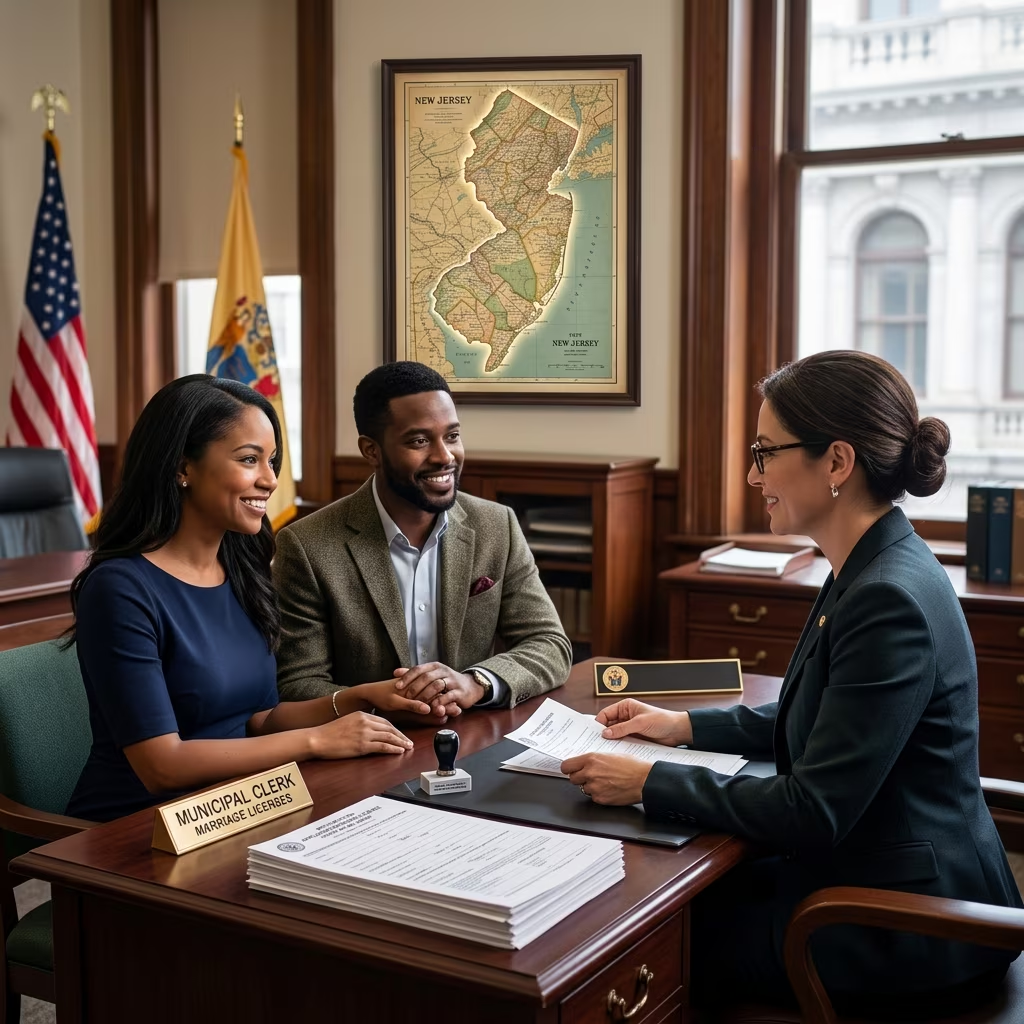
Couples planning to marry in New Jersey must follow specific state rules before their ceremony can be legally recognized. These rules focus on how to apply for a marriage license, which documents to bring, how long you must wait before the license is issued, and what happens to the license after the wedding. New Jersey sets these requirements statewide through its Department of Health and local registrars, and every couple needs to follow them carefully to avoid delays or legal problems.
Overview of New Jersey Marriage Licenses
A marriage license is a legal authorization issued by a local registrar that allows a couple to proceed with a marriage ceremony within New Jersey. The license is required before the ceremony takes place and serves as proof that the couple has met basic legal conditions such as age, identity, and residency.
New Jersey issues marriage licenses under uniform rules that apply in every municipality. Local clerk or registrar offices handle the paperwork, collect the fee, verify identity and residency, and enforce the mandatory waiting period before the license is released.
- Statewide rules: Requirements such as proof of identity, proof of residency, Social Security number, and waiting period are set at the state level.
- Local administration: You file the application with the local registrar in the municipality that has jurisdiction over your residence or your ceremony location.
- Civil and religious ceremonies: The same license rules apply whether the ceremony is performed by a judge, religious officiant, or other authorized person.
Where and When to Apply
The first step in the process is deciding where to submit your marriage license application. New Jersey rules distinguish between couples in which at least one partner lives in New Jersey and couples who live elsewhere but plan to marry in the state.
Choosing the Correct Municipality
- At least one NJ resident: Apply in the municipality where either applicant resides.
- Both applicants live out of state: Apply in the municipality where the ceremony will occur.
These rules help local registrars maintain accurate records and ensure that licenses are issued under the correct jurisdiction.
Appointment and Application Timing
Many New Jersey municipalities only accept marriage license applications by scheduled appointment during regular business hours. Because of the mandatory waiting period, it is important to plan ahead and avoid last-minute applications.
- Appointment-only offices: Towns often require you to call the clerk or registrar to schedule a time to submit your application and sign it under oath.
- Mandatory waiting period: There is a minimum 72-hour waiting period between filing the application and the license being issued.
- Planning backward from ceremony date: Couples commonly apply at least a week before the ceremony to avoid timing conflicts.
Eligibility: Who Can Apply for a New Jersey Marriage License
While the detailed rules on age and marital status are set out in state law and guidance, the application process itself focuses on confirming that each person is who they claim to be and that they are legally free to marry. The local registrar uses identification documents to verify name, age, and residency, and may ask for additional papers if there were prior marriages or civil unions.
| Eligibility Aspect | What the Registrar Checks |
|---|---|
| Identity | Valid government-issued photo ID and consistent information across documents. |
| Residency | Proof that at least one applicant lives in the municipality (if applicable). |
| Legal capacity to marry | Whether the applicant is currently married or in another legal union, based on any decrees or certificates provided. |
If either partner had a previous marriage, civil union, or registered domestic partnership, registrars often ask to see final divorce decrees, dissolution orders, annulment paperwork, or death certificates to confirm that the prior relationship has legally ended.
Required Documents and Information
New Jersey publishes detailed guidance on the documents and information each applicant must bring when applying for a marriage license. These items confirm identity, residency, and eligibility, and they are required under state regulations.
Core Documentation
- Proof of identity: Typically a driver’s license, passport, or other state or federal government-issued photo ID.
- Proof of residency: At least one NJ-resident applicant must show that they live in the municipality where they are applying. Common examples include a driver’s license with current address, a recent utility bill, or a bank statement.
- Social Security number: For U.S. citizens, the Social Security number is required by law and is kept confidential by the registrar.
- Witness: One witness who is at least 18 years old must accompany the couple when they sign the application under oath.
- Application fee: A non-refundable fee of $28 must be paid at the time of application. Municipalities usually accept cash or check.
Additional Helpful Records
Some documents are not strictly required in every case but are often requested or recommended because they help verify information more easily.
- Birth certificate, to establish parents’ names and birth details.
- Final divorce or dissolution decrees if a prior marriage or civil union ended.
- Death certificate of a former spouse, civil union partner, or domestic partner if the prior relationship ended due to death.
Foreign-Language Documents
If an applicant submits any document in a language other than English, the state requires a certified English translation to be provided along with the original document. This rule applies to identification papers, prior marriage decrees, and other supporting records.
Completing and Signing the Application
The marriage license application itself can usually be downloaded as a form, or obtained from the local registrar’s office. New Jersey emphasizes that applicants must not sign the form at home; instead, they must sign it in front of the issuing authority.
Steps to Complete the Application
- Obtain the form: You may print the application from state or municipal websites or pick it up at the registrar’s office.
- Fill in required information: Provide full names, current addresses, dates of birth, and parents’ names as requested on the form.
- List ceremony details: Many offices request the planned ceremony date, location, and officiant’s name and address.
- Do not sign at home: The application must be signed while under oath in the presence of the local registrar or clerk.
- Attend appointment with witness: Both applicants and the adult witness must appear together when the application is signed and the fee is paid.
Waiting Period and License Validity
New Jersey law imposes a waiting period after a marriage license application is filed. This delay is mandatory and begins once the registrar officially accepts the application.
Mandatory Waiting Period
- Duration: At least 72 hours (three days) must pass between filing the application and issuing the license.
- Calculation: The waiting period starts when the completed application is filed with the local registrar, not when you first call or schedule an appointment.
- Remarriage exception: For remarriage in certain circumstances, the usual 72-hour waiting period may be waived if you present a certified copy of the existing marriage, following state guidance.
License Validity After Issuance
Once the waiting period has passed and the registrar issues the marriage license, it is only valid for a limited time. This encourages couples to complete their ceremony within a reasonable window and ensures that information on the license is current.
- Time to use the license: The license must be used within a specific validity period after issuance (commonly up to 30 days, depending on state guidance and local practice).
- Expiration: If the license expires before the ceremony occurs, the couple must submit a new application and pay another fee.
- Application validity: A filed application is generally valid for six months from the date it is accepted, and may be extended up to one year with registrar approval. Only one license can be issued from a single application.
After the Ceremony: Filing the License
The license itself must be completed and returned after the ceremony so that the marriage can be officially recorded in New Jersey vital statistics. This step is often handled by the officiant, but couples should understand the process to ensure their marriage is properly registered.
Who Signs the License
- Couple: Both spouses sign the marriage license during or immediately after the ceremony.
- Officiant: The judge, clergy member, or other authorized officiant performs the ceremony and signs the license.
- Witnesses: Two witnesses typically sign at the ceremony, confirming that they observed the marriage. Some municipalities specify two witnesses at the ceremony in addition to the witness present at application.
Returning the License for Registration
Once all signatures have been obtained, the completed license must be filed with the registrar in the municipality where the ceremony took place. The filing deadline is often a few days after the ceremony, and each town may offer options for in-person drop-off or mailing.
- The officiant or couple returns the license to the local registrar of the ceremony municipality.
- Registrars then register the marriage and forward information to the state Office of Vital Statistics and Registry.
- Certified copies of the marriage certificate can later be requested from the registrar or the state vital records office.
Common Practical Tips for Couples
Because the rules are statewide but procedures vary slightly between municipalities, couples should contact their local registrar early in the planning process. Doing so reduces the risk of last-minute problems and gives the couple time to gather all required documents.
- Start early: Call the registrar as soon as you know your ceremony date and location to ask about appointment schedules.
- Gather documents in advance: Make sure you have current photo ID, proof of address, and any divorce or death certificates before your appointment.
- Check local procedures: Some towns require preliminary worksheets or online forms before scheduling your in-person signature appointment.
- Keep copies: Retain copies of all paperwork for your records, including receipts for fees and any certified translations.
- Confirm officiant authority: Ensure your officiant is legally authorized to perform marriages in New Jersey so that your license will be accepted for registration.
Frequently Asked Questions (FAQs)
Do we both need to appear in person to apply for a New Jersey marriage license?
Yes. Both applicants generally must appear together at the local registrar’s office to sign the application under oath, and they must be accompanied by an adult witness who is at least 18 years old.
Can we sign the marriage license application at home and mail it in?
No. New Jersey rules specifically state that you must not sign the application before going to the local registrar. The signatures must be made in the registrar’s presence while you are under oath.
Is there any way to avoid the 72-hour waiting period?
In general, New Jersey requires a 72-hour waiting period between filing the application and issuing the license. Certain remarriage situations may have different rules, but couples should discuss any special circumstances directly with the local registrar.
What if my identification or prior marriage documents are in another language?
If any supporting documents are not in English, you must provide a certified English translation along with the original. Registrars rely on these translations to verify your eligibility accurately.
How long is the marriage license valid once issued?
After the waiting period, the license is issued and is valid only for a limited time. You must use the license within that validity window, commonly up to 30 days after issuance; otherwise, you will need to reapply and pay a new fee.
Who files the completed license after the wedding?
Usually the officiant files the signed license with the registrar in the municipality where the ceremony occurred, but couples should confirm this step with their officiant and follow up with the registrar if necessary.
References
- Marriage License — New Jersey Department of Health, Vital Statistics. 2023-05-01. https://www.nj.gov/health/vital/registration-vital/marriage-licenses
- Entering Into a Marriage or Civil Union in New Jersey (REG-D30) — New Jersey Department of Health. 2022-03-01. https://www.nj.gov/health/forms/reg-d30.pdf
- Marriage License — NJWedding.com / Office of Vital Statistics and Registry (NJ). 2023-01-15. https://www.njwedding.com/marriage
- Marriage Licenses — Northwest Bergen Regional Health Commission, NJ. 2023-04-10. https://nwbrhc.org/marriage-licenses/
- Marriage Licenses — Paramus Borough, New Jersey. 2023-02-20. https://www.paramusborough.gov/168/Marriage-Licenses
- Applying for a Marriage License — Borough of Westwood, New Jersey. 2022-11-30. https://westwoodnj.gov/449/Applying-for-a-Marriage-License
- Marriage & Civil Union Licenses — Township of West Orange, New Jersey. 2023-03-18. https://www.westorange.org/244/Marriage-Civil-Union-Licenses