
Navigating Denver Courthouses: Locations, Roles, and Practical Tips
Understand Denver’s unique mix of state, county, municipal, and federal courts so you can find the right courthouse and prepare for your case.
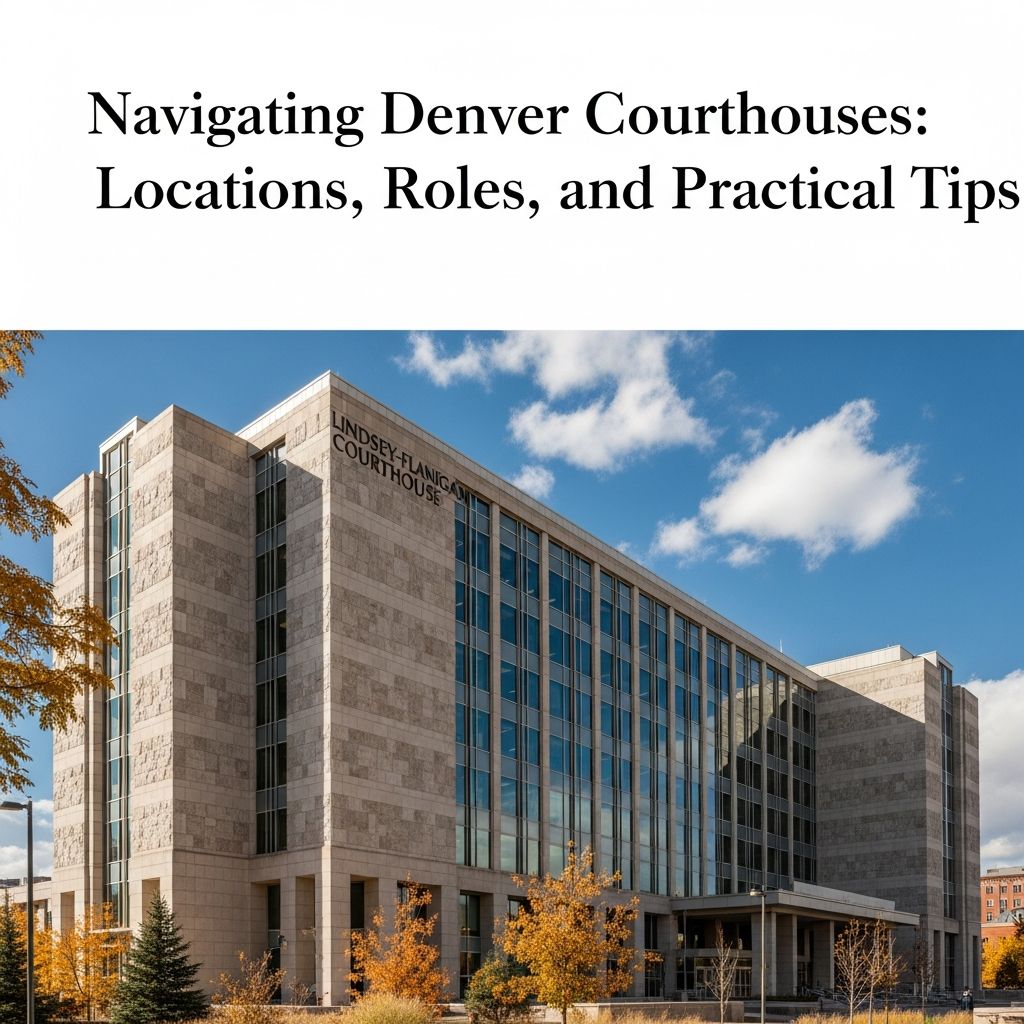
Denver is both a city and a county, which makes its court system different from every other county in Colorado. If you have a legal issue in Denver, understanding which courthouse you need—and what happens there—can save you time, confusion, and stress.
This guide explains the major courthouses in Denver, what kinds of cases they handle, and how they fit into Colorado’s broader judicial system. It is based on authoritative public information from the Colorado Judicial Branch and related institutions, but written in plain language for non-lawyers.
1. How Denver Fits Into Colorado’s Court System
Colorado’s courts are organized into several levels and types, from local trial courts up to the state Supreme Court. Denver is part of this statewide system, but it also has some unique courts of its own.
1.1 Core Types of Colorado Courts
- Municipal courts – Handle violations of city ordinances (e.g., certain traffic matters, local code violations).
- County courts – Hear misdemeanors, traffic offenses, and lower-value civil disputes (up to a statutory limit).
- District courts – Trial courts of general jurisdiction for major civil and criminal matters, as well as domestic relations, probate, and juvenile cases (outside Denver).
- Water courts – Specialized district courts with exclusive jurisdiction over water rights cases.
- Colorado Court of Appeals – Hears most appeals from district courts, and some agency decisions.
- Colorado Supreme Court – The state’s highest court, with supervisory authority over all state courts.
1.2 What Makes Denver’s Courts Unique?
Because Denver is both a city and a county, its court structure differs from the rest of Colorado in several important ways:
- Denver County Court acts as both a municipal and county court and is funded by Denver rather than the state.
- Denver has the only separate Juvenile Court and only separate Probate Court in Colorado. Everywhere else, those matters go through the district courts.
- Denver also has a regular District Court (for major civil and criminal cases) and is home to the Colorado Court of Appeals and Colorado Supreme Court.
2. Overview of Major Denver Courthouses
Different courthouses in Denver handle different kinds of cases. Before you go, you should identify which court has jurisdiction over your matter.
| Courthouse / Court | Level | Typical Case Types | Examples |
|---|---|---|---|
| Denver County Court | Local trial court (municipal + county) | Municipal ordinance violations, misdemeanors, some civil and traffic cases | Traffic tickets, city code violations, lower-value civil disputes |
| Denver District Court | State trial court (general jurisdiction) | Serious criminal cases, higher-value civil disputes, domestic relations (in Denver), some appeals from lower courts | Felony prosecutions, complex contract disputes, divorces |
| Denver Juvenile Court | Specialized state trial court | Juvenile delinquency and related matters | Delinquency charges, some status offenses |
| Denver Probate Court | Specialized state trial court | Probate, estates, some guardianship and conservatorship matters | Estate administration, will contests |
| Colorado Court of Appeals (Denver) | Intermediate appellate court | Appeals from district courts and certain agencies | Appeals from Denver District, Probate, and Juvenile Courts |
| Colorado Supreme Court (Denver) | State court of last resort | Selected appeals, original proceedings, attorney discipline | Discretionary review of Court of Appeals decisions |
| U.S. District Court for the District of Colorado | Federal trial court | Federal criminal and civil cases | Federal crimes, lawsuits under federal law, constitutional claims |
3. Denver County Court: Local and State-Level Functions
Denver County Court is one of the busiest courts in Colorado, handling about 100,000 cases each year. It is a hybrid court: in practice, it functions as both a municipal court and a county court for Denver residents.
3.1 Types of Cases in Denver County Court
According to official information from Denver County Court and the Colorado Judicial Branch, this court presides over a wide range of matters:
- Municipal criminal and ordinance cases – Violations of Denver city ordinances, such as certain low-level offenses and local code infractions.
- Traffic cases – Both municipal and state traffic violations, including serious traffic offenses that remain misdemeanors rather than felonies.
- Juvenile municipal ordinance matters – Some juvenile matters tied to local ordinances.
- Misdemeanor criminal cases – State law misdemeanors, such as lower-level assaults and certain theft offenses.
- Civil cases up to a statutory limit – Civil disputes where the amount in controversy falls below the county court jurisdictional cap (the precise dollar amount can change by statute).
- Small claims – Informal, streamlined civil cases for smaller amounts, often used by individuals and small businesses.
- Protection orders – Certain restraining and protection orders, often linked to domestic or interpersonal conflicts.
- Bond settings and felony advisements – Early stages of felony criminal cases before they proceed to Denver District Court.
3.2 Specialty and Problem-Solving Courts
Denver County Court participates in Colorado’s broader trend toward problem-solving courts, which focus on treatment and rehabilitation rather than only punishment. These specialty courts aim to address underlying issues like substance use or mental health concerns that often drive repeat offenses.
Examples of this kind of approach in Denver include:
- Community outreach-oriented dockets
- Wellness or mental health–focused programs
- DUI and sobriety treatment programs
- Competency-related diversion options
Statewide, Colorado operates dozens of similar problem-solving courts, dealing with drug use, DUI, mental health, and family issues.
3.3 Practical Tips for Denver County Court Visitors
- Check your paperwork carefully – The citation, summons, or notice you receive will specify if your appearance is in county court and usually list the courtroom and time.
- Arrive early – You may need to pass through security, locate your courtroom, and talk to a clerk or prosecutor before court starts.
- Dress and behave respectfully – Courts are formal environments; respectful attire and conduct can positively affect how your matter is handled.
- Bring documents and evidence – For civil or small claims cases, have contracts, photos, receipts, or other evidence neatly organized.
- Consider legal advice – Even in county court, legal rights and consequences can be serious. Speaking with a lawyer is strongly recommended for criminal charges.
4. Denver District Court, Juvenile Court, and Probate Court
While Denver County Court handles many local and lower-level cases, serious or specialized matters are typically heard in state trial courts that sit in Denver.
4.1 Denver District Court
Each county in Colorado is served by a district court, which acts as a trial court of general jurisdiction. For Denver, this court handles:
- Felony criminal cases – Serious criminal charges under state law.
- Major civil lawsuits – Higher-value disputes or cases seeking non-monetary relief such as injunctions.
- Domestic relations – Divorce, allocation of parental responsibilities (custody), and related family matters in Denver.
- Appeals from certain lower courts or agencies – In specific situations, district court reviews decisions made by lower tribunals or administrative bodies.
4.2 Denver Juvenile Court
Denver has Colorado’s only separate Juvenile Court.Outside Denver, juvenile matters are resolved in district court, but in Denver they are concentrated in this specialized tribunal.
Common matters include:
- Juvenile delinquency cases
- Certain status offenses and related proceedings
- Some matters involving the welfare of children, depending on case type
4.3 Denver Probate Court
The Denver Probate Court is another one-of-a-kind institution in Colorado. It focuses on issues connected with death, incapacity, and property transfer.
- Estates and wills – Admitting wills to probate, appointing personal representatives, and supervising estate administration.
- Guardianships and conservatorships – Court oversight of arrangements for individuals who cannot manage their personal or financial affairs.
- Trust and related disputes – Some cases involving disputes over trusts or fiduciary duties.
5. Appellate Courts Located in Denver
Although the appellate courts serve the entire state, they are physically based in Denver. Most people will never need to appear there, but it is helpful to understand their role.
5.1 Colorado Court of Appeals
The Colorado Court of Appeals is the state’s intermediate appellate court and generally serves as the first court to review decisions from district courts, including Denver’s District, Probate, and Juvenile Courts.
- It usually hears appeals in three-judge panels.
- It reviews the record from the lower court; it does not conduct new trials or hear new evidence.
- Its decisions are final unless the Colorado Supreme Court agrees to hear further review.
5.2 Colorado Supreme Court
The Colorado Supreme Court is the highest court in the state. It exercises supervisory authority over all Colorado state courts and has discretion over most of the cases it reviews.
Key functions include:
- Deciding whether to review certain Court of Appeals’ decisions (through petitions for certiorari).
- Handling appeals in specific types of serious criminal cases that may bypass the Court of Appeals.
- Ruling on attorney discipline and bar admissions issues.
- Addressing statewide legal and procedural questions that affect the whole judicial system.
6. Federal Court in Denver: U.S. District Court for the District of Colorado
Not all legal disputes in Denver go through state courts. Some matters belong in federal court, especially if they involve federal law, the U.S. Constitution, or the federal government as a party.
The U.S. District Court for the District of Colorado, headquartered in Denver, is the federal trial court that serves the state.
- Federal criminal cases – Prosecutions under federal statutes (for example, certain drug, firearms, fraud, or white-collar crimes).
- Civil lawsuits under federal law – Claims based on federal statutes or constitutional rights, such as some employment and civil rights cases.
- Multi-state disputes – Some cases between citizens of different states where federal jurisdiction is proper.
Appeals from this federal trial court go to the U.S. Court of Appeals for the Tenth Circuit (located in Denver) and ultimately may be reviewed by the U.S. Supreme Court.
7. Choosing the Right Denver Courthouse
To figure out which Denver courthouse you need to visit, work backwards from the type of problem you have and the paperwork you received.
7.1 Quick Guide by Issue Type
- Traffic ticket or city ordinance violation – Usually Denver County Court.
- Misdemeanor criminal charge – Denver County Court, unless it is part of a related felony case.
- Felony criminal charge – Begins with advisement and bond in Denver County Court, then typically moves to Denver District Court.
- Smaller civil dispute or small claims – Denver County Court (subject to the civil jurisdictional limit).
- Higher-value civil lawsuit or complex dispute – Denver District Court.
- Juvenile delinquency matter (in Denver) – Denver Juvenile Court.
- Estate, will, guardianship, or conservatorship (in Denver) – Denver Probate Court.
- Federal law claim or federal criminal case – U.S. District Court for the District of Colorado in Denver.
7.2 Information to Confirm Before You Go
Always double-check:
- The name of the court on your summons, ticket, or notice.
- The case number and division or courtroom.
- Whether your appearance is in person or can be handled remotely, since some courts allow virtual participation in certain proceedings.
- Any deadlines for filings, payments, or responses.
8. Frequently Asked Questions About Denver Courthouses
Q1: How can I tell if my case is in Denver County Court or Denver District Court?
Look at your ticket, summons, or court notice. It will identify the court by name (for example, “Denver County Court” or “Denver District Court”) and usually list the case number, courtroom, and date. As a rule of thumb, lower-level criminal matters and smaller civil disputes go to Denver County Court, while felonies and larger civil cases are heard in Denver District Court.
Q2: Do juvenile and probate cases in Denver use the same courts as the rest of Colorado?
No. Denver is unique because it has its own separate Juvenile Court and Probate Court. In other Colorado counties, district courts handle juvenile and probate matters. In Denver, those specialized courts focus exclusively on those case types.
Q3: Where do I appeal a decision from a Denver state trial court?
Most appeals from Denver’s District, Probate, and Juvenile Courts go to the Colorado Court of Appeals, which is headquartered in Denver. From there, a party can ask the Colorado Supreme Court to review the case, but the Supreme Court chooses which appeals it will hear in most situations.
Q4: When would my case be in federal court instead of a Denver state court?
Cases involving federal crimes, federal statutes, the U.S. Constitution, or certain disputes between citizens of different states may go to the U.S. District Court for the District of Colorado in Denver. Routine traffic, local ordinance, and most state-law disputes stay in Denver’s state courts.
Q5: Can I get legal help at the courthouse if I do not have a lawyer?
Courthouse staff can typically provide basic information about procedures, locations, and forms, but they cannot give legal advice. For rights, defenses, or strategy, you should speak with an attorney or a qualified legal aid organization.
References
- Denver County Court: Home — Denver County Court. 2024-01-01 (approx. last updated). https://www.denvercountycourt.org
- Colorado’s Judicial System — Office of the Denver District Attorney. 2023-01-01 (approx. last reviewed). https://www.denverda.org/colorados-judicial-system/
- Colorado Courts at a Glance (Brochure) — Colorado Judicial Branch. 2014-01-01. https://www.courts.state.co.us/userfiles/file/Media/Brochures/2014webglance.pdf
- Colorado Courts at a Glance (Updated) — Colorado Judicial Branch. 2020-01-01. https://www.courts.state.co.us/userfiles/file/Media/Brochures/2020webglance.pdf
- Courts – Colorado Judicial Branch — Colorado Judicial Branch. 2023-07-01 (approx. last updated). https://www.courts.state.co.us/Courts/Index.cfm
- Explainer: Key Facts About Colorado’s Courts — Colorado Judicial Institute. 2022-06-01. https://coloradojudicialinstitute.org/what-we-do/public-education/explainer-key-facts-about-colorados-courts.html
- United States District Court for the District of Colorado — U.S. District Court, District of Colorado. 2023-01-01 (approx. last updated). https://www.cod.uscourts.gov
Similar Articles








Read full bio of medha deb


