
National Security vs. Free Speech: A Modern Battleground
Exploring the delicate balance between security and the First Amendment.
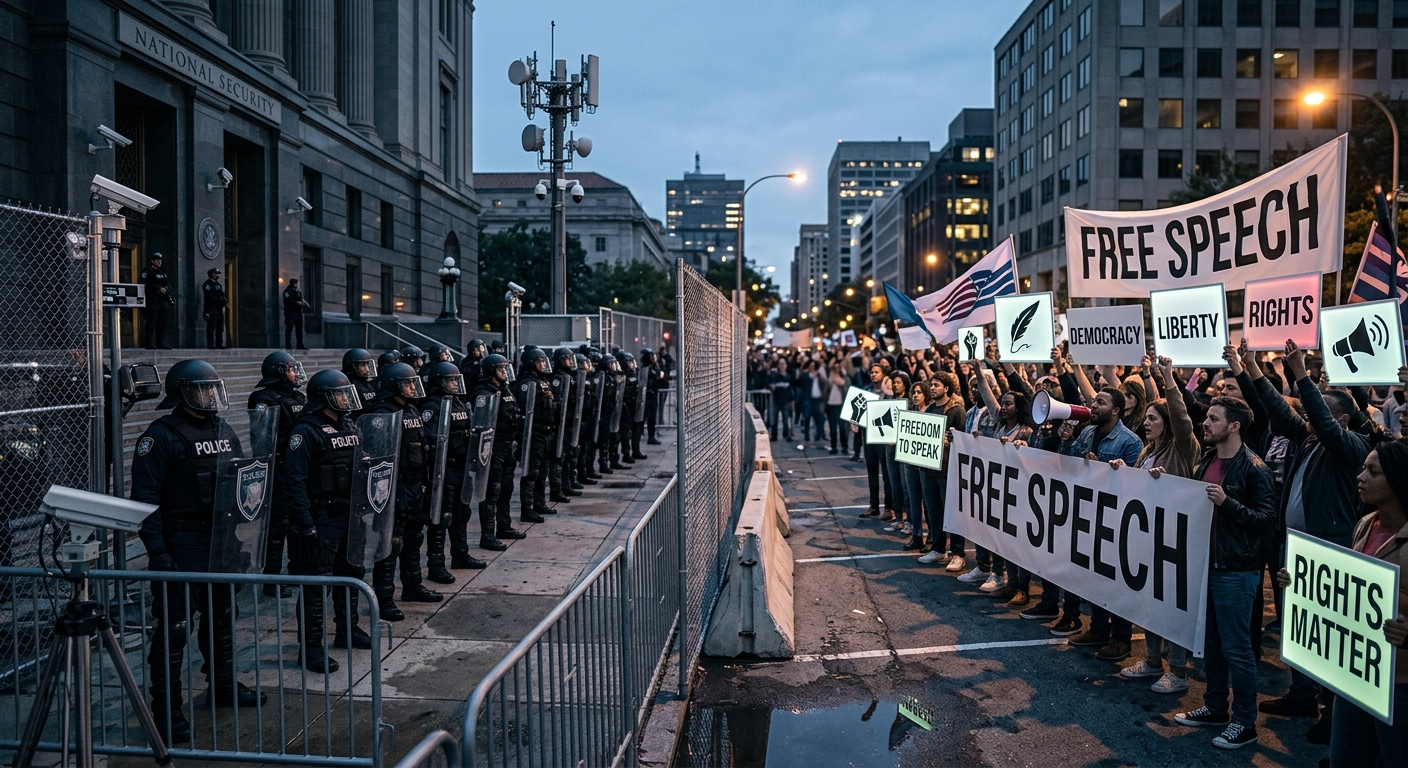
The Enduring Conflict: Civil Liberties in the Shadow of State Security
The First Amendment of the United States Constitution stands as the ultimate guarantor of democratic engagement, explicitly enshrining the fundamental freedoms of speech, the press, religion, assembly, and the right to petition. Yet, since the dawn of the republic, these liberties have collided with the state’s imperative to maintain national defense. From the Alien and Sedition Acts to the post-9/11 digital era, “national security” has frequently served as a rationale to justify the curtailment of civil liberties. When the government insists transparency threatens safety, the judicial system and the public face a delicate constitutional balancing act. The modern landscape—characterized by digital surveillance, whistleblower prosecutions, and unprecedented attempts to regulate foreign-owned technology—has transformed this tension into a high-stakes legal battlefield. Here, we explore the friction between protecting a nation from threats while preserving the marketplace of ideas.
The Justification of State Secrecy vs. The Public’s Right to Know
At the core of the debate is a profound philosophical divergence regarding the role of information. Democratic governance relies on an informed electorate capable of evaluating its leaders. This requires a press free to investigate and citizens free to debate. However, the executive branch argues that operational details, intelligence-gathering methodologies, and diplomatic communications must remain shrouded in secrecy to maintain effectiveness.
When invoking national defense to suppress speech, the government typically argues disclosure would cause immediate, irreparable harm. This creates an informational asymmetry: the government possesses the classified data and controls the narrative regarding potential damage. Meanwhile, journalists and the public are left to argue for the theoretical value of disclosure without fully knowing what is hidden. This dynamic places an enormous burden on the courts, which often lack specialized intelligence expertise to second-guess executive risk assessments.
Historically, this imbalance led to a judicial doctrine of broad deference to the executive branch. As the federal classification system balloons—with millions of documents classified annually, sometimes to shield political embarrassment rather than protect secrets—the public’s right to know is eroded. The struggle encompasses shielding bulk data collection programs and hiding the domestic deployment of surveillance technologies from public scrutiny.
Surveillance Architecture and the Chilling of Free Expression
The architecture of modern state surveillance, constructed largely after the September 11 attacks, represents a pervasive threat to First Amendment freedoms. Federal programs authorized under Section 702 of the Foreign Intelligence Surveillance Act (FISA) and Executive Order 12333 facilitate the bulk collection of digital communications on a staggering scale. While the explicit goal is foreign intelligence gathering, the incidental collection of domestic civilian communications is vast and opaque.
The constitutional injury extends beyond Fourth Amendment privacy concerns; it directly implicates the First Amendment through the “chilling effect.” When individuals suspect their internet search histories, emails, and phone metadata are monitored by the state, they instinctively alter their behavior. They become less likely to research controversial topics or associate with scrutinized advocacy groups.
For journalists, the surveillance state presents an existential crisis to newsgathering. The ability to guarantee source anonymity is the bedrock of investigative journalism. When the government can bypass the reporter and subpoena telecommunications companies or analyze metadata to uncover a whistleblower’s identity, the vital flow of information dries up. The intense secrecy surrounding the Foreign Intelligence Surveillance Court (FISC), which issues binding legal rulings interpreting these powers, exacerbates the problem. Persistent efforts to unseal FISC opinions argue that secret law is incompatible with a free society. Yet, courts frequently decline to intervene, leaving the chilling effect firmly entrenched.
The Espionage Act: A Weapon Against Whistleblowers and the Press
No single piece of federal legislation exemplifies the hostile collision between national security and free speech more starkly than the Espionage Act of 1917. Originally enacted during World War I to prosecute actual foreign spies, the law’s broad and outdated language is now frequently deployed to target government insiders who leak classified information to the press. It makes it a severe federal crime to retain or transmit “national defense information” to unauthorized persons.
Crucially, the law currently permits no “public interest” defense. A whistleblower facing decades in federal prison cannot argue in court that the leaked information revealed illegal government surveillance programs or constitutional violations. The jury is strictly barred from considering the moral reasoning behind the leak or the societal value of the disclosure.
Furthermore, the persistent legal ambiguity of the Espionage Act poses a severe threat to press freedom. The statutory language theoretically allows the Department of Justice to prosecute the civilian journalist who receives and publishes classified information. While the government historically adhered to informal norms refraining from crossing this dangerous Rubicon, recent legal maneuvers have signaled a dramatic shift. In direct response to this escalating threat, legislators have introduced reforms. The Daniel Ellsberg Press Freedom and Whistleblower Protection Act, introduced in 2026, explicitly sought to ban the use of the Espionage Act against journalists and establish a formal public interest defense, highlighting the urgent need to align early-20th-century laws with modern First Amendment principles.
Digital Frontiers: Tech Regulation and “Foreign Adversary” Bans
As the internet rapidly evolves into the primary public square, the national security apparatus increasingly focuses on digital platforms hosting global, borderless speech. The intersection of emerging technology, geopolitical rivalry, and free expression recently reached a boiling point with legislative efforts to ban foreign-owned applications, most notably TikTok. The political justification is rooted in national security: the fear that a foreign adversary could leverage user data for espionage, or subtly manipulate algorithms to conduct sophisticated psychological operations on American soil.
However, from a strict First Amendment perspective, banning a ubiquitous communications platform utilized by millions to express themselves and share independent news constitutes a massive prior restraint on speech. In landmark legal challenges, federal courts are forced to weigh speculative national security threats against the immediate, tangible suppression of domestic free speech. If the government can successfully ban a social media platform based predominantly on the nationality of its parent company, critics argue it establishes a profoundly dangerous legal precedent for systemic internet censorship.
Additionally, the proliferation of artificial intelligence (AI) has introduced new national security paradigms. The federal government’s push to implement strict AI guardrails and restrict the export of certain open-source AI technologies often directly infringes upon the First Amendment rights of developers. Computer code is broadly recognized by appellate courts as a distinct form of protected speech. When national security mandates dictate exactly what kind of algorithms can be published, the foundational freedom to innovate is compromised.
Judicial Review: The Balancing Act and Executive Deference
The judicial branch serves as the ultimate constitutional arbiter when executive national security demands infringe upon established First Amendment rights. The specific standard of judicial review applied is critical to the outcome. In typical domestic free speech cases, content-based restrictions are subjected to strict scrutiny, requiring the government to definitively prove that the restriction serves a compelling state interest and is narrowly tailored to achieve that goal.
However, when the executive branch explicitly invokes “national security,” courts historically pivot toward sweeping deference. The landmark Pentagon Papers case remains the celebrated high-water mark for press freedom, where the Supreme Court ruled the government had not met the heavy burden required to impose a prior restraint on publication. Yet, in the five decades since that ruling, courts have frequently sidestepped direct, confrontational oversight with the executive branch on intelligence matters.
Recent judicial terms have seen courts navigating these turbulent waters with mixed results. While the judiciary has robustly defended speech in domestic cultural contexts, it routinely applies a much more forgiving intermediate scrutiny standard, or invokes the “state secrets privilege,” when foreign intelligence operations are involved. As the definition of what constitutes a national security threat expands to encompass economic stability and digital infrastructure, the judiciary’s willingness to pierce the veil of executive secrecy will determine the future vitality of the First Amendment.
Conclusion
The inherent tension between robust national security and the First Amendment is a permanent, structural feature of a constitutional democracy grappling with an increasingly dangerous world. While absolute security is an appealing illusion, the wholesale surrender of fundamental liberties in its pursuit is a historical reality that citizens must constantly guard against. As federal surveillance capabilities grow more intrusive and digital mechanisms for disseminating public information become more complex, the legal frameworks governing this delicate balance must boldly evolve. Protecting whistleblowers, preserving an independent press, and demanding transparency from opaque intelligence agencies are not acts of subversion; they are strictly necessary mechanisms for holding immense power accountable. The true measure of a free society is not how it protects speech when it is perfectly safe, but how fiercely it upholds the First Amendment when the government insists the stakes are simply too high to allow it.
Frequently Asked Questions (FAQs)
- What is the core relationship between the First Amendment and national security?
The relationship is a constant constitutional balancing act. While the First Amendment guarantees free speech, the government often attempts to restrict these rights by claiming certain disclosures threaten the nation, requiring courts to weigh the public’s right to know against potential harms. - Can the government legally censor the press to protect classified information?
Censoring the press before publication is known as prior restraint. The Supreme Court has ruled that prior restraint is presumed unconstitutional. The government must prove that publication would cause inevitable, direct, and immediate harm to the nation, an exceptionally difficult standard. - How does the Espionage Act currently affect investigative journalists?
The Espionage Act is utilized to prosecute government whistleblowers who leak classified documents, fundamentally chilling journalists’ ability to cultivate sources. The law technically allows for the prosecution of journalists who publish classified information, creating a looming threat over reporting. - What exactly is the “chilling effect” in the context of government surveillance?
The chilling effect occurs when individuals consciously or unconsciously self-censor their speech, alter browsing habits, or avoid associating with political groups because they fear the government is monitoring their digital communications. - Has the Supreme Court ever fully upheld a prior restraint on national security grounds?
The Supreme Court has never permanently upheld a prior restraint injunction against the press on pure national security grounds. The most famous test was the Pentagon Papers case in 1971, where the Court decisively ruled in favor of allowing the press to publish classified documents.
References
- FREE SPEECH COALITION, INC., ET AL. v. PAXTON — Supreme Court of the United States. 2025-06-27. https://www.supremecourt.gov/opinions/24pdf/23-1122_e29g.pdf
- Daniel Ellsberg Press Freedom and Whistleblower Protection Act (Introduced) — U.S. House of Representatives / Congress.gov. 2026-03-12. https://tlaib.house.gov/posts/tlaib-introduces-bill-to-protect-whistleblowers-and-journalists
- Supreme Court Declines to Hear First Amendment Challenge to Secrecy of U.S. Surveillance Court — American Civil Liberties Union (ACLU). 2021-11-01. https://www.aclu.org/press-releases/supreme-court-declines-hear-first-amendment-challenge-secrecy-us-surveillance-court
- Notable First Amendment Court Cases — American Library Association (ALA). 2025-09-12. https://www.ala.org/advocacy/intfreedom/censorship/courtcases
- Chilling Ambiguity: Can Espionage Act Liability be Imposed for Reporting the News? — Connecticut Law Review. 2026-05-31. https://opencommons.uconn.edu/law_review/
Similar Articles








Read full bio of medha deb


