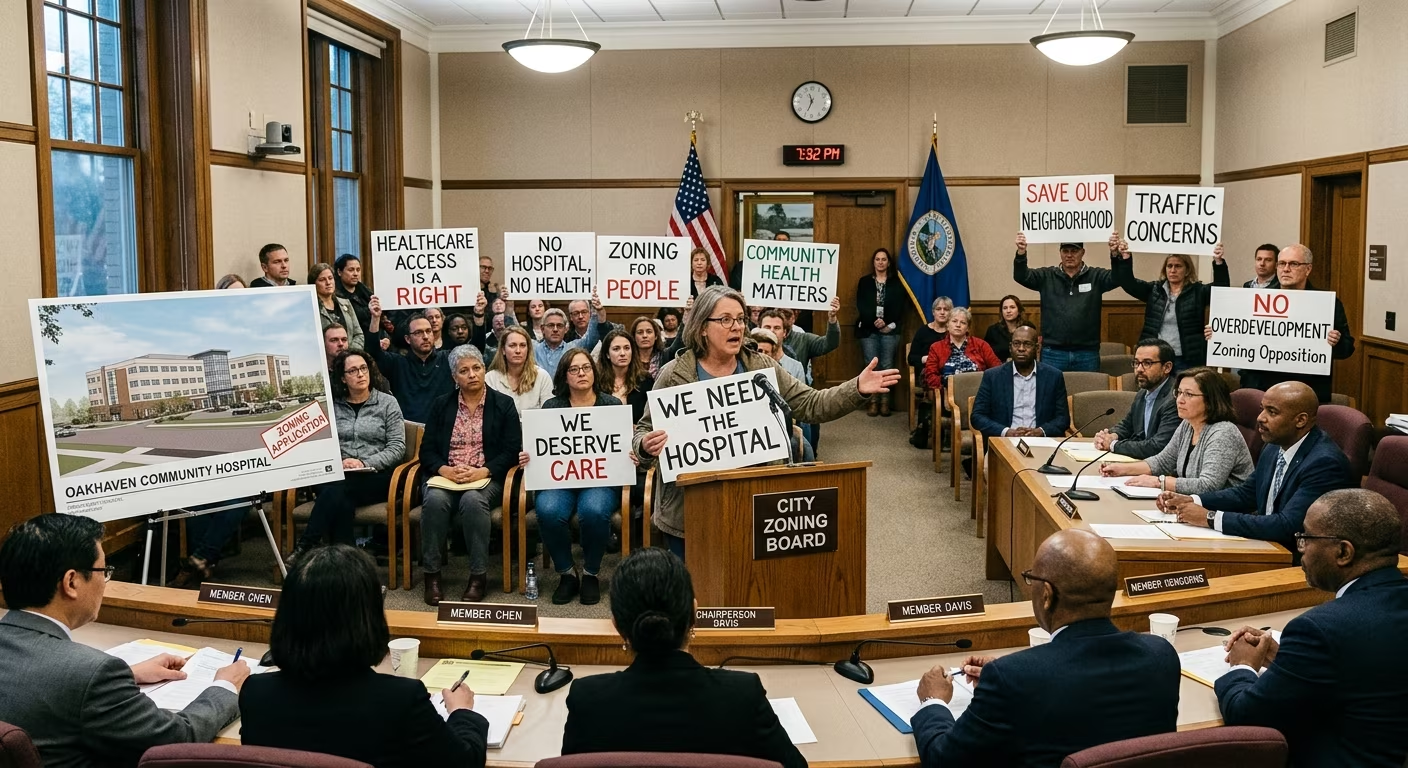
Local governance is typically associated with infrastructure maintenance, public parks, and dictating where commercial districts end and residential neighborhoods begin. Zoning ordinances, in their purest form, are pragmatic tools for community planning. They ensure that heavy industrial factories are not built next to elementary schools and that traffic flows manageably through suburban enclaves. However, an increasingly prevalent and controversial trend has emerged: the use of these hyper-local land-use regulations to dictate and restrict specialized medical access.
By maneuvering through municipal codes, city councils and zoning boards have found ways to indirectly restrict controversial medical services, most notably reproductive healthcare and abortion clinics. Rather than relying solely on state or federal mandates—which are often bogged down by rigorous constitutional scrutiny—local municipalities utilize the seemingly mundane machinery of building permits and zoning overlays. This practice transforms local bureaucratic processes into ideological battlegrounds, placing vital civil rights and healthcare access at the mercy of neighborhood zoning commissioners. This article delves into how local ordinances are weaponized to block specialized medical facilities, the legal frameworks that govern these disputes, and the profound ripple effects on community health.
The Weaponization of Land Use Ordinances
The concept of zoning was originally established to protect the public welfare by separating incompatible land uses. When appropriately applied, it ensures community safety, minimizes environmental hazards, and guides orderly urban development. Yet, the broad discretionary power granted to local zoning boards makes the system highly susceptible to ideological manipulation.
In the context of reproductive healthcare, municipalities have increasingly adopted what legal scholars categorize as a localized form of Targeted Regulation of Abortion Providers (TRAP) laws . While state-level TRAP laws might mandate medically unnecessary hospital admitting privileges or exact surgical-center hallway widths, localized TRAP regulations exploit the geographic placement of clinics . City councils can suddenly rezone a commercial district to exclude “surgical facilities,” or they might require reproductive health clinics to secure “special use permits”—a bureaucratic hurdle that opens the door to arbitrary denial based on community opposition rather than objective land-use criteria.
This strategy relies on the presumption of validity that courts traditionally afford to municipal zoning decisions. Local governments will often argue that restricting a clinic is not about banning a medical procedure, but about managing local traffic, preserving neighborhood aesthetics, or ensuring emergency vehicle access. However, when these ordinances are rushed through immediately after a clinic announces its opening or an expansion of its services, the underlying motive becomes glaringly apparent. The red tape is intentionally thickened to drain the clinic’s financial resources and delay patient care indefinitely.
Case Study: Micro-Bans and the Blueprint of Local Resistance
A striking illustration of this phenomenon can be found in the legal disputes that unfolded in Tennessee municipalities prior to the nationwide overturning of constitutional abortion protections. In a situation that serves as a powerful blueprint for localized medical restrictions, a suburban city council orchestrated a targeted zoning change specifically designed to block an existing clinic from expanding its services.
The clinic in question had been operating legally within the city limits, providing medication-based reproductive care alongside standard family planning services. Seeking to comprehensively serve its patient base, the healthcare provider initiated plans to construct facilities to offer surgical procedures. In an immediate and highly coordinated response, the local municipality introduced a zoning amendment to expressly ban surgical abortion facilities within the city limits.
Crucially, the city did not ban outpatient surgical centers for dentistry, cosmetic procedures, or minor orthopedics; the prohibitive ordinance was surgically aimed at one specific branch of reproductive care. This scenario exemplifies a “micro-ban.” Instead of addressing the medical validity of the procedure—a domain typically reserved for state medical boards or federal health agencies—the city framed the issue exclusively as a local zoning violation.
By drawing a geographic boundary around the city, the municipality effectively stated that while the right to healthcare might exist broadly across the state, it would not be accommodated within their specific zip code. Such actions force medical providers into an impossible corner. They must either abandon their plans to provide comprehensive care, relocate to a more permissive municipality (incurring massive financial losses), or engage in protracted, expensive litigation against the city.
The Tennessee example highlights a broader strategy utilized nationwide: when opponents of reproductive rights encounter roadblocks in securing sweeping federal bans, they pivot to hyper-local legislative bodies where ordinances can be passed quietly, swiftly, and often before the general public fully comprehends the legal and medical implications.
Navigating the Legal Framework: State Statutes vs. Local Codes
The clash between municipal zoning laws and healthcare rights creates a complex jurisdictional puzzle. In the United States, local governments only possess the powers granted to them by their state—a concept known in legal terms as “Dillon’s Rule” or generalized home-rule authority. When a municipality uses its zoning power to ban a legally recognized medical procedure, it often triggers robust legal challenges rooted in the doctrine of preemption .
Preemption occurs when a higher level of government (state or federal) displaces lower-level laws. If a state licenses and regulates medical clinics, a local city council cannot typically pass a zoning law that wholly contradicts or undermines that state regulation. Civil rights attorneys frequently argue that municipalities overstep their delegated police powers when they attempt to regulate the practice of medicine under the thin guise of regulating land use.
Furthermore, targeted zoning ordinances invite Equal Protection and Due Process challenges. If a city allows an outpatient podiatry clinic to operate in a specific commercial zone but bans a reproductive health clinic with the exact same physical footprint and traffic impact, the city must justify this disparate treatment. Historically, courts scrutinize local regulations that possess no rational basis other than moral disapproval or political animus. When zoning codes are manipulated solely to restrict liberties, judges have frequently stepped in to strike down the ordinances as arbitrary, capricious, and legally void.
Patient Access and Community Repercussions
The consequences of municipal healthcare bans extend far beyond municipal buildings and courtrooms; they have immediate, devastating impacts on public health and patient access . When local zoning boards successfully push clinics out of their borders, the geographic distribution of healthcare becomes increasingly fragmented. Patients are left navigating a patchwork of “medical deserts,” where the availability of care is dictated by the ideological makeup of a city council rather than actual community health needs.
The burden of these micro-bans is not shared equally. They disproportionately affect low-income individuals, young people, and marginalized communities who may lack the logistical and financial resources to travel across municipal or state lines to receive care.
Analyzing the Impact of Clinic Displacement
| Consequence of Local Bans | Impact on Patients and Community |
|---|---|
| Increased Travel Distances | Patients must secure reliable transportation, take additional time off work, and arrange for overnight childcare to reach out-of-town facilities. |
| Delayed Medical Care | Bureaucratic delays in clinic openings lead to delayed appointments, which can limit the types of medical interventions safely available to the patient. |
| Financial Strain | Reduced clinic availability drives up out-of-pocket costs for travel, lodging, and the procedures themselves due to decreased local healthcare competition. |
| Overburdened Alternatives | Remaining clinics in neighboring, permissive cities become flooded with patients, leading to severe staffing shortages and longer waitlists. |
When a city utilizes its zoning code to essentially banish a specific type of medical care, it forces patients into a logistical nightmare. The delay in securing an appointment often pushes reproductive health procedures later into a timeframe where medical complexities and costs rise exponentially. Ultimately, local zoning ordinances prioritizing political posturing over public health directly compromise the physical and financial well-being of the community’s most vulnerable residents.
Civil Rights Defense: Challenging the Zoning Board
In response to the weaponization of local ordinances, civil liberties organizations and health advocacy groups have taken up the mantle of defending clinic access in the courts. Litigation serves as a critical check against municipal overreach, ensuring that fundamental rights are not slowly eroded by neighborhood zoning commissioners.
When legal advocates challenge a city council, the legal strategy is multi-faceted. First, they often file for preliminary injunctions to immediately halt the enforcement of the discriminatory ordinance, allowing the clinic to open or continue operating while the case is litigated. The core legal argument frequently hinges on demonstrating “discriminatory intent.” Lawyers will scrutinize city council meeting minutes, public statements by municipal officials, and the timeline of the ordinance’s passage to prove that the zoning change was a pretextual maneuver designed specifically to target the clinic.
Moreover, civil rights litigation highlights the lack of a valid public interest. For a zoning law to be constitutional, it must generally serve a legitimate public purpose—such as reducing noise pollution or preventing industrial waste near residential homes. Legal advocates successfully illustrate that reproductive health clinics operate identically to other medical offices. They generate similar traffic, require the same parking accommodations, and pose zero unique threat to public safety. By stripping away the pretext of “land-use planning,” litigation exposes these ordinances as unconstitutional bans on medical care, thereby preserving the essential boundary between local urban planning and individual medical autonomy.
Frequently Asked Questions (FAQs)
Can a municipality completely ban a specific medical procedure?
Generally, a municipality cannot outright ban a medical procedure that is legally permitted and regulated by the state or federal government. However, cities often attempt to indirectly ban procedures by making it geographically impossible for a clinic to secure the necessary building permits or zoning approvals, leading to complex preemption lawsuits.
What are TRAP laws?
TRAP stands for Targeted Regulation of Abortion Providers. These are regulations specifically designed to impose burdensome and medically unnecessary requirements on reproductive health clinics. While often enacted at the state level, localized TRAP laws involve manipulating municipal zoning codes and special use permits to force clinics out of business.
Why do civil rights organizations sue local governments over zoning?
Organizations sue local governments to prevent the violation of rights through bureaucratic loopholes. When a city council uses zoning laws arbitrarily to target and exclude a protected class or legally recognized medical service, litigation is often the only mechanism to restore equal protection and ensure equitable healthcare access.
How do courts determine if a zoning law is unfair to a clinic?
Courts look at whether the zoning law treats the targeted clinic differently than similar medical or commercial facilities. If a city allows cosmetic surgery centers but bans reproductive health surgical centers in the same commercial zone without a valid, objective public safety reason, the court may deem the ordinance arbitrary, capricious, and legally invalid.
References
- “Down Where the Grass Grows”: Municipal Abortion Policies After Dobbs — University of Colorado Law Review. 2024-03-19. https://lawreview.colorado.edu/printed/down-where-the-grass-grows-municipal-abortion-policies-after-dobbs/
- Taking on TRAP Laws: Protecting Abortion Rights through Property Rights — The University of Chicago Legal Forum. 2018-01-10. https://chicagounbound.uchicago.edu/uclf/vol2017/iss1/24/
- Impacts of State-Level Abortion Restrictions — Milken Institute School of Public Health. 2018-04-01. https://publichealth.gwu.edu/sites/default/files/downloads/JacobsInstitute/Jacobs_Institute_Womens_Health_Abortion_Restrictions_Issue_Brief_2018.pdf