
Mortgage APR vs. Interest Rate: What Homebuyers Must Know
Understand how mortgage interest rates and APRs differ so you can compare loans accurately and avoid costly borrowing mistakes.
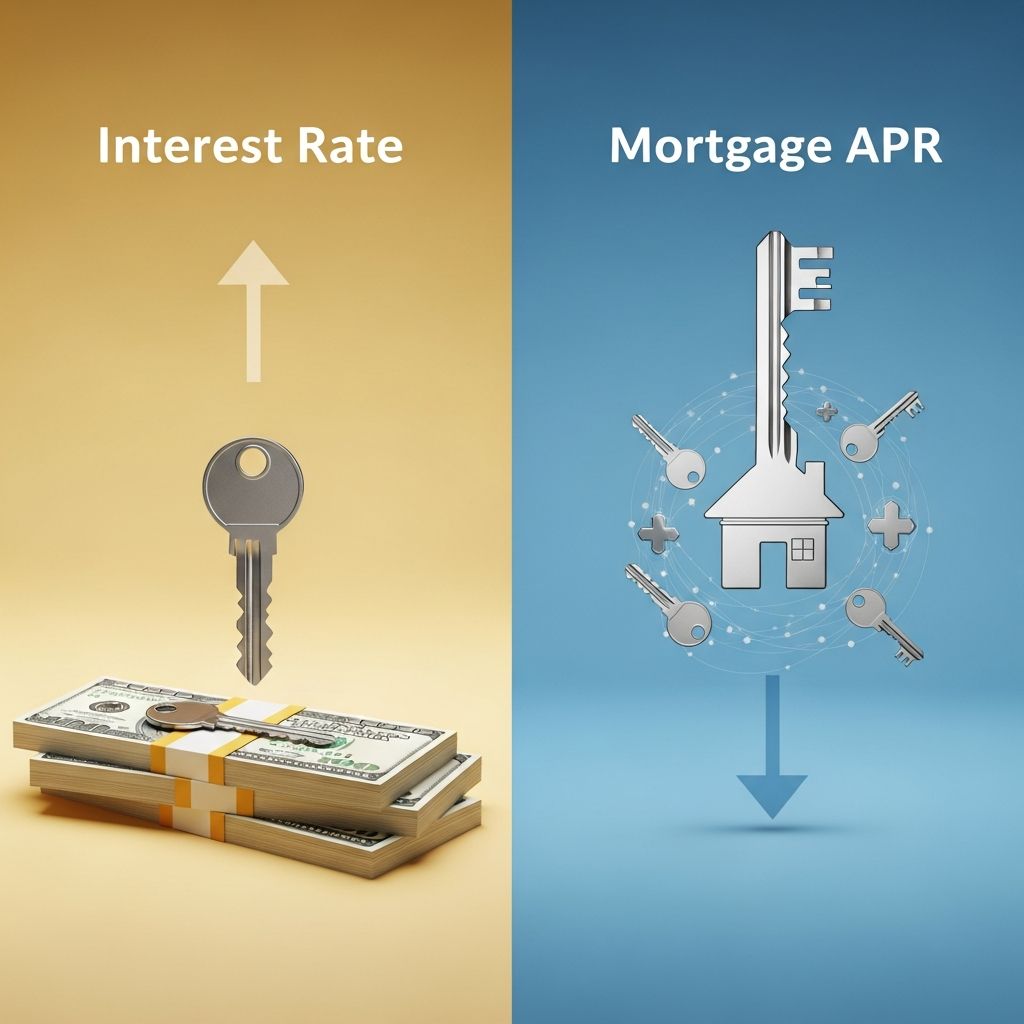
When you shop for a mortgage, you usually see two percentages on every quote: the interest rate and the APR (annual percentage rate). They look similar, but they measure different things and can lead to very different total costs over time. Understanding both is essential to choosing the right loan, whether you are buying a home or refinancing an existing mortgage.
Core Definitions: Interest Rate and APR
Start by separating the two numbers in your mind. They are related but not interchangeable.
What is a mortgage interest rate?
Your mortgage interest rate is the basic price you pay to borrow money. It is expressed as a percentage of your loan balance and applies only to the principal you borrow.
Key points about the interest rate:
- Shows the cost of borrowing, not including most fees.
- Determines how much interest accrues on your outstanding principal.
- Directly affects your monthly principal and interest payment.
- Is influenced by market conditions, your credit profile, loan type, and loan term.
What is a mortgage APR (Annual Percentage Rate)?
The APR is a broader measure of what the loan costs you each year. It includes the interest rate plus many of the required lender and broker charges you pay to get the loan.
According to the Consumer Financial Protection Bureau (CFPB), APR reflects:
- The interest rate.
- Points (discount points or lender points you pay upfront).
- Mortgage broker fees.
- Certain other charges you pay to obtain the loan.
Because it bundles in these additional costs, your APR is usually higher than your interest rate.
Interest Rate vs. APR at a Glance
The table below summarizes how these two numbers work and why both appear on mortgage offers.
| Feature | Interest Rate | APR (Annual Percentage Rate) |
|---|---|---|
| What it measures | Cost of borrowing the principal only. | Total yearly cost of borrowing, including interest and many upfront fees. |
| Includes lender & broker fees? | No, it generally excludes most fees. | Yes, it rolls in points, certain closing costs, and broker fees. |
| Effect on monthly payment | Directly determines the interest portion of your monthly payment. | Does not directly set monthly principal and interest; shows averaged annual cost. |
| Best used for | Estimating monthly payment size and interest expense. | Comparing total cost of competing loans over the full term. |
| Typical size | Lower number on the quote. | Usually higher than the interest rate because it adds fees. |
What Goes into APR (and What Does Not)
APR is designed by federal rules to make it easier to compare the total cost of different loan offers. It includes many charges but not every dollar you might spend at closing.
Common costs usually included in APR
Lenders often include:
- Origination fee or underwriting fee charged by the lender.
- Discount points if you pay to reduce the interest rate.
- Broker compensation if a mortgage broker is involved.
- Certain prepaid finance charges required as part of the loan, as defined by regulation.
Costs often excluded from APR
Some closing costs relate more to owning or transferring the property, not to the cost of borrowing. These may not be part of your APR, depending on how the fee is structured and federal definitions of “finance charge.” Examples can include:
- Title insurance premiums.
- Recording fees charged by local governments.
- Some appraisal or inspection fees.
- Owner’s title policy or optional services.
Because not every fee is included, two loans with identical APRs can still differ in their up-front cash requirements and overall flexibility. Reading the full closing cost details on your Loan Estimate and Closing Disclosure is essential.
Why APR is Usually Higher Than the Interest Rate
APR spreads the cost of certain upfront charges across the life of the loan and expresses that as an annual percentage. When you add fees to the finance cost and amortize them over many years, the effective yearly cost rises, so the APR becomes higher than the plain interest rate.
Three main factors tend to widen the gap between interest rate and APR:
- More fees: The more points and lender charges you pay, the bigger the gap.
- Shorter loan term: The same upfront fee spread over 10 years increases APR more than over 30 years.
- Smaller loan amount: A fixed fee represents a larger percentage of a smaller loan, raising APR.
How Interest Rate and APR Affect Your Payments
Although APR gives a fuller picture of overall cost, your monthly payment for principal and interest is determined mainly by three items:
- The interest rate itself.
- The loan amount.
- The loan term (for example, 15-year vs. 30-year).
Mortgages are typically amortized, meaning each payment includes both principal and interest, structured so the loan is fully repaid by the end of the term. Early in the loan, a larger share of your payment goes toward interest; later on, more goes toward principal.
While APR is not used directly to calculate your monthly payment, a higher APR usually means you are paying more to borrow overall, whether in the form of a higher rate, higher fees, or both.
When to Focus on APR vs. When to Focus on Interest Rate
Both figures matter, but they become more or less important depending on your plans for the home and loan.
Situations where APR is especially useful
APR is particularly valuable when you are:
- Comparing similar fixed-rate loans with the same term (for example, two 30-year fixed-rate mortgages).
- Planning to keep the loan for a long time, so fees and interest will matter over many years.
- Choosing between paying points and taking a higher rate, and you want to see which option is cheaper in total.
In these scenarios, a lower APR usually signals a lower total cost over the life of the loan, assuming you keep the mortgage for the full term.
Situations where the interest rate may matter more
There are situations where the interest rate itself deserves extra attention:
- You are focused on monthly payment affordability and want to reduce your monthly obligation.
- You expect to sell the home or refinance soon, long before the loan term ends.
- You are comparing different loan types (such as a 15-year vs. 30-year, or fixed-rate vs. adjustable-rate).
In these cases, an offer with a slightly higher APR but lower monthly payment in the period you plan to keep the loan could still meet your goals better.
Special Considerations for Adjustable-Rate Mortgages (ARMs)
Adjustable-rate mortgages complicate APR comparisons because the interest rate can change over time. The APR on an ARM is based on assumptions about how the rate might adjust in the future; it does not show the maximum rate you could pay.
For ARMs, pay attention to:
- The initial (introductory) rate and how long it lasts.
- The index the rate is tied to and the margin added to that index.
- Rate caps, which limit how much the interest rate can rise at each adjustment and over the life of the loan.
Because ARM APRs do not predict the highest possible cost, they are less reliable as a single comparison tool. Review the full terms carefully before choosing an adjustable-rate mortgage.
How to Use APR and Interest Rate When Shopping for a Mortgage
Federal law requires lenders to present standardized disclosures, including the APR, to help you compare offers more easily. Here is a step-by-step approach you can use.
1. Gather written Loan Estimates
For each lender you are considering:
- Request a Loan Estimate so you can compare the interest rate, APR, and closing costs side by side.
- Confirm that you are comparing the same loan type and term (for example, all 30-year fixed-rate loans) so differences are meaningful.
2. Compare both interest rate and APR
When reviewing offers:
- Use the interest rate to estimate monthly payments and immediate affordability.
- Use the APR to assess total borrowing cost and compare fees across lenders.
- Look at the line-item closing costs to see which fees are driving differences in APR.
3. Factor in how long you will keep the loan
If you are likely to move or refinance in a few years, the loan with the lowest APR over 30 years may not be the cheapest over your shorter time horizon. Tools such as break-even calculations—how long it takes the savings from a lower rate to outweigh higher upfront fees—can help you choose the best structure for your plans.
4. Ask questions before committing
If any part of the quote is unclear, ask the lender:
- Which fees are included in the APR calculation?
- Whether you are paying points, and if so, how much those points lower your rate.
- How much your payment might change for adjustable-rate options.
Common Misconceptions About APR and Interest Rate
Misunderstanding these terms can lead to expensive mistakes. Here are a few myths to avoid.
- “The lowest rate always means the cheapest loan.”
A very low interest rate with extremely high fees can produce a higher APR and a more expensive loan overall. - “APR and interest rate should be identical.”
In reality, APR usually exceeds the interest rate because it includes points and other costs you pay at closing. - “APR tells me exactly what I’ll pay every month.”
APR is a standardized, annualized measure of cost. Your actual monthly payment is calculated using the interest rate, not the APR. - “APR fully captures all homebuying costs.”
APR does not include every closing fee or ongoing homeownership cost such as property taxes, homeowners insurance, or maintenance.
Frequently Asked Questions (FAQs)
Q1: Why are lenders required to show APR as well as the interest rate?
Federal rules require APR disclosures so borrowers can compare loans on a more consistent basis, even when lenders structure fees differently. By converting many fees into a single annual percentage, APR gives you a clearer picture of the total cost of borrowing than the interest rate alone.
Q2: Is a lower APR always better than a higher APR?
Generally, a lower APR indicates a cheaper loan over the full term, assuming you keep it for the entire period and the loans are otherwise similar. However, if you plan to refinance or sell relatively soon, a loan with slightly higher APR but lower upfront costs might be better aligned with your short-term goals.
Q3: Can APR help me compare adjustable-rate mortgages?
APR can still be a useful data point for ARMs, but it is less reliable because it is based on projections about future rate changes. The APR on an ARM does not show how high your rate could eventually go. Always review the index, margin, and rate caps in addition to APR when comparing adjustable-rate loans.
Q4: Do government-backed loans (FHA, VA, USDA) use APR the same way?
Yes. Whether a mortgage is conventional or backed by a federal program such as FHA or VA, lenders must still disclose APR using the same general federal standards. However, different programs may have specific fees, insurance premiums, or upfront charges that influence the APR in different ways.
Q5: Where can I see the APR and interest rate for my loan offer?
Your lender must provide a standardized Loan Estimate early in the application process, which lists the interest rate, APR, projected payments, and estimated closing costs. Shortly before closing, you will receive a Closing Disclosure with the final numbers. Reviewing both documents carefully helps you confirm that the loan you are getting matches what you expected.
References
- What is the difference between a mortgage interest rate and an APR? — Consumer Financial Protection Bureau. 2022-05-09. https://www.consumerfinance.gov/ask-cfpb/what-is-the-difference-between-a-mortgage-interest-rate-and-an-apr-en-135/
- APR Vs. Interest Rate: What’s The Difference? — Bankrate. 2024-03-15. https://www.bankrate.com/mortgages/apr-and-interest-rate/
- Understanding the Difference Between APR and Interest Rate: What Homebuyers Need to Know — SIRVA Mortgage. 2023-06-01. https://mortgage.sirva.com/articles/understanding-the-difference-between-apr-and-interest-rates-what-homebuyers-need-to-know
- APR vs. Interest Rate: What’s the Difference? — Rocket Mortgage. 2024-02-10. https://www.rocketmortgage.com/learn/comparing-mortgage-options-apr-vs-interest-rate
- Understanding mortgage APR vs. interest rate — U.S. Bank. 2023-09-05. https://www.usbank.com/home-loans/mortgage/first-time-home-buyers/what-is-mortgage-apr.html
- Mortgage APR vs. Interest Rate: Key Differences — JPMorgan Chase Bank, N.A. 2023-08-21. https://www.chase.com/personal/mortgage/education/financing-a-home/how-mortgages-aprs-work
Similar Articles








Read full bio of medha deb




