Montana Vehicle Collision: Legal Rights and Responsibilities
Navigate Montana's car accident laws: understand liability, compensation, insurance requirements, and filing deadlines.
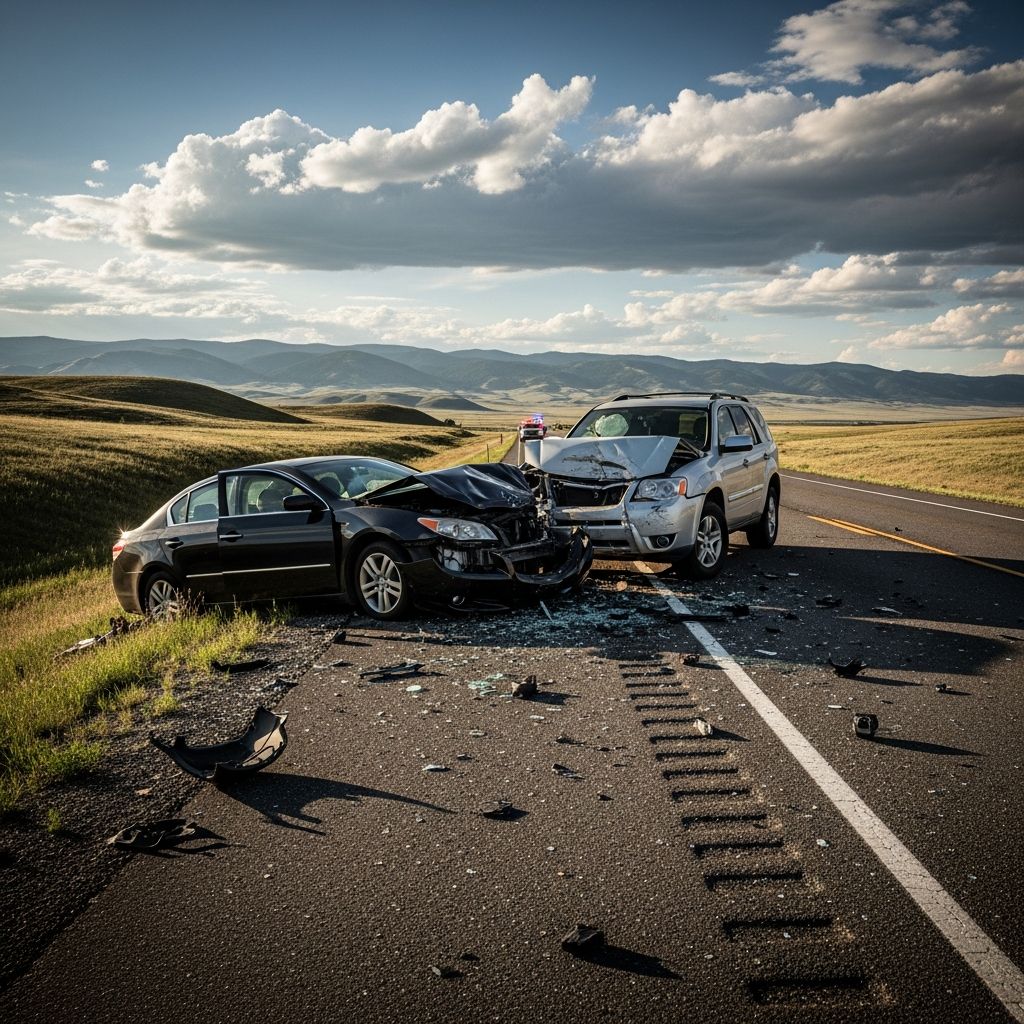
Understanding Vehicle Liability Requirements in Montana
Montana operates as an at-fault state for vehicle accidents, meaning drivers are responsible for damages they cause to others. Every vehicle operator on Montana roadways must maintain active liability insurance coverage that meets the state’s legally mandated minimum limits. These requirements exist to ensure that injured parties have a source of compensation when accidents occur.
The state’s minimum liability insurance coverage amounts are structured to address three distinct categories of potential damage. For bodily injury or death affecting a single individual in any given accident, drivers must carry at least $25,000 in coverage. When an accident results in bodily injury or death to multiple people, the minimum coverage requirement increases to $50,000. Additionally, Montana law mandates a minimum of $20,000 in property damage liability coverage to address damage to others’ vehicles or personal property.
Law enforcement has the authority to require drivers involved in traffic stops or motor vehicle collisions to present proof of active insurance coverage, along with their driver’s license and vehicle registration. The Montana Department of Justice established the Montana Insurance Verification System (MTIVS) to help authorities confirm that vehicle operators maintain compliant liability policies.
Accident Reporting Obligations and Legal Requirements
Montana’s Uniform Accident Reporting Act establishes clear obligations for drivers involved in collisions. Drivers who reasonably should know they’ve been involved in certain types of accidents must report the incident to law enforcement immediately.
The requirement to report an accident is triggered by specific circumstances. Accidents must be reported when they result in any fatality, when any person sustains injury, or when property damage exceeds $1,000. Additionally, accidents involving hit-and-run incidents or those meeting other statutory criteria require reporting.
The location of the accident determines which law enforcement agency should receive the report. For accidents occurring within incorporated city or town limits, drivers must contact the local police department. When an accident happens outside municipal boundaries, the report should go to the county sheriff’s office or the nearest Montana Highway Patrol station.
Failing to report a reportable accident violates Montana law and can result in legal consequences. Beyond the legal ramifications, proper accident reporting serves the injured party’s interests by creating an official record that becomes crucial evidence in pursuing compensation claims. An official police report documents the accident details, witness statements, and initial assessments that strengthen the foundation of any subsequent legal action.
Duty to Remain and Provide Assistance at Accident Scenes
Montana law imposes affirmative duties on all individuals present at accident scenes where injuries occur. Drivers involved in collisions resulting in injury must remain at the scene and provide reasonable assistance to injured parties. This obligation reflects a broader legal principle that individuals have responsibilities toward others, particularly when someone has suffered harm.
Reasonable assistance can take various forms depending on the circumstances. For someone without medical training, this might involve calling emergency services to summon an ambulance or notifying law enforcement about the collision. Others with appropriate skills or capabilities might provide first aid or other direct assistance. The law recognizes that reasonable assistance varies based on each person’s abilities and the specific situation.
Drivers must remain at the accident scene until law enforcement arrives and completes their initial investigation. During this time, all parties involved in the collision must exchange critical information with one another. This information exchange includes insurance details, driver’s license numbers, vehicle registration information, and contact information.
Montana law provides limited exceptions to the requirement to remain at the scene. A driver may leave the scene if doing so is necessary to seek emergency medical care for themselves or others. Additionally, leaving to notify law enforcement of the collision is permissible when police haven’t yet arrived at the scene.
The Modified Comparative Negligence Framework
Montana follows a modified comparative negligence standard, often referred to as the 51% rule, which fundamentally shapes how courts award damages in accident cases. This legal framework recognizes that accidents frequently involve shared fault among multiple parties rather than situations where one party bears complete responsibility.
Under Montana’s comparative negligence law, a plaintiff can recover damages even when partially at fault for the accident, provided their negligence does not exceed 50% of the total fault. This rule creates a more equitable outcome than fault-based systems that would deny recovery to any party bearing any degree of responsibility.
The mechanics of comparative negligence work through a reduction in the awarded damages based on the plaintiff’s percentage of fault. For example, if a court determines that a plaintiff incurred $50,000 in damages but was 30% responsible for the accident, the plaintiff would receive $35,000—representing 70% of the total damages. This adjustment directly reflects the plaintiff’s share of culpability.
The critical threshold under Montana’s modified comparative negligence rule occurs at the 50% mark. A plaintiff found to be exactly 50% at fault can still recover damages, receiving compensation reduced by the full 50% due to their equal share of fault. However, if a plaintiff is determined to be 51% or more at fault for the accident, they become barred from recovering any damages whatsoever. This sharp cutoff at 51% represents the defining feature of Montana’s modified comparative negligence standard.
Application to Multi-Party Accidents
The comparative negligence standard applies in complex scenarios involving multiple defendants or third parties. A plaintiff can recover damages as long as their negligence does not exceed the combined negligence of all other parties involved. This approach prevents situations where a plaintiff bears more fault than everyone else combined from receiving compensation.
Time Constraints for Filing Legal Claims
Montana establishes specific deadlines for pursuing legal remedies following vehicle accidents, known as the statute of limitations. These time limits are statutory requirements that courts strictly enforce, and missing these deadlines typically results in permanent loss of the right to sue.
The general statute of limitations for personal injury claims arising from vehicle accidents is three years from the date the accident occurred. This deadline applies to drivers, passengers, motorcyclists, bicycle riders, electric scooter riders, and pedestrians injured in the collision. Anyone sustaining bodily injury in a motor vehicle accident must file their lawsuit within this three-year window or lose the right to pursue court remedies.
For wrongful death claims resulting from fatal accidents, the three-year clock begins on the date of the victim’s death rather than the accident date. This distinction recognizes that wrongful death lawsuits are brought by survivors rather than the deceased victim and accounts for the timing of when survivors become aware of their legal rights.
Property damage claims from vehicle accidents operate under a different timeline. While Montana law permits property damage lawsuits, they are subject to their own statute of limitations period separate from the personal injury deadline.
The significance of these filing deadlines cannot be overstated. Courts will dismiss lawsuits filed after the statute of limitations expires, regardless of the merits of the case or the validity of the plaintiff’s injury claims. Individuals who suspect they have been harmed in a vehicle accident should consult with an attorney well in advance of the three-year deadline to preserve their legal rights and ensure timely claim filing.
Insurance Verification and Enforcement Mechanisms
Montana’s commitment to ensuring compliance with vehicle insurance requirements has led to the development of sophisticated verification systems. The Montana Insurance Verification System represents the state’s effort to maintain oversight of whether vehicle operators possess required liability coverage.
Law enforcement utilizes these verification systems when they conduct traffic stops or investigate accidents. The ability to quickly confirm whether a driver maintains active insurance coverage helps ensure immediate accountability for uninsured motorists and supports the enforcement of insurance requirements.
The establishment of the verification system reflects legislative recognition that voluntary compliance with insurance requirements needed additional enforcement mechanisms. By creating a system capable of confirming compliance with liability policy requirements, Montana strengthens protections for accident victims and ensures that compensation sources exist when accidents occur.
Documentation and Evidence Following an Accident
After a vehicle accident, gathering comprehensive documentation becomes essential for any subsequent insurance claim or legal proceeding. The police report created by law enforcement constitutes a foundational piece of evidence, documenting the officer’s observations, statements from involved parties, witness accounts, and initial assessments of how the accident occurred.
Beyond the official police report, individuals should document additional evidence including photographs of vehicle damage, scene conditions, traffic signals or signs present, weather conditions, and any visible injuries. Medical records detailing treatment for injuries sustained in the accident provide crucial documentation of damages. Repair estimates or invoices for vehicle damage establish the extent of property damage incurred.
Preserving witness contact information allows for future follow-up if witness statements become necessary for legal proceedings. Communication records with insurance companies, including dates and summaries of conversations, help establish the timeline of claim handling. Keeping organized files of all accident-related documentation facilitates efficient claim management and provides necessary evidence if disputes arise.
Actions to Take Immediately After an Accident
The immediate aftermath of an accident represents a critical period where prompt action protects legal interests and establishes important evidence. Several steps should be taken as soon as the accident occurs and the scene is secure:
- Contact law enforcement to report the accident if it meets reporting requirements, and remain at the scene pending their arrival
- Seek medical attention promptly, even if injuries appear minor, as some symptoms develop gradually
- Exchange insurance information, driver’s license numbers, and contact details with other involved parties
- Document the accident scene with photographs if safely possible, capturing vehicle positions, damage, and environmental conditions
- Notify your insurance company of the accident within the timeframe specified in your policy
- Preserve all medical records and treatment documentation related to accident injuries
- Maintain copies of the police report and any citations issued
Frequently Asked Questions About Montana Vehicle Accidents
Q: Is Montana an at-fault or no-fault state for vehicle accidents?
A: Montana is an at-fault state. Drivers are responsible for damages they cause to others based on their negligence or willful conduct. Montana law codifies this principle in its statutes, establishing that each person is responsible for injuries caused by their willful acts or lack of ordinary care.
Q: Can I recover damages if I was partially at fault for the accident?
A: Yes, Montana’s modified comparative negligence rule allows recovery if you are 50% or less at fault. Your compensation is reduced by your percentage of fault. For example, if you are 40% at fault for a $100,000 accident, you would receive $60,000.
Q: What happens if both drivers are equally at fault?
A: If you are exactly 50% at fault, you can still recover damages under Montana law since your negligence does not exceed the other party’s. Your recovery would be reduced by 50%, meaning you would receive half of your total damages. However, if you are 51% or more at fault, you cannot recover anything.
Q: How long do I have to file a lawsuit after a vehicle accident?
A: You have three years from the accident date to file a personal injury lawsuit. For wrongful death claims, the three-year period begins on the date of the victim’s death, not the accident date. Missing this deadline typically results in permanent loss of your right to sue.
Q: Must I report every vehicle accident to police?
A: No, only accidents meeting specific criteria require reporting. You must report accidents involving fatalities, injuries to any person, or property damage exceeding $1,000. Accidents also must be reported if they involve hit-and-run circumstances or meet other statutory criteria.
Q: What are Montana’s minimum liability insurance requirements?
A: Montana requires minimum coverage of $25,000 for bodily injury or death to one person, $50,000 for bodily injury or death to multiple people, and $20,000 for property damage. These minimums apply to all vehicles operated on Montana roadways.
Q: What information must I exchange with other drivers at an accident scene?
A: You must exchange insurance details, driver’s license numbers, vehicle registration information, and contact information with all other involved parties. This information enables insurance claim processing and potential legal action if necessary.
Q: Can I leave the accident scene after a collision?
A: You must remain at the scene until law enforcement arrives. Limited exceptions exist if you need to seek emergency medical care or notify police about the accident. Leaving without permission can result in additional legal consequences.
References
- Vehicle Insurance and Verification — Montana Motor Vehicle Division. 2024. https://mvdmt.gov/vehicle-insurance-and-verification/
- Montana Car Accident Lawsuit Deadline and Comparative Negligence — Nolo. 2024. https://www.nolo.com/legal-encyclopedia/montana-car-accident-laws.html
- Montana Car Accident Laws You Should Know — AFJ Law Firm. 2024. https://afjlawfirm.com/montana-car-accident-laws-you-should-know/
- What Are Your Rights Under Montana’s Comparative Negligence Law — Tipp Coburn. 2025. https://tippcoburn.com/blog/2025/10/what-are-your-rights-under-montanas-comparative-negligence-law/
- Is Montana a No Fault State for Car Accidents? — Boland Aarab. 2024. https://www.bolandaarab.com/faq/is-montana-a-no-fault-state-for-car-accidents/
- Time Limits for Filing Car Accident Claims in Montana — Beck Lawyers. 2024. https://www.becklawyers.com/time-limits-for-filing-car-accident-claims-in-montana/
- Montana Statute of Limitations: When Is It Too Late to Sue? — Murphy Law Office. 2024. https://www.murphylawoffice.net/accident-injury-guide/montana-statute-of-limitations/
Similar Articles








Read full bio of Sneha Tete