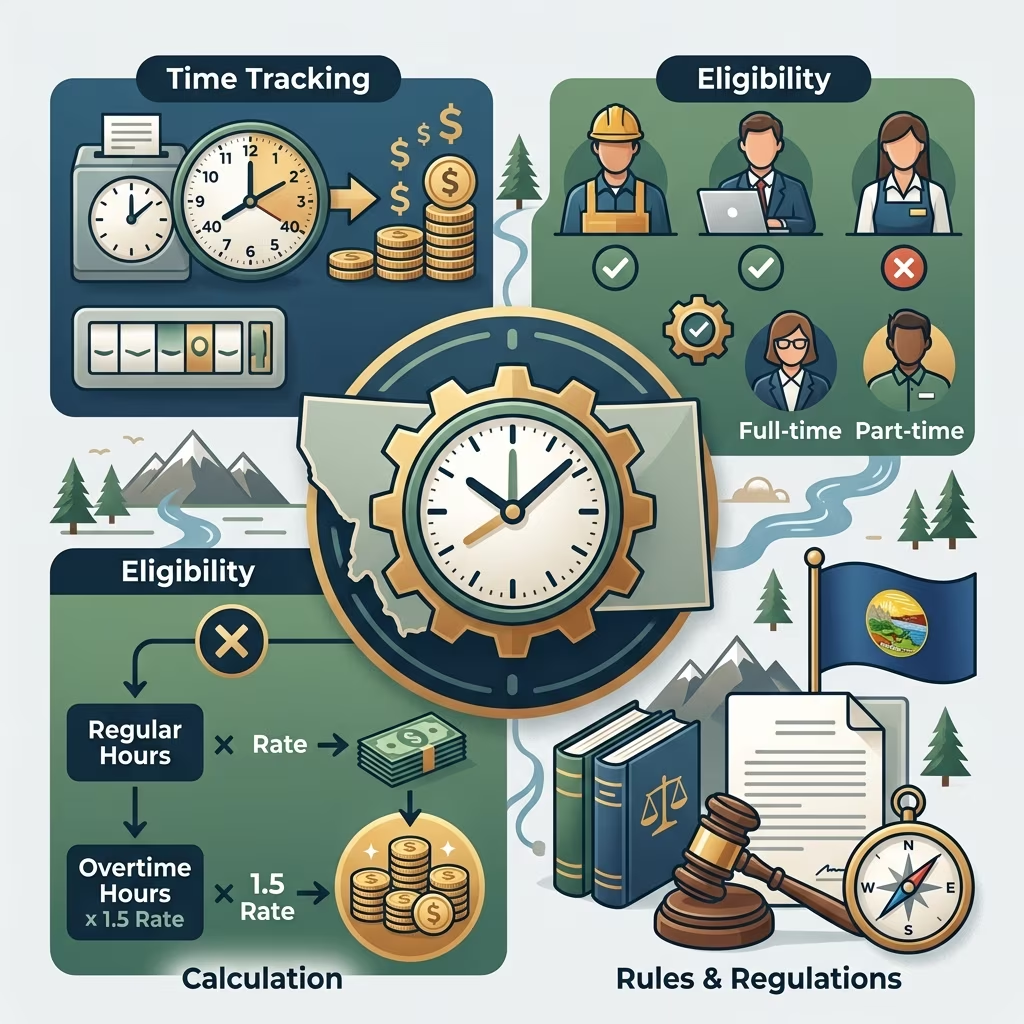
Montana wage law generally requires nonexempt employees to receive overtime pay when they work more than 40 hours in a seven-day workweek. In most cases, that overtime must be paid at one and one-half times the employee’s regular rate of pay, which places Montana in line with the federal Fair Labor Standards Act for the basic overtime standard.
That simple rule, however, does not tell the whole story. Montana law includes important exemptions, special schedules, and job-based exceptions that can change whether overtime is owed and how it is calculated. Employers and workers both benefit from understanding where the standard rule applies and where the law creates different treatment.
How Montana defines overtime
The core overtime rule in Montana is based on hours worked in a workweek, not on the number of hours worked in a single day. If an employee is not exempt and actually works more than 40 hours during the employer’s seven-day workweek, overtime compensation is due for the excess hours.
It is also important to distinguish actual work from paid leave. Vacation, sick leave, and holiday pay do not count as hours worked for purposes of determining overtime eligibility. In other words, an employee does not earn overtime just because paid time off makes the weekly total look higher than 40 hours.
| Issue | Montana rule |
|---|---|
| Basic overtime trigger | More than 40 hours worked in a workweek |
| Standard overtime rate | 1.5 times the regular rate |
| Paid leave counted as work? | No |
| Workweek basis | Seven-day workweek set by the employer |
Who is usually covered
Most hourly workers and many salaried workers are covered by overtime rules unless a legal exemption applies. Coverage depends less on the pay method and more on the duties performed, the industry involved, and whether the worker fits within one of Montana’s recognized exceptions.
A worker who is treated as nonexempt must generally receive overtime pay for hours over 40. A worker who is exempt is not entitled to overtime under the statute, even if the person regularly works long weeks. That means job title alone is not enough; the actual responsibilities and legal classification matter.
- Nonexempt employees usually earn overtime after 40 actual hours worked in a week.
- Exempt employees are not covered by the standard overtime rule.
- Actual job duties and statutory exceptions matter more than a job title.
Common exemptions and special exceptions
Montana law recognizes a number of exemptions from the ordinary overtime rule. Some of these exemptions track familiar federal concepts, while others are specific to state law. Agricultural and ranch workers are exempt from overtime under Montana statute, and that exception is broader than many workers expect.
Other exempt or specially treated groups include certain forestry and logging employees, outside buyers of poultry and dairy products, licensed-outfitter guides and related camp or livestock staff, and resident managers who live on site in lodging establishments or personal care facilities under their employment terms. Executive, administrative, and professional employees paid on a salary basis are also commonly exempt, along with outside salespersons.
Montana also excludes certain computer-related employees from overtime if they meet a specific wage threshold. The state recognizes an exemption for skilled computer employees such as systems analysts, programmers, software engineers, and network administrators who earn at least the required hourly amount under the statute.
- Agricultural and ranch workers
- Outside buyers of poultry and dairy products
- Employees of forestry or logging operations
- Guides and related workers employed by licensed outfitters
- Resident managers living on premises in certain facilities
- Executives, administrative staff, and professionals paid on salary
- Outside salespersons
- Qualified computer professionals meeting the statutory pay test
Special rules for certain workplaces
Some employees are covered by overtime rules that differ from the standard 40-hour benchmark. For example, seasonal amusement or recreational areas that provide board and lodging to student employees may use a 48-hour threshold. In that setting, overtime begins after the worker exceeds 48 hours in a week rather than 40.
Another notable exception concerns public-sector firefighters and law enforcement officers, whose overtime treatment must align with federal Fair Labor Standards Act rules and the regulations issued under that law. Public employers often need to apply a different overtime framework for these roles because federal law allows specialized work-period arrangements.
There is also a separate rule for some government employees working under mutually agreed or collectively bargained work periods. In those settings, the governing work period may differ from the ordinary weekly calculation, so employers must check the specific terms that apply to the position.
How overtime is calculated when pay rates vary
Not every employee earns a single hourly rate all week. Some workers perform different tasks at different pay rates, receive commissions, or are paid by piece rate or another nontraditional method. In those situations, Montana requires overtime to be calculated from the employee’s regular rate, which may need to be averaged across the week.
For employees with multiple hourly rates, employers generally determine the weighted average by combining the regular earnings earned at each rate and dividing by the total hours worked. The overtime premium is then based on that regular-rate calculation. This approach is designed to make sure the overtime payment reflects the employee’s actual earnings pattern rather than an artificially low or high number.
For workers paid by commission, piece rate, or a flat book-rate system, the weekly earnings are divided by the total hours actually worked to determine the regular rate. The employee then receives an additional half-time premium for overtime hours, on top of the underlying earnings already produced by the commission or piecework system.
- Multiple pay rates may require a weighted-average calculation.
- Commission and piece-rate workers still receive overtime protection if they are nonexempt.
- The overtime premium is tied to the regular rate, not simply the lowest or highest rate in the week.
Why weekends and holidays usually do not create overtime by themselves
Many workers assume that weekend or holiday work automatically triggers premium pay. Under Montana law, that is not generally true. Overtime is based on total hours worked in the workweek, so simply working on a Saturday, Sunday, or holiday does not automatically create overtime if the worker has not crossed the 40-hour threshold.
This distinction matters because employers sometimes offer separate premium-pay policies as a matter of company practice or collective bargaining, but those arrangements are different from legal overtime. A worker may receive extra pay because of an employer policy, yet still not be legally entitled to overtime unless the statute applies.
How Montana law compares with federal law
In the most common situation, Montana overtime law and federal law point in the same direction: nonexempt employees earn time-and-a-half after 40 hours in a workweek. The practical difference comes from Montana’s state-specific exemptions and sector-specific exceptions, which can narrow or reshape coverage.
That means an employer cannot rely on a broad assumption that all workplace hours are treated the same. The proper analysis requires checking whether the worker is exempt under Montana law, whether a special industry rule applies, and whether the worker’s pay structure changes how the overtime premium is calculated.
| Question | General Montana answer |
|---|---|
| Is overtime usually paid after 40 hours? | Yes |
| Is daily overtime the standard rule? | No |
| Do weekends automatically create overtime? | No |
| Do special exemptions exist? | Yes |
What employees should do if overtime is missing
If a worker believes overtime was not paid correctly, the first step is to review hours, pay stubs, and job classification. Employers sometimes make mistakes when tracking hours, applying exemptions, or calculating the regular rate for variable pay. Misclassification can be especially common when an employee is treated as salaried even though the duties do not support exemption.
Documentation is important. Records of schedules, time sheets, emails assigning overtime work, and pay statements can help determine whether the employee crossed the overtime threshold and whether the correct premium was paid. If the issue cannot be resolved internally, a wage-and-hour complaint or legal claim may be appropriate under state procedures.
- Check actual hours worked, not just paid hours.
- Confirm whether the employee is truly exempt.
- Review how the regular rate was calculated.
- Keep copies of time records and pay statements.
Frequently asked questions
Does Montana require overtime after 40 hours?
Yes. For most nonexempt employees, Montana requires overtime pay at one and one-half times the regular rate for hours worked over 40 in a seven-day workweek.
Do paid vacation, sick leave, or holidays count toward overtime?
No. Those forms of paid leave do not count as hours worked for overtime purposes under Montana wage rules.
Are all salaried employees exempt?
No. Salary alone does not decide the issue. The employee must also meet the legal duties test and any other applicable exemption requirements.
Is weekend work always overtime?
No. Weekend work only becomes overtime when total actual work hours in the week exceed the applicable threshold.
Are farm workers entitled to overtime in Montana?
Under Montana statute, farm workers are exempt from the standard overtime provision.
Can overtime be based on a different work period?
Yes. Some public and specially regulated positions use alternative work periods or specialized rules, especially where federal law or collective bargaining agreements apply.
Practical takeaways for employers and workers
For employers, the safest approach is to classify workers carefully, track actual hours accurately, and calculate the regular rate correctly when pay varies. For workers, the key is to know that overtime depends on actual work performed, not merely on a long schedule, a salary label, or the existence of holiday pay.
Montana’s overtime law is straightforward at its core, but the exceptions can be decisive. When a job falls into a special category, or when the pay structure is more complex than a standard hourly wage, a closer review is essential to determine the correct amount owed.
References
- 39-3-405 Overtime compensation — Montana Legislature. 2026-07-10. https://mca.legmt.gov/bills/mca/title_0390/chapter_0030/part_0040/section_0050/0390-0030-0040-0050.html
- Overtime — Montana Department of Labor & Industry, Employment Standards Division. 2026-07-10. https://erd.dli.mt.gov/labor-standards/wage-and-hour-payment-act/overtime
- Wage and Hour Labor Law Reference Guide — Montana Department of Labor & Industry. 2026-07-10. https://erd.dli.mt.gov/labor-standards/wage-and-hour-payment-act/wage-and-hour-laws-guide
- Overtime Pay Rules for 2026: Federal FLSA + Montana Requirements — Montana Payroll Guide. 2026-07-10. https://montanapayrollguide.com/blog/overtime-and-flsa
- Wage hour claim MT — Pines Bach. 2026-07-10. https://www.pinesbach.com/labor-employment/wage-and-hour/wage-hour-claim-mt/