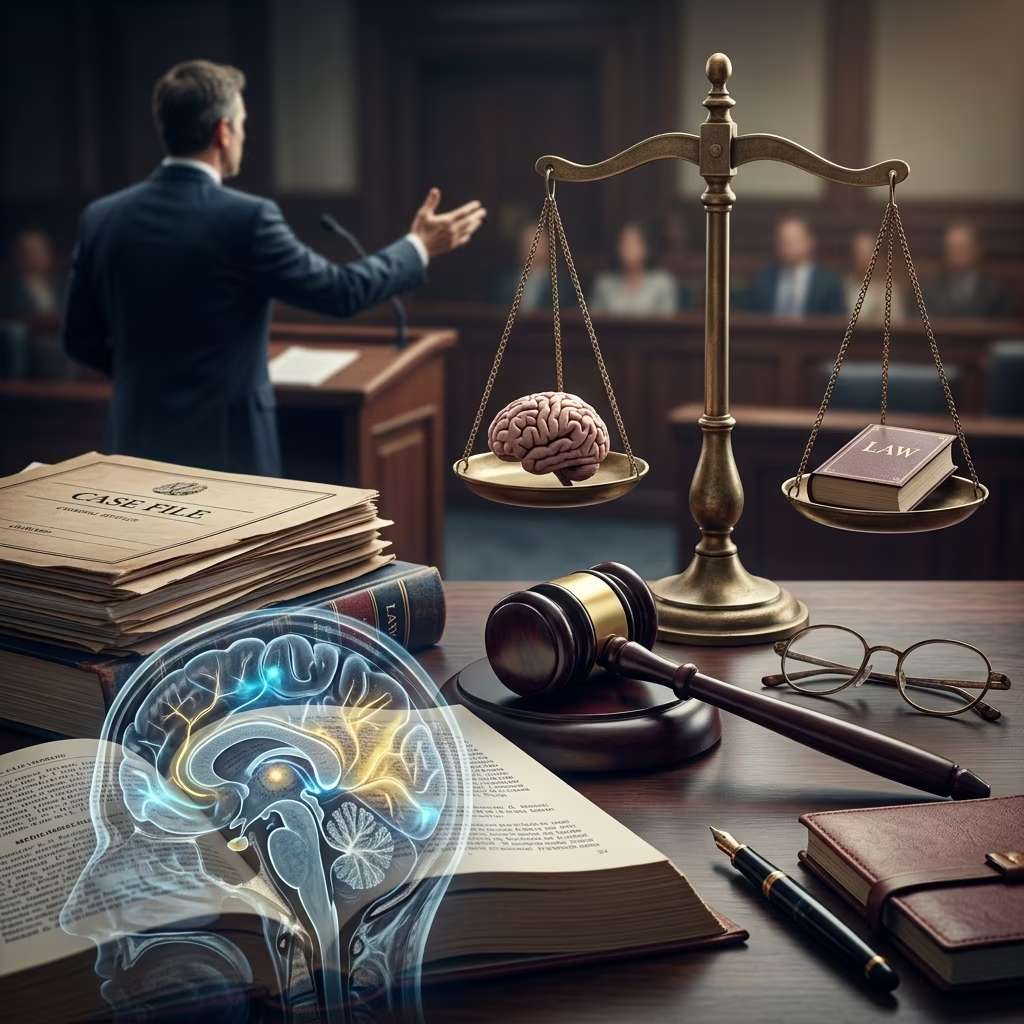
The insanity defense remains one of the most controversial and misunderstood doctrines in criminal law. It sits at the intersection of public safety, moral responsibility, and the rights of people living with severe mental illness. This article explains how the insanity defense is applied today in the United States, the major legal standards, who must prove what at trial, and what happens to defendants after an insanity verdict.
1. What the Insanity Defense Really Does
In an insanity defense, the defendant generally admits the conduct that would otherwise amount to a crime but argues that they should not be held criminally responsible because of a qualifying mental disease or defect at the time of the offense. The core idea is that punishment is inappropriate where a person’s mental condition prevented them from understanding, or sometimes controlling, their criminal behavior.
Importantly, insanity is a legal concept, not a clinical diagnosis. A person may have a significant psychiatric disorder, but unless that disorder meets the jurisdiction’s legal test for insanity, the defense will fail. Courts focus on the defendant’s capacity at the time of the alleged crime, not simply on the presence of mental illness.
- Key purpose: distinguish offenders who are morally blameworthy from those whose mental condition removes or substantially reduces criminal responsibility.
- Key limitation: not all mental disorders qualify; the illness must meet the specific legal standard in that jurisdiction.
- Key timing: the relevant question is the defendant’s mental state at the moment of the offense, not before or after.
2. Major Legal Tests for Insanity
Different jurisdictions use different tests to decide whether a defendant is legally insane. While the wording varies, they all focus on the relationship between mental disease and the defendant’s ability to understand or control their actions.
2.1 Overview Table of Leading Insanity Tests
| Test / Rule | Main Focus | Core Standard (Simplified) |
|---|---|---|
| M’Naghten Rule | Cognition (knowledge of nature & wrongfulness) | Defect of reason due to mental disease so that defendant did not know the nature and quality of the act or did not know it was wrong. |
| Irresistible Impulse Test | Volition (ability to control behavior) | Defendant knew the act was wrong but was unable to control their conduct because of mental disease. |
| Durham Rule | Causation | An unlawful act is not the defendant’s criminal responsibility if it was the product of mental disease or defect. |
| ALI / Model Penal Code Standard | Cognition & volition, substantial impairment | Defendant lacked substantial capacity either to appreciate the criminality/wrongfulness of conduct or to conform conduct to law. |
| Federal Insanity Defense Reform Act Standard | Cognition, severe illness | Defendant, as a result of a severe mental disease or defect, was unable to appreciate the nature and quality or wrongfulness of acts; mental disease does not otherwise constitute a defense. |
2.2 Traditional M’Naghten Rule
The M’Naghten rule, originating from an 1843 English case, focuses on whether the defendant understood what they were doing and whether it was wrong. It presumes sanity unless the defense can show that at the time of the act, a disease of the mind caused a defect of reason that prevented the defendant from knowing the nature and quality of the act or that it was wrong.
Many states still rely on the M’Naghten rule, sometimes combined with the irresistible impulse test to capture both knowledge and control.
2.3 Model Penal Code / ALI Standard
The American Law Institute’s Model Penal Code introduced a broader test in §4.01. Under this standard, a defendant is not criminally responsible if, due to mental disease or defect, they lack substantial capacity either to appreciate the criminality or wrongfulness of their conduct or to conform their conduct to the law.
This test explicitly includes both cognitive and volitional components and emphasizes substantial impairment rather than total incapacity, which many experts view as more realistic in psychiatric terms.
2.4 Federal Standard Under the 1984 Reform Act
After high-profile cases in the early 1980s, Congress passed the Insanity Defense Reform Act of 1984, codified at 18 U.S.C. § 17. The Act significantly narrowed the federal insanity defense:
- It requires a severe mental disease or defect.
- It removes the volitional prong: inability to conform conduct is no longer enough.
- It focuses solely on whether the defendant was unable to appreciate the nature and quality or wrongfulness of the acts.
This federal approach reflects a modern trend in many jurisdictions to tighten the criteria for insanity and limit the defense to the most serious mental impairments.
3. Where the Insanity Defense Is Available (and Where It Isn’t)
Most U.S. jurisdictions retain some form of insanity defense, but a few have abolished it or sharply limited it.
- Federal courts: allow insanity pleas under 18 U.S.C. § 17, applying the Reform Act standard.
- Most states: use some combination of M’Naghten, irresistible impulse, or ALI/Model Penal Code standards.
- States that abolished insanity defense: Idaho, Kansas, Montana, and Utah do not permit a traditional insanity defense, though defendants may still argue they lacked the required criminal intent.
In Kahler v. Kansas (2020), the U.S. Supreme Court held that the Constitution does not require states to adopt a particular insanity test based on the defendant’s ability to recognize moral wrongfulness. This decision confirmed that states have broad discretion to narrow or even abolish the insanity defense as long as they still consider mental state in evaluating elements like intent.
4. Burden of Proof: Who Has to Prove Insanity?
Historically, some jurisdictions required the prosecution to prove that the defendant was sane. In modern practice, most states and the federal system place the burden on the defense to establish insanity.
4.1 Typical Approaches to Burden of Proof
- Defense bears the burden:
- In many states, the defendant must prove insanity by either a preponderance of the evidence (more likely than not) or clear and convincing evidence (a higher standard).
- Under federal law, the defendant must prove insanity by clear and convincing evidence.
- Prosecution bears the burden (less common):
- Where the burden remains on the state, prosecutors must prove sanity beyond a reasonable doubt, the same standard used for other elements of the offense.
Placing the burden on the defense reflects legislative reactions to concerns that insanity verdicts were too easy to obtain in high-profile cases. Research, however, suggests that insanity pleas are relatively rare and succeed in only a small fraction of cases.[10]
5. Evidence and Expert Testimony
Insanity defenses rely heavily on forensic psychiatric and psychological evaluation. In the United States, trials involving the insanity defense typically feature expert witnesses who offer opinions on the defendant’s mental state at the time of the offense.
Common types of evidence include:
- Clinical evaluations: structured interviews, psychological testing, and review of medical records conducted by trained forensic experts.
- Historical records: prior psychiatric treatment, hospitalizations, and documented symptoms.
- Witness accounts: statements from family members, friends, and others about the defendant’s behavior around the time of the offense.
- Conduct at the scene: actions before, during, and immediately after the incident that shed light on the defendant’s state of mind.
Guidelines from professional organizations such as the American Academy of Psychiatry and the Law emphasize rigorous documentation, attention to collateral data, and clear explanation of how clinical findings relate to the jurisdiction’s legal standard.
6. What Happens After a Successful Insanity Defense?
When a defendant is found not guilty by reason of insanity (NGRI or NGI), they are not simply released. Instead, they are usually committed to a secure psychiatric facility for treatment and risk management.
6.1 Initial Commitment and Evaluation
After an insanity acquittal, courts commonly order confinement in a mental hospital for a designated evaluation period. During this time:
- Clinicians assess the defendant’s current mental status.
- Risk evaluations are performed to estimate the likelihood of future dangerous behavior.
- Treatment plans are developed, including medication and psychosocial interventions.
In many cases, the initial period of commitment is mandated by statute to ensure public safety and allow time for thorough evaluation.
6.2 Length of Hospitalization
Defendants found NGRI can remain in psychiatric facilities for lengthy periods, sometimes longer than the prison term they might have received if convicted. Release is typically contingent on demonstrating that:
- The mental disease or defect is sufficiently treated or stabilized.
- The individual no longer poses a significant danger to others or themselves.
- Appropriate community supports and supervision are in place.
Modern statutes often place the burden on the acquitted individual to prove that they are rehabilitated or that continued confinement is no longer necessary. Courts balance individual liberty against public safety, often relying on expert evidence to make these decisions.
7. Alternative Approaches: GBMI, Mens Rea, and Diminished Capacity
Because the insanity defense is narrow, many jurisdictions provide alternative ways for mental illness to play a role in criminal proceedings.
7.1 Guilty but Mentally Ill (GBMI)
Some states authorize a verdict of guilty but mentally ill (GBMI). This option is used when the defendant’s mental illness is significant but does not meet the legal definition of insanity. GBMI typically results in:
- A criminal conviction and sentence, similar to a standard guilty verdict.
- Requirements that the offender receive mental health treatment, often in a correctional or clinical setting.
Critics argue that GBMI may dilute the protective function of the insanity defense, while supporters view it as a pragmatic compromise between outright acquittal and ignoring mental illness.
7.2 Mens Rea and Diminished Capacity
Even where the insanity defense is limited or abolished, mental illness can still be relevant to whether the defendant had the required mens rea (criminal intent) or to the degree of culpability.
- Mens rea: evidence of severe mental illness may show that the defendant was incapable of forming specific intent (for example, intent to kill), which can defeat or reduce certain charges.
- Diminished capacity: some states allow defendants to argue that mental impairment partially reduced their ability to understand or control behavior, potentially leading to conviction for a lesser offense.
Advocacy organizations highlight the importance of preserving these defenses, especially in jurisdictions that restrict or abolish full insanity pleas.
8. Policy Debates and Future Directions
The insanity defense continues to generate debate among lawmakers, clinicians, and the public. Major themes in contemporary discussion include:
- Fairness vs. safety: balancing protection of individuals with severe mental illness against the need to prevent harm to the community.
- Scope of qualifying disorders: deciding which diagnoses and levels of impairment should be sufficient to excuse criminal responsibility.
- Quality of forensic evaluation: ensuring that expert assessments are evidence-based, unbiased, and aligned with legal standards.
- Access to treatment: providing adequate psychiatric care both in hospitals and after release, to reduce recidivism and improve outcomes.
Scholars note that although the insanity defense is rare and difficult to win, it plays a symbolic and practical role in maintaining a justice system that recognizes the limits of human responsibility in the face of severe mental illness.[10]
9. Frequently Asked Questions (FAQ)
9.1 Is the insanity defense used often?
No. Studies and legal scholarship indicate that insanity pleas are filed in a small percentage of criminal cases and succeed in only a fraction of those.[10] Media coverage of rare, high-profile cases can create the impression that the defense is common when it is not.
9.2 Does mental illness automatically mean a person can claim insanity?
Not automatically. Many people with mental illness never meet the strict legal criteria for insanity. The defense requires proof that, because of a qualifying mental disease or defect, the defendant lacked the necessary capacity defined by the jurisdiction’s test at the time of the offense.
9.3 If someone is found not guilty by reason of insanity, are they set free?
Generally, no. An insanity acquittal usually leads to involuntary commitment to a secure psychiatric facility, and confinement can last many years. Release typically depends on expert evaluations and court findings regarding risk and rehabilitation.
9.4 Can a state completely abolish the insanity defense?
Some states have abolished the traditional insanity defense, and the U.S. Supreme Court has upheld such laws as constitutional in decisions like Kahler v. Kansas. However, those jurisdictions usually still consider mental state when determining whether the prosecution has proven the required intent.
9.5 How does the federal insanity standard differ from broader state standards?
The federal standard under the Insanity Defense Reform Act requires a severe mental disease or defect and focuses only on the defendant’s ability to appreciate the nature and wrongfulness of the act. Some state standards, especially ALI/Model Penal Code-based tests, also consider whether the defendant could conform conduct to the law and do not always require the illness to be labeled “severe.”
References
- Insanity defense | Wex | US Law — Legal Information Institute, Cornell Law School. 2023-01-01. https://www.law.cornell.edu/wex/insanity_defense
- Insanity Defense Reform Act of 1984 – 18 U.S.C. § 17(a) — U.S. Department of Justice, Criminal Resource Manual. 2015-01-01. https://www.justice.gov/archives/jm/criminal-resource-manual-637-insanity-present-statutory-test-18-usc-17a
- Insanity defense — Psychiatry Online, Psychiatric News commentary on Supreme Court ruling. 2020-05-01. https://psychiatryonline.org/doi/10.1176/appi.pn.2020.5a29
- In support of the insanity defense — Mental Health America Position Statement. 2019-01-01. https://mhanational.org/position-statements/in-support-of-the-insanity-defense/
- AAPL Practice Guideline for Forensic Psychiatric Evaluation of Defendants Raising the Insanity Defense — American Academy of Psychiatry and the Law. 2014-01-01. https://www.aapl.org/docs/pdf/Insanity%20Defense%20Guidelines.pdf
- Insanity Defense: Past, Present, and Future — Indian Journal of Psychiatry (PMC). 2015-01-01. https://pmc.ncbi.nlm.nih.gov/articles/PMC4676201/
- The Insanity Defense in the Twenty-First Century — Indiana Law Journal. 2012-01-01. https://www.repository.law.indiana.edu/cgi/viewcontent.cgi?article=1494&context=ilj