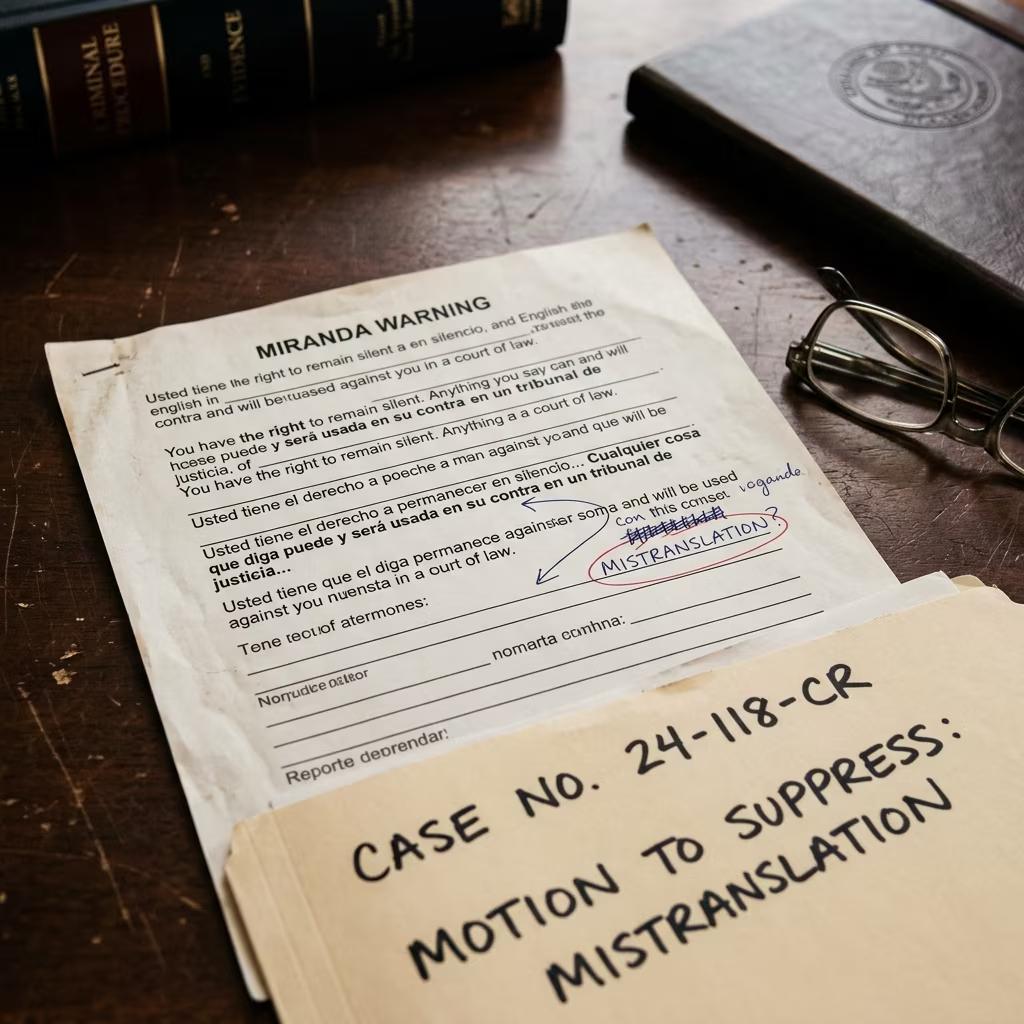
In the United States, the Miranda warning is meant to be a clear safeguard: before custodial interrogation, police must tell a suspect about their right to remain silent and to have an attorney. When those warnings are delivered in a language the suspect does not fully understand, everything depends on accurate translation. A single mistranslated phrase can turn a constitutional protection into a source of confusion, and in serious cases, can lead courts to suppress statements obtained after a flawed warning.
This article explains why accurate Miranda translations matter, how mistranslations occur, what courts consider when deciding to suppress statements, and why legal and linguistic experts are pushing for uniform, high-quality warnings in Spanish and other languages.
Miranda Rights: Purpose and Core Requirements
The modern Miranda warning originates from the U.S. Supreme Court’s decision in Miranda v. Arizona (1966), which held that police must inform suspects of their rights before custodial interrogation to protect the Fifth Amendment privilege against self-incrimination.
While exact wording varies by jurisdiction, a constitutionally adequate warning generally conveys four core points:
- Right to remain silent – The suspect does not have to answer questions.
- Use of statements in court – Anything said can be used as evidence against the suspect.
- Right to an attorney – The suspect has the right to consult with a lawyer before and during questioning.
- Appointment of counsel – If the suspect cannot afford a lawyer, one will be provided.
Courts focus not only on whether these elements are mentioned, but also on whether the warning reasonably conveys their meaning to the particular suspect, given their language abilities, education, and circumstances.
Why Translation Accuracy Is Constitutionally Significant
For suspects with limited English proficiency, rights are meaningful only if delivered in a language they understand. If translation is inaccurate or confusing, the suspect may appear to waive rights, yet do so without genuine understanding. That undermines the protections set out in Miranda and raises due process concerns.
Courts have emphasized that warnings must be given in a manner that the suspect can comprehend. This requirement becomes more complex when multiple languages and dialects are involved, or when police rely on improvised translations or unqualified interpreters.
Key Risks Created by Poor Translation
- Incomplete warnings – Omitting an element (for example, the right to appointed counsel) can render a warning defective.
- Misleading statements – Subtle wording changes may imply rights are more limited or conditional than they are.
- Ambiguity about cost – Misinterpretations regarding attorneys being “free” can confuse suspects about whether they truly have access to counsel regardless of ability to pay.
- Cultural and linguistic gaps – Literal translations that ignore idiomatic usage or legal concepts may fail to communicate the intended protection.
Common Problems in Spanish-Language Miranda Warnings
Spanish is the most commonly needed language after English in many jurisdictions, yet the U.S. has no single official Spanish translation of the Miranda warning. Agencies often rely on locally produced scripts or ad hoc interpretations by bilingual officers.
Examples of Translation Issues
Studies and legal analyses have identified recurring problems in Spanish Miranda translations:
- Invented or nonstandard words – Use of “Spanglish” or made-up terms that have no clear meaning in standard Spanish.
- Omission of subject pronouns – Grammatically acceptable in conversational Spanish, but in legal language can create ambiguity about who holds the rights.
- Misrendering “free” counsel – Some translations have described attorneys as “liberated” rather than “free of charge,” obscuring the right to no-cost legal representation.
- Overly complex vocabulary – Using formal or technical terms that non-lawyer, non-native speakers are unlikely to understand.
- Inconsistent phrasing – Differences between scripts used by neighboring agencies, which can lead to variable understanding and outcomes.
These issues are not just linguistic quirks. When a suspect relies on such a warning to decide whether to talk to police, the quality of each word can become central in later courtroom disputes over admissibility.
How Mistranslation Leads to Suppression of Statements
If a court finds that a suspect did not receive an effective Miranda warning, statements made during subsequent interrogation can be suppressed. Suppression means the prosecution cannot use those statements in its case-in-chief, although certain limited uses (such as impeachment) may be allowed in some circumstances, depending on the defect and applicable law.
Legal Standards Applied by Courts
When considering whether to suppress statements after a translated warning, courts typically examine:
- Content of the translation – Does it accurately convey each required element of the warning?
- Competence of the translator – Was the interpreter qualified, impartial, and fluent in relevant dialects?
- Suspect’s language abilities – How proficient is the suspect in English or the translated language? Did they ask clarifying questions?
- Totality of circumstances – Context of interrogation, length, environment, and whether coercion or pressure was present.
- Recorded evidence – Audio or video recordings of the warning and interrogation can reveal errors that may not appear in written forms.
Where a translation significantly alters or omits core rights, appellate courts have been willing to find Miranda violations and uphold suppression of resulting statements. Such rulings highlight that rights cannot be reduced to formal recitations; they must be effectively communicated.
The Push for Standardized Multilingual Miranda Translations
Recognizing inconsistent and often flawed translations, the American Bar Association (ABA) has urged development and use of accurate, culturally appropriate translations of Miranda warnings in multiple languages.
ABA Policy and Initiatives
In a policy resolution, the ABA called on law enforcement at all levels to create and adopt translations of Miranda warnings “in as many languages and dialects as necessary” to fully inform individuals of their rights. Key elements of the initiative include:
- Uniform Spanish scripts – Working toward a widely accepted Spanish version that avoids known translation pitfalls.
- Collaboration with experts – Involving linguists, law enforcement, and legal practitioners to test clarity and accuracy.
- Distribution to agencies – Providing translations to attorneys general, bar associations, and police departments for implementation.
Although ABA resolutions are not legally binding, they often shape professional norms and can motivate agencies to update practices. Standardized translations help reduce litigation over the adequacy of warnings and better protect non-English speakers.
Table: Comparing Key Elements of English and Spanish Miranda Warnings
The following table illustrates typical differences in conveying core Miranda concepts in English and Spanish. It does not represent an official script, but highlights translation challenges.
| Miranda Element | Typical English Concept | Translation Challenge in Spanish |
|---|---|---|
| Right to remain silent | “You have the right to remain silent.” | Choosing terms that clearly express a legal right, not a mere suggestion (e.g., “tiene el derecho” versus softer phrasing). |
| Use of statements | “Anything you say can be used against you in court.” | Avoiding ambiguous verbs and ensuring that “used against you” conveys evidentiary and adversarial use. |
| Right to an attorney | “You have the right to talk to a lawyer.” | Ensuring the term for lawyer (“abogado”) is widely understood, and that access includes both before and during questioning. |
| Appointment of counsel | “If you cannot afford a lawyer, one will be appointed for you.” | Accurately expressing “free of charge” without implying that attorneys are merely “available” or “released.” |
Best Practices for Law Enforcement and Legal Practitioners
To minimize the risk of mistranslated warnings and subsequent suppression, agencies and attorneys can adopt several best practices grounded in legal guidance and professional recommendations.[10]
For Law Enforcement Agencies
- Use vetted written translations – Rely on standardized, thoroughly reviewed scripts in common languages such as Spanish, rather than ad hoc wording.
- Train officers on language limitations – Educate personnel about the limits of conversational fluency versus legal translation competence.
- Document the warning – Record the delivery of the warning, when feasible, to provide a clear record for later review.
- Engage qualified interpreters – Use professional interpreters, especially when dealing with rare languages or dialects.
- Review translations periodically – Update scripts to reflect evolving case law and feedback from courts and linguistic experts.
For Defense Attorneys and Advocates
- Scrutinize translated warnings – Obtain copies of the actual language used and compare it with recognized standards or expert assessments.
- Investigate client comprehension – Ask clients about how they understood the warning and whether any parts seemed confusing or incomplete.
- Consult language experts – Engage translators or linguists to evaluate whether the warning adequately conveyed rights.
- Raise suppression challenges where warranted – If serious defects exist, move to suppress statements obtained during interrogation.
Impact on Non-English-Speaking Communities
Mistranslated Miranda warnings disproportionately affect communities where English is not the primary language. Spanish-speaking defendants, as well as speakers of Indigenous, Asian, and other languages, may encounter significant barriers in understanding legal rights during critical early stages of criminal proceedings.
Because the interrogation room is often the first point of contact with the justice system, flawed warnings can shape the entire trajectory of a case. A confession obtained after an inadequate translation may seem decisive, even if later suppressed, influencing charging decisions, plea negotiations, and public perceptions.
Frequently Asked Questions (FAQs)
Do Miranda warnings have to be in a suspect’s native language?
There is no single nationwide rule that warnings must be in a suspect’s native language, but courts require that the suspect be adequately informed of rights. If language barriers prevent real understanding, the warning may be considered deficient, and statements can be subject to challenge.
Can a minor or person with limited education understand a translated warning?
Courts assess comprehension under the “totality of the circumstances,” taking into account age, education, and other factors. For youth or persons with limited literacy, warnings should be delivered in simple, clear language, and officers may need to confirm understanding by asking the suspect to explain the rights back in their own words.
Why hasn’t the federal government issued an official Spanish Miranda script?
Miranda requirements derive from constitutional interpretation rather than a specific statute prescribing exact wording. As a result, states and local agencies maintain their own scripts. Professional bodies like the ABA have stepped in to encourage uniform translations, but these recommendations are advisory rather than mandatory.
What happens if a court suppresses statements due to a mistranslated warning?
If suppression is granted, the prosecution generally cannot use the statements in its main case against the defendant. Depending on the strength of other evidence, the case may weaken substantially, affect plea offers, or even lead to dismissal. However, suppression does not automatically invalidate the entire prosecution.
Are written Miranda forms better than oral translations?
Written forms can reduce inconsistency and provide a clear record, but they are effective only if the language is accurate and the suspect can read and understand the text. Oral explanation, especially by a qualified interpreter, remains important in ensuring comprehension, particularly for individuals with limited literacy.[10]
Looking Ahead: Improving Fairness in Multilingual Interrogations
As the U.S. becomes increasingly multilingual, the challenge of conveying constitutional rights across languages will only grow. Mistranslated Miranda warnings represent a critical intersection between criminal procedure and language access. Efforts by courts, bar associations, and law enforcement agencies to standardize and improve translations aim not only to protect defendants but also to strengthen the reliability and perceived legitimacy of criminal justice outcomes.
Ultimately, meaningful rights require meaningful communication. When suspects can clearly understand their ability to remain silent and obtain counsel—regardless of the language they speak—the system is better positioned to produce just, sustainable results.
References
- Miranda rights lose their meaning when not properly translated — McGough Law. 2016-08-23. https://www.mcgoughlaw.com/our-blogs/2016/august/miranda-rights-lose-their-meaning-when-not-prope/
- Translation Inadequacies in Nevada’s Spanish Miranda Warnings — ACLU of Nevada / National Juvenile Defender Center. 2015-01-01. https://www.defendyouthrights.org/wp-content/uploads/You-Have-the-Right-to-Keep-Quiet-Translation-Inadequacies-in-Nevadas-Spanish-Miranda-Warnings.pdf
- The Need for Spanish Miranda Rights Translations — Language Connections. 2017-06-01. https://www.languageconnections.com/blog/spanish-miranda-rights-translation/
- Lawyers Push For Spanish-Language Miranda Warnings — NPR. 2016-08-13. https://www.npr.org/2016/08/13/489913679/lawyers-push-for-spanish-language-miranda-warnings
- Miranda Warning Translation (ABA Policy Resolution 112C) — American Bar Association. 2017-02-01. https://www.americanbar.org/groups/public_interest/child_law/resources/attorneys/miranda-warning-translation/
- Miranda Rights translation can be complicated — Hollister Free Lance. 2010-09-03. https://sanbenito.com/miranda-rights-translation-can-be-complicated/
- Miranda Warnings Translations for Law Enforcement, Legal Professionals, and Community Organizations — MassLegalServices. 2014-01-01. https://www.masslegalservices.org/content/miranda-warnings-translations-law-enforcement-legal-professionals-and-community