
Mistaken Identity Arrests and Due Process in the Ninth Circuit
How courts treat wrongful arrests based on mistaken identity, and what victims can expect from constitutional due process protections.
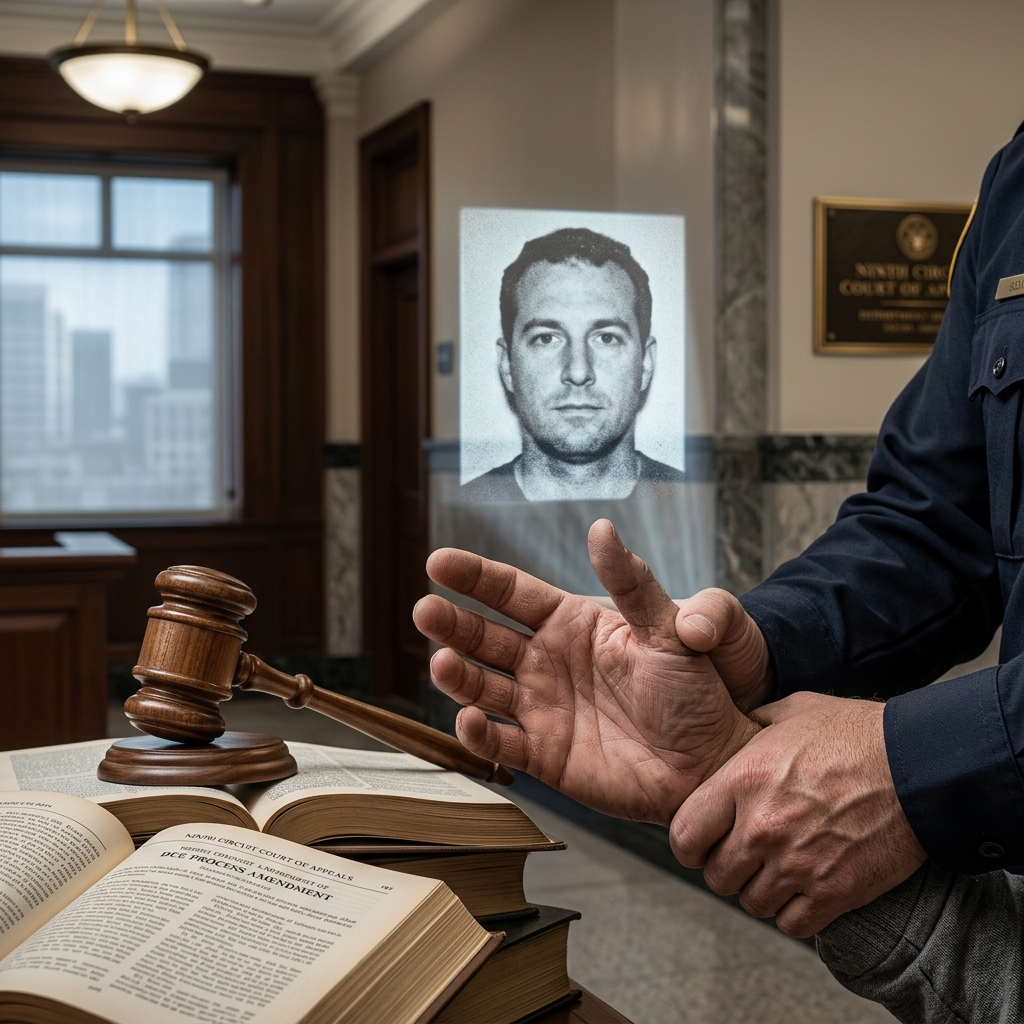
When police arrest the wrong person on a valid warrant meant for someone else, a fundamental question arises: how much protection does the Constitution offer to the innocent individual who is mistakenly taken into custody? In recent years, the U.S. Court of Appeals for the Ninth Circuit has confronted this problem directly, shaping an approach that focuses on due process safeguards and the need for reasonable identity verification.
This article uses a real-world scenario—police arresting a father on a warrant issued for his son—as a springboard to examine how mistaken-identity arrests are treated in constitutional law, with special emphasis on Ninth Circuit doctrine. It also contrasts that approach with other federal courts and offers practical guidance for individuals and lawyers dealing with such cases.
1. The Problem of Mistaken Identity Arrests
Mistaken identity arrests happen when law enforcement officers reasonably (or unreasonably) believe that an individual is the person named in a warrant or investigative alert, but that belief turns out to be wrong. These incidents are not rare, especially in jurisdictions that rely heavily on name-based checks and incomplete data systems.
Common patterns include:
- Arresting an individual who shares the same name and similar physical characteristics as the person actually wanted by police.
- Detaining people based on outdated or erroneous warrant records that were never corrected.
- Failure to verify key identifiers such as date of birth, Social Security number, or biometric data before formal booking.
In the hypothetical example paralleling the Ninth Circuit case, officers arrest a father because a warrant exists for his son. The father has the same last name, lives at a related address, and fits a general description. But once he is in custody, evidence quickly shows he is not the wanted person. The question is whether continued detention, despite this information, violates the Constitution.
2. Constitutional Framework: Fourth Amendment vs. Fourteenth Amendment
Two constitutional provisions typically come into play in mistaken-identity cases:
- Fourth Amendment – Protects against unreasonable searches and seizures. It governs whether the initial arrest was reasonable, given the information officers had at the moment of seizure.
- Fourteenth Amendment Due Process Clause – Protects against deprivations of liberty without adequate procedural safeguards. It often governs continued detention after the initial arrest, including failures to verify identity or provide access to courts.
In many mistaken-identity cases, the arrest is executed under a valid warrant for someone with the same name. The Supreme Court has suggested that such arrests can be constitutionally permissible at the moment of seizure, even if the wrong person is taken into custody, as long as officers reasonably rely on the warrant.
The more complex question—which the Ninth Circuit has addressed explicitly—is whether due process is violated when officials ignore clear indications that they have the wrong person, or when they fail to provide basic procedural safeguards that would allow a detainee to prove the mistake.
3. Ninth Circuit’s Due Process Approach to Mistaken Detention
The Ninth Circuit has established a relatively protective standard for mistaken-incarceration claims arising from identity errors. According to the court, a mistaken detention can violate the Due Process Clause when either of two conditions is met:
- Further investigation was clearly warranted under the circumstances, yet officials unreasonably failed to investigate; or
- Officials
This standard focuses on what happens after the arrest. Even assuming the arrest is based on a facially valid warrant for someone with the same name, jailers and officers must respond reasonably when a detainee insists, and evidence suggests, that they have arrested the wrong person.
Key features of the Ninth Circuit’s approach include:
- An emphasis on procedural safeguards
- Recognition that even short detentions can be constitutionally problematic if officials ignore obvious red flags about identity.
- Willingness to treat prolonged inaction or refusal to investigate as a due process violation, not merely an unfortunate error.
3.1 Example of Ninth Circuit Protection
In a notable Ninth Circuit case involving mistaken identity detention, the court held that due process was violated where a detainee repeatedly protested his innocence and substantial evidence indicated that the warrant applied to someone else, yet officials did not pursue basic verification measures. The court emphasized that the Constitution requires more than passive reliance on a name match once doubts arise.
While details differ, the father–son scenario raises similar concerns: if jailers have access to clear age differences, biometric data, or other indicators that the detainee is not the wanted son, failure to investigate can satisfy the Ninth Circuit’s standard for a due process violation.
4. Comparison: Eleventh Circuit’s Three-Day Rule and Other Approaches
Not all federal courts treat mistaken-identity detention the same way. The Eleventh Circuit, for example, has adopted a notably restrictive approach in Sosa v. Martin County, an en banc decision dealing with an individual detained for three days due to mistaken identity.
In Sosa, the court held that:
- As long as the arrest is executed under a valid warrant
- The mistaken detention lasts three days or less,
then there is no Fourteenth Amendment violation, even if the detainee is entirely innocent and the wrong identity could have been discovered earlier.
This has been described as a “three-day rule”, effectively insulating short mistaken detentions from constitutional scrutiny in that circuit. Critics argue that the rule misunderstands Supreme Court precedent and undervalues the liberty interest of innocent detainees.
4.1 Table: Ninth Circuit vs. Eleventh Circuit on Mistaken Detention
| Circuit | Core Standard | Focus | Implication for Short Detentions |
|---|---|---|---|
| Ninth Circuit | Mistaken detention violates due process when circumstances indicate further investigation is warranted or access to courts is denied for an extended period. | Procedural safeguards, reasonableness of follow-up investigation, opportunity to correct identity errors. | Even brief detention may be unconstitutional if officials ignore obvious doubts about identity. |
| Eleventh Circuit | No due process violation if arrest is under a valid warrant and detention is three days or less. | Length of detention and validity of warrant. | Short mistaken detentions (≤ 3 days) generally deemed constitutionally permissible. |
Other circuits have taken intermediate positions, focusing more on the totality of circumstances—such as the strength of the evidence pointing to mistaken identity and the steps officers took to verify identity—rather than a strict time-based rule.
5. Identity Verification Duties in Jails and Police Agencies
Beyond constitutional doctrine, professional policing standards emphasize the importance of robust identity verification processes. Law enforcement training materials highlight multiple safeguards that agencies can implement to minimize mistaken-identity arrests and detentions.
Common verification tools include:
- Fingerprint and biometric checks: Automated fingerprint identification systems (AFIS) and other biometric databases can quickly confirm whether the detainee matches the person named in a warrant.
- Photograph and physical-description comparison: Comparing booking photos and documented physical characteristics against the warrant subject.
- Cross-checking demographic data: Date of birth, height, weight, scars, tattoos, and other unique identifiers.
- Database consolidation: Integrating local, state, and federal records to reduce misidentification arising from fragmented data.
In the father–son scenario, a reasonable verification process might involve:
- Comparing the father’s fingerprints or photo to the son’s records.
- Checking date of birth and other identifiers listed on the warrant.
- Contacting the warrant-issuing agency to confirm whether the person in custody matches the intended target.
When agencies fail to take such steps despite obvious indications of a mismatch, the risk of constitutional liability increases, especially under the Ninth Circuit’s due process framework.
6. Practical Implications for Victims and Practitioners
For individuals wrongly arrested due to mistaken identity, the experience can be traumatic, with consequences ranging from loss of employment to reputational harm and emotional distress. Legal remedies depend heavily on the jurisdiction and the specific facts.
6.1 Potential Legal Claims
Possible civil claims may include:
- Fourth Amendment claims under 42 U.S.C. § 1983, arguing that the initial arrest was unreasonable given the information available to officers.
- Fourteenth Amendment due process claims, focusing on prolonged or unjustified detention after authorities should have recognized the identity error.
- State-law tort claims such as false imprisonment, negligence, or intentional infliction of emotional distress, depending on local law.
However, plaintiffs must navigate defenses such as qualified immunity, statutory limitations, and doctrines like the Federal Tort Claims Act’s judgment bar, which can preclude further suits against federal officers once certain claims have been resolved.
6.2 Factors Courts Often Consider
Courts evaluating mistaken-identity cases commonly examine:
- Reasonableness of initial arrest: Did officers have a valid warrant? Was the identity match strong enough to justify seizure?
- Duration of detention: Short vs. prolonged detention, and whether delays were justifiable.
- Evidence of mismatch: Clear differences in age, physical characteristics, or documented identifiers.
- Steps taken to investigate: Fingerprinting, photo comparison, contacting issuing agencies.
- Access to courts and counsel: Whether the detainee could meaningfully challenge the detention and present evidence of mistaken identity.
7. Policy Considerations and Reform Debates
Legal scholars and advocates have criticized restrictive doctrines like the Eleventh Circuit’s three-day rule, arguing that they allow significant harms to go uncompensated and fail to incentivize better identity-verification practices. They highlight:
- The real-world impact on innocent individuals who lose jobs, housing, or child custody due to even short detentions.
- The disproportionate burden on communities with common surnames or limited resources to challenge wrongful arrests.
- The need for courts to recognize a robust due process right against identity-based detention errors.
By contrast, the Ninth Circuit’s willingness to scrutinize investigative failures and procedural barriers reflects a more protective stance toward detainees’ liberty interests. Policymakers and law-enforcement leaders can draw on this jurisprudence to justify investments in technology and training aimed at reducing mistaken arrests.
8. FAQs: Mistaken Identity Arrests in the Ninth Circuit
FAQ 1: If I am arrested on a warrant for someone else, is that automatically unconstitutional?
Not necessarily. Courts often consider whether officers reasonably relied on a valid warrant and whether the identity match appeared plausible at the time of arrest. The key constitutional questions typically arise after you are detained and officials either investigate—or fail to investigate—your claim of mistaken identity.
FAQ 2: What makes a mistaken detention a due process violation in the Ninth Circuit?
According to Ninth Circuit doctrine, a mistaken detention can violate due process if circumstances clearly indicate that further investigation is warranteddeny access to courts or procedural safeguards for an extended period. Evidence such as obvious age differences, mismatched physical characteristics, or readily available biometric data can make additional investigation constitutionally necessary.
FAQ 3: Does the length of my detention matter?
Yes, but different circuits weigh duration differently. The Eleventh Circuit, for example, has held that a mistaken detention of three days or less under a valid warrant does not violate the Fourteenth Amendment. The Ninth Circuit, however, focuses more on whether officials ignored clear signs of error or blocked access to procedures, meaning even short detentions can be problematic in some circumstances.
FAQ 4: What should I do if I am the victim of a mistaken identity arrest?
Practical steps include:
- Immediately informing officers and jail staff of the identity error and providing any supporting documentation.
- Requesting fingerprint comparison, photo verification, or other biometric checks where available.
- Contacting an attorney as soon as possible to assert your rights and document the error.
- Preserving records of your detention, including booking documents and court filings, for possible civil claims.
FAQ 5: Are law enforcement agencies required to use fingerprints or biometrics to verify identity?
There is no single nationwide rule, but professional standards, training materials, and many local policies strongly encourage such practices to reduce mistaken-identity incidents. The constitutional requirement, particularly in the Ninth Circuit, is that authorities take reasonable steps to investigate identity when doubts arise, which often includes biometric verification where feasible.
9. Key Takeaways for the Father–Son Scenario
Returning to the motivating example—police arresting a father on a warrant for his son—the constitutional analysis in the Ninth Circuit would likely revolve around:
- Whether the father’s arrest was reasonable at the outset, given the warrant and available information.
- How quickly and thoroughly authorities responded once the father asserted that he was not the son and provided evidence.
- Whether biometric or documentary checks were promptly performed.
- Whether the father had timely access to judicial review, counsel, or other mechanisms to correct the mistake.
If officials ignored clear indications that they had the wrong person, delayed investigation without justification, or blocked basic procedural avenues, the Ninth Circuit’s due process standard would support a finding that the mistaken detention violated the Constitution.
References
- Examining the Eleventh Circuit’s Decision Concerning Detention of Arrestees Based on Mistaken Identity — University of Cincinnati Law Review. 2023-03-30. https://uclawreview.org/2023/03/30/examining-the-eleventh-circuits-decision-concerning-detention-of-arrestees-based-on-mistaken-identity/
- Sosa v. Martin County—Mistaken Identities and the Three-Day Rule — The University of Chicago Law Review Online. 2023-04-06. https://lawreview.uchicago.edu/online-archive/sosa-v-martin-county-mistaken-identities-and-three-day-rule
- What’s in a Name? How the Eleventh Circuit Ignored the Fourth Amendment — University of Miami Law Review. 2024-01-01. https://repository.law.miami.edu/cgi/viewcontent.cgi?article=4789&context=umlr
- Identity Verification — Legal & Liability Risk Management Institute (LLRMI). 2018-05-01. https://www.llrmi.com/articles/legal_update/jail_identity_verification/
- High Court Blocks Suit Over Mistaken-Identity Arrest — Courthouse News Service. 2020-06-15. https://www.courthousenews.com/high-court-blocks-suit-over-mistaken-identity-arrest/
Similar Articles








Read full bio of medha deb




