
Missouri Cannabis Licenses: A Practical Applicant Guide
A detailed, plain‑language roadmap to preparing, applying for, and maintaining a cannabis business license in Missouri while staying compliant with state and local rules.
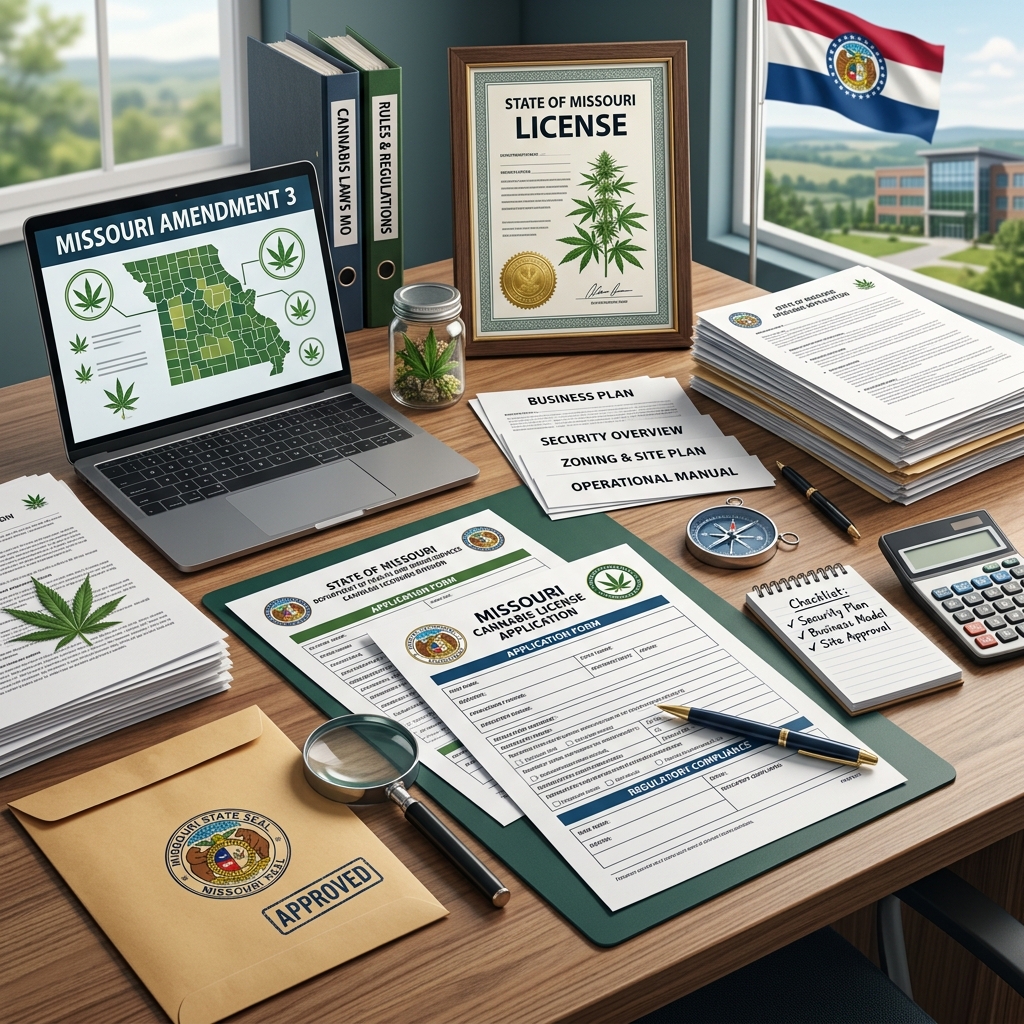
Missouri has moved rapidly from medical-only cannabis to a dual system that supports both medical and adult-use marijuana. As the legal market expands, so does the complexity of licensing. Understanding who can apply, what documents are required, and how the state evaluates applications is essential for any business hoping to participate in this regulated industry.
This guide offers a practical, plain-language overview of the major license types, core eligibility rules, document checklists, and process tips drawn from official Missouri regulatory resources and reputable industry guidance.
1. Overview of Missouri’s Cannabis Regulatory Landscape
Missouri regulates cannabis primarily through the Department of Health and Senior Services (DHSS) and its Division of Cannabis Regulation (DCR). The state now permits both medical and non-medical (adult-use) marijuana, with licensing frameworks tailored to different kinds of businesses and facilities.
Regulation focuses on:
- Patient access and consumer safety for medical and adult-use products.
- Strict tracking and reporting from seed to sale.
- Eligibility controls to limit participation to qualified individuals and entities.
1.1 Medical vs. Adult-Use Cannabis
Medical cannabis is authorized under constitutional provisions that lay out qualifying medical conditions, physician certification requirements, and patient registry rules. Adult-use cannabis, approved by voters in 2022, allows adults 21 and older to possess up to a statutorily defined limit of marijuana, with retail sales carried out by licensed facilities.
While both systems share core safety and compliance standards, medical licenses often carry additional requirements related to patient privacy, physician certifications, and cardholder verification.
1.2 Key License Categories
Missouri recognizes several cannabis-related license types, each with distinct application requirements and operational obligations. Broadly, business applicants may seek licenses related to:
- Cultivation (growing cannabis plants at scale).
- Manufacturing or processing (creating infused or extracted products).
- Dispensing/retail (selling cannabis to patients or adult consumers).
- Testing (lab analysis for potency and contaminants).
- Transportation (moving cannabis between licensed facilities).
- Seed-to-sale systems (track-and-trace technology providers).
- Microbusiness licenses, designed to broaden access for small and socially/economically disadvantaged operators.
| License Type | Typical Role | Key Regulatory Focus |
|---|---|---|
| Cultivation facility | Grow cannabis plants | Security, plant tracking, production limits, environmental controls |
| Manufacturing/infused products | Produce oils, edibles, concentrates | Food safety standards, extraction safety, labeling accuracy |
| Dispensary/retail facility | Sell cannabis to patients/adults | Verification of eligibility, record-keeping, product storage and security |
| Testing laboratory | Analyze potency and contaminants | Accreditation, validated methods, impartial reporting |
| Transportation certification | Move cannabis between facilities | Chain-of-custody, vehicle security, manifest compliance |
| Microbusiness license | Smaller-scale, equity-focused operations | Eligibility, lottery processes, reduced scale regulations |
2. Core Eligibility Requirements for Applicants
Before assembling a detailed application, prospective licensees need to confirm they meet baseline eligibility requirements. These vary somewhat by license type but typically address residency, ownership structure, and criminal history.
2.1 Residency and Ownership
For many traditional facility licenses (such as cultivation and dispensaries), Missouri has prioritized in-state ownership. Industry guidance notes that cannabis business entities often must be majority-owned by Missouri residents who can demonstrate at least a year of residency and no competing residency claims elsewhere. This is intended to ensure that profits and control remain closely tied to the state.
Microbusiness licenses, by contrast, do not have a general residency requirement, although they apply specific eligibility standards tied to income, geography, or prior records depending on statutory criteria.
2.2 Criminal History and Disqualifying Offenses
Missouri disqualifies applicants with certain felony convictions—particularly those involving violence or serious financial crimes—from ownership or employment in cannabis facilities. All major stakeholders, including principal owners and top managers, must typically attest that they do not have disqualifying felonies. Applicants may be required to submit fingerprints and undergo state or national criminal history checks.
Local jurisdictions, such as municipalities issuing business licenses, may also require separate criminal background checks for facility managers or owners.
2.3 Microbusiness-Specific Eligibility
Microbusiness licenses are designed to broaden participation in the cannabis market. Eligibility criteria, defined in state law and explained by the Division of Cannabis Regulation, may reference factors such as household income, residency in a designated area, or past cannabis-related offenses that meet statutory conditions. Applicants must provide supporting documentation that demonstrates they meet one of the qualifying categories.
3. Preparing Your Application: Information and Documents
Successful applications share a common theme: thorough preparation. Missouri’s application forms require detailed information about the applicant entity, ownership, facility design, and operations.
3.1 Business Identity and Ownership Details
Most applications require basic business and ownership information, including:
- Legal business name and any fictitious or “doing business as” names.
- Federal Employer Identification Number (FEIN).
- Contact person with mailing address, phone, and email.
- Ownership structure (e.g., LLC, corporation, partnership) and organizational charts.
- List of owners and key managers, including percentages of ownership and roles.
3.2 Facility Location and Design
Applicants must identify the proposed facility location and demonstrate compliance with zoning and local requirements. Missouri provides a DCR Location Tool that helps applicants determine which congressional and state districts their facility falls into, and capture GPS coordinates that must be entered into the application.
Typical location and design information includes:
- Street address and geographic coordinates of the facility.
- Attestation that local zoning and permitting requirements will be met.
- Facility floor plans and blueprints showing room functions and sizes.
- Security measures (access control, surveillance, storage areas).
- For cultivation, descriptions of growing methods and allocation of space among flowering, vegetative, and support areas.
3.3 Operational Plans and Seed-to-Sale Tracking
Missouri requires seed-to-sale tracking to ensure that all cannabis plants and products are accounted for throughout the supply chain. Some applicants, such as seed-to-sale system providers, must submit detailed certification applications outlining their technology and compliance protocols.
Facility applicants generally need to describe:
- Inventory management processes and interfaces with state-approved tracking systems.
- Record-keeping plans for sales, transfers, and waste disposal.
- Quality assurance procedures and standard operating procedures (SOPs).
- Patient or customer verification workflows and data protection measures.
3.4 Personal Qualifications and Management
Applications often request detailed information about top managers or principal officers. Industry guidance suggests including resumes, prior legal cannabis industry experience, and professional references. For city-level licenses, applicants may need to provide background checks and attestations for each manager responsible for operations.
4. Application Submission, Fees, and Timelines
Once the application packet is complete, the next step is submission through the appropriate channels and payment of any required fees. These processes vary by license type and evolve as regulations change, so applicants should always verify current requirements via official state resources.
4.1 State-Level Facility Applications
Historically, applications for cultivation, manufacturing, dispensing, testing, and transportation facilities have been accepted within defined application windows, with fees paid by certified funds or via designated online systems. While specific timelines have changed over time, a typical process has included:
- Completion of pre-filed license application forms and payment of fees to DHSS.
- Submission of full application materials via the state’s web-based or registry portal.
- Formal review by regulators with scoring against criteria such as security, public safety, and community impact.
4.2 Microbusiness Application Windows and Lottery
Microbusiness licenses follow a distinct process. Applicants must submit complete applications during designated microbusiness application periods announced on the department’s website. All valid applications submitted within the window, with appropriate fees, are entered into a randomized lottery conducted by the Missouri Lottery.
Key steps include:
- Submitting a complete microbusiness application via the online registry portal during the announced timeframe.
- Ensuring valid payment of the application fee at the time of submission.
- Providing all required documentation and responding promptly to any follow-up requests from DCR.
Microbusiness fees are generally lower than large-scale facility fees and may involve uniform application, annual, and renewal charges.
4.3 Local Business Licenses and City Requirements
Some cities require separate business licenses for medical marijuana or cannabis-related facilities. For example, the City of Columbia requires a medical marijuana facility business license, with an application, processing fee, criminal record check, and proof of no outstanding state sales tax obligations. Applicants must coordinate state and local requirements to ensure that both sets of licenses are obtained before operations begin.
5. Patient and Caregiver Applications (Medical Use)
In addition to business licenses, Missouri requires qualifying patients and caregivers to obtain medical marijuana cards to purchase and possess medical cannabis. This process is separate from business licensing but is crucial for dispensaries that intend to serve medical patients.
5.1 Medical Card Eligibility and Physician Certification
Patients must have a qualifying medical condition as defined under state law and obtain a certification from a Missouri-licensed physician (MD or DO) in good standing. Only state-licensed doctors can provide this certification, which must be submitted as part of the patient’s application.
5.2 Required Patient Application Information
According to Missouri’s cannabis information portal, a patient application typically includes:
- Identifying information and contact details.
- Proof of Missouri residency.
- A valid government-issued photo ID.
- Physician certification form completing the medical justification.
- A clear, recent photograph of the applicant’s face.
- Signed attestation statement and date.
Patients submit applications through the DHSS online portal and pay fees using electronic check or major credit cards.
6. Common Pitfalls and Practical Compliance Tips
Cannabis licensing in Missouri is competitive and detail-oriented. Even strong applicants can run into avoidable problems if they are not careful about documentation and timing.
6.1 Incomplete or Inaccurate Applications
Incomplete applications are a common reason for delays or denials. Issues may include missing documents, inconsistent ownership information, or facility plans that do not match what is described elsewhere in the application.
- Cross-check all sections of the application for consistency.
- Use checklists for required documents and signatures.
- Ensure GPS coordinates and district information are correctly entered, using the DCR Location Tool if applicable.
6.2 Underestimating Local Requirements
State licensing is not the only hurdle. Local governments may impose zoning constraints, business license requirements, and building code inspections. Applicants should consult with local planning and licensing offices early and document any approvals or conditions.
6.3 Insufficient Compliance Infrastructure
Regulators expect applicants to demonstrate robust compliance systems, not just basic security plans. This includes:
- Written SOPs for inventory control, record-keeping, and quality assurance.
- Clear lines of managerial responsibility and training programs.
- Policies for handling product recalls, complaints, and regulatory inspections.
7. Frequently Asked Questions (FAQs)
Q1: Do I need to be a Missouri resident to apply for a cannabis license?
For many traditional facility licenses, industry guidance indicates that majority ownership must be held by Missouri residents who can show at least one year of residency. Microbusiness licenses, however, do not impose a general residency requirement, though specific eligibility criteria apply.
Q2: How are microbusiness licenses awarded?
Microbusiness applications submitted during designated windows, with complete documentation and paid fees, are entered into a randomized lottery conducted by the Missouri Lottery. This process is overseen by the Division of Cannabis Regulation via the online registry portal.
Q3: Can I use an out-of-state medical marijuana card in Missouri?
No. Missouri does not recognize medical marijuana cards from other states. Patients must follow Missouri’s own application process and meet its requirements to obtain a valid card.
Q4: What kind of information is required for the facility location?
Applicants typically need to provide the facility address, district information, and GPS coordinates, along with attestations about compliance with local zoning requirements. Missouri offers a DCR Location Tool to assist with capturing accurate district and coordinate data.
Q5: Where can I get help if I have questions about my application?
The Division of Cannabis Regulation provides support through phone and email, including a Facility Application Services Unit that can direct inquiries to the appropriate staff. Local jurisdictions such as cities also have business license divisions that can answer questions about municipal requirements.
References
- Missouri Cannabis Information Portal — MissouriStateCannabis.org. 2023-03-01. https://missouristatecannabis.org/
- Microbusiness License FAQs — Missouri Department of Health and Senior Services, Division of Cannabis Regulation. 2023-08-01. https://health.mo.gov/safety/cannabis/faqs-micro.php
- How to Apply – Microbusiness — Missouri Department of Health and Senior Services, Division of Cannabis Regulation. 2023-08-01. https://health.mo.gov/safety/cannabis/how-to-apply-micro.php
- Microbusiness Information — Missouri Department of Health and Senior Services, Health Services Regulation. 2023-08-01. https://health.mo.gov/safety/cannabis/microbusiness.php
- Medical Marijuana Facility License — City of Columbia, Missouri. 2022-09-15. https://www.como.gov/finance/business-licenses/medical-marijuana-facility-license/
- Missouri Application for Medical Marijuana Licenses — Leaf Legal, P.C. 2019-07-25. https://www.leaflegalpc.com/missouri-application-process-for-cultivation-manufacturing-testing-transportation-seed-to-sale-or-dispensing-licenses
- Missouri Cannabis Microbusiness License Overview — CannDelta. 2023-10-01. https://canndelta.com/us/missouri/
Similar Articles








Read full bio of Sneha Tete


