
Missouri Assault Laws: Degrees, Penalties, and Defenses
A clear, practical guide to how Missouri defines assault, the four degrees of charges, possible penalties, and common legal defenses.
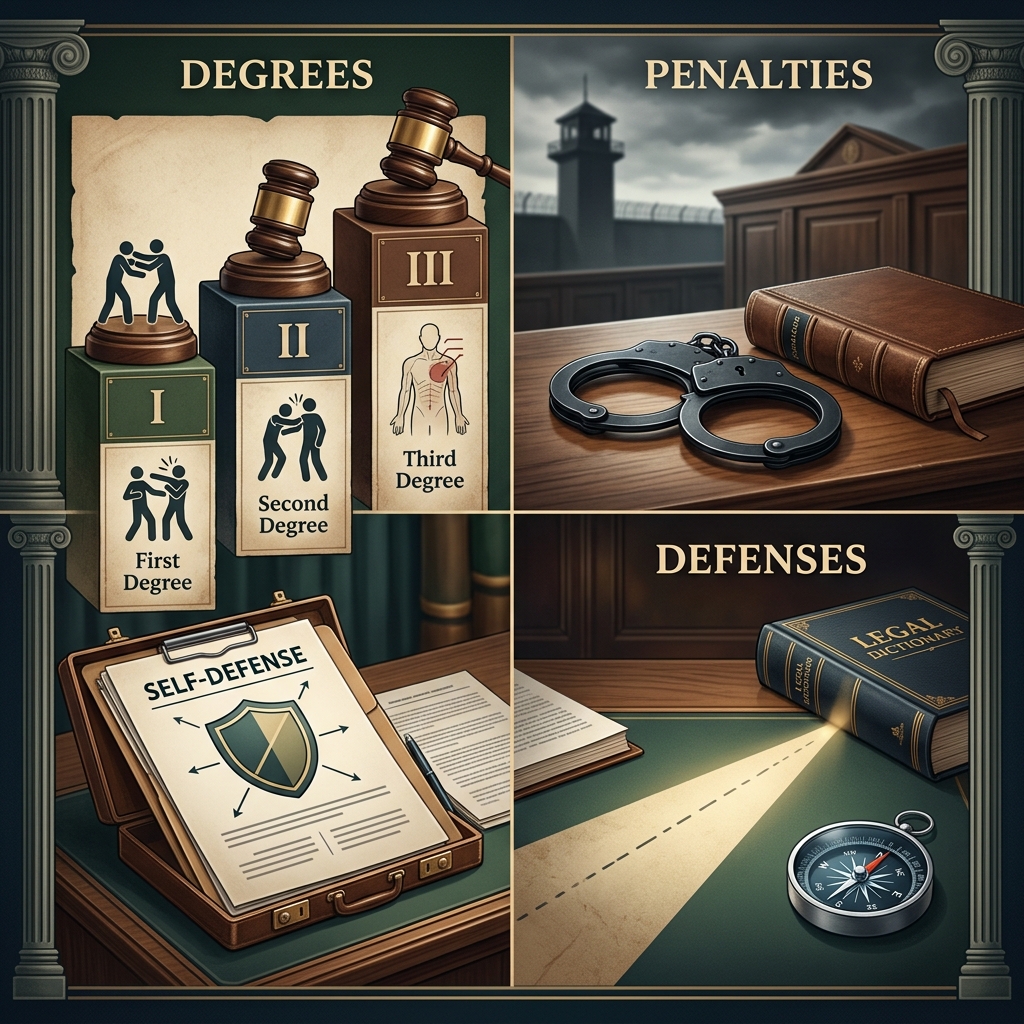
Assault charges in Missouri can range from a minor misdemeanor to a serious felony carrying long prison sentences. Understanding how the state defines assault, the four degrees of the offense, and the potential penalties is essential for anyone facing charges or trying to make sense of Missouri criminal law.
This guide explains, in plain language, how assault works under Missouri law, how cases are classified, what punishments might apply, and which defenses—such as self-defense—can sometimes reduce or defeat a charge.
Core Idea: What Counts as Assault in Missouri?
Under Missouri law, assault involves causing physical injury, attempting to cause injury, or putting someone in reasonable fear of immediate physical harm. It may be carried out through direct violence, reckless behavior, or even threatening conduct.
- Physical injury: Harm to the body, ranging from minor pain to serious, life-threatening damage.
- Serious physical injury: Injury that creates a substantial risk of death, causes serious disfigurement, or long-term loss or impairment of a bodily function.
- Threat or apprehension: Placing another person in reasonable fear of immediate physical harm, even if no injury actually occurs.
Missouri divides assault into four degrees, from first degree (most serious) to fourth degree (least serious), based on intent, level of injury, use of weapons, and the victim’s status.
Overview of the Four Degrees of Assault
Each degree of assault in Missouri corresponds to a different level of seriousness and a different class of felony or misdemeanor.
| Degree of Assault | Typical Classification | Key Features |
|---|---|---|
| First-degree assault | Generally Class B felony; may rise to Class A felony in some cases | Attempting to kill or knowingly causing/attempting to cause serious physical injury |
| Second-degree assault | Generally Class D felony | Reckless or weapon-based conduct causing serious injury, or harm due to sudden passion |
| Third-degree assault | Usually Class E felony; can be Class D felony for special victims | Knowingly causing physical injury, commonly without the extreme circumstances of first-degree cases |
| Fourth-degree assault | Typically Class A or Class C misdemeanor | Minor injury, offensive contact, or creating risk of harm or fear of immediate injury |
The actual charge in any case depends on the precise facts, including how the incident happened, the type of injury, and whether the victim qualifies as a special victim (such as certain public servants or vulnerable individuals under Missouri law).
First-Degree Assault: The Most Serious Level
First-degree assault is reserved for the most severe conduct. Under Missouri statutes, a person commits this offense if they attempt to kill someone or knowingly cause or attempt to cause serious physical injury to another person.
Legal Definition and Elements
According to Missouri Revised Statutes Section 565.050, the core elements include:
- An attempt to kill another person; or
- Knowingly causing or attempting to cause serious physical injury.
The word knowingly means the person is aware that their conduct is almost certain to cause the serious harm described in the law.
Penalties for First-Degree Assault
First-degree assault is typically charged as a Class B felony, which can carry a prison term of 5 to 15 years.
In certain circumstances—such as when the victim is in a protected category or the injuries are especially severe—the offense can be treated as a Class A felony, which may allow for a sentence of up to life in prison.
Second-Degree Assault: Serious Injury without Clear Intent to Kill
Second-degree assault covers serious injuries or attempts at harm that do not rise to the level of an attempted killing but still involve dangerous or reckless conduct.
Common Ways Second-Degree Assault Occurs
Missouri law typically considers second-degree assault when a person:
- Attempts to kill or cause serious physical injury under a sudden passion based on adequate cause;
- Attempts to cause physical injury using a deadly weapon or dangerous instrument;
- Recklessly causes serious physical injury to another person; or
- Recklessly causes injury by discharging a firearm.
These situations reflect either heightened danger (e.g., using a weapon) or serious harm caused by reckless behavior rather than a clear intent to kill.
Penalties for Second-Degree Assault
Second-degree assault is usually a Class D felony in Missouri.
A Class D felony can carry up to seven years in prison and fines, depending on the circumstances and the person’s prior criminal history.
Third-Degree Assault: Knowingly Causing Injury
Third-degree assault sits in the middle of Missouri’s assault scheme. It often involves intentional conduct causing physical injury, but without the extreme seriousness that defines first- or second-degree cases.
Definition Under Missouri Statutes
Missouri Revised Statutes Section 565.054 defines third-degree assault as knowingly causing physical injury to another person.
Key ideas include:
- The conduct is knowing—the person is aware that their actions will likely cause physical injury.
- The injury is real but may not rise to “serious physical injury.”
Felony Status and Special Victims
Third-degree assault is generally a Class E felony in Missouri.
If the person injured meets the statutory definition of a special victim, the charge can be elevated to a Class D felony, which carries a more severe potential sentence.
Fourth-Degree Assault: Misdemeanor-Level Conduct
Fourth-degree assault covers less serious behavior, often involving minor physical injury, offensive contact, or behavior creating risk or fear of harm. It is the lowest level of assault under Missouri law.
Statutory Definition
Missouri Revised Statutes Section 565.056 sets out several ways a person can commit fourth-degree assault, including:
- Attempting to cause or recklessly causing physical injury, physical pain, or illness;
- Causing physical injury through criminal negligence by discharging a firearm;
- Purposely placing another person in apprehension of immediate physical injury;
- Recklessly engaging in conduct creating substantial risk of death or serious physical injury;
- Knowingly causing or attempting to cause offensive or provocative physical contact, including with a person with a disability;
- Knowingly causing physical contact when the person knows the other will regard it as offensive or provocative.
Misdemeanor Class and Penalties
Fourth-degree assault is generally a Class A misdemeanor, which can result in up to one year in jail and fines, often up to around $2,000.
Certain specific subsections are treated as a Class C misdemeanor, punishable by a shorter potential jail term (up to roughly 15 days) and a lower fine (often up to around $700).
If the victim is a special victim, some Class C scenarios can be elevated to Class A misdemeanor status, increasing the possible penalties.
Felony vs. Misdemeanor Assault in Missouri
Assault charges in Missouri may be either felonies or misdemeanors, depending largely on the degree of assault and the circumstances of the case.
- Felony assault: Typically first-degree, second-degree, and most third-degree cases. Potential consequences can range from several years up to life in prison.
- Misdemeanor assault: Primarily fourth-degree assault and some lower-level third-degree situations. These cases usually involve county jail time and fines rather than long-term prison sentences.
Felony convictions often carry lasting consequences: loss of certain civil rights, difficulties with employment and housing, and potential long-term supervision after release. Misdemeanors are less severe but can still have significant personal and professional impacts.
Role of the Victim’s Status
Missouri law recognizes certain individuals as special victims. While the exact definition is set in statute, it commonly includes groups such as law enforcement officers, emergency personnel, and some vulnerable populations.
When a victim meets the definition of a special victim, an assault charge can be raised to a higher class of felony or misdemeanor, increasing the potential penalties.
Possible Legal Defenses: Self-Defense and Defense of Others
Even when the state alleges that someone has committed assault, defenses may apply. One of the most important recognized defenses is self-defense, and relatedly, defense of others.
Self-Defense Under Missouri Law
In Missouri, self-defense may be an affirmative defense to assault charges. This generally means the defendant admits using force but claims it was legally justified.
Key concepts in self-defense include:
- The person used force because they reasonably believed it was necessary to protect themselves from the use or imminent use of unlawful force by another;
- The amount of force used was proportionate to the perceived threat;
- The belief in the threat can sometimes be mistaken, as long as it was reasonable at the time.
Defense of Others
Missouri also allows a similar defense when the accused used force to protect another person. In this context, the person must reasonably believe that a third party faced unlawful force and that defensive action was necessary.
Other Potential Defenses
Beyond self-defense and defense of others, attorneys may examine issues such as:
- Identity: Whether law enforcement correctly identified the person responsible.
- Intent: Whether the accused truly acted knowingly or recklessly, as required by the statute.
- Credibility of witnesses: Whether witnesses are reliable and consistent.
- Evidence challenges: Whether physical evidence or statements were obtained lawfully and accurately.
The specific defense strategy will depend on the facts of the case and the degree of assault charged.
Practical Tips if You Face Assault Charges
Assault allegations in Missouri should be taken seriously, whether they involve a misdemeanor or a felony. Some practical steps include:
- Seek legal counsel promptly: An experienced criminal defense attorney can explain the charges, potential penalties, and available defenses.
- Avoid discussing the case: Statements to police, alleged victims, or on social media can be used as evidence.
- Preserve evidence: Keep any documents, messages, or contact information for witnesses that may support your account.
- Follow court orders: Comply with bond conditions, orders of protection, or other restrictions to avoid additional charges.
Because even a single incident can lead to long-term consequences, understanding the law and your rights is crucial.
Frequently Asked Questions About Missouri Assault Laws
Is every physical fight considered assault in Missouri?
Not every confrontation becomes a criminal assault, but any situation involving injury, attempts to injure, or credible threats of harm can lead to charges. The degree of assault depends on factors such as intent, severity of injury, and use of weapons.
Can I be charged with assault if no one was seriously hurt?
Yes. Third-degree and fourth-degree assault laws allow charges even when injuries are minor or when the conduct involves offensive contact or placing someone in fear of immediate harm.
What makes an assault a felony instead of a misdemeanor?
Felony assault usually involves more serious injury, use of weapons, or more dangerous conduct. First-, second-, and most third-degree assaults are felonies, while fourth-degree assault is typically a misdemeanor.
How does self-defense affect an assault case?
If a person reasonably believed they needed to use force to protect themselves or another from unlawful force, self-defense or defense of others may be an affirmative defense. Courts examine whether the belief and the level of force were reasonable under the circumstances.
Do assault penalties change if the victim is a police officer or other protected person?
Yes. When the victim qualifies as a special victim under Missouri law, some assault charges can move to a higher class of felony or misdemeanor, increasing the potential sentence.
References
- Missouri Revised Statutes Section 565.056 (Assault in the fourth degree) — Missouri Revisor of Statutes. 2017-01-01. http://revisor.mo.gov/main/PageSelect.aspx?section=565.056
- Missouri Revised Statutes Section 565.054 (Assault in the third degree) — Missouri Revisor of Statutes. 2017-01-01. http://revisor.mo.gov/main/PageSelect.aspx?section=565.054
- How Does Missouri Define the Different Degrees of Assault? — Bert Fulk, Attorney at Law. 2023-05-10. https://www.bertfulklaw.com/how-does-missouri-define-the-different-degrees-of-assault/
- Assault and Aggravated Assault — Higher Level Legal Law Firm. 2022-09-15. https://www.jjw-law.com/assault-and-aggravated-assault
- Understanding the levels of assault in Missouri — Sindel Law. 2023-07-20. https://www.sindellaw.com/blog/2023/07/four-levels-of-assault-in-missouri/
- Assault in Missouri — Twibell Pierson Criminal Law. 2022-11-01. https://twibellpierson.com/assault-in-missouri/
Similar Articles








Read full bio of medha deb




