
Missouri Alimony: How Spousal Maintenance Really Works
A practical, plain‑English guide to Missouri spousal maintenance, including eligibility, duration, modification, and tax issues.
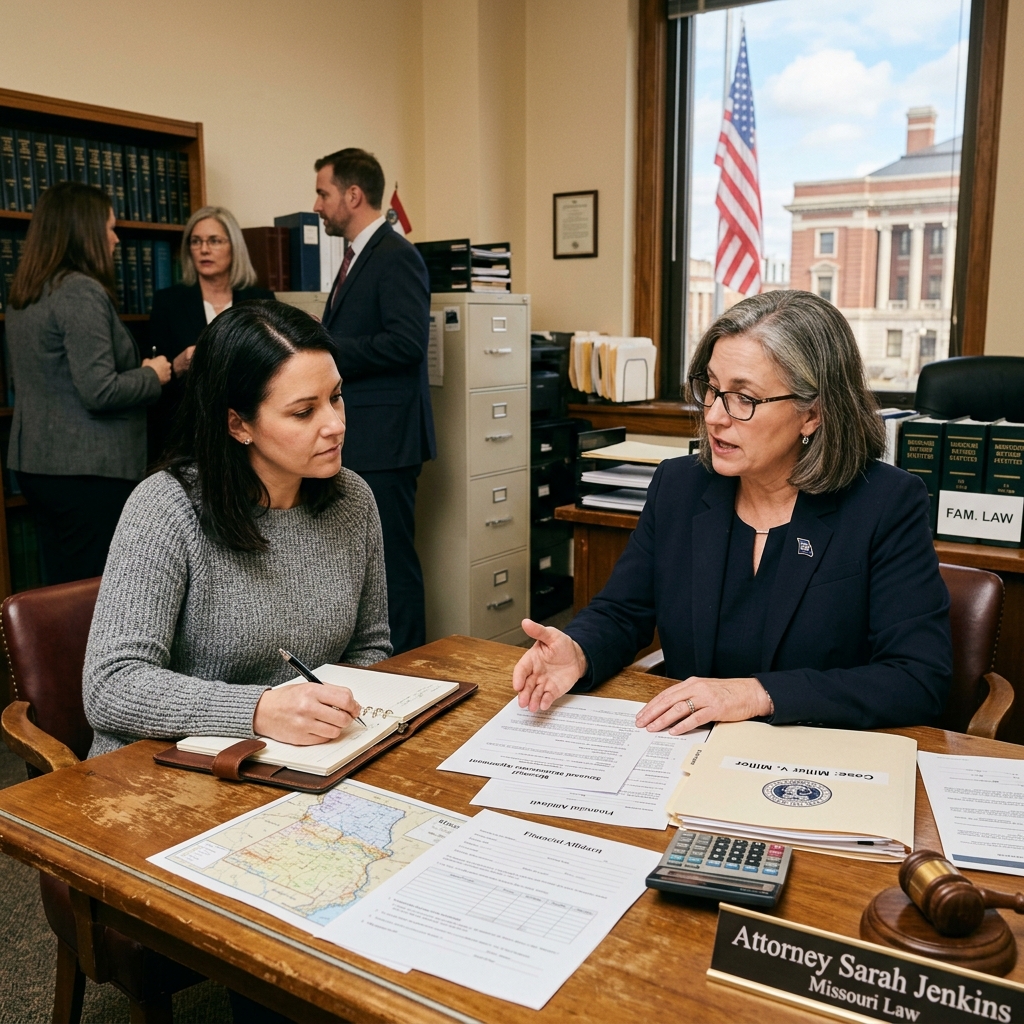
In Missouri, what many people call alimony is legally known as spousal maintenance. It is not automatic in every divorce case. Instead, a court may order one spouse to make payments to the other only when specific legal requirements are met and one spouse formally requests it during the divorce or legal separation process.
This guide explains when Missouri courts award maintenance, how the judge decides the amount and length of payments, what types of alimony exist, and how orders can be enforced or changed over time. It is for information only and is not a substitute for advice from a licensed Missouri attorney.
1. Basic Concepts: What Maintenance Means in Missouri
Missouri law allows a court to grant a maintenance order to either spouse, regardless of gender, during a divorce or legal separation case. The core idea is to prevent one spouse from suffering serious financial hardship after the marriage ends, while also considering the other spouse’s ability to pay.
- Maintenance = ongoing financial support from one ex‑spouse to the other, ordered by a court.
- Not automatic = the requesting spouse must ask for it and prove they meet legal requirements.
- Separate from child support = maintenance focuses on support between spouses, not on support for children.
Judges look closely at both spouses’ income, property, and realistic ability to work before awarding any maintenance at all.
2. The Two-Step Eligibility Test
Before a Missouri judge can decide how much maintenance to order, the law requires a two-part analysis under Missouri Revised Statutes section 452.335. Both parts must be satisfied; otherwise, no maintenance can be awarded.
2.1 Step One: Does the Spouse Need Maintenance?
The court first decides whether the spouse seeking maintenance:
- Does not have enough property (including marital property received in the divorce and any child support) to meet their reasonable needs; and
- Cannot support themself through appropriate employment, or is caring for a child whose condition makes outside employment unreasonable.
If either of these elements is missing, the judge must deny maintenance entirely. This threshold focuses on basic financial need, not on preserving a luxurious lifestyle.
2.2 Step Two: How Much and How Long?
If the judge finds that the spouse passes the first step, the court then weighs a list of statutory factors to decide the amount and duration of maintenance. The law requires the order to be in such amounts and periods as the court deems just after considering all relevant factors.
| Factor | What the Judge Looks At |
|---|---|
| Financial resources of requesting spouse | Marital and separate property, income, and any child support contributing to their needs. |
| Time needed to gain education or training | How long it will take to become self‑supporting through school, licensing, or job training. |
| Earning capacity of each spouse | Actual income and realistic future earning potential, given skills, experience, and health. |
| Standard of living during the marriage | The lifestyle the couple established while married, not just during the final months. |
| Duration of the marriage | Short vs. long-term marriage; long marriages often justify longer or higher maintenance. |
| Age and physical/emotional condition | Health issues that reduce ability to work or increase ongoing expenses. |
| Ability of paying spouse to meet own needs | Whether the paying spouse can cover their own reasonable expenses and still pay maintenance. |
| Marital conduct | Behavior during the marriage, including economic misconduct or domestic abuse, when relevant. |
| Any other relevant factor | Any circumstance the court finds important, such as long periods out of the workforce. |
Missouri stands out because judges may consider the parties’ conduct during the marriage, including serious misconduct, when deciding maintenance.
3. Types of Alimony in Missouri
Missouri law does not list rigid categories by name in the statute, but in practice, courts and practitioners commonly recognize several broad types of maintenance.
3.1 Temporary Maintenance (While the Case Is Pending)
Temporary maintenance covers the period while a divorce or legal separation case is still in progress. It helps a lower‑earning spouse pay for living expenses until final orders are entered.
- Ends when the final divorce decree is signed, unless the court converts or replaces it with a different maintenance order.
- Often based on current, short‑term needs and the immediate ability to pay.
3.2 Short-Term or Rehabilitative Maintenance
Rehabilitative
- Common when the requesting spouse needs education, training, or a period to re‑enter the workforce.
- Often ordered for a defined number of months or years.
- May be modifiable if circumstances substantially change, depending on the wording of the order.
3.3 Long-Term or Indefinite Maintenance
Long‑term or indefinite maintenance is more likely after a long marriage or when the recipient is unlikely ever to become self‑supporting because of age, health, or other serious limitations.
- Can last for an open‑ended period, but can still end upon death or remarriage and may be subject to modification in some cases.
- Not routine; courts still require proof of genuine, ongoing need and limited earning ability.
4. How Courts Decide the Amount of Maintenance
Missouri does not use a fixed statewide formula for alimony the way some states do for child support. Instead, the judge exercises discretion, guided by the statutory factors and evidence presented at trial or during settlement negotiations.
4.1 Balancing Need and Ability to Pay
Two themes drive every maintenance decision:
- Reasonable needs of the recipient – housing, food, transportation, healthcare, and other essential expenses based on the marital standard of living.
- Ability of the paying spouse to contribute – without being pushed below a reasonable standard of living themself.
Courts look at pay stubs, tax returns, bank records, budgets, and sometimes expert evidence about earning capacity. Historical income and future prospects can be more important than a single year of unusually high or low income.
4.2 Role of Property Division and Child Support
Maintenance decisions do not occur in a vacuum. The judge considers:
- Marital property awarded to each spouse – a spouse receiving substantial property might need less maintenance, or none at all.
- Child support orders – both what the paying spouse must pay and what the recipient receives, because child support may help cover some household expenses.
By law, the court must consider the financial resources of the spouse seeking maintenance, including marital property and any child support that effectively benefits that spouse as custodian.
5. Duration and Termination of Maintenance
Missouri maintenance typically ends when specific legal events occur or when a stated termination date arrives.
5.1 Common Termination Events
- Death of either spouse – maintenance obligations end upon the death of either the payor or recipient, unless the order specifically provides otherwise.
- Remarriage of the recipient – in most cases, the right to receive maintenance ends when the supported spouse remarries.
- Reaching the stated end date – many orders specify a date when maintenance automatically terminates.
Some courts also consider whether long‑term cohabitation with a new partner should affect maintenance, although the statute focuses expressly on remarriage and death; how that issue is treated can depend on case law and the wording of the decree.
5.2 Fixed vs. Indefinite Orders
A judge can craft orders that:
- Set a fixed period (for example, 5 years of rehabilitative maintenance); or
- Use indefinite language, such as continuing until further order of the court, especially in long‑term marriage cases with serious health limitations.
Even when an order is indefinite, it does not mean “permanent regardless of circumstances.” It can often be modified or terminated if the law’s requirements for modification are met and the order is not explicitly nonmodifiable.
6. Modification: Changing an Existing Maintenance Order
Missouri law allows courts to modify maintenance orders in many situations, but only under strict conditions. A party seeking change must prove a substantial and continuing change of circumstances that makes the existing order unreasonable.
6.1 When Can Maintenance Be Modified?
Unless the divorce decree says the maintenance is nonmodifiable, the court may increase, decrease, extend, terminate, or otherwise adjust maintenance based on a qualifying change that occurred before any scheduled termination date.
Typical examples of changes that might justify modification include:
- Significant job loss or reduction in income not caused by voluntary underemployment.
- Substantial pay increases or promotions.
- Serious health problems affecting a spouse’s ability to work or increasing medical costs.
- Completion of education or training that raises earning capacity.
Routine ups and downs in income are usually not enough; the change must be both substantial and expected to continue.
6.2 Nonmodifiable Maintenance
Some orders or settlement agreements expressly state that maintenance is nonmodifiable. When a decree clearly says so, the court generally lacks authority to later change the amount or duration, even if circumstances shift dramatically.
This can be a powerful tool for predictability but can also create risk if future events do not go as expected. Parties should seek legal advice before agreeing to any nonmodifiable provision.
7. Enforcement of Maintenance Orders
Once a maintenance order is entered, it carries the force of law. A spouse who fails to pay can face serious consequences.
- Contempt proceedings – courts can find a non‑paying spouse in contempt and impose fines or other sanctions if they willfully fail to comply.
- Income withholding – in some cases, payments may be taken directly from wages or other income streams.
- Judgments and liens – unpaid maintenance can be reduced to a judgment, potentially leading to collection efforts such as garnishment.
Because enforcement mechanisms can be complex, a spouse owed maintenance often benefits from counsel experienced in Missouri family law procedures.
8. Tax Treatment of Alimony Payments
Federal tax treatment of alimony changed significantly under the Tax Cuts and Jobs Act (TCJA). For divorce or separation instruments executed after December 31, 2018:
- Payors can no longer deduct qualifying alimony payments on their federal income tax returns.
- Recipients no longer include those payments as taxable income on their federal returns.
This represented a major shift from prior law and can affect how parties negotiate maintenance amounts, because the tax advantage to the paying spouse has been removed. State tax treatment can vary, so reviewing current Missouri and federal tax rules or consulting with a tax professional is recommended.
9. Practical Tips Before Asking for or Agreeing to Maintenance
Anyone considering a maintenance request or facing the possibility of paying it should think strategically before going to court or negotiating a settlement.
9.1 For the Spouse Requesting Maintenance
- Document your budget – prepare a realistic list of monthly expenses tied to the lifestyle during the marriage.
- Gather proof of limited income – collect pay stubs, tax returns, and any evidence of time out of the workforce (for example, staying home with children).
- Plan your path to independence – consider what education, training, or job search steps you need and how long they will likely take.
- Discuss modifiability – explore with your attorney whether you want your maintenance to be modifiable or nonmodifiable and what trade‑offs that entails.
9.2 For the Spouse Who May Pay Maintenance
- Prepare clear income evidence – provide accurate information to avoid an order based on inflated earning assumptions.
- Review your own budget – show the court or negotiating partner what you reasonably need to support yourself.
- Consider lump-sum vs. ongoing payments – in some situations, a property division offset may reduce or eliminate the need for ongoing maintenance.
- Think about future changes – job stability, potential relocations, and health issues all matter when assessing long‑term obligations.
10. Frequently Asked Questions About Missouri Alimony
Is alimony automatic in a Missouri divorce?
No. Missouri courts award maintenance only if a spouse specifically requests it and satisfies the statutory two‑part test showing insufficient property and limited ability to meet reasonable needs through employment.
Can either spouse receive maintenance, or only a wife?
Either spouse may receive maintenance regardless of gender. The focus is on financial need and the other spouse’s ability to pay, not on traditional gender roles.
Does marital misconduct affect alimony?
Yes, potentially. Unlike some states, Missouri law allows courts to consider the parties’ conduct during the marriage, including economic waste or domestic violence, when deciding the amount and duration of maintenance.
Will my alimony end if I remarry?
In most cases, the obligation to pay maintenance ends when the recipient remarries, unless the decree provides otherwise. Maintenance also ends upon the death of either spouse.
Can we agree to waive maintenance entirely?
Yes. Spouses can negotiate a settlement in which both waive maintenance. Courts typically enforce such agreements if they are voluntary and not unconscionable, but waiving maintenance can have serious long‑term consequences, so independent legal advice is essential.
Can I change my maintenance later if my income drops?
Possibly. If the order is modifiable, you may ask the court to adjust maintenance by showing a substantial and continuing change of circumstances that occurred before any termination date in the order.
References
- Missouri Revised Statutes § 452.335 – Maintenance — Missouri General Assembly. 2023-08-28. https://revisor.mo.gov/main/OneSection.aspx?section=452.335
- Missouri Alimony — FindLaw. 2023-05-01 (last reviewed). https://www.findlaw.com/state/missouri-law/missouri-alimony.html
- Understanding and Calculating Alimony in Missouri — DivorceNet / Nolo. 2022-11-15. https://www.divorcenet.com/resources/divorce/spousal-support/understanding-and-calculating-alimony-m-1
- Divorce: Can I get alimony? — WomensLaw.org / National Network to End Domestic Violence. 2021-09-10. https://www.womenslaw.org/laws/mo/divorce/can-i-get-alimony
- Spousal Maintenance in Missouri: The Old and the New — Robert G. Scofield, Missouri Law Review. 1975-01-01. https://scholarship.law.missouri.edu/cgi/viewcontent.cgi?article=2324&context=mlr
Similar Articles








Read full bio of medha deb


