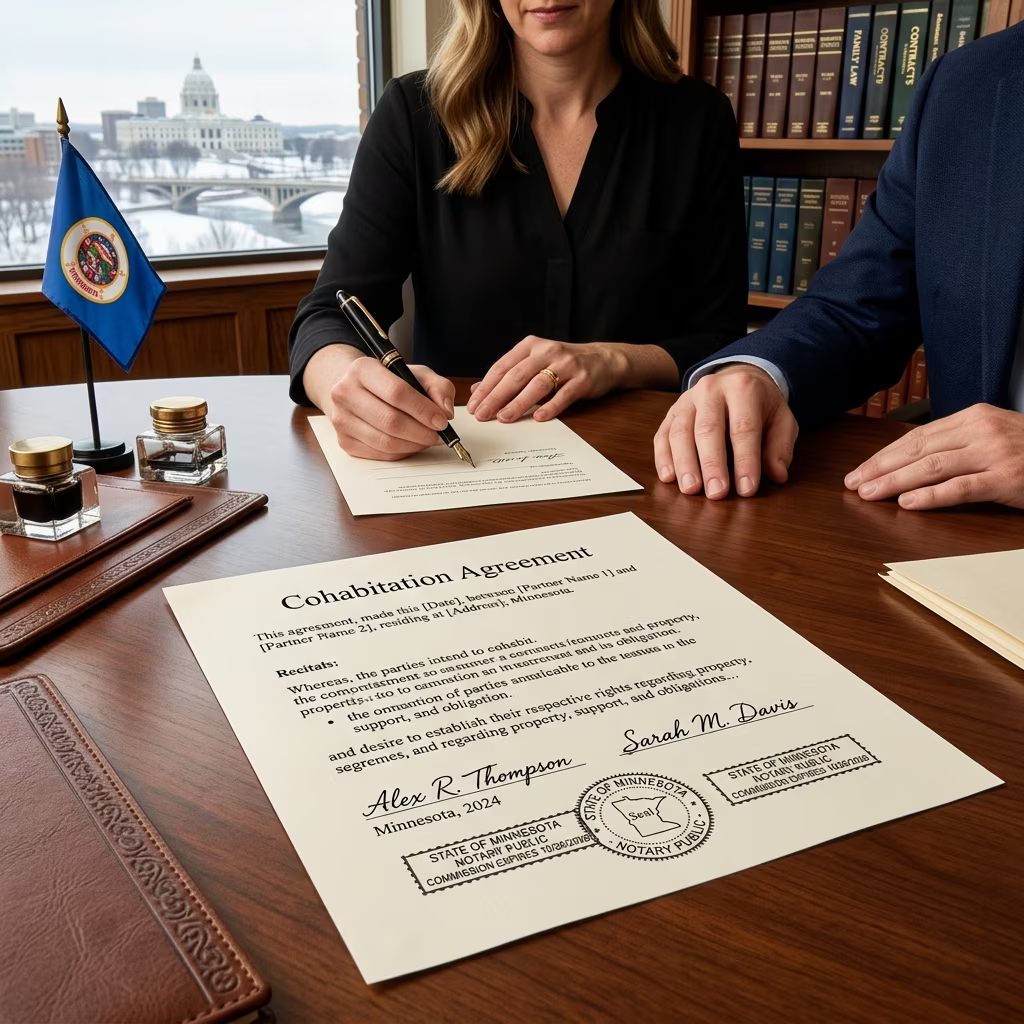
Unmarried couples in Minnesota often share homes, finances, and even raise children together. Yet, when these relationships end, the legal protections are very different from those available to married spouses. Minnesota has specific rules that sharply limit claims sometimes called palimony—financial support similar to alimony but for unmarried partners—and strictly regulate how cohabitation agreements are enforced.
This article explains how Minnesota law treats palimony, why written cohabitation agreements are crucial, and what steps unmarried partners can take to protect their financial and property interests.
Palimony vs. Alimony: Key Differences in Minnesota
Alimony, known in Minnesota as spousal maintenance, is financial support one spouse may be ordered to pay the other after divorce. Palimony, by contrast, is not a formal legal term but a popular way of describing financial support claims between unmarried partners.
| Feature | Alimony (Spousal Maintenance) | Palimony (Unmarried Partners) |
|---|---|---|
| Relationship status | Requires a valid marriage and usually a divorce or legal separation. | Applies to romantic, cohabiting partners who were never married. |
| Legal basis | Statutory right governed by Minnesota maintenance laws. | Based on contract law, not family law—must rely on an enforceable written agreement. |
| Court authority | Courts have broad authority to award, modify, and enforce maintenance orders. | Courts have no jurisdiction to consider palimony claims without a qualifying written contract. |
| Common law marriage | Not recognized in Minnesota, so cohabitation alone does not create spousal rights. | Cohabitation without a valid contract gives no right to another partner’s income or property based solely on the relationship. |
The bottom line: Minnesota does not recognize “pure” palimony claims based only on the fact that two adults lived together in a romantic relationship. Any support or property claims between unmarried partners must rest on a written, enforceable contract.
Minnesota’s Anti-Palimony Statutes
In response to litigation in other states where courts allowed broad palimony and property claims for unmarried partners, Minnesota enacted what are commonly called the anti-palimony statutes, found in Minnesota Statutes sections 513.075 and 513.076.
These statutes do not ban financial arrangements between unmarried partners. Instead, they impose strict requirements on when such agreements are legally enforceable.
Core Requirements Under Minnesota Law
When two adults live together, or intend to live together, in a romantic relationship where sexual relations are contemplated, Minnesota law allows contracts concerning their property and financial relations only if specific conditions are satisfied.
- Written contract required: Any agreement about property or financial support must be in writing. Oral promises or implied understandings are not enforceable.
- Signed by both parties: The written agreement must be signed by each partner. Without signatures, the courts lack jurisdiction to enforce the contract.
- Enforcement after relationship ends: The statute requires that enforcement be sought after the cohabiting relationship has terminated. Claims during an ongoing relationship may not fall within the statute’s framework.
- Relationship-based claims barred without a contract: If there is no qualifying written agreement, courts must dismiss any claim for earnings or property that is based on the fact that the parties lived together in contemplation of sexual relations and out of wedlock.
These rules reflect Minnesota’s broader policy: cohabitation alone does not create spousal-like rights, because Minnesota does not recognize common law marriage.
Cohabitation Agreements: Why They Matter
A cohabitation agreement (sometimes called a “nonmarital contract” or “living together agreement”) is the primary tool available to unmarried partners in Minnesota who wish to set clear rules about property ownership, financial responsibilities, and support if the relationship ends.
Typical Subjects Covered in Cohabitation Agreements
Although each agreement should be tailored to the couple’s situation, many cover similar issues:
- Ownership shares in a home or other real estate purchased together.
- Responsibility for mortgage payments, rent, utilities, and major repairs.
- How vehicles, bank accounts, investments, and personal property will be divided if the relationship ends.
- Allocation of debts, such as credit cards, student loans, or personal loans taken during the relationship.
- Possible ongoing financial support if one partner is economically dependent on the other.
- Procedures for resolving disputes, such as mediation, before filing a lawsuit.
By documenting these arrangements in a written, signed contract, unmarried partners create enforceable rights that the courts can recognize even though they are not married.
Limits on Oral and Implied Agreements
In other areas of contract law, courts sometimes enforce oral agreements or implied contracts based on the parties’ conduct. For unmarried cohabitants in Minnesota, that approach is largely unavailable when claims are based on the relationship itself.
- Oral promises are not enough: Statements such as “I’ll always take care of you” or “What’s mine is yours” will generally not create legally enforceable palimony or property claims.
- Equitable remedies restricted: Courts are barred from using equitable theories (like unjust enrichment or constructive trust) if the claim rests on the fact that the parties lived together in contemplation of sexual relations and out of wedlock, and there is no qualifying written contract.
- Title usually controls: In the absence of a contract, property such as real estate is presumed to belong to the person whose name appears on the title or deed.
These restrictions underscore the importance of documenting expectations in writing before or during cohabitation.
Property and Debt When Unmarried Couples Separate
When married couples divorce, Minnesota’s marital property statutes govern how assets and debts are divided, and courts have broad power to make equitable distributions. For unmarried couples, those rules do not apply; instead, property and debt are resolved through title, contract, and general civil law.
How Property Is Usually Divided
If unmarried partners do not have a cohabitation agreement, courts look primarily to ownership documents:
- Real estate: The person listed on the deed or title is generally considered the owner. If both names appear, each usually owns the share reflected in the title.
- Vehicles: Ownership follows the name on the title.
- Bank accounts: Each partner keeps accounts held in their own name; joint accounts are typically divided proportionally or according to documented contributions.
- Personal property: Items bought by each person are usually treated as that person’s property unless otherwise agreed.
Without a written agreement, one partner cannot claim a share of the other’s property simply because they lived together in a romantic relationship.
Responsibility for Debts
Debt issues can be particularly complicated:
- Jointly signed debts: If both partners sign a loan or credit agreement, both may be legally responsible for repayment, regardless of who used the funds.
- Individual debts: Debts incurred in one partner’s name alone typically remain that partner’s responsibility.
- Informal arrangements: Agreements where one partner “promises” to pay the other’s debt are hard to enforce without a clear written contract.
Because financial disputes can be costly and stressful, many legal aid organizations and family law attorneys recommend that unmarried partners address property and debt in a cohabitation agreement before problems arise.
Financial Support for Unmarried Partners
Unlike married spouses, unmarried partners have no automatic statutory right to ongoing financial support after a breakup. Any claim resembling palimony requires a written agreement that clearly sets out the terms.
When Support May Be Enforceable
Support provisions in a cohabitation agreement are more likely to be enforced when:
- The agreement is written, dated, and signed by both parties.
- The terms are reasonably clear—for example, specifying the amount, duration, and conditions under which support is paid.
- The agreement was entered voluntarily, ideally with each party having the opportunity to seek independent legal advice.
- The contract does not violate public policy or attempt to circumvent statutory rules governing child support or spousal maintenance.
Even with a written contract, courts will evaluate the agreement under general contract principles and may refuse to enforce terms that are unconscionable or contrary to law.
Children and Support
Having children together does not convert an unmarried relationship into a marriage or create new rights to property or palimony. However, Minnesota law provides separate mechanisms for child support, custody, and parenting time that apply regardless of marital status.
Parents who are not married may still pursue child support through the appropriate family court processes, but those rights exist independently of any cohabitation or palimony claims.
Practical Steps for Unmarried Couples in Minnesota
Given the restrictions in Minnesota’s anti-palimony statutes, unmarried partners who share finances or property should take proactive measures to protect themselves.
Key Actions to Consider
- Discuss expectations early: Before moving in together or purchasing significant assets, talk openly about who owns what, how expenses will be shared, and what should happen if you separate.
- Create a written cohabitation agreement: Work with an attorney familiar with Minnesota law to draft a contract that addresses property, debts, and potential support. Ensure it is signed by both partners and kept in a safe place.
- Align titles with reality: Make sure property titles and account ownership reflect your actual intentions (for example, joint ownership if both partners are truly co-owners).
- Review agreements periodically: Update your contract if your circumstances change—such as buying a home, starting a business, or one partner leaving the workforce.
- Seek legal advice before separation: If the relationship is ending, consult a lawyer to understand how your agreement, or lack of one, affects property division and potential claims.
These steps cannot guarantee a conflict-free breakup, but they significantly reduce uncertainty and help ensure that each partner’s rights are clearly defined.
Frequently Asked Questions About Minnesota Palimony
1. Does Minnesota recognize palimony like some other states?
Not in the broad sense. Minnesota does not allow claims to another person’s earnings or property based solely on the fact that the parties lived together in a romantic, cohabiting relationship. Any palimony-like claim must be based on a qualifying written contract.
2. Is there common law marriage in Minnesota?
No. Minnesota does not recognize common law marriage. A valid marriage requires a license, solemnization, and proper filing of a marriage certificate; without these steps, cohabiting partners are not treated as spouses for property and support purposes.
3. If we lived together for many years, do I automatically get half of everything?
No. Length of cohabitation alone does not create ownership rights or automatic entitlement to a share of your partner’s property. Courts look to titles, written agreements, and general contract law to determine who owns what.
4. Can an oral promise to support me be enforced?
Generally not in the context of palimony. Minnesota’s anti-palimony statutes require that agreements concerning property and financial support in romantic cohabiting relationships be in writing and signed by both parties to be enforceable.
5. Do I need a lawyer to create a cohabitation agreement?
While not legally required, it is strongly advisable. A lawyer familiar with Minnesota family and contract law can ensure your agreement meets statutory requirements, reflects your intentions, and avoids enforceability problems.
6. What if we have children but are not married?
Having children does not create palimony or marital property rights between the adults. However, child support, custody, and parenting time can be addressed through separate legal processes, and parents may still benefit from a cohabitation agreement to manage property and financial responsibilities.
References
- Palimony in Minnesota — Beyer & Simonson, P.A. 2017-04-10. https://beyersimonson.com/palimony-in-minnesota
- Cohabitation – Do I have an Interest in Property & Can I get Support? — Messerli & Kramer P.A. 2015-06-01. http://www.minnesotalawyers.com/blogs/cohabitation—do-i-have-an-interest-in-property—can-i-get-support-
- Minnesota’s Cohabitation Statute — Law & Inequality Journal, University of Minnesota Law School. 1991-01-01. https://scholarship.law.umn.edu/cgi/viewcontent.cgi?article=1287&context=lawineq
- Living With Your Significant Other? Think About a Cohabitation Agreement. — Gislason & Hunter LLP. 2020-09-15. https://www.gislason.com/living-significant-think-cohabitation-agreement/
- Unmarried Couples, Debt, and Property — LawHelp Minnesota. 2023-03-01. https://www.lawhelpmn.org/self-help-library/fact-sheet/unmarried-couples-debt-and-property