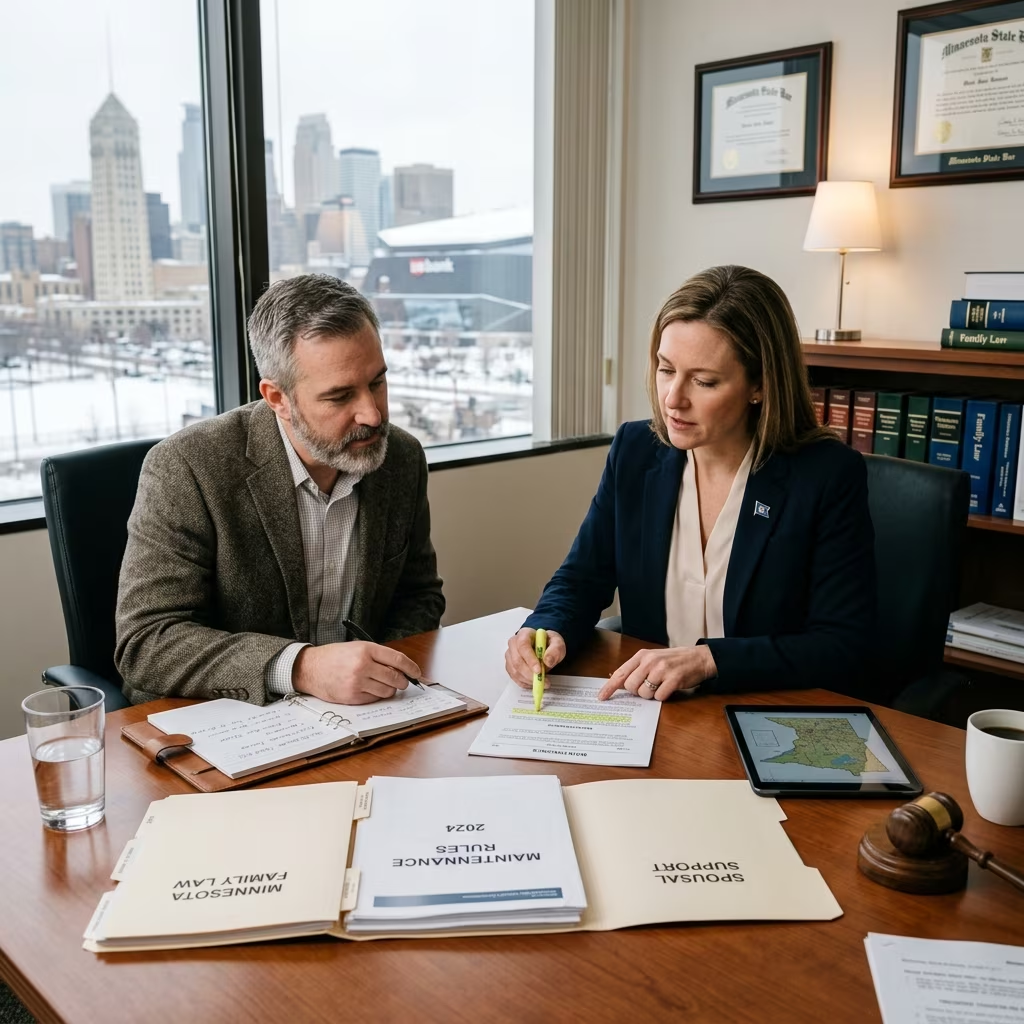
Minnesota uses the term spousal maintenance instead of alimony, but the concept is the same: ongoing financial support that one ex-spouse may be ordered to pay to the other after separation or divorce. It is not automatic; a judge must decide there is a real financial need and an ability to pay before making an order.
This guide explains how alimony works in Minnesota today—who can receive it, how judges decide the amount and length of payments, how recent law changes affect long and short marriages, and what options exist for unmarried couples who separate.
1. What Alimony Means in Minnesota
Under Minnesota law, alimony is called maintenance and can be ordered in a divorce, legal separation, or in some situations after a divorce when the court later gains authority over the other spouse. Either spouse can ask for maintenance; it does not matter who filed for divorce first or who is at fault for the marriage ending.
Spousal maintenance is designed to address two linked questions:
- Does one spouse need financial support to meet their reasonable living expenses after the divorce?
- Does the other spouse have the ability to pay while still meeting their own reasonable needs?
Judges look at both sides together. A spouse might have a real need, but if the other has very limited income or heavy obligations, maintenance could be reduced or denied.
2. When a Minnesota Court Can Award Maintenance
The starting point is Minnesota Statutes section 518.552, which sets out specific conditions for maintenance. A judge may award maintenance if the spouse requesting it meets at least one of these thresholds:
- The spouse lacks sufficient property to provide for their reasonable needs, considering the standard of living during the marriage; or
- The spouse is unable to support themself through appropriate employment in a way that meets those reasonable needs; or
- The spouse has custody of a child whose needs or circumstances make it appropriate for the spouse not to work outside the home or not to work full time.
These rules recognize that divorce often affects one spouse more heavily, particularly if that spouse spent years caring for children, supporting the other spouse’s career, or earning less income while the other built a higher-paying profession.
2.1. “Reasonable needs” and standard of living
“Reasonable needs” does not mean luxury spending, but it also does not automatically mean bare-bones survival. Judges consider the standard of living during the marriage, including housing, transportation, and typical household expenses. Recent changes to Minnesota law instruct courts to look at whether that lifestyle was supported by debt—for example, regular use of loans or credit cards—so that unrealistic lifestyles are not simply replicated after divorce.
3. Types of Spousal Maintenance in Minnesota
Minnesota case law and commentary commonly describe three broad types of maintenance: temporary, transitional (short-term), and indefinite (longer-term).
| Type of maintenance | Typical purpose | Common situations |
|---|---|---|
| Temporary | Support during the divorce process itself. | Helps a lower-earning spouse pay bills while the case is pending. |
| Transitional (short-term) | Support for a limited time after divorce. | Used when a spouse is expected to become self-supporting after training or job adjustment. |
| Indefinite | Ongoing support with no end date set in advance. | More common in longer marriages where a spouse has limited earning prospects. |
Terminology in the statutes has recently been updated, and some practitioners now refer to “indefinite” and “transitional” maintenance more explicitly in line with the 2024 law changes.
4. How Judges Decide the Amount and Duration
Minnesota does not use a fixed alimony calculator or formula. Instead, judges apply a list of factors in the statute and balance them based on the evidence presented in each case.
4.1 Key factors courts must consider
Under section 518.552, courts weigh multiple considerations when deciding whether to award maintenance, and if so, how much and for how long. Important factors include:
- Financial resources of the spouse asking for support, including marital property they receive in the divorce and their ability to meet their own needs through work.
- Time needed for education or training so that the spouse can find appropriate work and become fully or partly self-supporting.
- The standard of living during the marriage, including whether it was financed by debt.
- The length of the marriage and the extent to which the requesting spouse’s earning capacity was affected by time spent at home or by unemployment or underemployment.
- Age and health (physical, emotional, and in updated guidance, mental and chemical health) of each spouse.
- The ability of the paying spouse to meet their own needs while paying maintenance.
- The contributions of each spouse to the marriage, including non-financial contributions such as child care or supporting the other spouse’s career or education.
No single factor is decisive. A judge must weigh them together to reach an order that is as fair as possible under the circumstances.
4.2 New presumptions about duration based on years of marriage
Recent legislative changes created rebuttable presumptions about how long maintenance should last, depending on the length of the marriage. A presumption is a default rule that can be changed if the evidence strongly supports a different outcome.
| Length of marriage | Default presumption for maintenance duration |
|---|---|
| Less than 5 years | Presumption of no maintenance, unless unusual circumstances justify it. |
| 5 to 20 years | Presumption of transitional maintenance lasting no more than about one-half the length of the marriage, if the factors support an award. |
| More than 20 years | Presumption of indefinite maintenance, if the other statutory factors also support maintenance. |
For example, if a couple was married for 12 years, the law now presumes that, if maintenance is appropriate, it will last no longer than about six years—unless the facts show that a shorter or longer duration is necessary.
5. How Alimony Is Calculated in Practice
Because there is no mandatory formula, each judge may approach calculations slightly differently. In general, courts follow a two-step analysis similar to the approach described by Minnesota family law practitioners:
- Determine the reasonable monthly budget of each spouse after the divorce, including housing, food, insurance, transportation, debts, and other regular expenses.
- Compare the spouse’s net income (after taxes and withholdings) to those needs to see which spouse has a shortfall and which has a surplus.
Maintenance is then set to try to balance:
- the amount needed by the lower-earning spouse to meet reasonable expenses, and
- the amount the higher-earning spouse can realistically pay without being unable to meet their own reasonable needs.
Judges can adjust the figure based on the statutory factors, such as the likelihood of future raises, health conditions that may limit work, and whether the paying spouse is already supporting children or others.
6. How Long Alimony Lasts and When It Ends
Spousal maintenance in Minnesota can be ordered for a set period or on an indefinite basis. The presumptions described earlier guide the decision but do not absolutely control it.
6.1 Automatic termination
Unless the divorce decree or a written agreement clearly says otherwise, Minnesota law provides that maintenance automatically ends when:
- either spouse dies, or
- the spouse receiving maintenance remarries.
Parties can negotiate different terms in a written agreement if they choose, and the court may incorporate those terms into the final judgment.
6.2 Changing or ending existing orders
Maintenance is not necessarily fixed forever. A court may modify a maintenance order if a spouse proves that one or more significant changes have made the existing order unreasonable and unfair. Common examples include:
- meaningful changes in either spouse’s income (up or down),
- serious health problems, disability, or other major life changes affecting ability to work,
- retirement, especially at a customary retirement age, and
- large unexpected expenses.
To request a change, a spouse typically files a motion with the court that issued the original order and must present financial information and other evidence to support the request.
7. Tax Treatment of Alimony in Minnesota
Federal tax law changes that took effect for divorces finalized after January 1, 2019 made an important shift in how alimony is taxed nationwide. For most recent Minnesota divorces:
- The paying spouse can no longer deduct maintenance payments from income for federal tax purposes.
- The receiving spouse generally does not report maintenance as taxable income for federal taxes.
These rules apply under the federal Tax Cuts and Jobs Act and affect Minnesota residents because federal tax law is used in calculating net income. Older divorce decrees finalized before the change may be governed by different rules, so it is important to confirm which tax regime applies to a given order.
8. Unmarried Couples and “Palimony”-Style Claims
Unlike some states, Minnesota does not treat unmarried partners the same as spouses for purposes of ongoing support. However, there is limited room for financial claims when an unmarried couple separates, if they made a valid written agreement.
8.1 Cohabitation agreements
For unmarried partners, Minnesota allows courts to enforce certain cohabitation contracts about financial matters, but only under strict conditions. To pursue a claim sometimes compared with “palimony,” a person typically must show that:
- There was a written contract addressing financial rights or obligations between the partners.
- The contract was signed by both parties before or while they were living together.
- The claim is brought after the relationship ends, not while they are still together.
If these requirements are not met, Minnesota courts generally lack authority to decide financial disputes between unmarried partners based on their intimate relationship alone, and will dismiss such cases.
8.2 How palimony differs from alimony
Traditional alimony is based on the marriage relationship and statutory factors. These cohabitation-based claims are instead grounded in contract law, focusing on what the parties agreed to in writing, rather than on the fairness standards used in divorce cases.
9. Practical Tips for Spouses Facing Alimony Questions
Whether you are potentially paying or receiving maintenance, preparation is key. Considering the statutory factors and recent changes, some practical steps include:
- Gather detailed financial records: pay stubs, tax returns, bank statements, retirement account information, monthly bills, and debt statements.
- Prepare a realistic budget: list your post-divorce expected housing, insurance, transportation, food, childcare, and debt payments.
- Evaluate earning capacity: consider whether more training, education, or a job change would be realistic and how long it might take.
- Document contributions: keep a record of time spent in child care, managing the home, and supporting the other spouse’s career, as these can be significant in maintenance decisions.
- Understand the new duration presumptions: know how the length of your marriage may influence default expectations for how long maintenance will last.
Because the law is complex and fact-specific, many people choose to consult a family law attorney to get advice tailored to their particular situation.
10. Frequently Asked Questions About Minnesota Alimony
10.1 Is alimony guaranteed in every Minnesota divorce?
No. Minnesota law does not guarantee alimony in any case. The court first decides whether the requesting spouse meets the statutory criteria and then applies the factors described above to determine whether maintenance is appropriate and, if so, the amount and duration.
10.2 Does fault, like adultery, affect alimony?
Minnesota is a no-fault divorce state, so maintenance decisions are based on financial need, ability to pay, and the statutory factors—not on who caused the marriage to break down. The focus is on economic fairness rather than blame.
10.3 Can we agree on maintenance without a judge deciding?
Yes. Spouses can negotiate maintenance as part of a broader divorce settlement, often with the help of lawyers or mediators. If both sides agree and the court finds the agreement fair and consistent with the law, the judge can incorporate those terms into the final divorce decree.
10.4 What if my ex-spouse stops paying court-ordered maintenance?
If a spouse fails to follow a maintenance order, the other spouse can seek enforcement through the court. Tools may include income withholding, contempt proceedings, or other enforcement remedies under Minnesota law. Specific options depend on the facts and the terms of the decree.
10.5 Can alimony be changed after I retire?
Retirement can be a basis to ask the court to review and possibly modify maintenance, especially when retirement is at a typical retirement age and significantly reduces income. The judge will weigh whether the change makes the existing order unreasonable and unfair and may adjust the amount or duration accordingly.
10.6 Does living with a new partner end alimony automatically?
Under Minnesota law, the automatic termination events listed in the statute are death of either spouse and the receiving spouse’s remarriage, unless the decree or a written agreement provides otherwise. Cohabitation with a new partner does not automatically end maintenance, but it can be raised as a factor in a motion to modify support if it significantly changes the receiving spouse’s financial needs.
References
- Minn. Stat. § 518.552 – Maintenance — Minnesota Office of the Revisor of Statutes. 2024. https://www.revisor.mn.gov/statutes/cite/518.552
- Minnesota Alimony Laws — FindLaw. 2023. https://www.findlaw.com/state/minnesota-law/minnesota-alimony-laws-1.html
- Significant Changes to Minnesota’s Spousal Maintenance Statute — Lommen Abdo. 2024-08-01. https://lommen.com/significant-changes-to-minnesotas-spousal-maintenance-statute/
- Understanding and Calculating Alimony in Minnesota — DivorceNet (Nolo). 2023. https://www.divorcenet.com/resources/divorce/spousal-support/understanding-and-calculating-alimony-mi
- Divorce: Getting Alimony – Minnesota — WomensLaw.org. 2024. https://www.womenslaw.org/laws/mn/divorce/getting-alimony
- 2024 Changes to Minnesota Spousal Maintenance Laws — Mundahl Law. 2024. https://www.mundahllaw.com/2024-changes-to-minnesota-spousal-maintenance-laws/
- How Is Alimony Calculated in Minnesota? — Alithis Family Law. 2023. https://alithisfamilylaw.com/how-is-alimony-calculated-in-minnesota/