
Essential Military Leave Rules for Employers
Navigate federal and state military leave requirements to protect your business and support service members effectively.
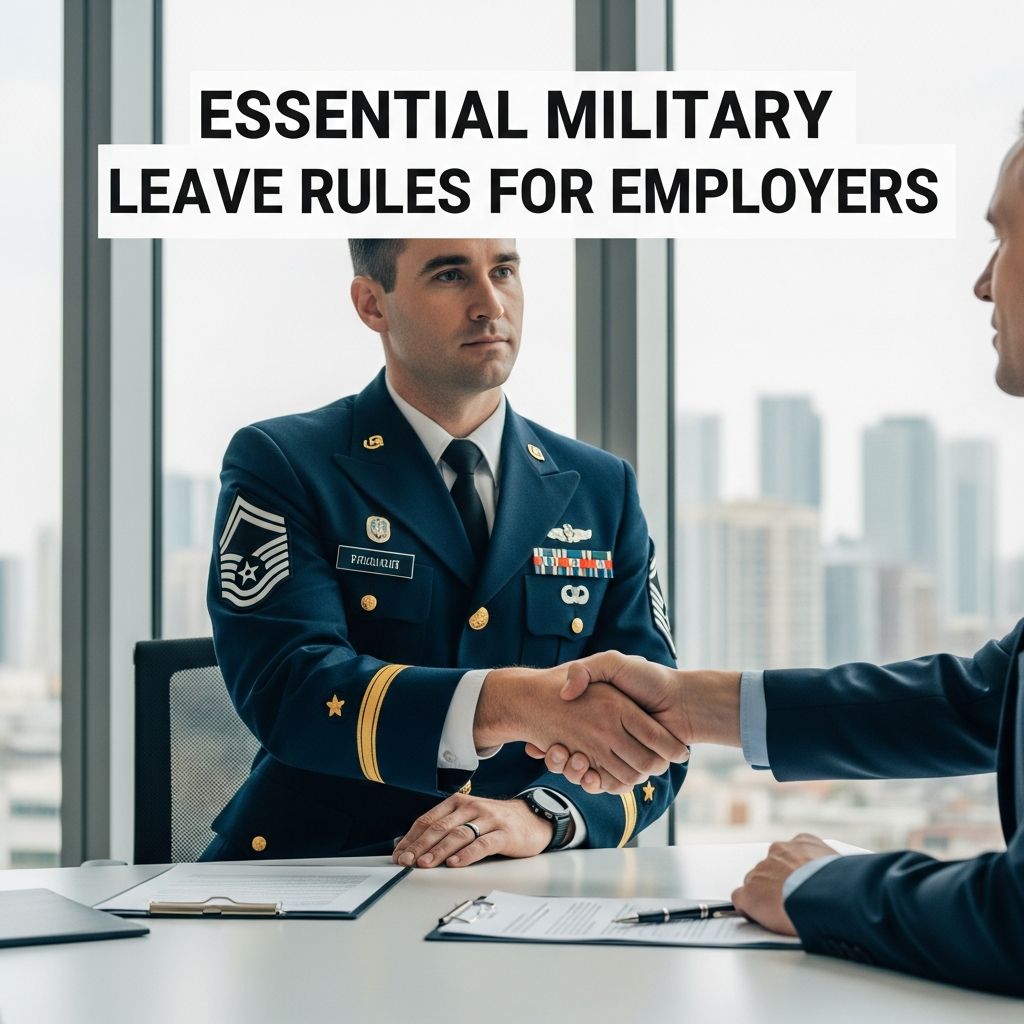
Military leave laws safeguard employees serving in the armed forces, reserves, or National Guard, requiring employers to grant unpaid time off and facilitate reemployment. These regulations, primarily governed by the Uniformed Services Employment and Reemployment Rights Act (USERRA), apply to all employers regardless of size, ensuring job protection and non-discrimination.
Understanding USERRA: The Cornerstone of Military Leave Protections
The
Uniformed Services Employment and Reemployment Rights Act (USERRA)
is the primary federal statute protecting civilian job rights for military service members. Enacted in 1994 and administered by the U.S. Department of Labor’s Veterans’ Employment and Training Service (VETS), USERRA mandates that employers provide leave for uniformed service and reemploy eligible individuals upon return.Key principles include prohibiting discrimination based on military affiliation and guaranteeing reemployment in a position of comparable seniority, status, and pay. This ‘escalator principle’ ensures returning employees are placed as if they had continued working, accounting for promotions or changes during absence.
- Scope: Covers active duty, reserve training, National Guard duty, and even voluntary service.
- Duration Limit: Up to five years of cumulative service per employer, with exceptions for involuntary duty or training requirements.
- Private vs. Public Employers: Applies universally; private employers are not required to pay during leave but must hold positions open.
Employers must post notices of USERRA rights, as required by the Veterans Benefits Improvement Act of 2004, typically in break rooms or where other labor posters are displayed.
Who Qualifies for Military Leave and What Notice is Required?
Eligibility extends to any non-temporary employee called to uniformed service, including probationary workers. Temporary or seasonal employees may not qualify if their role ends naturally.
Employees must provide
advance notice
of military service, either verbally or in writing, unless prevented by military necessity. The notice can come from the employee or a military authority. Upon return, timely reporting is essential: within days for short service (30 days or less), weeks for 31-180 days, or 90 days for longer absences.| Service Length | Reporting Deadline |
|---|---|
| 30 days or less | Next workday or drill weekend |
| 31-180 days | 14 days after release |
| Over 180 days | 90 days after release |
Reemployment requires honorable discharge (or equivalent), fitness for duty, and no excessive absences. Employers cannot deny benefits accrued during leave or penalize for service-related gaps.
Reemployment Rights and the Escalator Principle
Reemployment is not automatic but presumed unless the employer proves undue hardship, such as business closure or the employee’s inability to qualify. The escalator principle positions the veteran at the career point they would have reached absent service, potentially including promotions.
For example, if a promotion occurred during leave and the employee met criteria, they receive it upon return. Seniority for benefits like vacation continues accruing. Employers must restore health benefits without re-qualifying periods; employees cover only standard premiums during leave.
- Protected Positions: Same or equivalent job with equivalent pay, benefits, and status.
- Post-Service Protections: No termination without cause for 180 days (service 30-180 days) or one year (over 180 days).
Compensation During Military Leave: What Employers Must and May Do
Private employers are
not required to pay
during military leave, distinguishing it from public sector mandates. However, many voluntarily offer differential pay—bridging the gap between military and civilian salaries—to retain talent.Military leave cannot be charged against vacation or PTO without employee consent; it stands alone. Reservists on weekend drills receive unpaid time off, with protections against discipline. Public employees accrue paid leave: up to 160 hours annually under 5 U.S.C. §6323(a), plus 176 hours for emergencies.
Military Family Leave Under FMLA Expansions
Amendments to the
Family and Medical Leave Act (FMLA)
provide additional protections for families of service members. Eligible employers (50+ employees) must grant:- 26 weeks unpaid leave for spouses, parents, or children to care for servicemembers with serious injuries from post-9/11 active duty.
- 12 weeks for ‘qualifying exigencies’ like deployment briefings, childcare, or financial arrangements.
Eligibility mirrors standard FMLA: 12 months employment, 1,250 hours worked. California extends similar rights, including 10 days unpaid for spouses of deployed personnel.
State-Specific Military Leave Requirements
While USERRA sets the federal floor, states often enhance protections. For instance:
- California: Broader USERRA application plus state code protections; all employers covered.
- Wyoming: Five years unpaid leave with accruing seniority; one-year no-termination post-return.
- Others: Vary from paid leave for short drills to extended family provisions. Employers must check state laws via resources like DOL maps.
Compliance tip: Multi-state employers harmonize policies to exceed the strictest requirements.
Prohibited Actions: Discrimination and Retaliation
USERRA bans adverse actions motivated by military service, including denial of promotions, training, or benefits. Employers cannot:
- Refuse hire or fire based on service obligations.
- Treat military leave differently from other leaves.
- Require premium payments beyond standard shares during leave.
Retaliation against USERRA complaints is also prohibited. Violations trigger DOL investigations, potential lawsuits, and liquidated damages.
Developing an Effective Military Leave Policy
A clear policy fosters compliance and loyalty. Essential elements include:
- Notice procedures for leave requests.
- Reemployment application process.
- Benefit continuation details.
- Non-discrimination statement.
- Contact for HR support.
Distribute via handbooks and train managers. Voluntary programs like differential pay enhance recruitment of veterans.
Frequently Asked Questions (FAQs)
Does USERRA apply to small businesses with fewer than 15 employees?
Yes, USERRA covers all employers, public and private, regardless of size.
Can I require proof of military orders for leave?
Yes, but advance notice suffices initially; orders verify upon request if needed.
What if my business changes significantly during the employee’s service?
Reemployment may be denied only if it causes undue hardship, proven by the employer.
Are weekend National Guard drills protected?
Absolutely; employers must allow unpaid time off without reprisal.
How do I handle health insurance during extended leave?
Continue coverage; employee pays normal share, up to 102% for over 30 days.
Best Practices for Compliance and Support
Proactive steps include partnering with Employer Support of the Guard and Reserve (ESGR) for mediation and training. Track service members’ absences, communicate regularly, and celebrate returns to build morale. These efforts mitigate risks and tap into the skilled veteran workforce.
In summary, mastering military leave laws protects your business from liability while honoring those who serve. Consult legal experts for tailored advice amid evolving regulations.
References
- Military Leave Laws for Employees — Wolters Kluwer. 2023. https://www.wolterskluwer.com/en/expert-insights/military-leave-laws-for-employees
- Military Leave Laws By State And USERRA — Paycor. 2024. https://www.paycor.com/resource-center/articles/military-leave-laws-by-state/
- Military Leave Guide — Riverside County HR. 2022-04-04. https://rc-hr.com/files/migrated/Portals/2/Military%20Leave%20Guide%204-4-22.pdf
- 2.1.18 Military Leave — Stanford Administrative Guide. 2024. https://adminguide.stanford.edu/chapters/human-resources/staff-employment-policies/military-leave
- Military Leave — U.S. Office of Personnel Management. 2024. https://www.opm.gov/policy-data-oversight/pay-leave/pay-administration/fact-sheets/military-leave/
- Employers Obligations To Employees Who Are Called Up For Military Service — CDF Labor Law. 2023. https://www.cdflaborlaw.com/blog/employers-obligations-to-employees-who-are-called-up-for-military-service
- USERRA Pocket Guide — U.S. Department of Labor. 2024. https://www.dol.gov/agencies/vets/programs/userra/USERRA-Pocket-Guide
Similar Articles








Read full bio of medha deb


