
Military Child Support: How Courts Calculate It
Learn how military pay, allowances, and custody arrangements affect child support calculations.
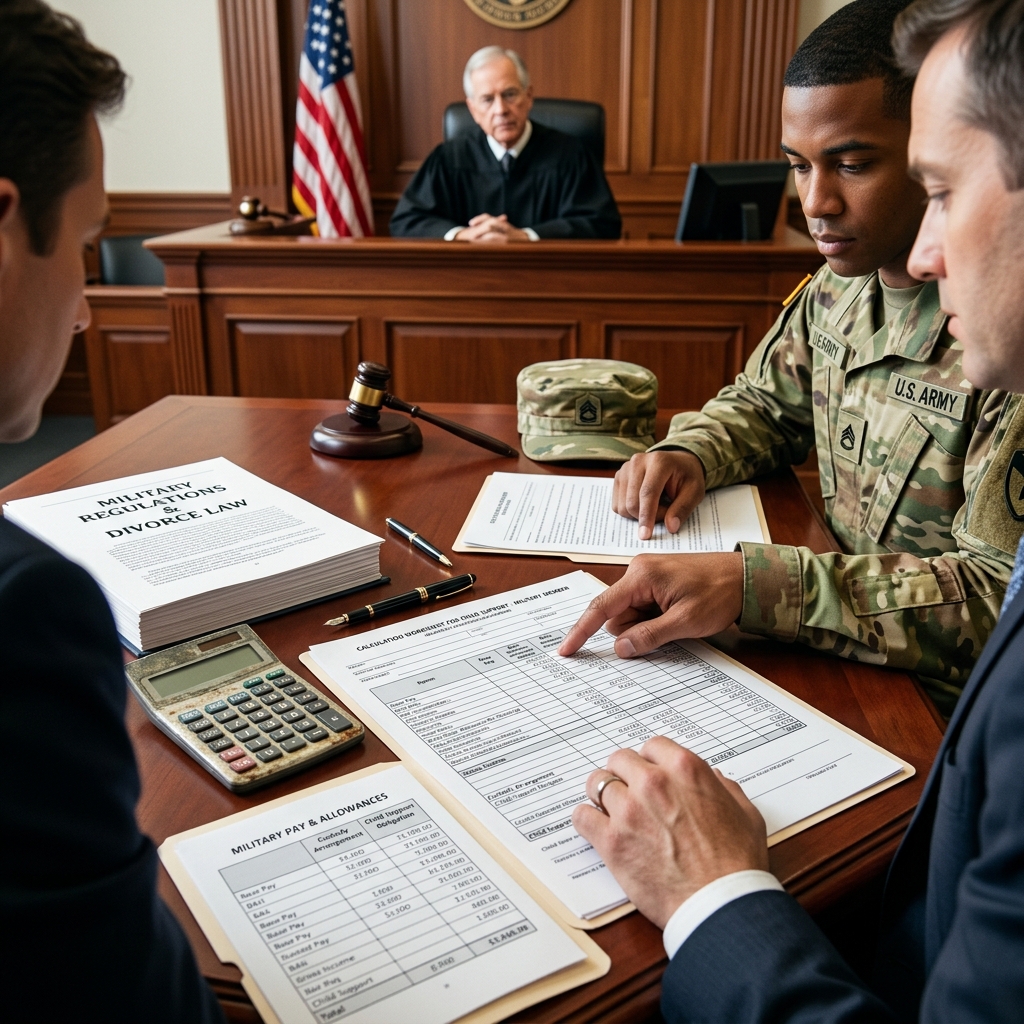
How child support is determined when the paying parent serves in the military
Military families often face child support questions that do not arise in civilian cases. The core rule is simple: the court applies the state’s child support guidelines, but the service member’s pay structure can make the income analysis more complicated. That means base pay is only the starting point. Courts may also look at allowances, special pay, and certain forms of in-kind compensation when deciding what support should be paid.
If the parents have not yet reached a final support order, there may also be a temporary or interim support arrangement. In that situation, military branch guidance and local child support agencies can help estimate a reasonable amount while the state court process moves forward.
Why military pay is different from civilian wages
A civilian paycheck usually shows gross wages, deductions, and perhaps bonuses. Military compensation is broader. A service member may receive taxable pay, tax-free allowances, and benefits that reduce living costs. Because these benefits affect real household resources, they may matter in a support calculation even when they do not appear as ordinary wages on a tax return.
One important consequence follows from that difference: a tax return alone is often not a reliable way to identify military income for child support purposes. The tax form may miss non-taxable components that still increase the service member’s actual ability to contribute to a child’s needs.
The income sources courts commonly review
Courts and child support agencies usually begin with the service member’s base pay, then add other recurring compensation. The exact treatment varies by state, but the following items are often considered when they are part of the service member’s regular compensation package:
- Base pay
- Basic Allowance for Housing, often called BAH
- Basic Allowance for Subsistence, often called BAS
- Special or hazardous duty pay
- Bonuses and reenlistment incentives
- Value of housing, meals, or other in-kind benefits in some cases
Some states also consider other non-wage benefits or reimbursements if they reduce ordinary living expenses. The key question is whether the payment or benefit increases the parent’s financial ability to support the child.
Why the Leave and Earnings Statement matters
The Leave and Earnings Statement, usually shortened to LES, is one of the most useful documents in a military support case. It is more detailed than a simple pay stub and often shows a full picture of the service member’s compensation. The LES may list base pay, housing and subsistence allowances, dependent information, leave balances, and other payroll details that help verify income.
Using the LES is often better than using a tax return because the LES captures benefits that are not always taxable but still matter to support calculations. If a parent is trying to estimate child support, the LES is usually the best starting point for the income side of the worksheet.
How state child support guidelines fit into the analysis
Even in military cases, state law controls the final child support amount. Most states use a guideline formula that looks at each parent’s income, the number of children, parenting time, health insurance costs, childcare expenses, and sometimes extraordinary medical expenses.
In many states, the process works roughly like this:
- Identify each parent’s income.
- Convert military pay and benefits into a monthly support figure.
- Add both parents’ incomes together.
- Apply the state formula or worksheet.
- Adjust for childcare, medical coverage, or shared parenting time.
The result is usually a presumptive support amount. A judge may depart from that amount if the facts justify a different result, but the guideline figure is the usual baseline.
Interim support before a court order is entered
Military families often need a temporary support plan before a judge issues a final order. If the parents cannot agree on an amount, the military itself may provide interim guidance. Each branch has its own family support rules, and those amounts are generally designed to be temporary rather than a substitute for state child support law.
Because these interim amounts are often lower than what a state guideline might require, they should be treated as a short-term measure. A parent seeking a stable order should still file in state court or work through the local child support enforcement agency.
Housing, subsistence, and other allowances
BAH and BAS are central to many military support disputes. They matter because they reduce the service member’s out-of-pocket cost of living. Courts frequently treat these allowances as part of income when calculating support, even though they may not be taxable.
That approach reflects a practical idea: support should be based on actual economic capacity, not just on taxable salary. If a service member’s housing is partially or fully covered, the family budget looks very different from the budget of a parent who must rent an apartment with after-tax wages alone.
| Component | Possible role in support calculation |
|---|---|
| Base pay | Usually counted as income |
| BAH | Often counted as income |
| BAS | Often counted as income |
| Special pay | May be counted if recurring |
| On-base housing value | May be considered as in-kind compensation |
This table is a general guide only. State law and the judge’s interpretation always control the final result.
In-kind benefits and noncash support
Military compensation can include more than cash. For example, a service member may receive housing, meals, or other practical benefits tied to service. In some jurisdictions, those benefits may be included in the income analysis because they reduce the amount of money the parent must spend to maintain a household.
This issue matters most when the service member receives on-base housing or comparable noncash support. Even if no money changes hands, the benefit still has economic value. Courts looking at fairness often consider whether leaving that benefit out would understate the service member’s real ability to contribute to the child’s needs.
Custody time, insurance, and childcare expenses
Child support is rarely based on income alone. State formulas usually account for the child’s living arrangements and certain added costs. Parenting time can change the final amount because a parent who has the child more often generally covers more day-to-day expenses.
Courts may also adjust support for items such as health insurance premiums, work-related childcare, and extraordinary medical expenses. If the service member pays for the child’s insurance or daycare, those payments may reduce the final support obligation or be built into the guideline worksheet.
In practice, the most accurate calculation often requires a complete financial picture, not just pay information. That is why service members are often asked to provide documentation for insurance, childcare, and any other recurring costs tied to the child’s care.
What happens if the service member is receiving disability benefits
Disability-related benefits can complicate support calculations. In many states, veterans’ disability compensation may still be counted as income for child support purposes, even though it is treated differently for tax purposes or other legal issues.
That does not mean every disability-related payment is treated the same way. Courts usually look closely at the type of benefit and the governing state law. A parent should not assume that because a payment is labeled a benefit, it is automatically excluded from support calculations.
Enforcing child support through military pay systems
Once a support order exists, payment can often be collected through income withholding. The Defense Finance and Accounting Service, commonly called DFAS, can process certain orders and voluntary allotments so that support is paid directly from military income.
For withholding to begin, the relevant order usually has to be sent to DFAS or the child support enforcement agency with the proper documentation. In other words, a court order is only the beginning; administrative steps are needed to make sure the payment method actually works.
What happens when back support builds up
If a service member falls behind, the unpaid balance is generally handled in state court or through the state’s enforcement agency. Back child support, often called arrears, can lead to collection efforts even after active service changes or the parent’s assignment changes.
Parents seeking arrears usually need documentation showing what was owed, what was paid, and how long the balance remained unpaid. The fact that a parent is in the military does not eliminate the underlying support obligation.
Practical steps for parents trying to estimate support
Parents who are trying to estimate a military child support amount should gather complete financial records before using a guideline worksheet. A careful estimate often depends on more than one month of pay, especially if the service member’s income changes because of deployments, special duty, or bonus payments.
- Collect the most recent LES statements.
- Identify recurring pay and allowances.
- Note health insurance and childcare expenses.
- Check the state’s child support worksheet.
- Confirm whether the case is temporary or final.
Some cases also benefit from advice from a military Legal Assistance Office or a state child support enforcement agency, especially when parents are trying to put a temporary agreement in place before the court enters an order.
Common mistakes that lead to inaccurate calculations
One of the biggest mistakes is using only taxable income and ignoring allowances. Another common error is relying on a single paycheck rather than a more complete annual picture. A third mistake is failing to include insurance or childcare payments, which can materially change the final support number.
Parents also sometimes overlook the effect of shared parenting time. Even where the military parent earns more, the guideline amount may be adjusted if the child spends substantial time with both parents.
Frequently asked questions
Does military status change the legal duty to pay child support? No. Military service changes the way income is measured, but it does not remove the duty to support a child.
Should I use a tax return to estimate military income? Usually no. A tax return may leave out non-taxable allowances that matter for support calculations.
Can housing benefits be included as income? Often yes. Courts frequently consider BAH and related housing benefits, and some may also consider the value of in-kind housing.
Can support be taken directly from military pay? Yes, in many cases income withholding can be used, and DFAS plays a role in processing certain orders.
What if the parents only need temporary support? Branch family support rules and local child support agencies can help establish interim support until a state court enters a final order.
Putting the calculation into context
Military child support cases are not about creating a special rule for service members. They are about applying ordinary child support law to a pay system that is more complex than a typical civilian paycheck. Once the service member’s true monthly resources are identified, the state’s child support formula can do most of the remaining work.
The most reliable approach is to gather the LES, include allowances and recurring benefits, account for healthcare and childcare costs, and then apply the state’s guideline worksheet. That method gives both parents a clearer picture of what support should look like under the law.
References
- Child Support When a Spouse is in the Military — Brinkley Law Firm. n.d.. https://www.brinkleylawfirmllc.com/can-you-get-child-support-from-a-spouse-in-the-military/
- Military Child Support Calculator: What Families Need to Know — Hobson & Hobson, P.C.. n.d.. https://thehobsonlawfirm.com/military-child-support-calculator/
- Calculating Child Support — Maryland People’s Law Library. n.d.. https://www.peoples-law.org/calculating-child-support
- Calculating Child Support When the Paying Parent Is in the Military — DivorceNet. n.d.. https://www.divorcenet.com/resources/divorce/military-divorce/calculating-child-support-when-paying-p
- Veterans and Child Support Issues — Texas Law Help. n.d.. https://texaslawhelp.org/article/veterans-and-child-support-issues
Similar Articles








Read full bio of Sneha Tete


