Middle Fingers and Free Speech: When Is It Legal?
Explore how U.S. free speech law treats the raised middle finger, especially when directed at police, officials, and other authority figures.
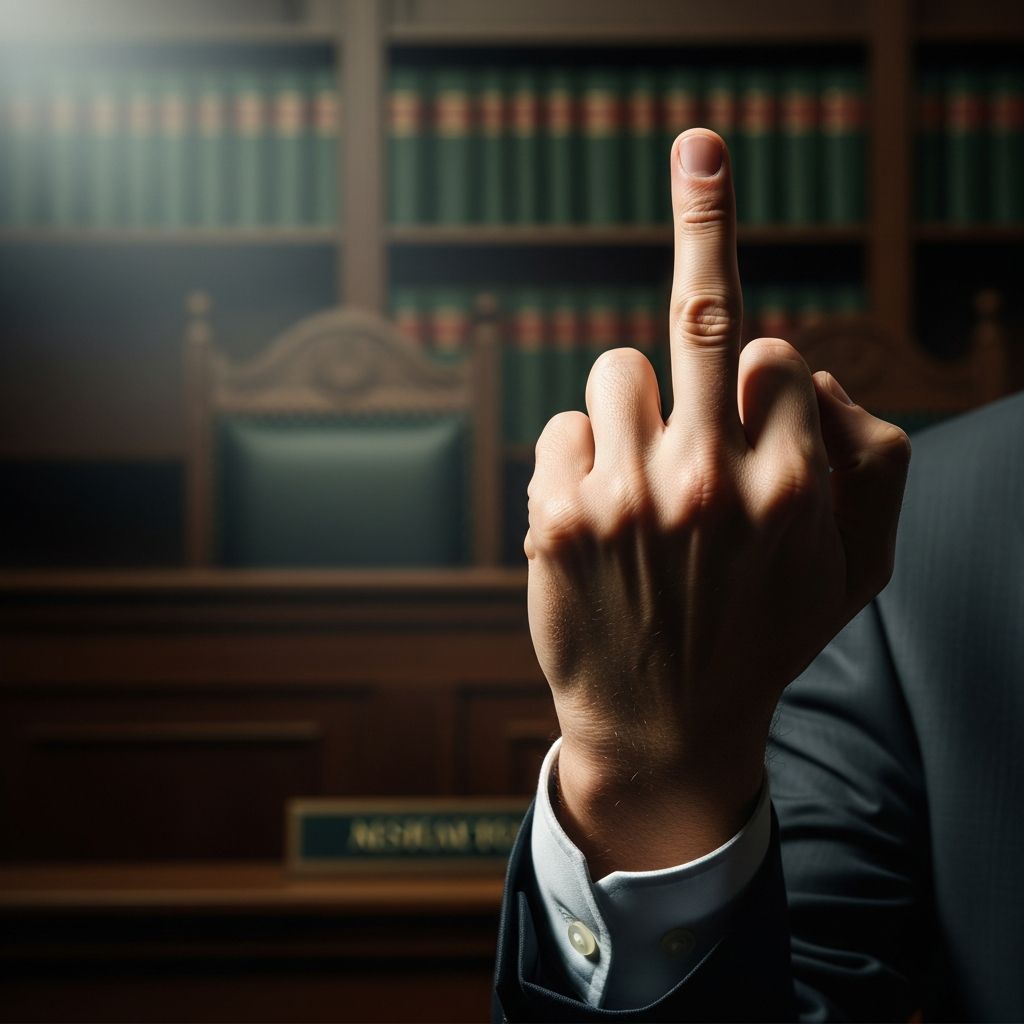
Middle Fingers and Free Speech: What the Law Really Says
In the United States, the raised middle finger is a familiar, rude gesture. But rudeness and illegality are not the same thing. Under the First Amendment, even crude or impolite expression can receive strong protection — including nonverbal gestures like flipping the bird.
This article explains, in practical terms, when giving the middle finger is treated as protected free speech and when it can still lead to legal trouble. It draws on real court decisions and free speech principles but is written for non-lawyers.
1. The Middle Finger as Free Speech
The First Amendment protects not just spoken and written words, but also many forms of symbolic expression — actions that are meant to communicate a message. Courts have long recognized that gestures, clothing, and other forms of conduct can count as speech when they are understood to express an idea.
In that framework, the middle finger usually functions as:
- A nonverbal way to express anger, disrespect, or criticism.
- A recognizable symbol that most observers understand without explanation.
- A form of expressive conduct analogous to shouting an insult.
Because of this, federal courts have held that raising a middle finger toward another person, including a police officer, is typically protected expression under the First Amendment.
2. Key First Amendment Principles That Apply
Several basic First Amendment rules shape how the law treats vulgar gestures:
- Offense alone is not enough. The Supreme Court has repeatedly held that the government cannot ban speech merely because it is offensive or distasteful.
- Protected vs. unprotected categories. Some narrow categories of speech — such as obscenity, incitement, true threats, and fighting words — can be punished without violating the First Amendment.
- Symbolic conduct can be speech. When someone intends to communicate a message and observers are likely to understand it, conduct like burning a flag or wearing an armband can be treated as expressive activity.
- Government retaliation is limited. Public officials, including police, may not punish people simply for engaging in protected speech, even if they find it disrespectful.
Putting these rules together, courts generally treat the middle finger as protected symbolic expression unless it crosses the line into one of the unprotected categories.
3. Flipping Off Police: What Courts Have Said
Many legal disputes about the middle finger involve encounters with law enforcement. People are often cited, arrested, or pulled over after directing the gesture at an officer. Appellate courts have repeatedly ruled that, standing alone, flipping off police is not a valid reason for arrest or punishment.
In one prominent federal case, a U.S. appeals court held that a driver who raised her middle finger at an officer after a traffic stop was engaged in protected speech. The officer pulled her over a second time and issued a harsher citation; the court ruled that this second stop violated both the First Amendment (for retaliation) and the Fourth Amendment (for an unreasonable seizure).
The court emphasized:
- Any reasonable officer should know that a citizen’s raised middle finger is protected speech.
- Being rude or ungrateful does not make someone a lawbreaker.
- Once the original traffic stop ended, the officer had no legal basis to initiate a new stop based solely on the gesture.
Legal commentators and other courts have echoed this understanding. Lower courts have repeatedly held that the middle finger alone does not constitute disorderly conduct, does not provide probable cause for arrest, and does not justify additional charges when directed at police.
Quick Comparison: What Police May and May Not Do
| Scenario involving a gesture | Typical Legal Treatment |
|---|---|
| Driver silently raises middle finger at officer while passing | Generally protected speech; not valid reason alone for a stop or arrest. |
| Person combines gesture with explicit threat of violence | May be treated as an unprotected “true threat” or as part of another crime, depending on the context. |
| Person repeatedly approaches officer aggressively, inches from their face, shouting and gesturing | Could be charged under laws against obstruction, harassment, or disorderly conduct if conduct crosses into unprotected behavior. |
| Officer escalates a traffic citation solely because driver flipped the bird | Likely unconstitutional retaliation under the First Amendment and an unreasonable seizure under the Fourth Amendment. |
4. When the Middle Finger May Lose Protection
Although the gesture is usually treated as protected expression, context matters. Courts evaluate the surrounding facts to decide whether the behavior has crossed into an unprotected category such as:
- True threats. Direct, serious expressions of an intent to commit violence can be punished, even if vulgar language or gestures are involved.
- Fighting words. The Supreme Court has described this as face-to-face insults likely to provoke an immediate violent reaction, though modern courts apply this doctrine narrowly.
- Incitement. Speech that is intended and likely to produce imminent lawless action can lose protection.
- Obstruction or interference with duties. Physically blocking an officer, refusing lawful commands, or interfering with an arrest are not protected, even if expressive motives are claimed.
In most cases, the middle finger by itself does not satisfy these tests. However, if it is part of a larger pattern of behavior — for example, repeated aggressive advances, loud threats, or physical interference — authorities may have lawful grounds to act, not because of the gesture itself, but because of the surrounding conduct.
5. Different Settings, Different Rules
Free speech protections are strongest in traditional public forums like streets and parks, and generally weaker in more controlled settings such as schools or courthouses.
5.1. On the Street or in Public Spaces
In public, the starting assumption is that offensive expression is protected. Courts have overturned many arrests where the only real complaint was that a bystander, driver, or pedestrian directed an obscene gesture at someone else.
Still, local laws against disorderly conduct or harassment might come into play if the gesture is combined with:
- Persistent stalking or following someone while gesturing and shouting.
- Targeted harassment of specific victims over time.
- Conduct that creates a genuine risk of violence or public disturbance.
Even then, the government must justify restrictions in a way that is consistent with First Amendment protections.
5.2. In Schools
Public schools have more authority to regulate student behavior than the government has to regulate adults in public spaces. Courts allow schools to discipline students for expression that substantially disrupts school operations or intrudes on the rights of others.
As a result, a student who gives a teacher or principal the middle finger is more likely to face school discipline without a successful constitutional challenge, especially if the conduct interferes with classroom functioning or amounts to harassment. Academic commentary notes that schools are one of the main “exception” settings where the middle finger has led to upheld sanctions.
5.3. In Courtrooms and Toward Judges
Courts are highly controlled environments, and judges have special powers to maintain order through contempt of court sanctions. Legal scholarship documents instances where people, including criminal defendants, were held in contempt and even received additional jail time for giving the middle finger to judges during proceedings.
While there are constitutional limits on contempt, the threshold for punishing disruptive or disrespectful behavior in the courtroom is significantly lower than on the street. A gesture that would be protected in public can trigger swift sanctions when directed at a judge in open court.
5.4. At Work or in Private Settings
The First Amendment restricts government action; it generally does not control what private employers, private schools, or private property owners may do. A private business can often fire an employee or ask a customer to leave for using offensive gestures, provided other employment and anti-discrimination laws are respected.
So even when the middle finger would be protected from government punishment, it can still carry serious non-legal consequences in workplaces, restaurants, stores, and other private settings.
6. Criminal Charges Often Used — and Often Overturned
When people are cited or arrested over middle-finger incidents, officers and prosecutors typically rely on broadly worded laws such as:
- Disorderly conduct or disturbing the peace.
- Harassment or stalking statutes.
- Obstruction of justice or interference with official duties.
Law review scholarship surveying these cases finds that many resulting convictions are later reversed on appeal because punishing mere offense conflicts with First Amendment protections. Appellate courts often point out that criminal law is meant to prevent serious harms to persons or property, not to police civility.
In some instances, courts have explicitly declared that applying a disorderly conduct ordinance to the middle finger gesture is unconstitutional as a violation of free expression.
7. Civil Lawsuits: When Citizens Sue Officials
Sometimes the person who gave the gesture is not the defendant but the plaintiff. Several modern cases involve citizens suing police officers for retaliating against them because of protected speech.
These lawsuits often assert:
- First Amendment retaliation: arguing that an officer took adverse action (such as a second traffic stop or new citation) specifically in response to protected speech.
- Fourth Amendment violations: claiming an unreasonable seizure or stop when there was no lawful basis other than the person’s expression.
Federal appeals courts have allowed these suits to proceed, rejecting claims of qualified immunity when existing precedent clearly establishes that a gesture like the middle finger is protected. In practical terms, this means officers may be personally shielded from damages only when the law is uncertain; where free speech rules are clear, immunity may not apply.
8. Practical Takeaways: What This Means for You
Understanding the legal landscape can help separate what is technically lawful from what is wise in real life. Consider these points:
- The raised middle finger, by itself, is usually protected free speech, even when directed at government officials or police.
- Police cannot constitutionally arrest or ticket you solely because of this gesture, though disputes arise when officers also claim other justifications.
- Context can change the legal analysis — threats, physical interference, or persistent harassment may remove First Amendment protection.
- Special environments like schools and courtrooms give authorities wider leeway to punish disrespectful conduct.
- Even if the government cannot punish the gesture, private employers or property owners often can respond with workplace discipline, bans, or other consequences.
In short, the First Amendment protects a wide range of expressive behavior, including some that many people consider boorish. But legal protection does not guarantee social, professional, or practical safety, and asserting your rights in a heated moment can still lead to conflict.
Frequently Asked Questions (FAQs)
Q1: Is it illegal to give the middle finger to a police officer?
In most situations, no. Federal courts and legal experts agree that raising the middle finger toward an officer is generally protected by the First Amendment and, by itself, is not a lawful basis for arrest or citation. However, if it is combined with threats, physical interference, or other criminal conduct, police may still act on those separate grounds.
Q2: Can I be charged with disorderly conduct just for flipping someone off?
Many people have been charged this way, but higher courts often overturn such convictions because mere offense is not enough to justify criminal punishment. For a disorderly conduct charge to survive constitutional review, officials usually must show more than a single rude gesture — for example, actual disruption, harassment, or risk of violence.
Q3: Does the First Amendment protect me from being fired for giving the finger at work?
Generally no, if you work for a private employer. The First Amendment restrains government action, not private companies. Unless other employment laws (like protections for union activity or anti-discrimination rules) apply, a private employer can often discipline or terminate employees for offensive gestures, even though the same behavior might be constitutionally protected against government punishment.
Q4: What if I flip off a judge in court?
Doing that is very likely to bring swift and serious consequences. Judges have contempt powers to maintain order and respect in the courtroom, and legal scholarship documents cases where people received additional jail time for such gestures. The level of protection for offensive expression is significantly lower inside a courtroom than on the street.
Q5: If my rights are violated after I use a rude gesture, can I sue?
Potentially, yes. Several federal cases have allowed citizens to sue officers for retaliating against them because they gave the middle finger, especially when officers conducted additional, unjustified stops or escalated citations. Success depends on the specific facts, existing precedent in your jurisdiction, and issues such as qualified immunity, so consulting an attorney is essential.
References
- Sixth Circuit: A Raised Middle Finger Is Free Speech — First Amendment Watch, New York University. 2019-03-19. https://firstamendmentwatch.org/sixth-circuit-a-raised-middle-finger-is-free-speech/
- Court rules First Amendment protects motorist who gave the middle finger to police officer — First Amendment Encyclopedia, Middle Tennessee State University. 2019-03-25. https://firstamendment.mtsu.edu/post/court-rules-first-amendment-protects-motorist-who-gave-the-middle-finger-to-police-officer/
- Digitus Impudicus: The Middle Finger and the Law — Robbins, Laura E., UC Davis Law Review. 2008. https://lawreview.law.ucdavis.edu/sites/g/files/dgvnsk15026/files/media/documents/41-4_Robbins.pdf
- Can you be arrested for giving the finger to police? — TalksOnLaw (Interview with Prof. Rachel Harmon, University of Virginia School of Law). 2020. https://www.talksonlaw.com/briefs/can-you-be-arrested-for-giving-the-finger-to-police
Similar Articles








Read full bio of Sneha Tete