Michigan Marriage License Rules: A Practical Guide
Understand Michigan’s marriage license rules, documents, timing, and fees before your wedding day arrives.
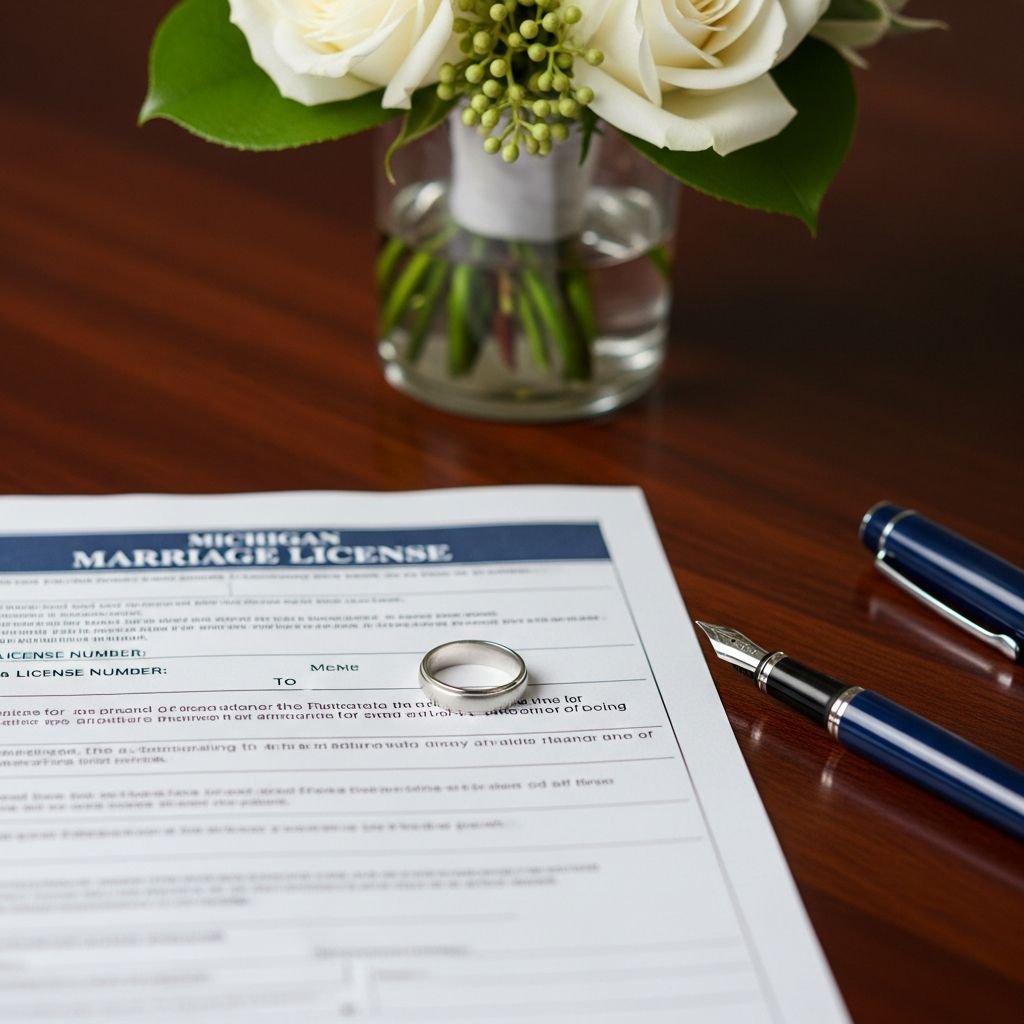
Michigan Marriage Licenses: Everything Couples Need to Know
Before you can legally marry in Michigan, you must obtain a marriage license from a county clerk. This license is what authorizes your ceremony under Michigan law, and every couple must follow specific rules about where, when, and how to apply.
This guide explains Michigan marriage license rules in clear language so you can avoid last-minute surprises and plan your wedding with confidence.
1. Basic Legal Requirements to Marry in Michigan
Michigan law sets several baseline rules that determine who can legally marry and under what circumstances.
1.1 Minimum age and legal capacity
- Minimum age: In practice, county clerks in Michigan require each applicant to be at least 18 years old to independently apply for a marriage license.
- Not already married: You cannot be legally married to someone else at the time you apply; any prior marriage must be ended by divorce, annulment, or death, and you may be required to provide documentation of that.
- Competent to consent: Both parties must be able to understand that they are entering into a binding legal marriage and must freely agree to it.
Clerks will not independently investigate your relationship, but they will require documentation that supports age and identity, and they may ask questions if any information is unclear.
1.2 Who may not marry
Michigan law also places limits on who may marry, mostly for reasons of existing marital status and close family relationship.
- You generally may not marry a person who is already your close blood relative (such as a parent, child, or sibling), even if both adults consent.
- You may not obtain a valid Michigan marriage license to marry someone if either of you is still legally married to someone else.
The exact list of prohibited relationships appears in Michigan statutes, and questions about unusual family situations or past marriages are best addressed with an attorney.
2. Where to Apply for a Michigan Marriage License
Michigan uses a county-based application system. Where you file depends on whether at least one of you lives in Michigan.
2.1 If at least one applicant lives in Michigan
- Michigan residents must apply for a license in the county where either applicant resides.
- Once issued, the license is then valid for a ceremony anywhere in Michigan, not just in your home county.
- If you each live in different Michigan counties, you may choose either county for the application.
2.2 If neither applicant lives in Michigan
- If you both live out of state, you generally must apply in the county where your ceremony will be held.
- In that situation, the license is usually valid only within that same county; check with the clerk’s office to confirm local practice.
Most county clerks provide detailed instructions on their official websites, and some allow online applications before you visit in person.
3. Timing Rules: Waiting Periods and Expiration
Michigan couples often underestimate how important timing is. State law and local practices set both a waiting period and a use-by deadline for every marriage license.
3.1 Mandatory waiting period
- After you file your application, there is a 3-day waiting period before the license can be issued.
- Some counties consider the waiting period satisfied if an online application was filed at least three days before your in-person visit to complete the process and pay fees.
- Michigan law allows county clerks to waive the 3-day waiting period for “good and sufficient cause,” often for an additional fee. Common reasons include imminent deployment, very near wedding dates, or other compelling circumstances.
3.2 License expiration
- Once you apply, a Michigan marriage license typically remains valid for 33 days from the date of application.
- Your ceremony must take place within that 33-day window or the license becomes void and you must reapply and repay the fee.
- Because of this, clerks often warn couples not to apply earlier than 33 days before the planned wedding date.
| Step | Typical Rule |
|---|---|
| Earliest you should apply | Up to 33 days before your ceremony |
| Waiting period | 3 days after application before license is issued |
| License validity | 33 days from application date |
| Possible waiver | 3-day waiting period may be waived for a fee if you show good cause |
4. Documents You Need to Bring
County clerks consistently require proof of identity, age, and sometimes residency for each applicant. Bring paper copies unless the clerk’s instructions clearly allow digital versions.
4.1 Identification and proof of age
- Government-issued photo ID such as a driver’s license or state ID is usually required for both applicants.
- Certified birth certificate or other official proof of birth may be needed to establish age and legal name.
- For foreign birth certificates, an official English translation or a certified translation must usually accompany the document.
4.2 Proof of residency
Because your county of residence determines where you may apply, clerks often insist on documentation that shows your current address.
- A Michigan driver’s license or state ID listing your current address is commonly accepted.
- Some counties also accept other documents, such as a utility bill, lease, mortgage statement, or county ID card, if your address is not current on your license.
4.3 Social Security and prior marriage records
- Many clerks ask applicants to provide their Social Security numbers, and some request the actual cards.
- If you were previously married, you may need a certified copy of your divorce judgment or a death certificate for a deceased spouse, showing that the prior marriage legally ended.
5. Costs and Payment Methods
Marriage license fees in Michigan are set by state law in broad terms but may vary slightly by county. Several county clerks publish the same basic structure:
- Michigan residents: Often around $20 for a marriage license.
- Out-of-state residents: Commonly about $30.
- Waiting period waiver: Counties may charge an additional fee, such as $20–$35, if you request an immediate license and the clerk agrees to waive the 3-day waiting period.
Payment options depend on the county. Expect at least cash and money order, with many offices accepting credit or debit cards; some impose small processing or “enhanced access” fees for card payments.
6. How the Application and Issuance Process Works
Although details differ by county, the general steps are fairly similar across Michigan.
6.1 Step-by-step overview
- Review county instructions. Visit your county clerk’s official website to confirm hours, fees, forms, and any appointment requirements.
- Complete the application. Some counties allow you to fill out the marriage license application online; others require forms to be completed at the office.
- Appear in person. At least one party, and often both, must appear at the clerk’s office with all required documents and payment.
- Observe the waiting period. Unless waived, you will wait three days before the license can be issued.
- Pick up the license. After the waiting period and payment, you receive the license, which must be given to your officiant for completion at the ceremony.
6.2 Who may perform the ceremony
Michigan law recognizes certain individuals as authorized to solemnize marriages, including judges, some local officials, and properly ordained or licensed members of the clergy. County clerks typically advise couples to verify that their chosen officiant is legally authorized before the ceremony, and some recommend consulting an attorney if there is any doubt.
7. After the Ceremony: Filing and Certified Copies
Your license is not fully effective until the officiant completes it and it is returned to the appropriate county office.
7.1 Officiant responsibilities
- The officiant records the date and location of the marriage on the license and signs it, adding their name, title, and address.
- Some counties require that completed copies be returned to the clerk’s office within a specific period, such as 10 days after the wedding.
7.2 Obtaining certified copies
Once the license has been recorded by the county clerk, you can request a certified copy of your marriage record.
- Certified copies are often needed to change your name on a driver’s license or identification card, Social Security records, passport, and financial accounts.
- Counties typically charge a base fee (such as $20) for the first certified copy and a reduced fee for additional copies ordered at the same time.
8. Name Changes and Identity Documents
Getting married in Michigan does not automatically change your name; it simply gives you a legal basis to request a name change with various agencies.
- To change the name on a Michigan driver’s license or state ID, you must visit a Secretary of State branch office with your current ID, a certified copy of your marriage license, and documentation of your legal presence, such as a birth certificate.
- You should also contact the Social Security Administration and other institutions, such as banks or employers, to update your records after you receive your certified marriage certificate.
9. Frequently Asked Questions
Q1: How far in advance should we apply for a Michigan marriage license?
Apply within the 33 days before your wedding date. If you apply too early, the license may expire before your ceremony; if you apply too late, the 3-day waiting period could interfere with your plans.
Q2: Do we both have to go to the county clerk’s office?
At least one applicant generally must appear in person, and some counties prefer or require both applicants to appear together. Check your county clerk’s published rules before making an appointment.
Q3: Can we use our Michigan marriage license in another state?
No. A license issued by a Michigan county is valid only for ceremonies performed within Michigan, although a license obtained in your home county can typically be used anywhere in the state.
Q4: What happens if we do not get married within 33 days?
If you do not hold your ceremony within the license’s validity period, the license becomes void and you must reapply, pay the fee again, and obtain a new license before a valid marriage can be performed.
Q5: Can the 3-day waiting period be waived for an emergency wedding?
Michigan law authorizes county clerks to waive the waiting period for good cause. A separate waiver fee is commonly charged, and documentation such as deployment orders or proof of an imminent ceremony may be required.
Q6: Are online ordinations recognized for officiants in Michigan?
Michigan statutes describe who may perform marriages but do not directly address every type of ordination. Because the legal status of some online ordinations can be complex, many clerks recommend consulting an attorney or reviewing state law if you plan to use an online-ordained minister.
References
- Marriage Licenses — Grand Traverse County, Michigan Clerk. 2024-01-10. https://www.gtcountymi.gov/257/Marriage-Licenses
- Apply for Marriage License — Ottawa County, Michigan Clerk/Register of Deeds. 2023-11-15. https://miottawa.org/clerk/vital-records/marriage-license/
- Apply for a Marriage License — Kalamazoo County Government, Clerk/Register of Deeds. 2024-02-05. https://www.kalcounty.gov/436/Apply-for-a-Marriage-License
- Applying for a Marriage License — Jackson County, Michigan Clerk. 2023-08-21. https://www.co.jackson.mi.us/344/Applying-for-a-Marriage-License
- Marriage Licenses — Wayne County, Michigan Clerk’s Office. 2024-03-12. https://www.waynecountymi.gov/Government/Elected-Officials/Clerk/General-Office/Marriage-Licenses
- Get a Marriage License — Kent County, Michigan Clerk. 2023-10-04. https://www.kentcountymi.gov/804/Get-a-Marriage-License
Similar Articles








Read full bio of Sneha Tete